
Zero-Knowledge Proofs in Cryptocurrency: How ZKPs Secure Privacy
Imagine proving you know a password without ever typing it. Or showing you have enough money to buy coffee without revealing your bank balance. That is the core magic of Zero-Knowledge Proofs (ZKPs). In the world of Cryptocurrency, this cryptographic method solves a massive paradox: how do we verify transactions are valid while keeping user data private? It sounds like science fiction, but it is the backbone of modern privacy coins and scaling solutions.
You might be wondering why this matters if Bitcoin already works. The truth is, public blockchains are transparent by design. Anyone can trace every satoshi from its origin. For many users, that lack of anonymity is a dealbreaker. For developers, the sheer volume of data slows networks down. Zero-knowledge proofs address both issues simultaneously. They allow a "prover" to convince a "verifier" that a statement is true, without leaking any extra information about the underlying data. This isn't just theory; it powers networks like Zcash and layer-2 solutions on Ethereum.
The Core Concept: Trust Without Disclosure
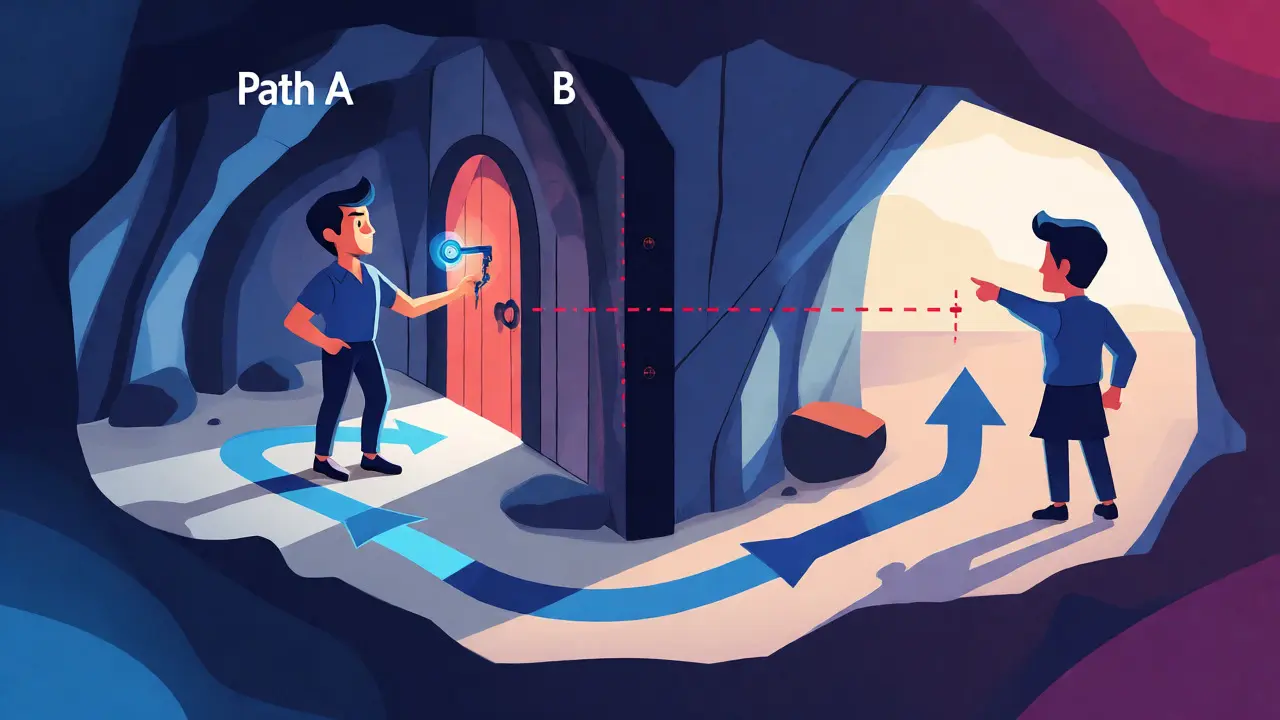
To grasp ZKPs, forget complex math for a second. Think of a cave with a secret door. You claim you know the password to open it. I stand outside and ask you to enter through one of two paths (A or B). Then, I shout which path I want you to exit from. If you truly know the password, you can always exit from the requested side, regardless of where you entered. If you don't know it, you only have a 50% chance of guessing right each time. After repeating this twenty times, if you succeed every time, the probability that you are lying drops to nearly zero. Yet, I never heard the password.
This interactive process was formalized in 1985 by Goldwasser, Micali, and Rackoff. In crypto, we make this non-interactive using hash functions. The prover generates a mathematical proof that anyone can check instantly. This satisfies three strict properties:
- Completeness: If the statement is true, an honest verifier will be convinced.
- Soundness: If the statement is false, a dishonest prover cannot easily fool the verifier.
- Zero-Knowledge: The verifier learns nothing about the secret itself, only that the statement is true.
Types of Zero-Knowledge Proofs
Not all ZKPs are created equal. Developers choose specific types based on speed, size, and trust assumptions. The two most prominent families in crypto today are zk-SNARKs and zk-STARKs.
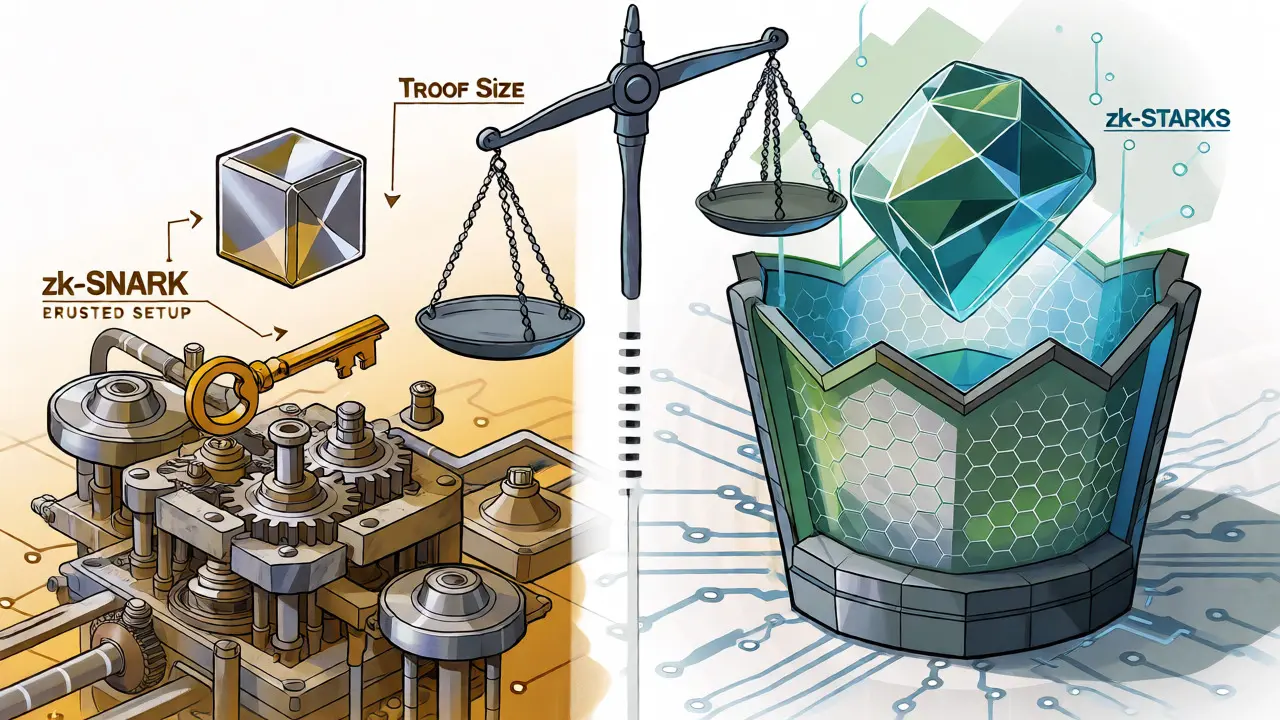
zk-SNARKs stand for "Zero-Knowledge Succinct Non-Interactive Arguments of Knowledge." They are incredibly small-often under 300 bytes-and fast to verify. However, they require a "trusted setup." This means someone had to generate initial parameters for the system. If that person leaked their secret key during the ceremony, the whole system could be broken. Zcash solved this in 2016 with a multi-party ceremony involving six people across different countries. Each destroyed their portion of the "toxic waste," ensuring no single entity held the master key.
zk-STARKs, or "Scalable Transparent Arguments of Knowledge," remove the trusted setup requirement. They rely on collision-resistant hash functions instead of elliptic curves. This makes them quantum-resistant, a huge plus for long-term security. The trade-off? The proofs are much larger, often around 45KB compared to SNARKs' tiny footprint. Verification is also slightly slower, though still efficient.
| Feature | zk-SNARKs | zk-STARKs | Bulletproofs |
|---|---|---|---|
| Proof Size | Small (~288 bytes) | Large (~45 KB) | Medium (O(log n)) |
| Trusted Setup | Required | Not Required | Not Required |
| Verification Speed | Very Fast | Fast | Moderate |
| Quantum Resistance | No | Yes | No |
| Primary Use Case | Zcash, Ethereum L2s | StarkNet, Validium | Monero |
Privacy Coins: Hiding the Trail
Bitcoin is pseudonymous, not anonymous. Your wallet address is linked to your identity if you use an exchange. Zcash changed the game by offering "shielded" transactions. When you send funds in a shielded pool, the sender, receiver, and amount are encrypted. The network only sees that valid inputs were converted to valid outputs. No links exist between old and new addresses.
How does it work? Zcash uses zk-SNARKs to prove that the transaction follows the rules: inputs equal outputs, and the sender owns the private keys. The proof is verified by miners, who add the block to the chain without ever seeing the details. This allows Zcash to maintain consensus integrity while providing financial privacy similar to cash.
Monero takes a different approach. It uses Bulletproofs and ring signatures. While not a pure ZKP implementation in the same way as Zcash, Bulletproofs significantly reduced transaction sizes and verification times when implemented in 2018. Monero’s default state is private; you have to opt-out to reveal details. Zcash defaults to transparency, requiring users to opt-in to privacy. Both approaches leverage cryptographic proofs to hide sensitive data, but Monero offers stronger metadata protection out of the box.
Scaling Blockchains with ZK-Rollups
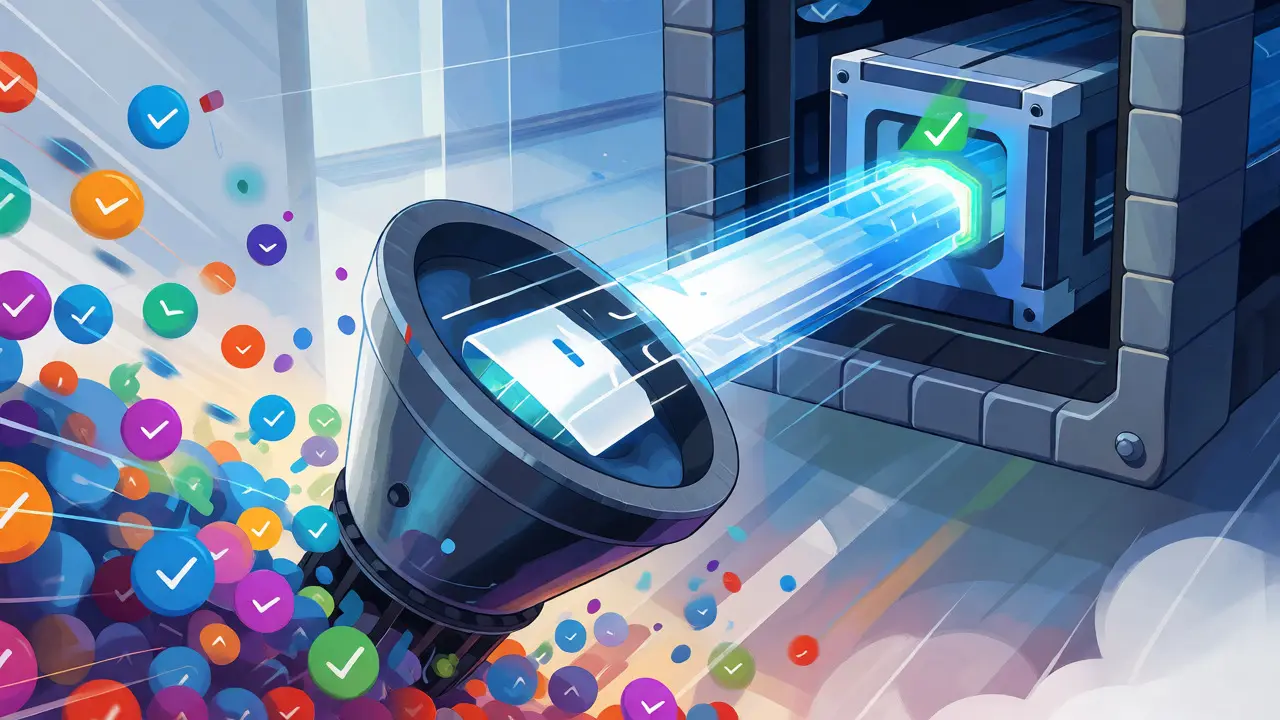
Privacy isn't the only reason for ZKPs. They are becoming essential for scaling. Ethereum faces congestion and high gas fees. Layer-2 solutions called Rollups bundle hundreds of transactions into a single batch. Instead of posting every transaction to the mainnet, they post a compressed summary and a validity proof.
ZK-Rollups use zero-knowledge proofs to assert that the batch is valid. Once the proof is verified on Ethereum, the state updates immediately. This contrasts with Optimistic Rollups, which assume validity unless challenged within a week. ZK-Rollups offer faster withdrawals because there is no fraud-proof window. Networks like zkSync and StarkNet process thousands of transactions per second at fractions of a cent.
The impact on costs is dramatic. During normal network conditions, an Ethereum mainnet swap might cost $1.50. On zkSync Era, the same action often costs $0.02. This efficiency comes from compressing data and moving computation off-chain. The mainnet only checks the final proof, not the individual steps. As Vitalik Buterin noted, ZK-EVMs are projected to handle over half of Ethereum transactions by 2027, drastically reducing congestion.
Challenges and Limitations
Despite the hype, ZKPs aren't a silver bullet. Implementation complexity is high. Writing circuits for zk-SNARKs requires specialized languages like Circom or ZoKrates. Developers report needing 6-9 months of study to become proficient. Mistakes in circuit logic can lead to vulnerabilities that standard audits miss.
Proving time is another bottleneck. Generating a proof for a complex smart contract can take minutes on consumer hardware. While verification is fast, the computational load on the prover is heavy. This has led to the rise of decentralized proving networks, like Espresso Systems, to distribute this workload.
Then there is the issue of metadata leakage. Even if transaction amounts are hidden, timing patterns and IP addresses can deanonymize users. Chain analysis firms constantly evolve techniques to break privacy. Dr. Sarah Jamie Lewis warns that many implementations provide "false privacy assurances" if users aren't careful with their operational security. A perfect proof doesn't help if you reuse addresses or leak your IP.
The Future of Zero-Knowledge Technology
We are moving beyond simple payments. ZKPs are being applied to identity verification, allowing users to prove age or citizenship without sharing birth certificates. Voting systems can use ZKPs to ensure ballots are counted correctly without revealing who voted for whom. Supply chains can verify product authenticity without exposing proprietary sourcing data.
Institutional adoption is accelerating. JPMorgan’s Onyx division uses ZKPs for interbank settlements, processing billions daily. Regulatory bodies like the FATF are updating guidelines to accommodate these technologies, emphasizing compliance without sacrificing core privacy features.
The market trajectory suggests ZK technology will capture a significant share of the Layer-2 scaling market. With projects like Polygon investing heavily in ZK developer tools and hardware acceleration, the barriers to entry are lowering. We are likely heading toward a future where zero-knowledge proofs are invisible infrastructure, powering everything from social media feeds to global finance, all while keeping our digital lives private.
Are zero-knowledge proofs completely secure?
They are mathematically sound if implemented correctly. However, security depends on the quality of the code and the trusted setup (for SNARKs). Bugs in the circuit logic or compromised setup ceremonies can introduce vulnerabilities. Regular audits and formal verification are critical.
Do ZKPs slow down transactions?
Generating proofs can be computationally intensive and slow for the sender. However, verifying them on the blockchain is very fast. In rollups, batching multiple transactions into one proof actually increases overall network throughput and reduces latency for users.
What is the difference between zk-SNARKs and zk-STARKs?
SNARKs have smaller proof sizes and faster verification but require a trusted setup. STARKs do not need a trusted setup and are quantum-resistant, but they produce larger proofs and are more computationally expensive to generate.
Can governments ban zero-knowledge proofs?
Governments can regulate their use, especially regarding anti-money laundering laws. Some jurisdictions may restrict privacy coins or require compliance layers. However, banning the underlying mathematics is impossible, so regulation usually focuses on on-ramps and off-ramps rather than the protocol itself.
Why is the trusted setup controversial?
If the participants in the trusted setup ceremony conspire or fail to destroy their secrets, they could theoretically create fake proofs that look valid. This undermines trust in the system's integrity. Multi-party ceremonies mitigate this risk, but it remains a centralization concern for some purists.