
Wrapped Apertum (WAPTM): What It Is, How It Works, and Risks
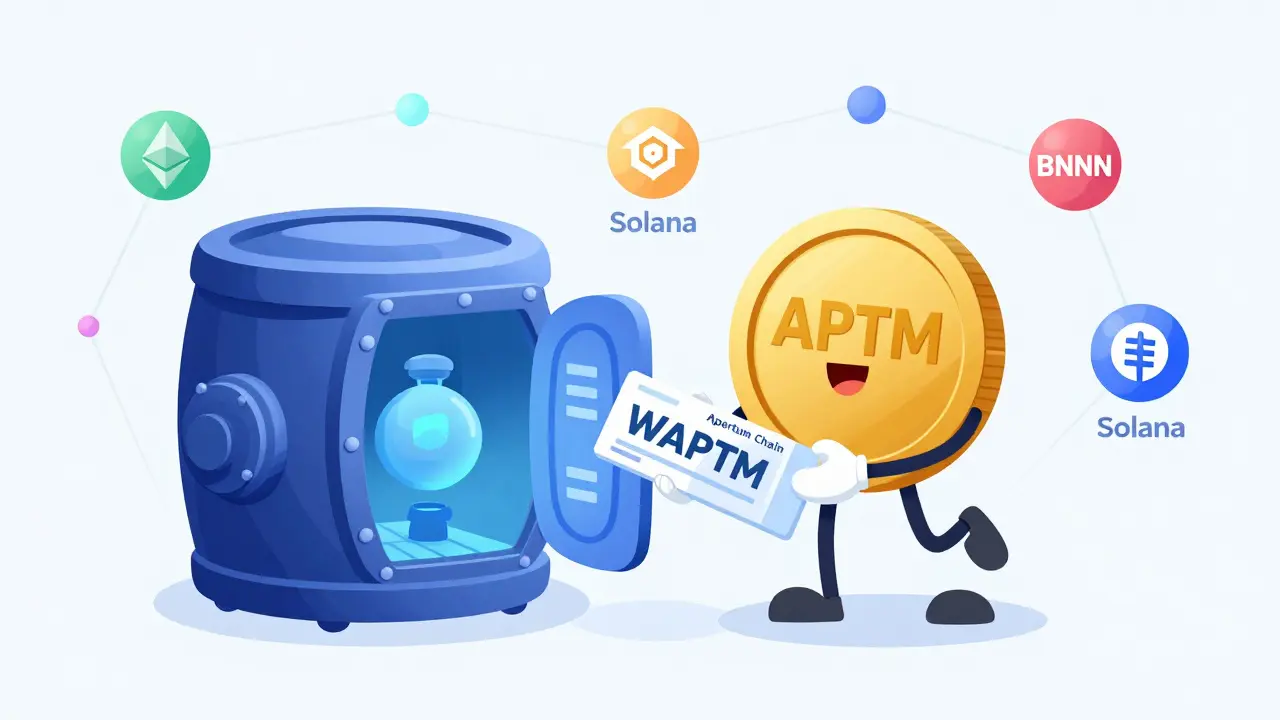
You’ve probably seen a token with a "W" prefix or the word "wrapped" in its name and wondered if it’s a scam, a new coin, or just a copy of something else. If you are looking at Wrapped Apertum (ticker: WAPTM), you aren’t alone. This asset sits at the intersection of two complex crypto concepts: Layer-1 blockchains built on Avalanche and cross-chain bridging.
Simply put, Wrapped Apertum is not a standalone cryptocurrency in the traditional sense. It is a digital receipt that represents the native Apertum Coin (APTM) locked up on its home network. Think of it like leaving your cash at a hotel concierge and getting a voucher to spend at the resort pool. The voucher isn't cash, but it holds the same value and lets you move around freely where cash might be restricted. WAPTM allows Apertum’s value to travel across other major networks like Ethereum, BNB Chain, Solana, and Bitcoin.
The Core Concept: Why Wrap a Token?
To understand WAPTM, you first need to understand its parent: Apertum Coin (APTM) is the native utility token of the Apertum Layer-1 blockchain, which operates as a dedicated subnet on the Avalanche network. Apertum markets itself as next-generation infrastructure for smart contracts, decentralized finance (DeFi), and AI integrations. It uses an EVM-compatible architecture, meaning developers can build apps for it using standard Ethereum tools.
However, being on an Avalanche subnet has a downside for liquidity. Most DeFi protocols, lending platforms, and traders live on Ethereum or Solana. They cannot natively use APTM because their code doesn't speak "Avalanche." That is where wrapping comes in.
When you wrap APTM into WAPTM, you are essentially locking your APTM in a secure vault (a smart contract) on the Apertum chain. In exchange, you receive WAPTM tokens on a different chain, such as Ethereum. These WAPTM tokens are backed 1:1 by the locked APTM. You can then use WAPTM in Ethereum-based DeFi apps, trade it on exchanges that only support Ethereum assets, or send it to wallets that don't support Avalanche subnets yet.
- Native APTM: Used for gas fees, staking, and governance within the Apertum ecosystem.
- Wrapped WAPTM: Used for trading, liquidity provision, and interoperability on external chains like Ethereum, BNB Chain, and Solana.
How the Wrapping Mechanism Works
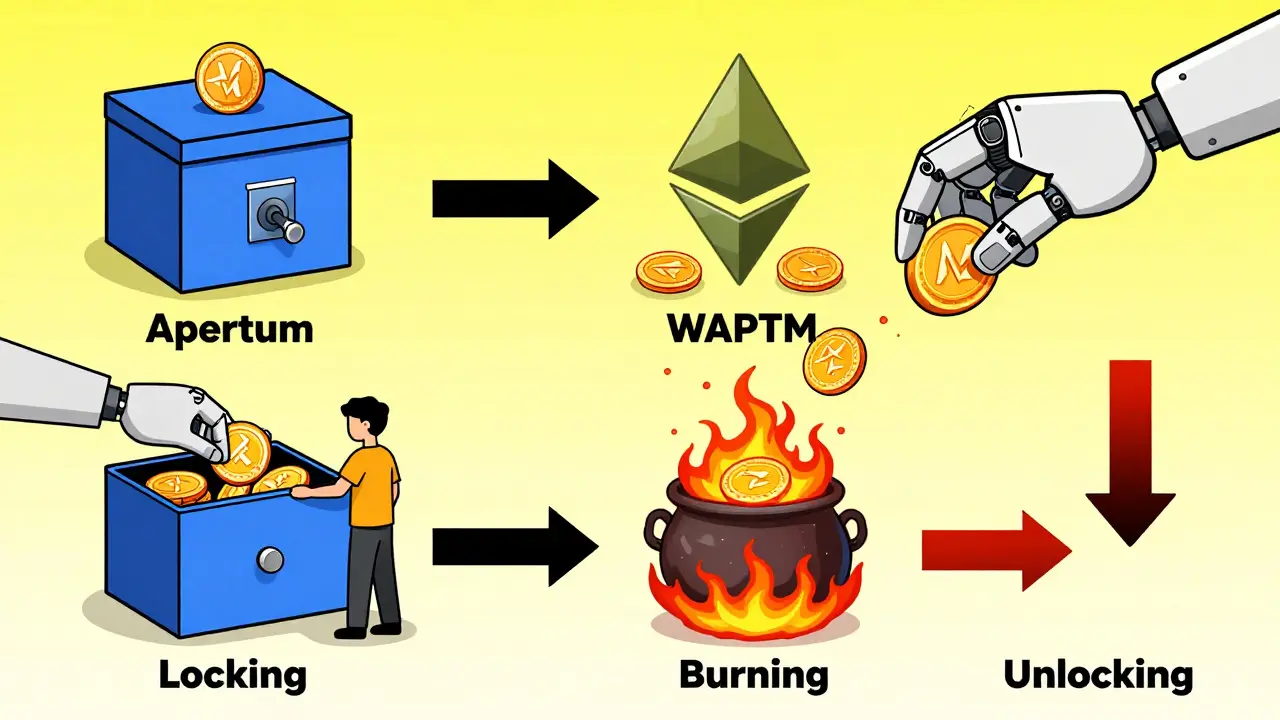
The process relies on a bridge-a set of smart contracts that connect two separate blockchains. Here is how the lifecycle of a wrapped token typically functions in this model:
- Locking: You send your native APTM to a designated bridge address on the Apertum chain. The smart contract freezes these tokens so they cannot be spent or moved elsewhere.
- Minting: The bridge verifies the deposit and instructs a corresponding smart contract on the target chain (e.g., Ethereum) to create (mint) an equal amount of WAPTM tokens.
- Usage: You now hold WAPTM on Ethereum. You can trade it, lend it, or swap it for other assets.
- Burning: When you want your original APTM back, you send the WAPTM to a burn address on the Ethereum chain. The contract destroys the WAPTM.
- Unlocking: The bridge sees the burn event and releases the equivalent amount of APTM from the vault on the Apertum chain back to your wallet.
This mechanism ensures that the total supply of WAPTM never exceeds the amount of APTM locked in the vault. In theory, this maintains parity. However, as we will see later, execution risks exist.
Tokenomics and Supply Dynamics
One of the most confusing aspects of analyzing WAPTM is the discrepancy in supply data across various tracking platforms. As of mid-2026, data providers report varying figures for circulating supply, which reflects the dynamic nature of wrapped assets.
| Metric | Native APTM | Wrapped WAPTM |
|---|---|---|
| Max Supply | 2,100,000,000 | 2,100,000,000 (Theoretical Cap) |
| Circulating Supply | ~110,000,000 | Varies widely (4.2M - 47.6M reported) |
| Market Cap Range | $13.4M - $14M | $6.0M - $6.85M |
| Primary Use Case | Gas, Staking, Governance | Cross-chain Trading, DeFi Liquidity |
| Network Origin | Apertum (Avalanche Subnet) | Ethereum, BSC, Solana, etc. |
Note that while the maximum supply for both is capped at 2.1 billion units, the circulating supply of WAPTM fluctuates based on user demand. If more users lock APTM to access Ethereum DeFi, the WAPTM supply increases. If they redeem, it decreases. This volatility in supply data is normal for wrapped assets but makes fundamental analysis tricky. Always check multiple sources like CoinMarketCap, CoinGecko, and Binance trackers for real-time discrepancies.
Price Performance and Volatility
Like many emerging crypto assets, WAPTM has experienced significant price swings since its launch in 2025. Understanding its historical performance helps set realistic expectations.
In February 2025, WAPTM reached an all-time high (ATH) of approximately $4.80 USD. By mid-2026, prices had settled into a much lower range, generally trading between $0.14 and $0.20 USD depending on the exchange. This represents a drawdown of roughly 97% from its peak. While this looks alarming on paper, it is consistent with the broader pattern of altcoins post-launch hype cycles.
Current trading volumes vary significantly by venue. On some days, 24-hour volume hovers around $24,000, while on others, particularly during spikes in interest, it can reach over $600,000. This low-to-moderate volume means that large trades can impact the price heavily (slippage). For retail investors, this implies you should use limit orders rather than market orders when buying or selling WAPTM to avoid unfavorable pricing.
Risks Associated with Wrapped Assets
It is crucial to approach WAPTM with caution. Holding a wrapped token introduces risks that do not exist when holding the native asset directly. Here are the primary concerns:
- Bridge Security: The entire system relies on the security of the bridge smart contracts. If hackers exploit a vulnerability in the bridge code, they could drain the locked APTM vault. Since WAPTM is only valuable if there is underlying APTM backing it, a hack would render WAPTM worthless. There are currently no public third-party audit reports specifically highlighting WAPTM's bridge security status in mainstream aggregators.
- Liquidity Fragmentation: Because WAPTM exists on multiple chains (Ethereum, BNB, Solana), liquidity is split across these venues. You might find deep liquidity on Ethereum but shallow depth on Solana, leading to worse execution prices.
- Counterparty Risk: Unlike holding APTM in your own non-custodial wallet on the Apertum chain, holding WAPTM often involves interacting with third-party protocols or centralized exchanges that manage the wrapping process. If an exchange goes bankrupt or gets hacked, your WAPTM holdings may be lost.
- Regulatory Uncertainty: As regulators scrutinize stablecoins and wrapped assets more closely, there is a risk that certain bridges could be delisted or restricted, potentially trapping funds or making redemption difficult.

How to Buy and Use WAPTM
If you decide to proceed, here is how you can acquire and utilize Wrapped Apertum. Note that direct fiat-on-ramp options for WAPTM are limited compared to major coins like Bitcoin or Ethereum.
Option 1: Centralized Exchanges (CEX)
Some centralized exchanges list WAPTM directly. Platforms like Phemex and Bitget have provided listings or guides for purchasing WAPTM.
Steps:
1. Create an account on a supported exchange.
2. Complete KYC (Know Your Customer) verification.
3. Deposit fiat currency (USD, EUR) or another crypto.
4. Search for the WAPTM/USDT trading pair and execute a buy order.
Option 2: Bridging Native APTM
This is the more common route for advanced users. You buy the native APTM and wrap it yourself.
Steps:
1. Buy APTM on an exchange like MEXC, BingX, or Poloniex.
2. Withdraw APTM to a self-custody wallet that supports the Apertum chain (ensure your wallet supports Avalanche subnets).
3. Use an official Apertum bridge interface to lock your APTM and mint WAPTM on your desired target chain (e.g., Ethereum ERC-20).
Future Outlook and Ecosystem Growth
The long-term viability of WAPTM depends entirely on the success of the underlying Apertum ecosystem. The Apertum team positions their chain as infrastructure for AI integrations and scalable DeFi. If developers build popular applications on Apertum, demand for APTM (for gas and staking) will rise, which should positively correlate with WAPTM’s value.
However, as of July 2026, Apertum remains a relatively small player in the crowded Layer-1 space, ranking outside the top 900 by market cap. Its social presence, including an X (Twitter) account with tens of thousands of followers, shows community engagement, but there is a lack of independent expert analysis or large-scale institutional adoption metrics. Without significant growth in Total Value Locked (TVL) or unique daily active users, WAPTM may remain a niche asset for cross-chain traders rather than a mainstream investment.
For now, treat WAPTM as a specialized tool for accessing Apertum’s economy from other blockchains, not necessarily as a standalone speculative play. Always verify bridge addresses through official channels before initiating any wraps to avoid phishing scams.
Is Wrapped Apertum (WAPTM) the same as Apertum Coin (APTM)?
No. APTM is the native token used for transactions and governance on the Apertum blockchain. WAPTM is a wrapped version of APTM that exists on other blockchains like Ethereum or Solana. WAPTM is backed 1:1 by locked APTM, allowing Apertum's value to move across different networks.
Why does WAPTM have different prices on different websites?
Price discrepancies occur due to fragmented liquidity across different exchanges and blockchain networks. WAPTM trades on various platforms (like Phemex, Binance, and decentralized exchanges), and each market has its own supply and demand dynamics. Additionally, data aggregators may update at different speeds, causing temporary mismatches in displayed prices.
What happens if the Apertum bridge gets hacked?
If the bridge securing the locked APTM is compromised, the underlying collateral could be stolen. Since WAPTM derives its value solely from this locked collateral, a successful hack would likely cause WAPTM to lose all its value, becoming worthless. This is the primary risk associated with any wrapped asset.
Can I convert WAPTM back to APTM?
Yes. To get your native APTM back, you must send your WAPTM to a designated "burn" address on the external chain (e.g., Ethereum). Once the smart contract verifies the burn, it signals the Apertum bridge to unlock and release the equivalent amount of APTM to your wallet on the Apertum network.
Is WAPTM a good investment in 2026?
Investing in WAPTM carries high risk. It is a niche asset with low liquidity and significant volatility, having dropped ~97% from its all-time high. Its value depends entirely on the growth of the Apertum ecosystem. Only invest what you can afford to lose, and consider the additional risks of bridge security and smart contract vulnerabilities.