
What is ZELIX (ZELIX) crypto coin? Explained with price, use case, and market reality
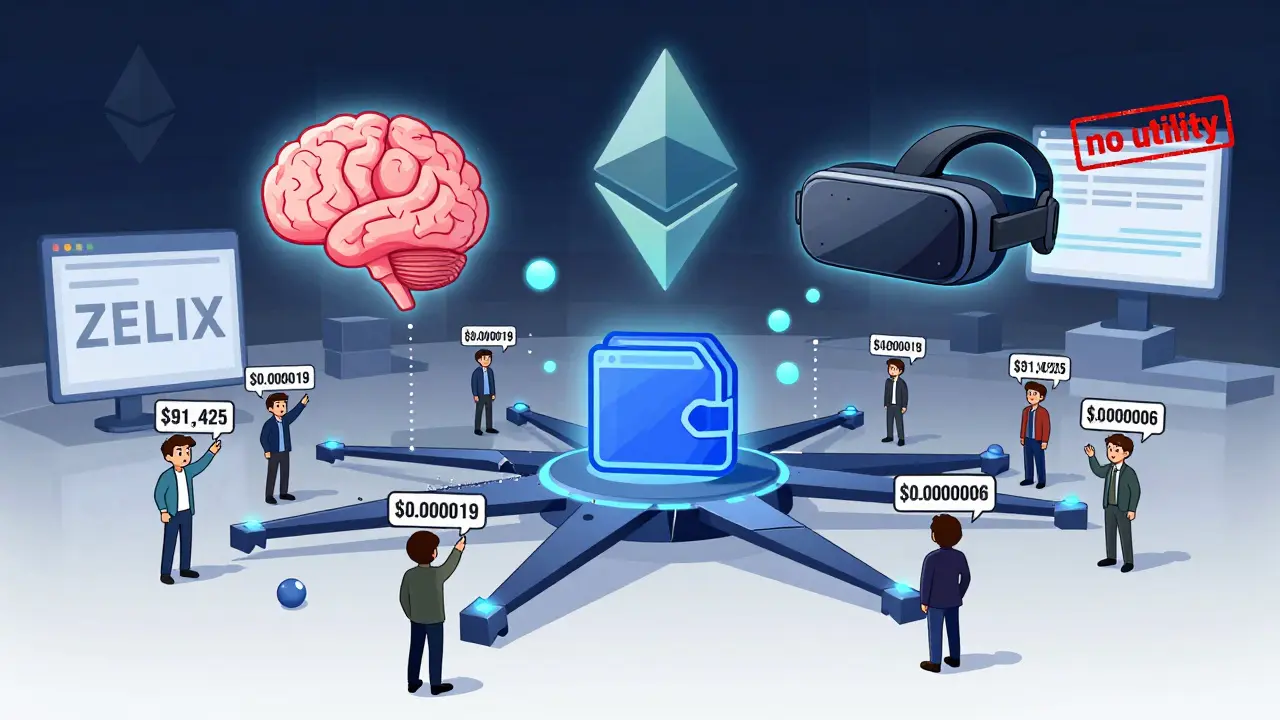
Ever heard of ZELIX and wondered if it’s just another crypto meme or something real? You’re not alone. ZELIX (ZELIX) is a token that’s hard to pin down - one site calls it an AI platform, another says it’s a metaverse, and the price? It changes wildly depending on which exchange you check. This isn’t a well-known coin like Bitcoin or Ethereum. It’s a tiny, fragmented project with conflicting claims and shaky data. Let’s cut through the noise and find out what ZELIX actually is - and whether it’s worth your time.
What ZELIX claims to be (and why it’s confusing)
ZELIX is built on Ethereum as an ERC-20 token, which means it runs on the same network as Chainlink, Uniswap, and dozens of others. But what it tries to do? That’s where things get messy.
Some sources say ZELIX is a ZELIX a blockchain-based platform designed to create a decentralized artificial intelligence ecosystem, allowing developers to train, deploy, and monetize AI models without relying on centralized cloud services. Under this version, it’s supposed to give users control over their data, let AI models run on a peer-to-peer network, and even let people earn tokens for contributing computing power or datasets. Think of it like a decentralized version of Google’s AI tools - but without the company owning the data.
But then you check CoinMarketCap or Blockspot.io, and suddenly ZELIX is a metaverse a multi-ecosystem platform that links virtual worlds using Unity engine technology, offering NFT marketplaces, virtual theme parks, and cross-platform avatars. Now it’s about buying virtual land, attending concerts in VR, and trading digital art - like Second Life, but with blockchain.
Which one is real? The truth? Neither, fully. ZELIX was originally called ONSTON. In late 2024, the team rebranded it to ZELIX and did a token swap: 1 ONSTON became 10 ZELIX. But they never clearly explained why. Did they pivot from AI to metaverse? Or are they trying to appeal to two different crowds at once? The result? Confusion. Investors don’t know what they’re buying. Developers don’t know what to build on. And the community? It’s small - only about 711 wallet holders according to CoinMarketCap.
Price chaos: Why ZELIX’s value jumps around
Here’s where things get wild. ZELIX’s price isn’t just low - it’s all over the map.
- Binance says it’s $0.000019 per token.
- CoinPaprika says $0.000017.
- CoinGecko claims it’s $91,425 - yes, over ninety thousand dollars. That’s clearly a data glitch.
- TradingView reports $0.0000006.
That’s a 150,000x difference between the highest and lowest reported prices. What’s going on? Simple: extremely low liquidity.
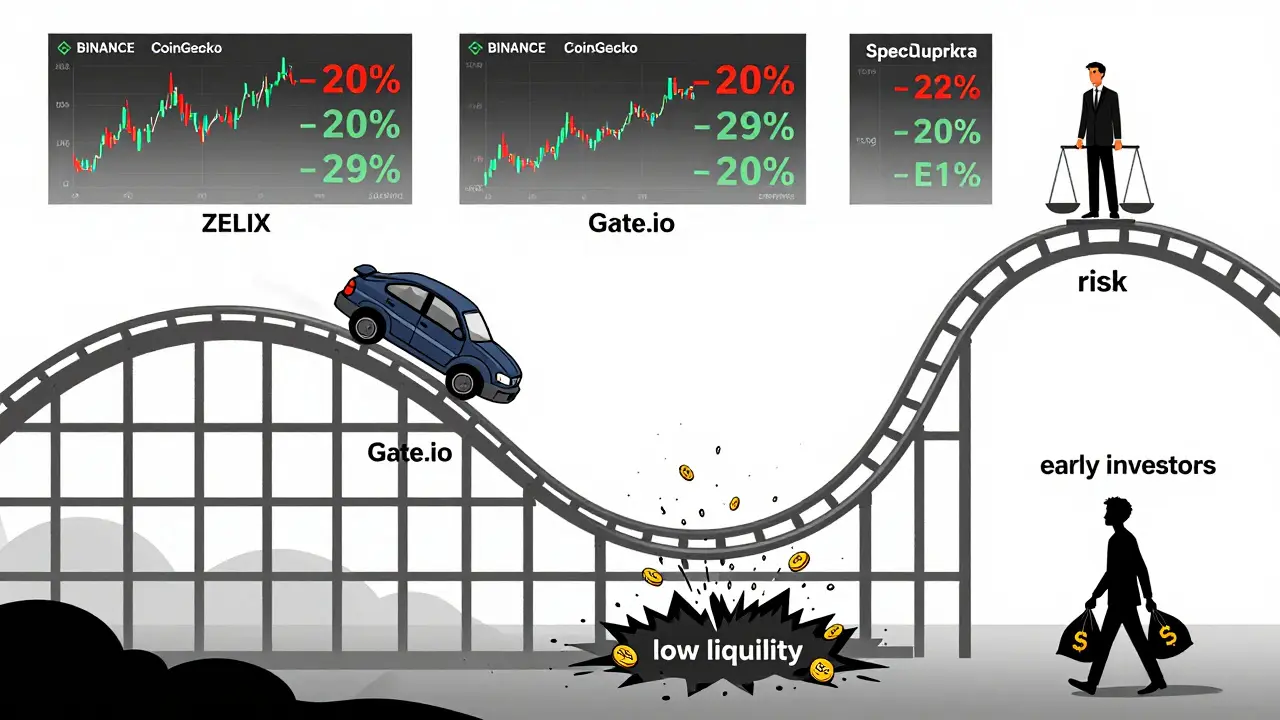
ZELIX trades on only two or three exchanges - mostly smaller ones like Gate.io and Mexc. There’s no major exchange like Coinbase or Kraken listing it. That means there are almost no buyers and sellers at any given time. One person buys 1 million tokens, and the price spikes 20%. Another sells, and it crashes. The 24-hour trading volume ranges from $19,000 to $190,000 across platforms - tiny compared to even the smallest legitimate coins.
Market cap numbers are equally unreliable. Binance reports $138,646. CoinMarketCap says $4,468. CoinGecko says $1.2 million in BTC. These aren’t just different estimates - they’re from different data feeds, and none of them are trusted by serious investors.
The circulating supply is around 7.45 billion tokens, with a max supply of 10 billion. That means most of the supply is already out there. But with so few holders and so little trading, it’s easy for a few wallets to control the price.
Who’s using ZELIX? And is there any real product?
Let’s be blunt: there’s no working product you can use right now.
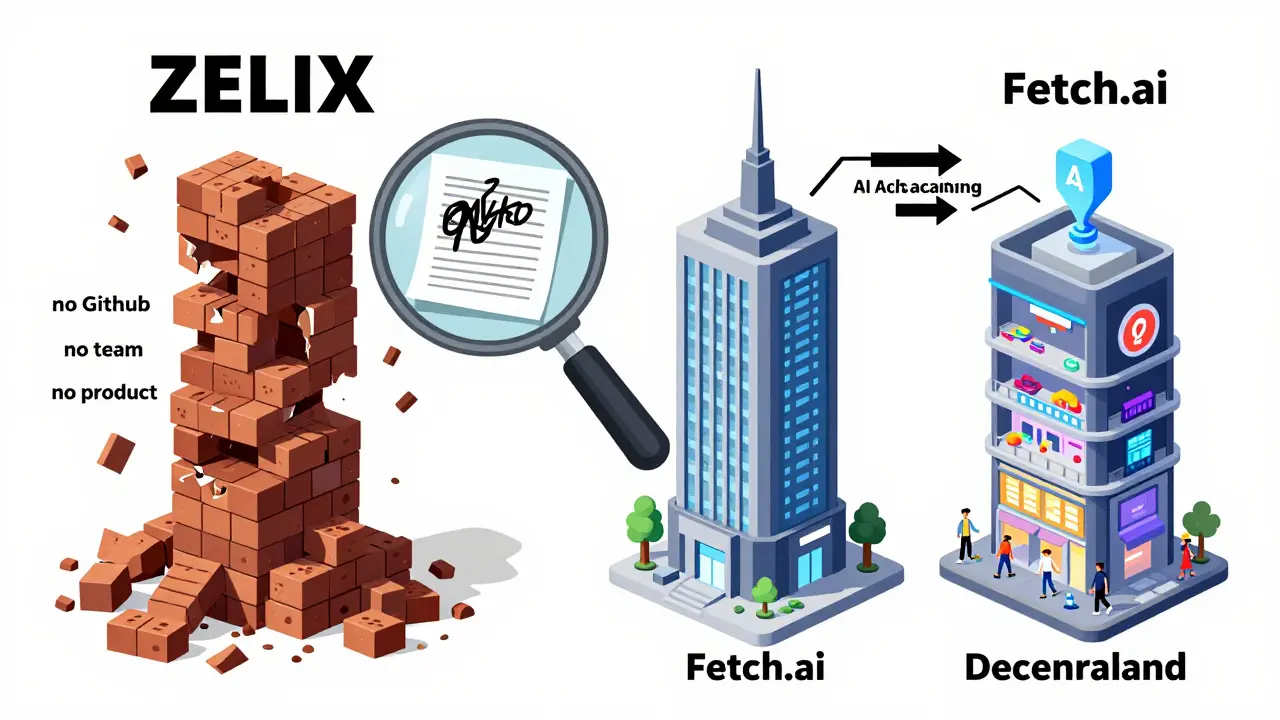
If ZELIX is an AI platform, where’s the dashboard? Where’s the developer toolkit? Where are the AI models you can deploy? No GitHub repo. No live beta. No documentation. Just a website with vague promises.
If it’s a metaverse, where’s the app? Can you log in and walk around a virtual mall? Can you buy an NFT? No. There’s no Unity download. No VR headset integration. No user reports. No YouTube walkthroughs. Just a placeholder page with a logo and a whitepaper that reads like a marketing brochure.
This isn’t a case of "it’s still in development." This is a case of "it never really started." The rebrand from ONSTON to ZELIX didn’t bring new code, new team members, or new partnerships. It just changed the name and the pitch.
Compare this to projects like Filecoin or Arweave - they launched with clear use cases, open-source code, and active communities. ZELIX has none of that. It’s a token with no utility, no traction, and no roadmap you can trust.
Is ZELIX a scam? Not exactly - but it’s risky
Is ZELIX a scam? Not in the classic "pump and dump" sense. There’s no evidence the team stole funds or disappeared. The token exists. The blockchain records are public. The wallet addresses are real.
But it’s still a high-risk gamble. Why?
- No clear purpose: You don’t know if you’re buying into AI, metaverse, or just a name change.
- Low liquidity: If you buy ZELIX, you might not be able to sell it later. No one’s trading it.
- Data inconsistency: Even tracking sites can’t agree on its value. That’s a red flag.
- No team transparency: Who’s behind it? No LinkedIn profiles. No Twitter threads. No interviews. Just a website with a contact form.
This isn’t a project you invest in because you believe in it. This is a project you gamble on because you think someone else will buy it for more. That’s not investing - that’s speculation.
What should you do if you’re considering ZELIX?
If you’re thinking about buying ZELIX, here’s the reality check:
- Don’t invest more than you can afford to lose. This isn’t a long-term holding. It’s a lottery ticket.
- Check the exchanges. Only trade on the ones that list it - Huobi, Gate.io, Mexc. Avoid centralized platforms like Coinbase. They don’t list it for a reason.
- Don’t trust price charts. The 24-hour spikes are noise. Look at trading volume - if it’s under $50,000, it’s too thin to be safe.
- Look for code. If there’s no GitHub, no smart contract audit, no public dev activity - walk away.
- Ask: Who benefits? If the only people making money are early investors and the team, you’re not part of the ecosystem - you’re the last one in.
ZELIX doesn’t have a future because it never defined a past. It’s a token without a mission, built on a network that already has better alternatives.
Alternatives to ZELIX
If you’re interested in AI + blockchain, look at:
- Fetch.ai (FET): Real AI agents trading on blockchain. Live network. Used in logistics and supply chains.
- SingularityNET (AGIX): Marketplace for AI services. Has real clients and developers.
If you want metaverse exposure:
- Decentraland (MANA): Fully functional virtual world with events, shops, and user-built spaces.
- The Sandbox (SAND): Game-focused metaverse with partnerships from Atari and Sony.
These projects have working products, active users, and transparent teams. ZELIX has none of that.
Is ZELIX a real cryptocurrency or just a scam?
ZELIX is a real token on the Ethereum blockchain, but it lacks substance. It’s not a scam in the sense that funds were stolen - but it has no working product, no clear purpose, and almost no adoption. It’s better described as a speculative asset with high risk and low utility.
Why do different websites show different prices for ZELIX?
ZELIX trades on only a few small exchanges with very low trading volume. This means prices are easily manipulated by single trades. Some sites use outdated data, others use incorrect decimals, and CoinGecko’s $91,425 price is likely a data error. The real price is around $0.000015-$0.000020, but even that’s unstable.
Can I use ZELIX to buy things or access services?
No. There are no merchants, platforms, or services that accept ZELIX. It has no utility beyond speculation. You can’t use it to pay for AI tools, virtual land, or any other service - despite what the website claims.
Is ZELIX built on Ethereum?
Yes. ZELIX is an ERC-20 token on the Ethereum blockchain, meaning it uses Ethereum’s network for transactions and smart contracts. But being on Ethereum doesn’t make it valuable - thousands of tokens are, and most fail.
What happened to ONSTON?
ONSTON was the original token name. In late 2024, the team rebranded it to ZELIX with a 1:10 swap ratio. The ONSTON wallet was shut down, and all tokens were converted. The rebrand came with no new features, no updated whitepaper, and no clear explanation - making it hard to trust the project’s direction.
17 Comments
lol i just saw this and thought it was a joke. zelix? like, seriously? i thought my phone was glitching when i saw the $91k price. who even uses this?
i swear if i bought one i’d have to sell it just to pay for my coffee.
this is why crypto is a circus 🤡 one guy types "ai metaverse" and suddenly we’re all supposed to believe it’s the next bitcoin. i’ve seen more substance in a reddit amv.
let’s be real - zelix isn’t even a project, it’s a vibe. the team didn’t build anything, they just slapped two buzzwords on a whitepaper and called it a day. liquidity? what’s that? oh right, it’s the thing that doesn’t exist here.
i checked the github - blank. the discord - ghost town. the website? looks like a 2017 wordpress theme with a crypto filter. this isn’t innovation, it’s a digital ghost story.
The fundamental issue with ZELIX lies not in its technical architecture - which, as an ERC-20 token, is functionally unremarkable - but in its complete absence of operational coherence. A blockchain project without a verifiable development pipeline, a transparent team, or demonstrable utility is not a cryptocurrency; it is a financial artifact devoid of intrinsic value. The discrepancies in pricing across platforms are not anomalies - they are symptoms of a market that has no foundation. To invest in ZELIX is to engage in a transaction predicated entirely on the expectation that another actor will assume greater risk - a classic Ponzi dynamic, dressed in blockchain jargon.
as someone from the us who’s seen a lot of crypto hype, i just feel bad for the people who got sucked in.
i remember when people thought dogecoin was going to change the world. zelix is dogecoin after it got hit by a bus and forgot its own name.
the rebrand from onston? that’s not a pivot - that’s a panic. and nobody’s buying it.
look - if you’re looking for real ai + blockchain, go for fetch.ai or singularitynet. they’ve got code, they’ve got users, they’ve got actual revenue. zelix? it’s like buying a car with no engine and hoping the dealership will install one next week.
don’t get me wrong - i love crypto innovation. but this? this is just noise.
if you’re thinking of buying, ask yourself: would i put my money in a startup with no website, no team, and no product? if the answer is yes… you’ve got bigger problems than crypto.
The ZELIX phenomenon exemplifies the pathological dissonance endemic to the contemporary crypto-ecosystem: a semantic vacuity masquerading as technological convergence. The conflation of AI infrastructure with metaverse architecture - two fundamentally divergent paradigms - constitutes not innovation but semantic inflation. The absence of verifiable smart contract audits, coupled with non-existent developer engagement, renders this token a mere speculative vector. One must interrogate the ontological status of value when the underlying asset possesses neither utility nor provenance. This is not a market inefficiency - it is a market failure.
i mean… if you’re gonna scam people, at least make it look good. this website looks like it was designed in 2015 on a free template.
and the price on coingecko? $91k? someone’s clearly just pasted a number into a spreadsheet and hit enter.
i’m not mad. i’m just… disappointed. this is the lowest bar i’ve ever seen.
i bought 10k zelix because i thought it was gonna be the next big thing.
now i just sit here watching it go from $0.000018 to $0.000017 and back.
it’s like watching paint dry… but with more anxiety.
i’m not even mad. i just feel stupid.
i just read this whole thing and honestly? you did a great job breaking it down.
i didn’t even know zelix existed until today. now i’m glad i didn’t invest.
thanks for saving me from a bad decision. you’re the real ai here.
the fact that people still fall for this stuff is wild.
zelix is like a blank canvas with a price tag.
if you want to believe it’s a masterpiece - go ahead.
but don’t cry when the frame falls off.
zeli what? i thought it was a typo. why are we even talking about this? just delete it and move on.
soo… is this like a coin that wants to be everything? ai and metaverse? cool. but where’s the app? where’s the demo? why does it have 700 wallets?
i dont get it. i just dont get it.
thank you for this clear breakdown. i’ve been confused by zelix for months.
now i understand - it’s not a project. it’s a mirage.
i’m glad i didn’t dive in. peace.
oh wow. so this is what happens when you let a marketing intern write a whitepaper.
"ai metaverse" - genius. next up: blockchain-powered yoga retreats.
and the $91,425 price? clearly the result of a bot with a glitch and a grudge.
i’m not surprised. i’m just… deeply unimpressed.
you think this is a scam? nah. it’s worse.
this is a government psyop.
they’re using zelix to test how many people will buy a coin with no utility, no team, and a price that makes no sense.
next they’ll launch "crypto meditation tokens" and we’ll all be too confused to notice.
i’ve seen the patterns. this is phase one.
🤔👁️🔮
i just want to say… i love how crypto lets you believe in anything.
like, you can look at zelix and see a revolution. or you can look at it and see a website built in 2017 with a few fancy words.
i dont know what to believe anymore.
maybe we’re all just chasing ghosts.
but hey - at least we’re chasing together.
maybe that’s the real coin.