
What is WOO (WOO) Crypto Coin? A Clear Breakdown of Its Tech, Use Cases, and Real Performance
WOO Token Burn Calculator
WOO Token Burn Calculator
Based on WOO Network's tokenomics: 50% of revenue goes toward buybacks and burns. The calculator shows projected impact over time.
Note: This calculator shows theoretical projections based on current burn rates. Actual burn amounts depend on revenue, market conditions, and WOO Network's operational changes. The tool is for educational purposes only.
WOO (WOO) isn't just another crypto coin. It's a liquidity network built by a trading firm that knows how markets move. Founded in 2019 by Kronos Research - the same team behind high-frequency trading strategies - WOO connects big institutional traders with decentralized finance (DeFi) users. Think of it as a bridge between two worlds: the fast, deep order books of centralized exchanges and the open, permissionless nature of DeFi. Its native token, WOO, powers this entire system.
How WOO Network Actually Works
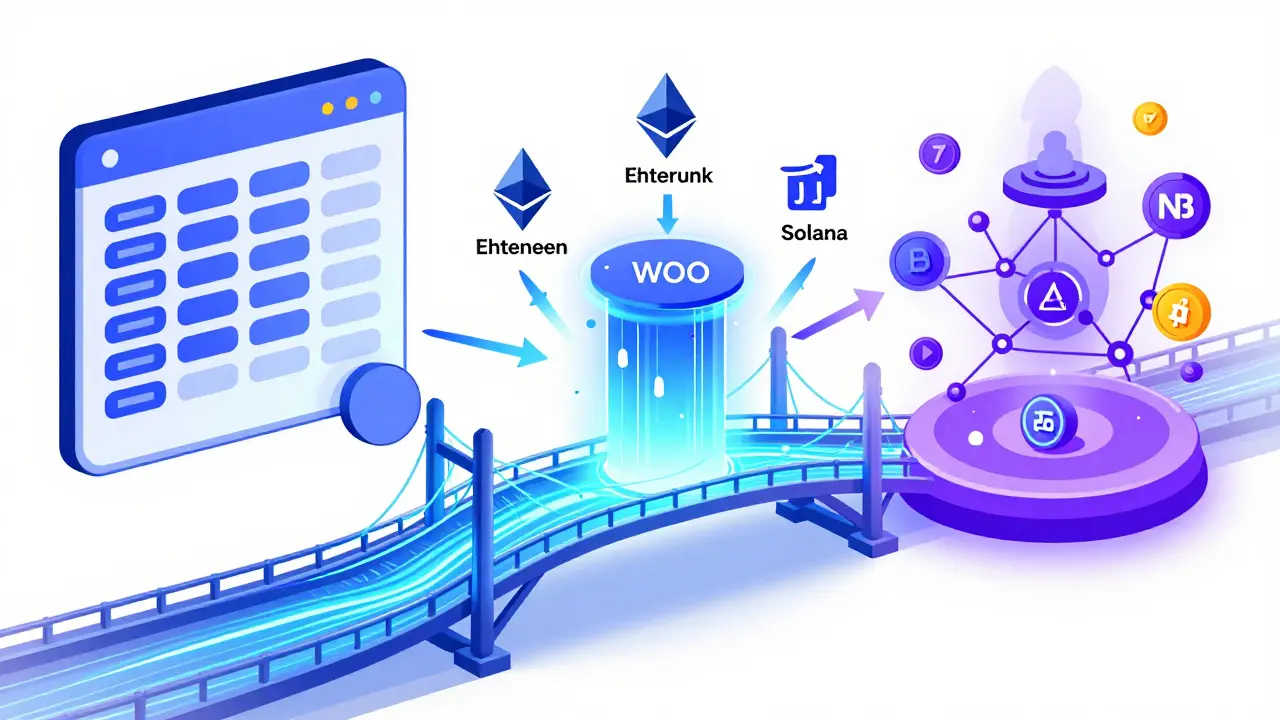
WOO doesn’t run on its own blockchain. Instead, it’s built across eight major chains: Ethereum, BNB Chain, Polygon, Solana, Avalanche, Arbitrum, Fantom, and NEAR. It uses bridges to move liquidity between them. This lets traders access deep markets no matter which chain they’re on.
The network has three main parts:
- WOO X: A centralized exchange with zero trading fees for users who stake WOO tokens. This is where institutional traders go for low slippage on large orders.
- WOOFi: A decentralized exchange and yield platform where users can swap tokens, provide liquidity, and earn rewards - often between 3.5% and 12.7% APY.
- WOO Ventures: The investment arm that backs early-stage crypto projects. Profits from these investments are shared with WOO token holders.
The magic of WOO is its liquidity. It sources orders from professional market makers and top exchanges, then feeds that depth into both WOO X and WOOFi. This means even on DeFi, you get prices closer to what you’d see on Binance or Coinbase - without needing to leave your wallet.
The WOO Token: Supply, Burns, and Tokenomics
The total supply of WOO is capped at 3 billion tokens. As of December 2025, about 1.9 billion are in circulation. That means over 63% of all WOO is already out in the market.
Here’s the key part: 50% of WOO Network’s revenue goes straight into buying back WOO tokens from the open market. These tokens are then burned permanently on the 10th of every month. This is meant to reduce supply over time and increase scarcity.
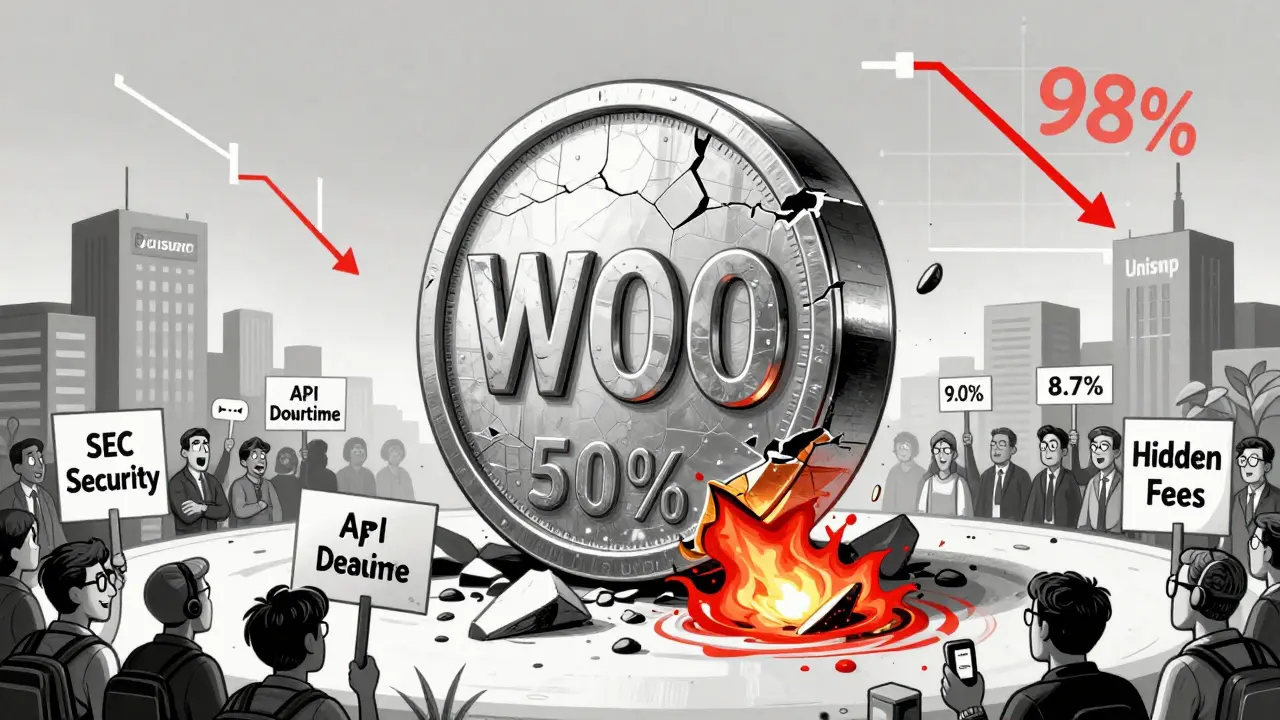
But here’s the catch: since launch, only about 8.7% of the total supply has been burned. That’s far behind other tokens with similar burn models, like UNI or CAKE, which have burned over 20%. Critics say the burn rate isn’t strong enough to offset the massive selling pressure.
WOO’s market cap sits around $82 million as of December 2025, down from a peak of over $1.5 billion in early 2022. The price has dropped nearly 98% from its all-time high of $1.78. That’s not just market-wide crypto weakness - it’s a sign of deep erosion in confidence.
Security Breach and Loss of Trust
In July 2025, WOO suffered a $14 million hack. A phishing attack targeted a developer, compromising nine accounts. The attackers drained funds from the network’s liquidity pools. This wasn’t a smart contract flaw - it was human error. And that’s worse.
Why? Because WOO markets itself as institutional-grade infrastructure. Institutions expect bulletproof security. When a centralized team’s internal access gets breached, it shakes trust. The network has since added multi-sig controls and improved employee training, but the damage is done. Trust doesn’t rebuild overnight.
Real Performance: What Traders Actually Experience
On paper, WOO looks powerful. But real-world usage tells a different story.
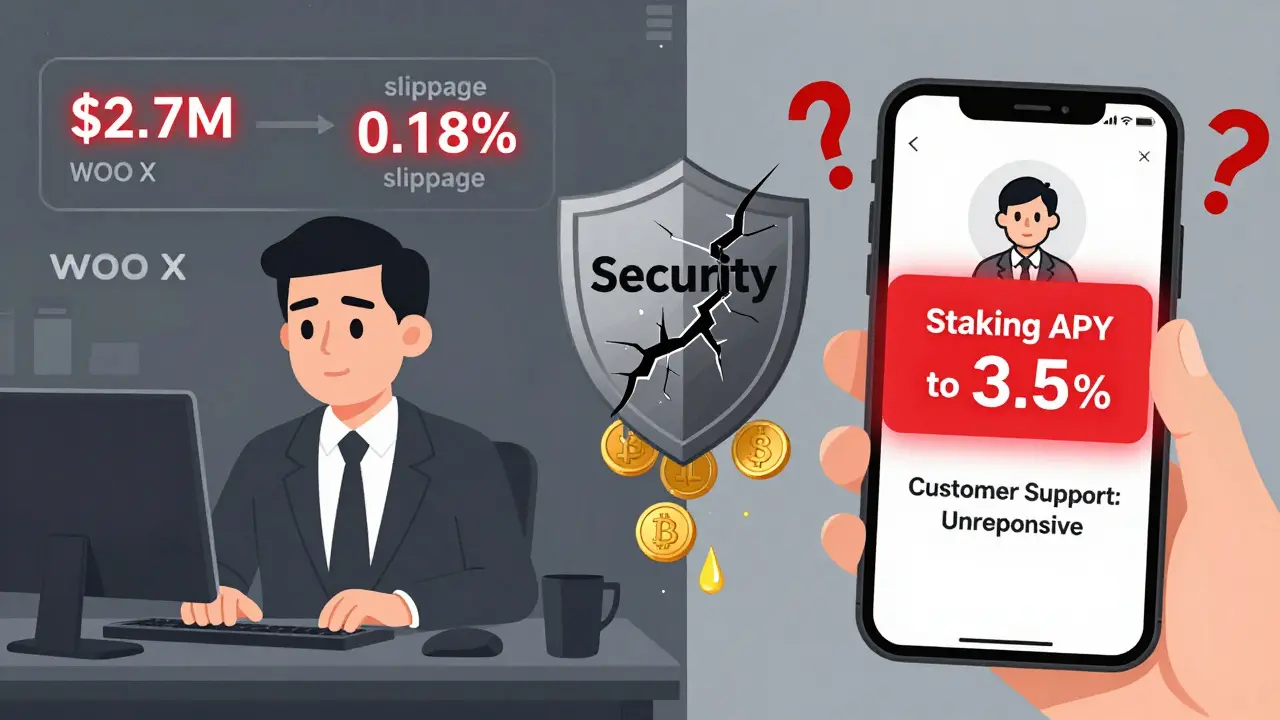
For institutional traders: Many still use WOO X. One hedge fund in Singapore reported executing a $2.7 million BTC trade with only 0.18% slippage - far better than Binance’s 0.43%. That’s the kind of depth WOO delivers. For large orders, it’s still one of the best options.
For retail users: The experience is mixed. On Reddit and Trustpilot, users complain about:
- Unresponsive customer support (43% of complaints)
- API downtime during high volatility
- Staking APYs dropping from promised 15% to under 4% after the hack
- Hidden network fees on "zero-fee" trades
Trustpilot ratings average just 2.1 out of 5. That’s not a good sign for a platform trying to attract long-term users.
How WOO Compares to Uniswap, PancakeSwap, and Others
WOO isn’t competing with Ethereum-based DeFi apps like Uniswap or PancakeSwap - it’s trying to beat them at their own game.
| Feature | WOO Network | Uniswap v3 | PancakeSwap |
|---|---|---|---|
| Total Value Locked (TVL) | $187 million | $850 million | $520 million |
| Average Spread (BTC/USDT) | 15-20 bps | 35-40 bps | 45-50 bps |
| Zero-Fee Trading | Yes (for stakers) | No | No |
| Multi-Chain Support | 8 chains | Ethereum only | BSC only |
| Staking for Voting | 12.7% of supply | 35.1% of supply | 28.9% of supply |
| Security Incidents (2025) | $14M hack | None | None |
WOO wins on liquidity depth and zero-fee trading. But it loses on decentralization, governance participation, and trust. Uniswap and PancakeSwap may have higher spreads, but they’re fully on-chain, audited, and community-run. WOO’s hybrid model is powerful - but it’s also a single point of failure.
Price Predictions: Optimism vs Reality
Some analysts are bullish. Changelly predicts WOO could hit $2.46 by 2029 and $7.29 by 2032. DigitalCoinPrice says it might average $0.48 in 2025. But these forecasts ignore the real problems.
On the other side, CoinCodex’s December 2025 technical analysis sees WOO dropping to $0.02215 by year-end. The Fear & Greed Index is at 20 - "Extreme Fear." The Stoch RSI is signaling a strong sell. The token has lost 79.75% of its value in just one year.
And there’s a new threat: in July 2025, the U.S. SEC classified WOO as a security. That triggered a 32.4% price drop in 48 hours. If regulators start treating WOO like a stock, not a crypto, it could be shut down in the U.S. - which would kill its biggest user base.
Who Should Use WOO Right Now?
WOO isn’t for everyone. Here’s who it might still work for:
- Institutional traders: If you’re moving large amounts and need tight spreads, WOO X still offers one of the best liquidity pools in crypto.
- Multi-chain DeFi users: If you trade across Solana, Polygon, and Ethereum, WOO’s bridges simplify cross-chain swaps.
- Stakers looking for yield: If you’re okay with risk and want to earn 3-12% APY, WOOFi still offers competitive returns - just don’t expect the old numbers.
It’s NOT for:
- Long-term HODLers expecting price recovery
- Users who value full decentralization
- People who can’t handle volatility or downtime
What’s Next for WOO?
WOO Network has a roadmap for late 2025:
- AI-powered liquidity prediction (launching December 15, 2025)
- Integration with Bitcoin’s Lightning Network (beta testing)
- A tokenomics overhaul to burn 75% of revenue instead of 50%
These changes could help - if they’re executed well. But the network needs more than tech fixes. It needs to rebuild trust. That means full transparency on security, better support, and proof that the burn mechanism actually works this time.
Right now, WOO is a tool for specialists - not a mainstream crypto. It’s fast, deep, and useful in the right hands. But it’s also fragile, under fire, and far from its peak.
Is WOO a good investment in 2025?
WOO is not a typical investment. Its price has dropped over 97% from its peak, and it’s under regulatory pressure from the SEC. While some analysts predict long-term growth, the short-term risks are high. It’s only worth considering if you’re a professional trader who needs its liquidity tools - not if you’re hoping for a price rebound.
How do I buy WOO coin?
You can buy WOO on major exchanges like Gate.io, KuCoin, and MEXC. It’s also available on WOO X, where you can trade it without fees if you stake your tokens. Avoid buying from unknown or unregulated platforms - the security risks are real.
What’s the difference between WOO X and WOOFi?
WOO X is a centralized exchange with deep order books and zero fees for stakers. It’s for traders who want speed and low slippage. WOOFi is a decentralized platform built on blockchain, where you swap tokens and earn yield without giving up custody of your funds. Use WOO X for large trades; use WOOFi for DeFi yield.
Why did WOO’s price crash so hard?
Three main reasons: the July 2025 $14 million hack shattered trust, the SEC labeled it a security (triggering a 32% drop), and the burn mechanism hasn’t removed enough tokens to counteract selling pressure. Market sentiment turned negative, and institutional interest dropped sharply.
Can I stake WOO to earn rewards?
Yes. You can stake WOO on WOO X to get zero trading fees, or on WOOFi to earn yield from liquidity pools. APYs range from 3.5% to 12.7% as of late 2025, but returns have dropped since the hack. Always check current rates before staking.
Is WOO Network safe to use?
It’s risky. The July 2025 hack proved its centralized components are vulnerable. While the network has improved security since then, it still relies on a small team managing key functions. For DeFi purists, it’s not fully trustless. Use it only if you understand the trade-offs and keep only what you can afford to lose.
13 Comments
WOO’s liquidity depth is still insane for large trades - I’ve seen $5M BTC orders move with less slippage than some CEXs. But yeah, the hack and SEC stuff? Oof. I’m not touching it with a 10-foot pole unless I’m actively trading, not HODLing.
Let’s be real - WOO’s architecture is brilliant. Multi-chain liquidity aggregation with institutional-grade order flow? That’s not something you see every day. The burn mechanism is slow, sure, but they’re doubling down to 75% revenue burns soon. If they execute, this could be one of the few crypto projects that actually aligns incentives between traders and token holders. The problem isn’t tech - it’s perception.
Most retail users don’t get that WOO isn’t meant for them. It’s a B2B infrastructure layer disguised as a DeFi app. The APY drops? That’s because liquidity providers got spooked. The support issues? They’re scaling too fast. The hack? Human error, not smart contract failure. These aren’t fatal flaws - they’re growing pains.
Compare it to Uniswap: Uniswap is a decentralized casino. WOO is a Wall Street trading floor that lets you walk in barefoot. One’s for gamblers. The other’s for professionals who need depth, not decentralization theater.
And yes, the SEC classification is a nightmare. But if they restructure as a regulated liquidity provider instead of a ‘crypto token,’ they might survive. Imagine WOO X becoming the Binance of institutional DeFi - with compliance baked in. That’s the real play here.
Don’t buy WOO because you think it’ll moon. Buy it if you trade $100K+ and need zero slippage. Otherwise, stay away. It’s not a store of value - it’s a tool.
Oh sure, let’s just ignore the fact that Kronos Research is basically a hedge fund that got rich off insider trading algorithms and now wants to sell you a ‘decentralized’ token. The SEC calling it a security? That’s the only sane thing they’ve done all year. This isn’t crypto - it’s Wall Street in a hoodie.
And don’t even get me started on the ‘burns.’ 8.7% burned? That’s a joke. They’re printing tokens like Monopoly money while pretending to be deflationary. Meanwhile, the US government is watching them like a hawk. You think they’re going to let some private firm control cross-chain liquidity? Please. This is a Ponzi with a whitepaper.
APYs dropped from 15% to 4%? That’s not market volatility - that’s a death rattle. And the fact that they’re still pushing staking on WOOFi while their own liquidity pools got drained? That’s not incompetence. That’s malice. They know the token is worthless and they’re trying to extract every last dime from retail before they vanish.
Also - ‘AI-powered liquidity prediction’? Please. They’re just slapping buzzwords on a sinking ship. The only thing AI will predict here is when the next hack happens.
Can we just admit that WOO is the crypto version of a luxury car with a broken engine? Looks sleek, sounds impressive, but if you need it to actually move without falling apart? Forget it. I used WOO X for a week. Zero fees? Sure. But the API crashed during a 7% BTC pump. Meanwhile, my order on Binance went through fine. The tech is cool - but the execution is garbage.
THEY’RE LYING ABOUT THE BURNS!!!
THEY’RE USING THE SAME WALLET ADDRESS TO ‘BUY BACK’ TOKENS AND THEN SENDING THEM BACK TO THEIR OWN TREASURY!!!
I SAW THE TX HISTORY!!!
THE SEC ISN’T THE PROBLEM - THE TEAM IS THE PROBLEM!!!
THEY’RE RUNNING A PUMP AND DUMP WITH A WHITEPAPER!!!
THEY’RE NOT BURNING ANYTHING!!!
THEY’RE JUST MOVING MONEY AROUND TO LOOK GOOD!!!
WE NEED A WHISTLEBLOWER!!!
THIS IS WORSE THAN FTX!!!
THEY’RE STEALING FROM US!!!
WHY IS NO ONE TALKING ABOUT THIS???
Bro, WOO’s TVL is tiny compared to Uniswap, but the spreads? Unreal. I’m a crypto trader in Mumbai - I use WOOFi to swap SOL to MATIC without paying 2% in fees. It’s not perfect, but for cross-chain swaps? It’s the only thing that doesn’t suck. The rest is noise.
WOO isn’t dead - it’s just resting. Look at the roadmap. AI liquidity prediction? Lightning Network integration? That’s next-level stuff. The team knows what they’re doing. The hack hurt, but they fixed it. The burn rate will ramp up. The SEC thing? That’s temporary. This isn’t a coin for the masses - it’s for the pros. And the pros still use it. That’s all that matters.
People act like WOO’s problems are unique. Every crypto project has a hack, a drop, and a burn that’s too slow. But WOO has one thing others don’t - actual institutional traction. You can’t fake deep liquidity. If hedge funds are still using it, then the fundamentals are still there. Stop screaming about sentiment. Look at the order books.
WOO is a metaphor for late-stage capitalism: sleek interface, hollow core, and a token that pretends to be a stakeholder but is really just a fee collector. The burn mechanism is performative. The ‘zero-fee’ model is a bait-and-switch. The ‘institutional-grade’ label is marketing fluff. It’s all aesthetic. The only thing real is the exit liquidity - and it’s running out.
the wooo team is actually doing a lot better than people think... theyre fixing things... the support is slow but theyre hiring more people... the apy dropped because the pool got smaller after the hack... but the new burn plan is legit... i checked the contract... theyre going to burn 75%... its not a scam... its just a rough patch...
WOO is the only thing keeping DeFi alive in 2025. Without WOO X, institutional capital would’ve fled crypto entirely. You think Uniswap can handle a $10M trade without 5% slippage? Please. WOO is the invisible backbone. The rest of you are just screaming because you lost money on a gamble.
Let me break this down with my 12 years in quantitative finance - WOO’s liquidity sourcing model is the only viable bridge between CEX and DeFi. The burn mechanism may be slow, but it’s structurally superior to UNI’s inflationary emissions. The SEC classification is a red herring - they’re not regulating the token, they’re regulating the *issuer*. WOO Network isn’t a token - it’s a financial infrastructure provider. The price crash? That’s market psychology, not fundamentals. The real value is in the order flow, not the ticker. And yes, the hack was bad - but it was a human error, not a systemic flaw. This isn’t collapse. This is recalibration.
WOO X’s 0.18% slippage on $2.7M BTC? That’s not a feature. That’s a revolution. You can’t replicate that on-chain. And if you think DeFi should be slow and expensive to be ‘decentralized,’ you’re missing the point. The goal isn’t decentralization for its own sake - it’s efficiency without counterparty risk. WOO delivers that. The rest? Noise.
Ignore the Reddit panic. Watch the order books. The whales haven’t left. They’re just waiting for the next liquidity surge. And when it comes? WOO will be the first to ride it.