
What is STORAGENT (STORAGENT) Crypto Coin? A Guide to AI-Driven Decentralized Storage

Quick Summary / Key Takeaways
- STORAGENT is a cryptocurrency token designed for a decentralized storage network that uses an AI Agent to optimize data placement and security.
- The project relies on the InterPlanetary File System (IPFS) for its underlying file distribution protocol.
- Tokenomics show a total supply of approximately 999.98 million tokens, with no clearly defined maximum supply cap in public listings.
- It competes in a niche sector alongside established players like Filecoin and Arweave, but currently has lower visibility and adoption metrics.
- As an early-stage project, it carries higher uncertainty regarding long-term viability, technical audits, and market performance compared to mature storage coins.
What Exactly Is STORAGENT?
You’ve probably heard of Bitcoin for money or Ethereum for smart contracts. But what about storing your files without relying on Google Drive or Amazon S3? That’s where storage cryptocurrencies come in. STORAGENT is one such project, positioning itself as a decentralized storage solution that combines web3 infrastructure with artificial intelligence.
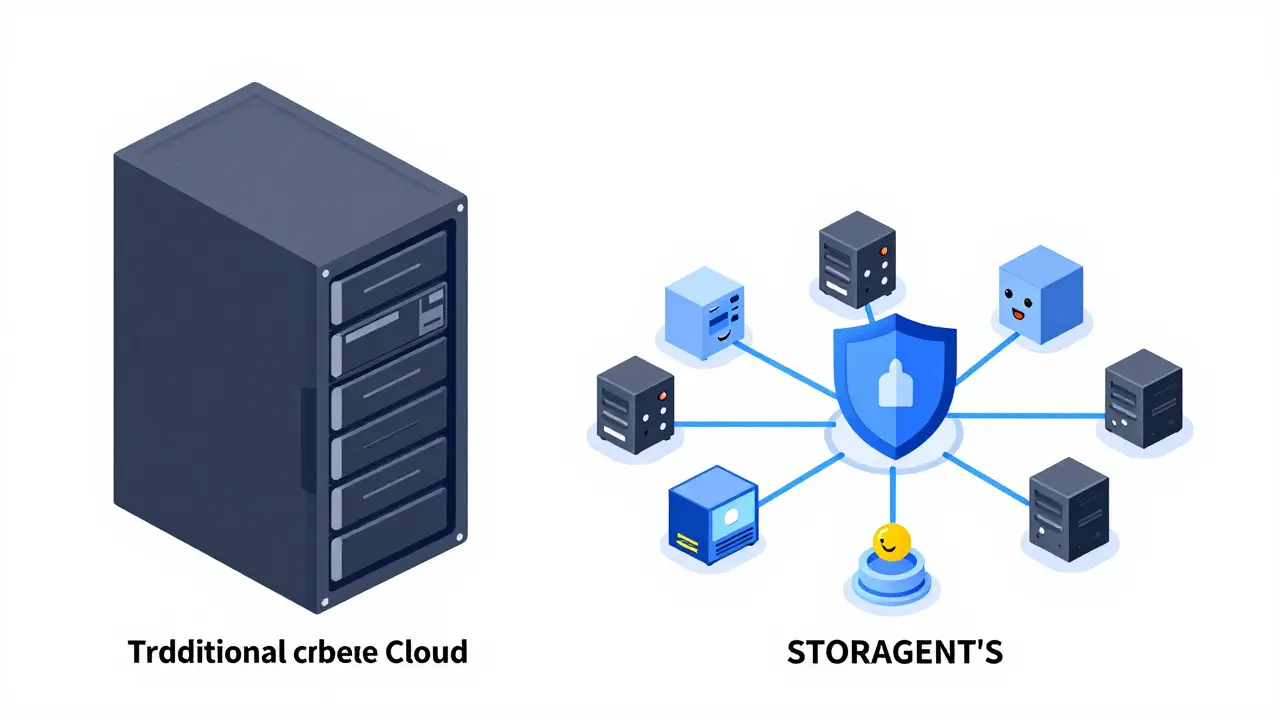
Unlike traditional cloud providers that keep your data on centralized servers (which can be hacked, censored, or shut down), STORAGENT aims to distribute your data across a global network of nodes. The twist here is the branding: they call it “Secure Storage with AI Agent.” This suggests the system doesn’t just dump files anywhere; it uses an intelligent layer to decide where data goes for the best speed, security, and reliability.
If you are looking at this coin, you likely want to know if it’s just another buzzword-heavy token or if there’s actual technology behind it. Let’s break down what we know from available data on platforms like CoinMarketCap and CryptoSlate.
How Does the Technology Work?
To understand STORAGENT, you need to look at its two main pillars: the storage protocol and the AI optimization layer.
1. The Storage Layer: IPFS
At its core, STORAGENT utilizes the InterPlanetary File System (IPFS). IPFS is a peer-to-peer hypermedia protocol. Instead of finding files by their location (like a URL pointing to a specific server), IPFS finds them by their content hash. This means if you upload a file, it gets broken into chunks and distributed across many computers worldwide. If one computer goes offline, the data remains accessible from others. This provides censorship resistance and high fault tolerance.
2. The Optimization Layer: The AI Agent
Here is where STORAGENT tries to differentiate itself. Standard decentralized storage networks often struggle with inconsistent node performance-some nodes are fast, some are slow, and some disappear entirely. STORAGENT claims to use an AI Agent to manage this chaos. While detailed algorithmic specs aren’t publicly available, the concept implies that the AI monitors node health, latency, and reputation in real-time. It then dynamically routes data to the most reliable nodes, ensuring faster retrieval and better security than static routing methods.
| Feature | Traditional Cloud (AWS/Google) | Filecoin (FIL) | STORAGENT |
|---|---|---|---|
| Data Control | Centralized (Provider owns keys) | Decentralized (User controls) | Decentralized (User controls) |
| Underlying Protocol | Proprietary Servers | Custom Blockchain + IPLD | IPFS + AI Orchestration |
| Optimization Method | Automated Load Balancing | Cryptoeconomic Incentives | AI-Agent Driven Node Selection |
| Censorship Resistance | Low (Can be taken down) | High | High |

Tokenomics: Supply and Circulation
When evaluating any crypto asset, the numbers matter. Here is what the current data shows for STORAGENT:
- Total Supply: Approximately 999.98 million tokens.
- Circulating Supply: Reports indicate nearly 100% of the total supply is circulating (approx. 999.98 million).
- Maximum Supply: Not explicitly capped or verified in major aggregators (listed as "--").
The fact that almost all tokens are already circulating can be a double-edged sword. On one hand, there’s no hidden inflation waiting to hit the market later. On the other hand, the lack of a hard maximum supply cap raises questions about future monetary policy. Will new tokens be minted for development rewards? Without a transparent, audited whitepaper detailing this, investors should treat the supply dynamics with caution.
Where Does It Fit in the Market?
The decentralized storage sector is small but growing. According to recent data from CryptoSlate, the entire storage crypto sector has a market capitalization of around $1.11 billion, comprising about 33 assets. This represents less than 0.05% of the total cryptocurrency market.
In this crowded room, giants like Filecoin (FIL), Arweave (AR), and Storj (STORJ) dominate the conversation. These projects have years of track records, massive developer communities, and clear enterprise adoption.
STORAGENT, by comparison, is relatively obscure. It does not appear in mainstream “Top 5” lists from major exchanges like Binance. This absence isn’t necessarily bad-it just means it’s an early-stage or niche player. For a retail investor, this means higher risk but potentially higher reward if the AI-driven storage model proves superior to existing solutions. However, liquidity might be lower, meaning buying or selling large amounts could impact the price significantly.
Risks and Considerations
Before you buy or store data on STORAGENT, consider these critical factors:
- Lack of Technical Transparency: The term “AI Agent” is used heavily in marketing, but specific details on the AI model (e.g., machine learning algorithms, training data, decision logic) are scarce. Is it a sophisticated neural network or a simple heuristic script? Without open-source code or technical audits, it’s hard to verify.
- Security Audits: Major storage coins undergo rigorous third-party security audits to prevent hacks. There is no widely publicized audit report for STORAGENT in the available sources. Always check if the smart contract has been verified by firms like CertiK or SlowMist.
- Adoption Metrics: A storage network is only valuable if people use it. Since STORAGENT lacks significant user testimonials or developer SDK documentation in public forums, its network effect is currently weak compared to competitors.
- Regulatory Uncertainty: As with all crypto assets, regulatory landscapes change. Ensure you understand the legal implications of holding or using this token in your jurisdiction (e.g., New Zealand, USA, EU).
Is STORAGENT Right for You?
If you are a developer looking for a robust, battle-tested storage solution for your dApp, established options like Filecoin or Arweave might offer more stability and community support right now. Their ecosystems are mature, with plenty of tutorials and libraries.
However, if you are an early adopter who believes that AI-optimized storage is the next evolution in web3, STORAGENT presents an interesting case study. Its focus on using AI to solve the “node reliability” problem is a valid pain point in decentralized storage. If they can deliver on the promise of faster, smarter data retrieval, they could carve out a unique niche.
Just remember: in crypto, “new” often means “unproven.” Do your own research (DYOR), start with small amounts if investing, and never store irreplaceable data on a new platform without backups elsewhere.
What blockchain is STORAGENT built on?
While the specific base layer (e.g., Ethereum, BNB Chain, Solana) is not explicitly detailed in the primary listing snippets, STORAGENT operates within the web3 ecosystem and likely uses smart contracts for token transactions. Users should check the official documentation or CoinMarketCap’s contract address section to identify the exact blockchain network for wallet compatibility.
How is STORAGENT different from Filecoin?
Filecoin relies on a complex cryptoeconomic proof system (Proof-of-Spacetime) to incentivize storage. STORAGENT differentiates itself by emphasizing an “AI Agent” that optimizes storage decisions, aiming for better performance and fault tolerance through intelligent node selection rather than just economic incentives alone.
Is STORAGENT safe to use for sensitive data?
Like any decentralized storage solution, it offers enhanced privacy compared to centralized clouds because data is encrypted and sharded. However, since STORAGENT is an early-stage project with limited public security audits, it is recommended to avoid storing highly sensitive or irreplaceable data until the network has a proven track record of security and uptime.
What is the total supply of STORAGENT tokens?
The total supply is reported as approximately 999.98 million STORAGENT tokens. Currently, nearly all of these are in circulation, though a hard maximum supply cap is not clearly documented in major aggregator listings.
Where can I buy STORAGENT?
STORAGENT is listed on CoinMarketCap, which tracks its price and trading pairs. To buy it, you would typically need to find a supported exchange (such as a decentralized exchange or smaller centralized exchange) that lists the token. Always verify the contract address to avoid scams.