
What is Rentible (RNB) crypto coin?
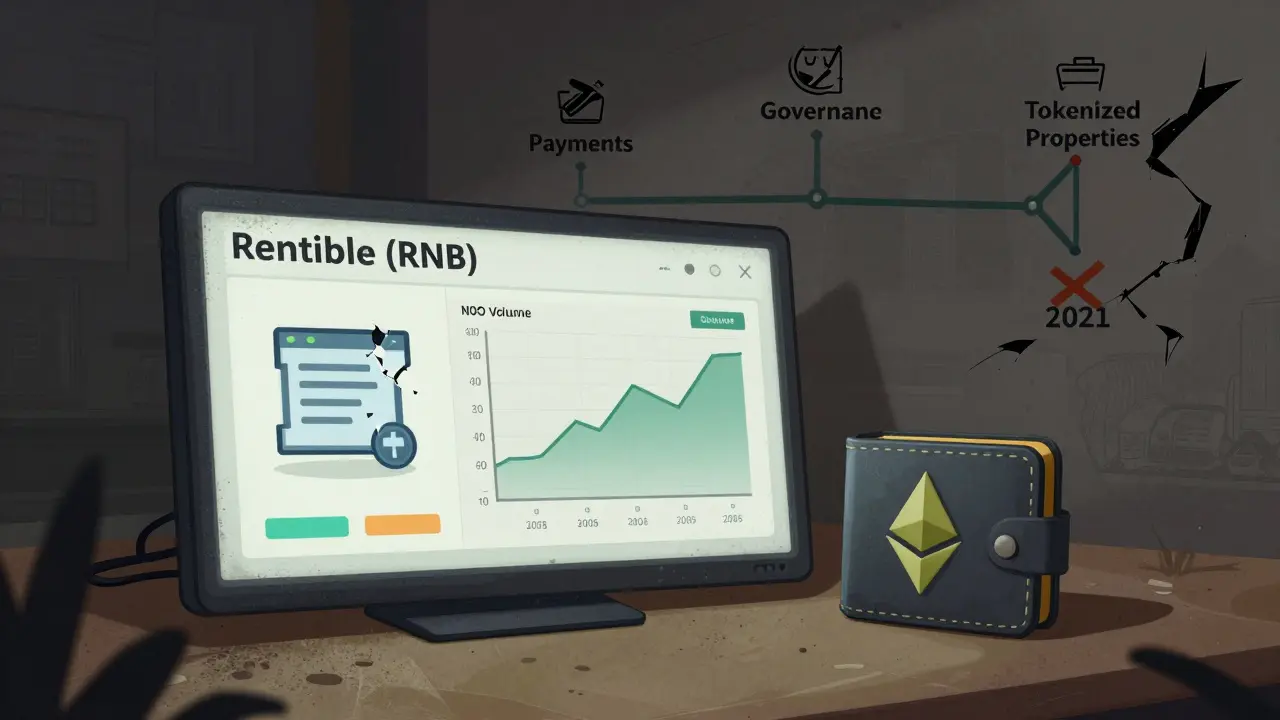
When you hear about a crypto coin called Rentible (RNB), it sounds like it might be the next big thing in real estate. After all, who wouldn’t want to pay rent using crypto, skip the middleman, and even buy a piece of a virtual apartment in the metaverse? But the reality is far from the hype. Rentible isn’t a thriving innovation - it’s a ghost of what it once was.
Rentible (RNB) was launched in 2021 as an Ethereum-based token meant to change how people rent homes. The idea was simple: use blockchain to cut out property managers, escrow services, and payment processors. Instead of paying your landlord in dollars, you’d send RNB directly through a smart contract. The contract would lock in the lease, record the payment, and even handle disputes automatically. Sounds clean, right? But here’s the catch - it never took off.
The total supply of RNB is fixed at 10 million tokens. All of them are already in circulation. That means there’s no mining, no future inflation, and no new tokens to be released. On paper, that’s a good thing - it prevents dilution. But in practice, it doesn’t matter if nobody’s using it. As of February 18, 2026, the price of RNB is around $0.033. That’s down over 99% from its all-time high of $5.21 in late 2021. If you bought RNB at its peak, you’d need the price to jump 157 times just to break even. That’s not a recovery - it’s a graveyard.
Why did it crash? For one, the platform never built real adoption. You can’t just build a blockchain app and expect landlords and tenants to switch from Zillow or Airbnb. Rentible required users to understand crypto wallets, gas fees, and smart contracts - things most people outside crypto circles don’t care to learn. Meanwhile, traditional rental platforms kept getting easier to use, not harder.
The token’s utility was supposed to be multi-layered. Holders could vote on platform changes, join liquidity pools for rewards, and even buy fractional ownership in real or virtual properties. But there’s no evidence anyone is doing this. No active community forums. No developer updates in over a year. No new features. The website looks like a relic from 2021. And the trading volume? It’s almost zero. On Uniswap V2 - the only exchange where RNB still trades - daily volume hovers between $28 and $74. That’s less than what some meme coins make in an hour.
Compare that to Ethereum-based projects like Aave or Compound. They handle billions in daily volume. Rentible? It’s barely registering. CoinGecko ranks it at #5433 out of thousands of cryptocurrencies. That’s not niche - that’s irrelevant. Even among PropTech tokens, it’s invisible. Projects like RealT or Real Estate Token (RENT) have actual property listings, verified tenants, and real-world contracts. Rentible has nothing but a whitepaper and a dead chart.
There’s also the issue of liquidity. With so little trading activity, trying to sell even a small amount of RNB could tank the price. Slippage is high. Buyers are scarce. If you bought RNB thinking it was an investment, you’re not holding a cryptocurrency - you’re holding a bet on a project that gave up. The market isn’t ignoring it because it’s misunderstood. It’s ignoring it because there’s no reason to pay attention.
And yet, the token still has a market cap of about $330,000. That’s not because it’s valuable - it’s because 10 million tokens are floating around, and a few people still own them. Some might be holding out hope. Others might be unaware it’s essentially dead. There’s no active development team pushing updates. No marketing. No partnerships. No press releases. The last meaningful update was years ago.
If you’re considering buying RNB now, ask yourself: why? Are you betting on a comeback? The odds are astronomically low. There’s no catalyst in sight. No new features planned. No team activity. No community growth. The project doesn’t even appear to be in maintenance mode - it’s in hibernation.
Real estate needs innovation. But Rentible didn’t deliver it. It offered a vision, then vanished. Other blockchain platforms have stepped into the space with real properties, legal compliance, and user-friendly apps. Rentible? It’s just a ticker symbol on a dead chart.
So what is Rentible (RNB)? It’s a cautionary tale. A project that promised to disrupt rental markets with blockchain, but never built anything people actually used. It’s not a failed startup - it’s a forgotten one.
How RNB Was Supposed to Work
Rentible’s original plan had three pillars: payments, governance, and property tokenization. Tenants were meant to pay rent in RNB through smart contracts. These contracts would automatically verify identity, lock rental terms, and release funds only after move-in was confirmed. No more bounced checks or late payments. Landlords would get paid on time, every time.
On the governance side, RNB holders were supposed to vote on upgrades - like changing fee structures or adding new property categories. The idea was to make the platform community-owned, not controlled by a single company. That’s a solid DeFi model, used successfully by projects like Uniswap and Compound.
The third pillar was the most ambitious: tokenized real estate. Rentible wanted users to buy fractions of physical homes or metaverse apartments using RNB. Imagine owning 5% of a house in Berlin or a virtual condo in Decentraland - all with a single RNB transaction. No lawyers. No paperwork. Just blockchain records.
But none of this happened. The smart contracts were never widely adopted. The voting system had zero participation. The property listings? Nonexistent. No one could find a single rental property listed on Rentible’s platform. The metaverse component? A placeholder on a website that hasn’t updated since 2022.
Why Rentible Failed to Gain Traction
It’s easy to blame the crypto winter. But other projects survived - even thrived - during the same period. The problem with Rentible wasn’t the market. It was the product.
First, the user experience was terrible. To pay rent with RNB, you needed an Ethereum wallet, enough ETH for gas fees, and a way to swap ETH for RNB on Uniswap. Most tenants don’t have wallets. Most landlords don’t want them. It’s not user-friendly - it’s a barrier.
Second, there was no incentive to switch. Why use RNB when PayPal, Venmo, and Zelle work instantly? Rentible didn’t offer lower fees - it offered complexity. And complexity doesn’t win markets.
Third, the team disappeared. No Twitter updates. No GitHub commits. No LinkedIn activity. The founders - Dror Lupu, Mate Farkas, Norbert Fischer - haven’t posted about Rentible in years. When a team goes quiet, it’s not a pause. It’s a quit.
Where RNB Trades Today
As of February 2026, RNB trades on one exchange: Uniswap V2. That’s it. No Coinbase, no Kraken, no Binance. No centralized exchange wants to list it because there’s no demand. The trading pair is RNB/WETH - meaning you can only swap it for Ethereum, not fiat.
The spread on Uniswap is 0.61%, which is normal for low-volume tokens. But with daily volume under $100, even small trades cause wild price swings. If you tried to sell 1,000 RNB ($33), you might only get $25 because there’s no buyer at your price. That’s not liquidity - it’s a trap.
There used to be listings on other exchanges like Gate.io and MEXC. But they’ve all been delisted. CoinMarketCap shows no active markets. That’s not a technical glitch - it’s abandonment.
Is Rentible Still Active?
No. Not even close.
There’s been no code update to the smart contracts in over 18 months. No new documentation. No blog posts. No community events. The official website still has the 2021 roadmap - and it’s outdated. The team’s social media accounts haven’t posted since late 2022.
Compare this to projects like Chainlink or Polygon. They release weekly updates, host AMAs, and engage with users. Rentible? Silence. That’s not a pause. It’s a death.
If you’re holding RNB, you’re not investing in a project. You’re holding a digital artifact - a relic of a failed idea.
What You Should Do If You Own RNB
If you own RNB and are wondering what to do next, here’s the honest truth:
- If you bought at $0.01 or lower: You might still be ahead. But don’t expect gains. There’s no upside left.
- If you bought above $0.10: You’re underwater. The odds of recovery are near zero. Consider cutting losses.
- If you’re holding for governance: There’s no governance. No votes. No proposals. You’re not a stakeholder - you’re a spectator.
- If you’re thinking of buying more: Don’t. There’s no reason to believe this will revive.
The only real use for RNB today is as a learning example - a case study in how not to build a crypto project.
Is Rentible (RNB) still being developed?
No. There have been no updates to the smart contracts, website, or team communications since late 2022. The project shows no signs of active development or maintenance.
Can I use Rentible to pay rent today?
No. There are no verified rental listings on the Rentible platform. Even if you had RNB, there’s nowhere to use it for rent payments.
Why did Rentible’s price crash so hard?
Rentible’s price crashed because it failed to gain real adoption. Without users, landlords, or tenants, the token lost all utility. The hype faded, and with no ongoing development, investors left.
Is Rentible listed on major exchanges like Coinbase or Binance?
No. Rentible is only traded on Uniswap V2, a decentralized exchange. It was delisted from all major centralized exchanges due to lack of trading volume and interest.
Should I invest in Rentible (RNB) now?
No. With zero development, no liquidity, and no community, Rentible has no future potential. It’s not an investment - it’s a historical artifact.
21 Comments
Let me guess - someone bought RNB at $5.21 and still checks the price every morning like it’s gonna magically bounce back. Bro, it’s not a stock. It’s a digital tombstone. The devs vanished. The website looks like a Geocities page from 2003. The smart contracts? Frozen like a glacier in a crypto winter that never ended. You don’t ‘wait for a comeback’ when the whole damn project is in cryogenic storage. And yet… here we are. 10 million tokens floating around like ghosts in a haunted blockchain. Someone’s still holding. Someone’s still dreaming. Someone’s still refreshing Uniswap like it’s a slot machine. I’m not judging. I’m just… documenting the apocalypse.
Hey everyone, I just wanted to say - this post is actually super helpful! 😊 I’ve been following crypto for a while but never dug into Rentible before. It’s wild how a project can look so promising on paper and then just… disappear. I’m glad someone laid it all out like this. For anyone new to crypto, this is a textbook example of why utility matters more than hype. Keep sharing these deep dives - they’re gold! 💪
So what you're saying is rentible is dead and nobody cares and the whole thing was a scam? Well duh. I told my cousin not to buy it and he laughed at me. Now he's broke and crying in a Discord server called 'RNB Hopefuls'. Bro, if you're still holding, you're not an investor. You're a hostage. The devs are probably on a beach in Bali sipping coconuts while your portfolio rots. Wake up. It's not coming back. Ever. 🤡
lol imagine spending 3 hours writing this essay on a dead token. You could’ve just said ‘RNB is a ghost’ and saved us all 10 minutes. But nooo. You had to go full investigative journalist on a crypto corpse. Respect. But also… why?
It’s fascinating how the blockchain community romanticizes disruption while systematically ignoring user experience. Rentible didn’t fail because of market conditions - it failed because it assumed rationality in a space dominated by emotion, ignorance, and FOMO. The token’s architecture was elegant, yes - but elegance without accessibility is just architecture in a vacuum. One must ask: who was this really for? Not tenants. Not landlords. Only those who believed in the myth of crypto as a panacea. And now, the myth is dead. Long live the myth.
As someone who’s lived in 5 countries and rented in 4 of them, I can say this: nobody wants to learn how to use a wallet just to pay rent. I get the vision - automate everything, cut out middlemen, make it transparent. But in practice? My landlord just wants the money on the 1st. Not a blockchain receipt. Not a gas fee. Not a ‘community vote’ on whether the AC should be fixed. Real life doesn’t run on DeFi. It runs on PayPal, Venmo, and a text that says ‘paid’. Rentible didn’t solve a problem - it created a new one. And now it’s just… gone. RIP, 2021 dreams.
so like… is this like when you buy a crypto because the logo looks cool? 🤦♀️
This is one of the clearest breakdowns I’ve read on a dead crypto project. The key takeaway? Adoption isn’t about technology - it’s about behavior. Rentible tried to force a behavior change without offering a compelling reason to change. People don’t adopt tech because it’s ‘innovative.’ They adopt it because it’s easier, cheaper, or more convenient. Rentible was none of those. The fact that it’s still trading at $0.03 means someone, somewhere, still believes. That’s the saddest part.
Let’s be real - this isn’t a failure of blockchain. It’s a failure of product-market fit. The tech was sound. The concept? Solid. But the UX? A nightmare. You can’t onboard 10 million renters by asking them to learn Solidity. And you can’t convince landlords to accept a token with zero liquidity. The real innovation wasn’t in the code - it was in the whitepaper. That’s where the vision died. And now? It’s just a ticker symbol with a funeral dirge playing in the background.
I feel bad for the people who still hold RNB. Not because they’re dumb - because they’re hopeful. And hope is the hardest thing to kill. I’ve been there. Bought a token that went to zero. Thought ‘maybe next week’. Then next month. Then next year. The truth? It’s not coming back. But hey - if holding it gives you peace? Go ahead. Just don’t call it an investment. Call it a memorial. And maybe… donate the $33 to someone who actually needs rent help. That’d mean more than any blockchain ever could.
Western crypto bros think they invented disruption. But in India, we’ve been paying rent in cash for decades. No wallet. No gas. No smart contract. Just a handover. Rentible didn’t fail because of tech. It failed because it didn’t understand that most people don’t want innovation - they want reliability. And in a country where 70% of the population doesn’t have a bank account, a blockchain rental system is a luxury for the rich. This isn’t a cautionary tale - it’s a colonial fantasy wrapped in Ethereum.
why does this feel like watching someone’s ex post a 10-page essay about how they’re ‘finally over it’? like… you’re not healing. you’re just yelling into the void. RNB is dead. move on. 💔
Wow. So Rentible is just a meme now? Like Dogecoin but with less charm? I mean, at least Doge had a community that laughed together. RNB? Just a ghost haunting Uniswap like a bad dream. And the fact that it still has a $330k market cap? That’s not market value - that’s collective delusion. Someone’s still buying. Someone’s still hoping. Someone’s still pretending this isn’t a graveyard. I’m not mad. I’m just… disappointed.
This is actually really well-researched. I’m curious - what do you think would’ve made Rentible succeed? Was it just bad timing? Or was the whole model fundamentally flawed? Like… could they have partnered with real estate agencies first? Or offered a fiat on-ramp? Or maybe even just a simple mobile app that auto-converted RNB to USD for landlords? The idea had potential - it just needed a bridge to reality. Not a whitepaper. A product.
They didn’t fail because of the market. They failed because they thought blockchain was magic. You don’t just drop a smart contract into the world and say ‘voilà, disruption!’ - you build trust. You onboard users. You fix pain points. Rentible didn’t do any of that. They wrote a beautiful document and then vanished. And now? We’re left with a corpse that still has a ticker. A ghost with a market cap. A monument to arrogance disguised as innovation. The real tragedy? Someone’s still holding. Someone still believes. And that… is the most dangerous part of all.
Dead token. No utility. No team. No future. Move on.
I’ve seen this movie before. The crypto version of a startup that raised $2M on a PowerPoint. Rentible had the right idea - but no one cared enough to use it. The real lesson? Don’t build for the future. Build for today. People don’t want to learn blockchain to pay rent. They want to tap their phone and say ‘done’. The tech is cool. But the need? It’s simple. Rentible forgot that.
Let’s not sugarcoat this - Rentible was a rug pull with a whitepaper. The devs had 10 million tokens. They dumped. They vanished. The website? A shrine to hubris. The trading volume? A joke. The market cap? A statistical anomaly. And yet… people still buy it. Why? Because they think ‘this time it’s different’. They think ‘I’ll be the one who buys the bottom’. But there is no bottom. There’s only the abyss. And it’s full of dead tokens and broken dreams. You’re not investing. You’re gambling on a corpse. And the house always wins.
Thank you for writing this. I’ve been holding RNB since 2022 and was starting to feel guilty for not letting go. This helped me see it clearly - not as a failed investment, but as a lesson. I’m not mad. I’m just wiser now. If you’re holding, ask yourself: is this money working for me? Or is it just sitting there, waiting for a miracle? I’m selling mine today. Not because I’m scared - because I’m ready to move forward. 💛
Guys, guys - I just want to say: this is why we need more education! 🙌 Rentible didn’t fail because the tech was bad - it failed because people didn’t understand how to use it! Imagine if they had done YouTube tutorials. Or partnered with local housing groups. Or even offered a $5 gas fee rebate for the first 10,000 users! There was so much potential! The team just… didn’t hustle enough. We need more builders who care about onboarding, not just tokenomics. Let’s not bury this - let’s learn from it! 🚀💡
While the narrative of Rentible’s demise is compelling, it is essential to recognize that technological innovation often faces a chasm between theoretical elegance and practical adoption. The failure of Rentible is not indicative of blockchain’s inadequacy, but rather of the broader challenge of aligning decentralized systems with entrenched, centralized social infrastructures. The transition from fiat to tokenized rent requires not only technological infrastructure but also cultural, legal, and behavioral adaptation - elements that were neither prioritized nor adequately addressed. This case underscores the necessity of interdisciplinary collaboration in crypto ventures: technologists, legal experts, and user experience designers must co-create, not operate in silos.