
What is Osmosis (OSMO)? A Guide to the Cosmos Ecosystem's Top DEX
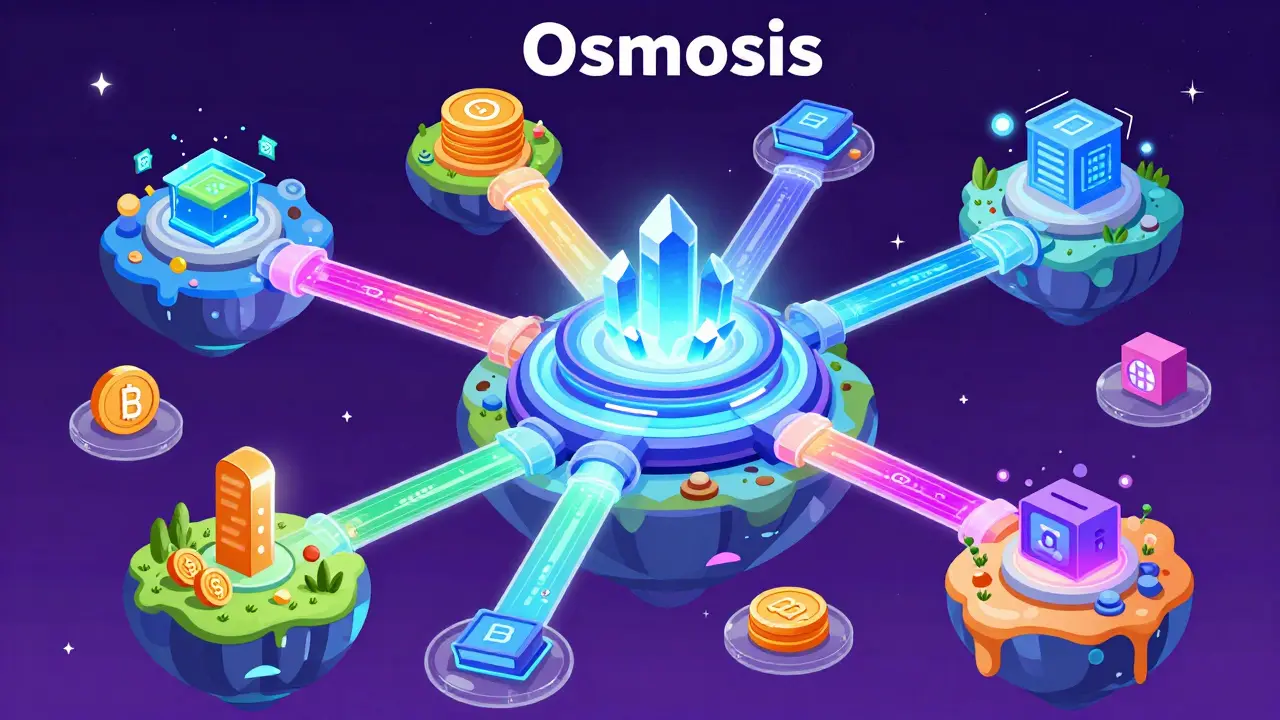
Imagine trying to swap tokens between two different blockchains. Usually, it feels like trying to move money between two banks that speak different languages and use different currencies; you need a middleman, a bridge, and a lot of patience. Osmosis is a decentralized exchange (DEX) protocol built on the Cosmos blockchain that acts as the primary liquidity hub for the entire ecosystem. Launched in June 2021 by Sunny Aggarwal, it removes the friction of cross-chain trading by using the OSMO token to power a network where assets from dozens of different chains can be swapped almost instantly.
Quick Summary: Key Takeaways
- Core Function: An Automated Market Maker (AMM) specifically for the Cosmos ecosystem.
- Unique Feature: Superfluid staking allows you to earn staking rewards and liquidity provider fees simultaneously.
- Interoperability: Uses the IBC protocol to connect with over 47 different blockchains.
- Token Utility: OSMO is used for governance, staking, and paying transaction fees.
- Efficiency: High-speed transaction finality (6-7 seconds) with very low fees (typically $0.01-$0.05).
How Osmosis Actually Works
At its heart, Osmosis is an Automated Market Maker. If you've used Uniswap, the concept is similar: instead of a traditional order book where buyers and sellers wait for a match, you trade against a pool of assets. However, Osmosis takes this further by leveraging the Cosmos SDK, which is the software framework used to build independent, interoperable blockchains. This means Osmosis isn't just a piece of software running on a chain; it is its own sovereign blockchain.
The secret sauce is the IBC Protocol (Inter-Blockchain Communication). Think of IBC as the "internet for blockchains." It allows Osmosis to talk directly to other "zones" in the Cosmos ecosystem. When you move tokens from the Cosmos Hub to Osmosis, you aren't using a risky third-party bridge that could be hacked; you are using a standardized communication protocol that ensures the assets are securely transferred and accounted for.
One of the biggest upgrades in the protocol is the introduction of concentrated liquidity. In a standard pool, your money is spread across all possible prices, which is inefficient. Concentrated liquidity lets you pick a specific price range where your assets are active. According to technical reports, this has boosted capital efficiency by 4.3x for stablecoin pairs, meaning liquidity providers can make more money with less capital.
The OSMO Token and Its Value
The OSMO Token is the engine that keeps the exchange running. It serves three main purposes: governance, security, and utility. If you hold OSMO, you have a say in how the protocol evolves, such as voting on new pool additions or fee structures.
What makes OSMO different from most DeFi tokens is the "thirdening" schedule. Rather than a single halving event like Bitcoin, Osmosis reduces its token issuance three times a year. This creates a gradual downward slope in supply, which is designed to prevent the massive price shocks often seen with traditional halving events while still maintaining scarcity over the long term.
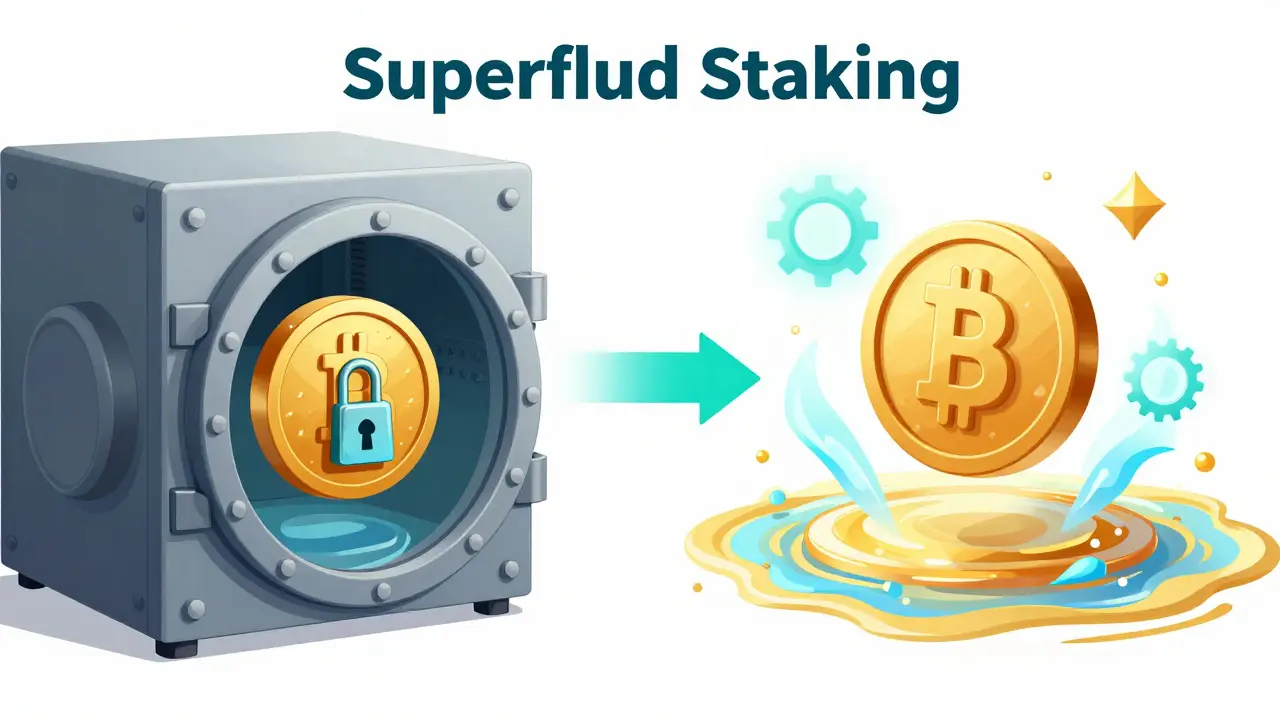
For those looking to earn, Osmosis (OSMO) offers something called Superfluid Staking. In most networks, you have to choose: do you stake your tokens to secure the network, or do you put them in a liquidity pool to earn trading fees? Superfluid staking lets you do both. You stake your tokens to a validator, and those staked tokens are then used to provide liquidity. This effectively doubles your earning potential without adding the typical risk of unstaking your assets.
Comparing Osmosis to Other DEXs
When you put Osmosis next to giants like Uniswap or Balancer, the trade-offs become clear. Uniswap has massive volume, but it is largely confined to Ethereum and its Layer-2s. Osmosis is the king of its own backyard-the Cosmos ecosystem-supporting assets from over 47 chains natively. While Balancer allows for multi-token pools, Osmosis combines that flexibility with the deep integration of the IBC protocol.
| Feature | Osmosis (OSMO) | Uniswap | Balancer |
|---|---|---|---|
| Primary Ecosystem | Cosmos (IBC) | Ethereum / L2s | Ethereum |
| Max Tokens per Pool | Up to 8 | 2 | Up to 8 |
| Staking Model | Superfluid Staking | Standard Staking | Liquidity Mining |
| Avg. Transaction Fee | $0.01 - $0.05 | Variable (High on L1) | Variable (High on L1) |
| Cross-Chain Method | Native IBC | Bridges / L2s | Bridges |
Getting Started: A Practical Walkthrough
If you're new to the Cosmos world, the learning curve can feel a bit steep. You can't just use a standard MetaMask wallet. Instead, you'll need a Keplr Wallet, which is the gold standard for Cosmos-based assets. About 83% of Osmosis users rely on Keplr because it handles the complex address formats of different Cosmos zones automatically.
- Install Keplr: Add the browser extension and create a secure seed phrase.
- Fund Your Wallet: You'll need a small amount of OSMO to pay for gas fees on the Osmosis chain.
- Bridge Assets via IBC: Use a compatible chain (like the Cosmos Hub) to send tokens to Osmosis. You'll select "Osmosis" as the destination in your wallet.
- Connect to the App: Head to the official Osmosis front-end and connect your Keplr wallet.
- Swap or Provide Liquidity: Choose your pair, enter the amount, and confirm the transaction in your wallet.
A pro tip for beginners: if your IBC transfer seems to hang or fail, it's usually a gas fee issue. Slightly increasing the gas limit in your wallet settings often fixes the problem immediately. Also, keep in mind that while the exchange is fast, the initial transfer of assets between chains can take a few minutes to reflect in your balance.
The Upside and the Downsides
No project is perfect, and Osmosis has its hurdles. The biggest strength is clearly its integration. If you are already in the Cosmos ecosystem, there is no better place to trade. The superfluid staking is a genuine game-changer for yield farmers, with some ATOM/OSMO pools delivering over 22% APY in recent quarters.
On the flip side, the "walled garden" effect is real. While IBC is powerful, it mostly connects Cosmos chains. If you want to trade Bitcoin or Ethereum assets, you still have to rely on external bridges, which adds a layer of risk and complexity. Furthermore, the user interface can be overwhelming. Many users have reported that the process of moving assets between different zones took hours to figure out the first time.
From a market perspective, Osmosis is the dominant force in its niche, commanding over 68% of the total value locked among Cosmos-based DEXs. However, it faces growing competition from newer cross-chain protocols like Axelar and LayerZero, which aim to connect not just Cosmos, but every single blockchain in existence.
Is Osmosis a safe way to trade crypto?
Osmosis is a non-custodial protocol, meaning you always keep control of your private keys via your wallet (like Keplr). This is generally safer than using a centralized exchange. However, like all DeFi protocols, it carries "smart contract risk," where a bug in the code could potentially lead to loss of funds. It is significantly safer than using third-party bridges because it uses the native IBC protocol for transfers.
What is the difference between OSMO and ATOM?
ATOM is the native token of the Cosmos Hub, which acts as the central coordination point for the entire ecosystem. OSMO is the native token of the Osmosis DEX. While ATOM is used to secure the hub and govern the network of networks, OSMO is used specifically to govern the exchange and provide liquidity within the trading pools.
What is superfluid staking exactly?
In a normal system, if you stake your tokens for security, they are "locked" and cannot be used for anything else. Superfluid staking allows those locked, staked tokens to be used as liquidity in a pool. This means you earn the standard staking reward (for securing the network) AND the trading fee reward (for providing liquidity) at the same time.
How long does it take for transactions to clear on Osmosis?
Transactions on Osmosis typically reach finality in about 6 to 7 seconds. This is significantly faster than Ethereum's Layer 1 and provides a near-instant trading experience for the user.
Can I use Osmosis on my phone?
Yes, you can access the Osmosis exchange via a mobile browser, and the Keplr wallet has a mobile app. However, some users find the mobile experience less intuitive than the desktop version, and full native app support has been a common point of feedback for improvement in the community.
Next Steps and Troubleshooting
If you are just starting out, your first goal should be to set up a Keplr wallet and move a small amount of assets over via IBC to get a feel for the speed. If you find the interface too complex, look for the "Simple Swap" feature which hides some of the advanced liquidity provider settings.
For the Yield Farmer: Look into the ATOM/OSMO superfluid staking pools. These are often the most stable and highest-yielding paths for those already holding Cosmos assets. Just be aware of "impermanent loss," which happens if one token's price moves significantly compared to the other.
For the Trader: If you're encountering IBC transfer failures, don't panic. Check the gas levels in your sending wallet. If the issue persists, the Gravity DEX bridge is a reliable alternative for moving assets from outside the Cosmos ecosystem (like Ethereum) into Osmosis.
24 Comments
Oh wow, a DEX that's actually fast. Groundbreaking. 🙄
The IBC protocol is essentially what makes the Cosmos ecosystem viable. Without it, we'd just have a collection of isolated app-chains. It's the most robust way to handle cross-chain communication currently available.
That's a great point about the protocol stability.
I just love how the concept of a 'liquidity hub' feels like a digital sanctuary for our assets, creating a beautiful bridge between disparate worlds where we can all flourish together in this decentralized garden! 🌸 It's honestly so inspiring to think about how we are moving away from the rigid, cold structures of traditional banking into something that feels more like a communal effort, and the idea of superfluid staking is just the cherry on top because it lets us be both protectors of the network and active participants in the flow of value, which is such a poetic way to handle finance! ✨💖
This is all just fancy words for gambling. It's not a bank, it's a casino.
Typical mindset. You're missing the spiritual evolution of currency. (눈_눈)
I just tried Keplr for the first time!!! It's so smooth!!! Absolutely love the interface!!!
The assertion that the user interface is "overwhelming" is a subjective observation that ignores the necessary complexity of managing sovereign blockchain interactions. If one possesses a basic understanding of network topology, the logic of the Osmosis front-end is perfectly sound.
Look at Emily over here with the big dictionary. Maybe if you spent less time on grammar and more time actually trading, you'd realize the UI is a nightmare.
The tension between usability and decentralization is an eternal struggle in this space. We sacrifice the polished feel of a CEX for the freedom of non-custodial ownership.
The sheer audacity of comparing this to a 'garden'. It is a digital ledger, nothing more. Such pedestrian analogies are truly exhausting to behold.
I find the technical specifications of the IBC protocol to be quite impressive, provided one maintains a measured approach to the risks involved.
I'm sure we will see the UI improve over time. The team is very dedicated.
The concentrated liquidity feature is actually a massive deal for LPs! It drastically reduces the amount of capital needed to maintain a tight spread, which is a total game-changer for stablecoin pairs! 😱✨
To expand on the concentrated liquidity point, the efficiency gain is mathematically significant because it eliminates the waste of providing liquidity at price points that are virtually never reached in a trading pair.
I wonder how the liquidity efficiency compares to newer V3-style AMMs on other chains.
Too many steps to get started. Just a mess.
It can be a bit much at first, but we can help you through it! Just take it one step at a time.
yea the keplr wallet is a bit weird at first but you get used to it lol
Just keep at it the learning curve is worth it for the low fees and speed
The synergistic potential of the ATOM/OSMO pools is absolutely phenomenal!!! We are seeing a paradigm shift in liquidity provision through this hybrid staking architecture!!!!
Love the vibes here! Keep exploring! 🌈✨
vibrant ecosystem for sure just keep those gas fees in check and you are golden
Let's just pause and realize that we are essentially redefining what 'money' is in real-time. It's absolutely wild to think that we're moving away from centralized control toward a web of interconnected zones where the user is actually the sovereign! This isn't just about trading tokens; it's a philosophical shift in how humanity handles value and trust, and honestly, if you aren't excited about the potential of an interoperable future, you're missing the biggest story of the decade!