
What is OAX (OAX) Crypto? Token Utility, Risks, and Current Status Explained
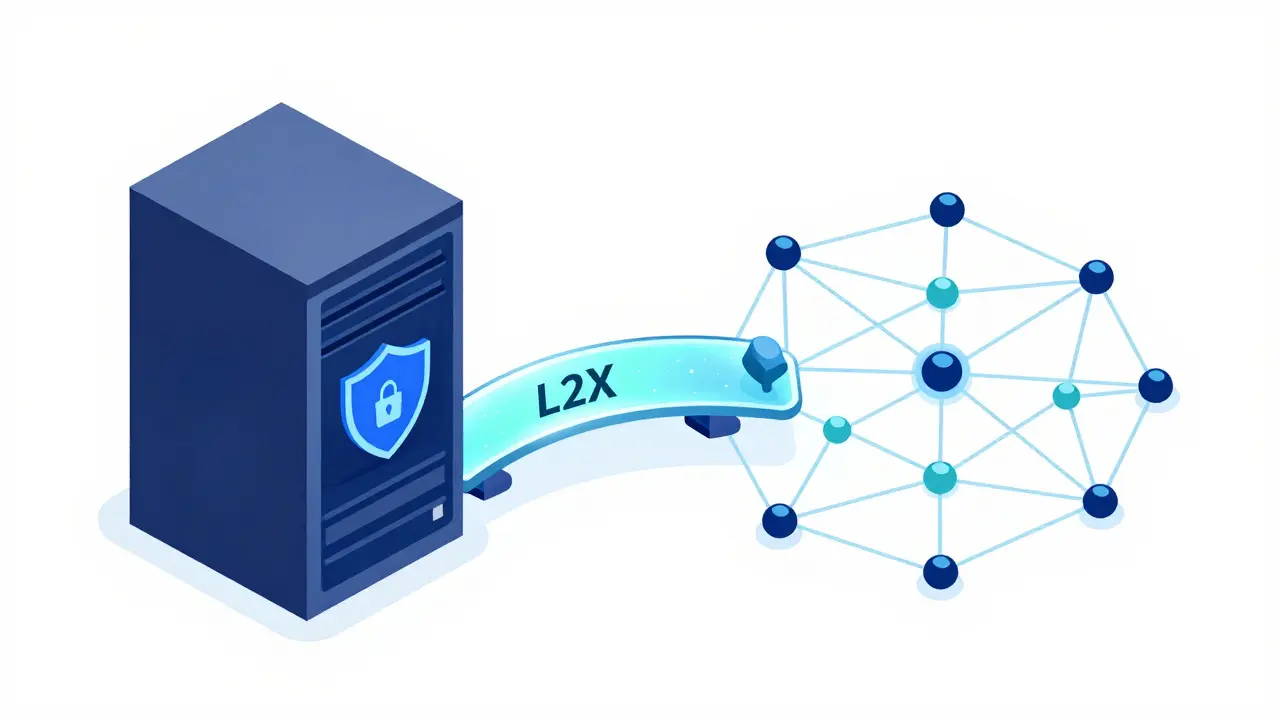
You might have stumbled upon OAX (a cryptocurrency token designed to power the openANX decentralized exchange ecosystem) while scrolling through a list of low-cap coins or digging into old DeFi projects. If you are wondering what this token actually does, why it exists, and whether it is worth your attention in 2026, you are not alone. The crypto space is flooded with thousands of tokens, many of which fade into obscurity, while others evolve into critical infrastructure. OAX falls into a tricky middle ground: it has an ambitious technical history but currently struggles with visibility and liquidity.
This guide cuts through the noise. We will break down what OAX is, how its technology was supposed to work, where you can trade it today, and-most importantly-the real risks involved in holding or buying this specific asset right now.
The Origins and Purpose of OAX
To understand OAX, you first need to look at its roots. The project launched in 2017 under the name openANX (an early attempt to create a hybrid centralized-decentralized exchange model). It was created by ANX International and managed by the OAX Foundation (a non-profit organization based in Hong Kong focused on digital asset governance). The core idea was bold: combine the speed and user-friendliness of centralized exchanges (like Binance or Coinbase) with the security and transparency of decentralized exchanges (DEXs).
In traditional DEXs, you hold your own keys, which is great for security but often slow and expensive due to blockchain congestion. In centralized exchanges, trading is fast, but you trust a company with your money-a major risk if that company gets hacked or goes bankrupt. OAX aimed to solve this via a Layer-2 protocol called L2X. This system allowed trades to happen off-chain (for speed) while keeping funds locked in smart contracts (for security). Essentially, no single operator could steal your funds because the code controlled them.
The OAX token itself is an ERC-20 utility token on the Ethereum network. Its primary purpose within this ecosystem was twofold:
- Governance and Membership: Users could burn OAX tokens to join different tiers of the platform, gaining access to features like dispute resolution services and legal support.
- Transaction Fees: The token was designed to be used for paying fees on the L2X trading layer, creating demand from active traders.
With a fixed total supply of 100,000,000 tokens issued during its Initial Coin Offering (ICO), the economic model relied on scarcity. As users burned tokens for memberships, the circulating supply would decrease, theoretically driving up value if adoption grew.
Technical Evolution: From Ethereum to Multi-Chain
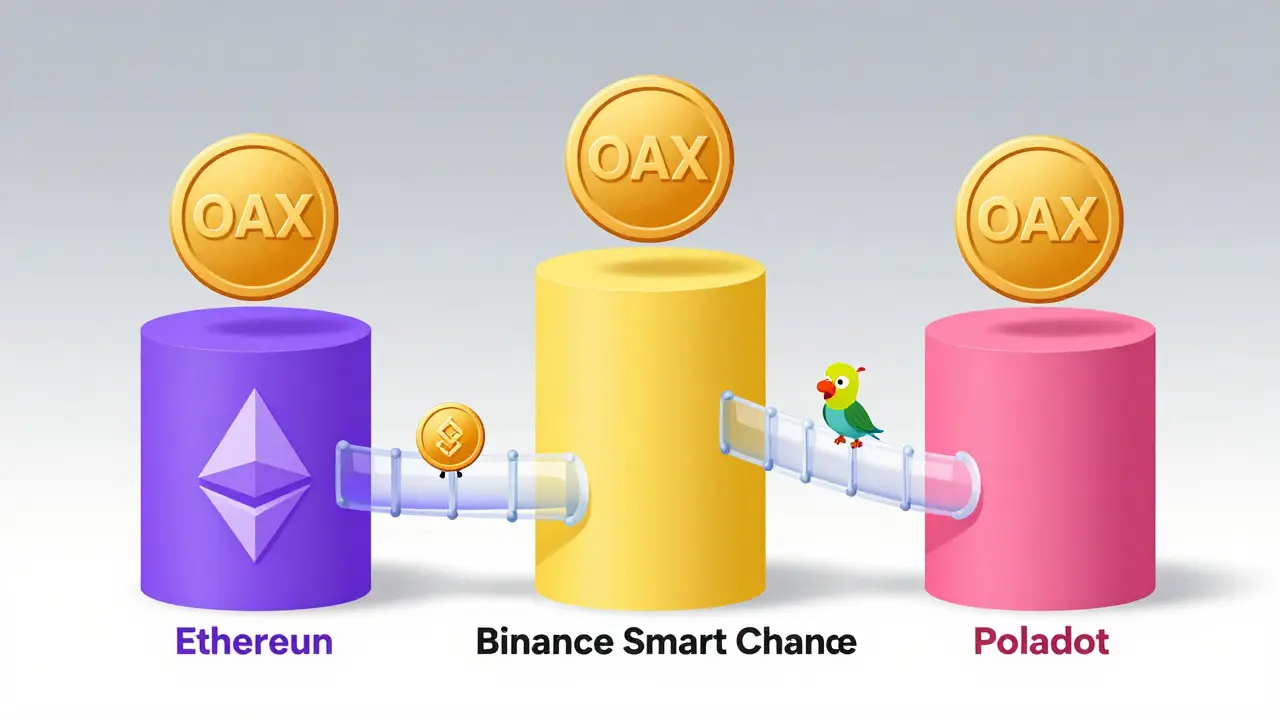
Technology moves fast, and OAX had to adapt to survive. Initially built entirely on Ethereum, the project expanded its reach to remain relevant in the evolving DeFi landscape. By 2021, OAX introduced a wrapped version of its token on the Binance Smart Chain (BSC) (a blockchain network compatible with Ethereum virtual machine, known for low transaction fees). This move allowed OAX to participate in the boom of BSC-based decentralized exchanges like PancakeSwap.
Furthermore, the foundation invested in Polkadot (a multi-chain protocol enabling different blockchains to transfer messages and value) infrastructure. They developed "Parrot," a Substrate-based blockchain intended to operate as a parachain on Polkadot. This demonstrated a serious commitment to cross-chain interoperability, allowing assets to move seamlessly between networks without relying on trusted third parties.
Despite these technical achievements, including claims of reaching 1,000 transactions per second (TPS) on their testnet, the main challenge remained: getting enough users to actually use the platform. Without significant trading volume, the utility of the token diminishes, regardless of how robust the underlying code is.
Current Market Status and Liquidity Challenges
If you check the current data for OAX in mid-2026, the picture is starkly different from its 2017 launch hype. OAX is currently classified as a micro-cap asset. Depending on the data source, its market capitalization fluctuates wildly, often sitting below $1 million USD. For context, top-tier cryptocurrencies have market caps in the hundreds of billions. This disparity highlights OAX's niche status.
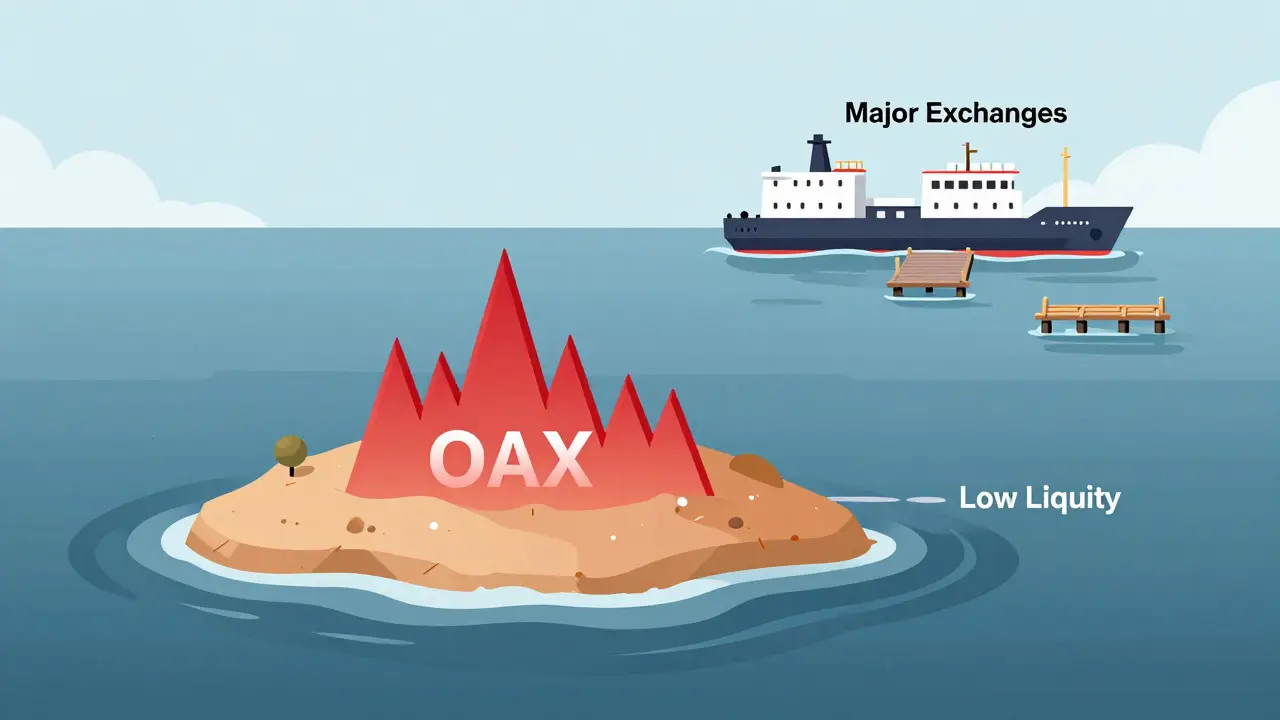
One of the biggest red flags for any investor is liquidity. Liquidity refers to how easily you can buy or sell an asset without causing its price to crash. For OAX, liquidity is extremely thin. Most trading volume is concentrated on Gate.io (a global cryptocurrency exchange offering spot and futures trading) and various smaller BSC-based DEXs. On Gate.io, the daily trading volume often hovers around tens of thousands of dollars. While this sounds like a lot in everyday terms, in the crypto world, it means large orders can slip significantly in price.
A major blow to the project’s visibility occurred in late 2024 when Binance (the largest cryptocurrency exchange by trading volume) delisted OAX. Citing low trading volumes and non-compliance with certain industry standards, Binance removed all OAX trading pairs. For small-cap tokens, being listed on Binance provides massive credibility and liquidity. Losing that listing often leads to a sharp decline in price and interest, as seen with OAX’s roughly 40% drop following the announcement.
| Attribute | Details |
|---|---|
| Total Supply | 100,000,000 OAX (Fixed) |
| Circulating Supply | ~95.8 Million (varies by source) |
| Blockchain Standards | ERC-20 (Ethereum), BEP-20 (BSC) |
| Primary Use Case | Exchange fees, Governance, Membership |
| All-Time High (ATH) | ~$2.39 (Historical peak) |
| Current Risk Level | Very High (Low liquidity, Micro-cap) |
How to Buy and Store OAX Safely
If you decide to proceed with acquiring OAX despite the risks, here is the practical path forward. Since Binance no longer lists it, your options are more limited.
- Choose an Exchange: The most reliable venue for OAX/USDT pairs is currently Gate.io. Ensure you complete any necessary KYC (Know Your Customer) verification required by the platform.
- Deposit Funds: Deposit USDT (Tether) or BTC into your exchange account. USDT is generally preferred for stable pair trading.
- Execute the Trade: Navigate to the OAX/USDT market. Be aware of the order book depth; placing a large market order might result in a worse price than expected due to slippage. Limit orders are safer.
- Withdraw to a Wallet: Never leave long-term holdings on an exchange, especially one that might delist the token again. Withdraw your OAX to a self-custody wallet.
For storage, you need a wallet that supports both Ethereum (ERC-20) and Binance Smart Chain (BEP-20) networks. Popular choices include MetaMask, Trust Wallet, or Ledger hardware wallets. When withdrawing, double-check the network. Sending ERC-20 OAX to a BEP-20 address (or vice versa) without proper bridge conversion can lead to lost funds. Always start with a small test transaction.
Risks You Must Consider Before Investing
Investing in OAX is not like buying Bitcoin or Ethereum. It carries substantial risks that every holder must acknowledge.
- Liquidity Risk: With low daily volume, selling large amounts can crash the price. You might find yourself unable to exit a position quickly without taking a significant loss.
- Delisting Risk: As seen with Binance, exchanges regularly remove low-volume tokens. If Gate.io or other remaining venues decide to delist OAX, accessibility could vanish overnight.
- Development Uncertainty: While the OAX Foundation remains active in educational initiatives and hackathons, the core product-a widely adopted decentralized exchange-has yet to achieve mainstream usage. The gap between technical potential and actual adoption remains wide.
- Volatility: Micro-cap coins are prone to extreme price swings. A 50% drop or rise in a single day is not uncommon for assets in this tier.
It is also crucial to verify the legitimacy of any new announcements. Scammers often create fake websites or Telegram channels mimicking legitimate projects. Always refer to the official OAX Foundation website and verified GitHub repositories for updates.
Is OAX Still Relevant in 2026?
The short answer is: technically yes, commercially questionable. The OAX Foundation continues to operate, releasing updates and participating in Web3 events like HacktheEast. Their vision of a compliant, transparent, and secure decentralized exchange is still valid. However, the crypto market has moved on. Major players like Uniswap, Curve, and newer Layer-2 solutions have captured the bulk of DEX liquidity.
OAX now serves as a case study in the challenges of bridging centralized and decentralized models. It offers valuable lessons in governance and tokenomics but lacks the network effect needed to compete with giants. For developers interested in Substrate or Layer-2 architecture, the open-source codebase remains a resource. For average investors, it represents a high-risk speculative play rather than a foundational holding.
What is the current price of OAX?
As of mid-2026, the price of OAX is highly volatile and varies significantly between exchanges. Data sources report prices ranging from fractions of a cent to a few cents, with a market cap often below $1 million. Always check real-time data on platforms like Gate.io or CoinGecko before trading.
Can I buy OAX on Binance?
No. Binance delisted OAX in December 2024 due to low trading volumes and compliance issues. You can no longer trade OAX directly on Binance.
Is OAX a scam?
OAX is not considered a scam in the traditional sense. It is backed by the OAX Foundation, a registered non-profit, and has open-source code. However, it is a high-risk investment with low liquidity and limited adoption, meaning you could lose money due to market dynamics rather than fraud.
What is the difference between ERC-20 and BEP-20 OAX?
ERC-20 OAX exists on the Ethereum blockchain, while BEP-20 OAX exists on the Binance Smart Chain. They represent the same underlying asset but require different networks for transactions. Transferring between them usually requires a bridge service. Ensure your wallet supports the specific network you are using.
Where can I trade OAX safely?
The most prominent centralized exchange currently listing OAX is Gate.io. For decentralized trading, you can use BSC-based DEXs like PancakeSwap or 1inch Network, provided you have the BEP-20 version of the token.
What happens to my OAX if an exchange delists it?
If an exchange delists OAX, you will typically be given a window to withdraw your tokens to a personal wallet. If you fail to withdraw, some exchanges may convert the balance to a stablecoin or freeze it. Always keep your crypto in self-custody to avoid this risk.