
What is Melon Dog (MELON) Crypto Coin? A Deep Dive into the Token
You’ve probably seen it pop up on a tracker or heard a whisper in a Discord channel: Melon Dog (MELON). It sounds cute. The name implies fun, perhaps a nod to the endless stream of dog-themed tokens that flooded the market. But behind the playful branding lies a stark reality for anyone considering putting money into this asset. MELON is not just another speculative bet; it is a textbook example of a micro-cap meme coin operating on the Solana blockchain with extremely low liquidity and high volatility.
If you are asking what Melon Dog actually is, the short answer is that it is a token with no whitepaper, no clear utility, and a market capitalization that hovers around $175,000. That puts it firmly in the "micro-cap" category, far below the radar of institutional investors and deep within the danger zone for retail traders. Let’s break down exactly what you are looking at when you see MELON on your screen.
The Anatomy of a Micro-Cap Meme Coin
To understand MELON, you first have to understand where it lives. It exists on the Solana blockchain. Solana became the playground for meme coins in 2024 because transaction fees are near zero and speeds are fast. This accessibility allowed millions of new tokens to be created, including MELON. Unlike Bitcoin or Ethereum, which serve as digital gold or smart contract platforms respectively, MELON serves no functional purpose. It does not secure a network, nor does it offer governance rights to a decentralized application.
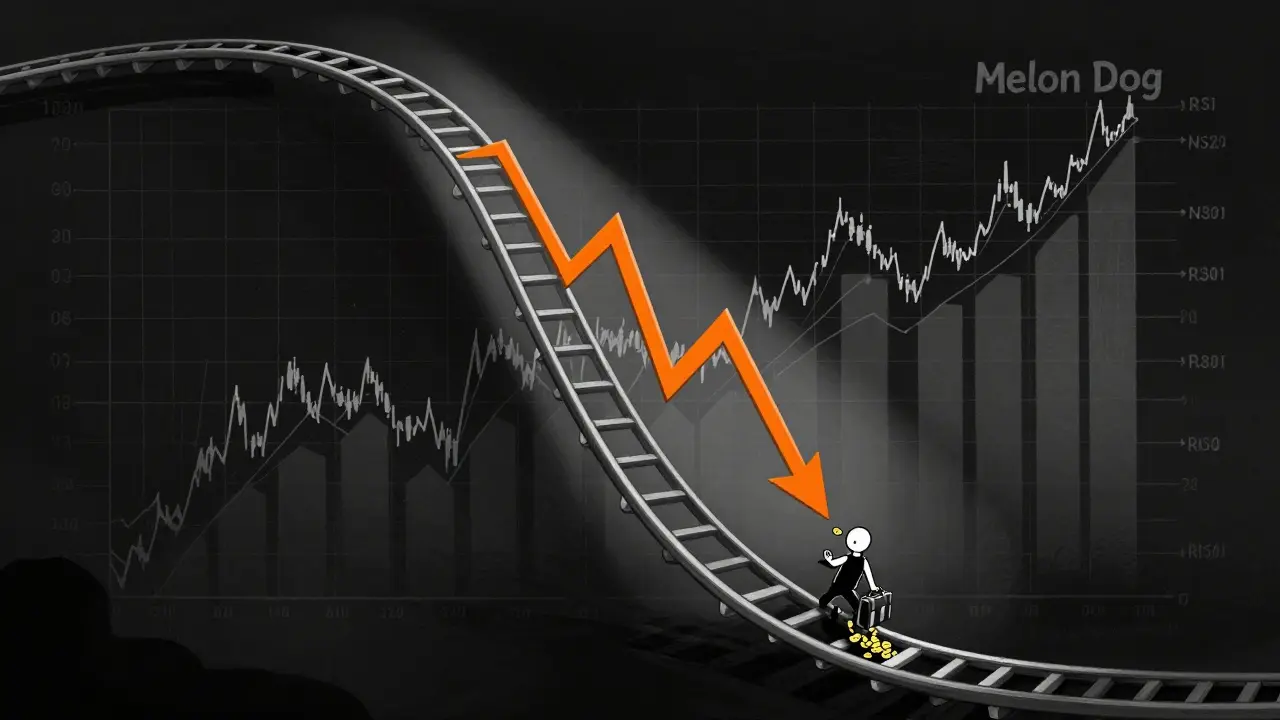
The tokenomics are straightforward but revealing. There is a fixed circulating supply of 407,510,417 MELON tokens. This matches the maximum supply, meaning there are no hidden reserves waiting to be dumped on the market by developers-a common tactic in "rug pulls." However, the lack of a burn mechanism means the supply remains static. Without utility driving demand, the price relies entirely on speculation. When you look at the price history, the story is one of extreme turbulence. The all-time high was $0.07 back in March 2024. By late 2024, the price had crashed to roughly $0.0002. That is a drop of over 99%. For context, if you bought $1,000 worth at the peak, you would be left with less than $3 today.
Liquidity: The Silent Killer
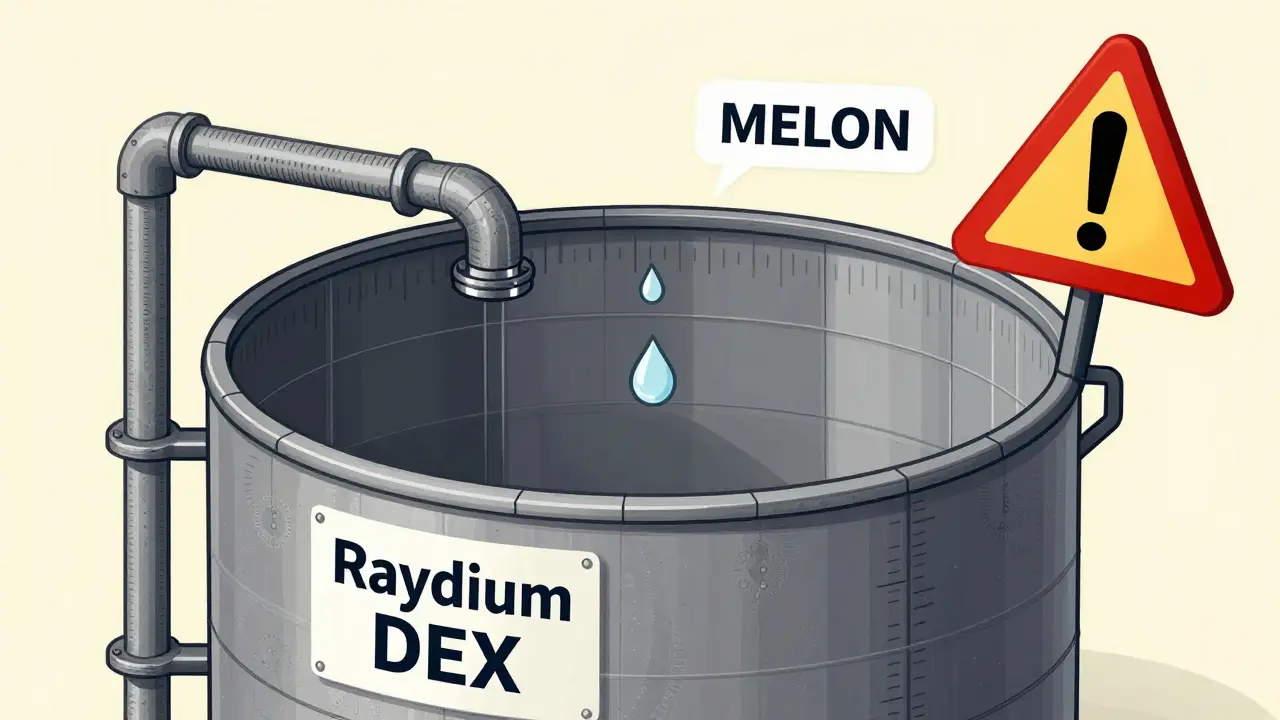
Here is the part most beginners miss. You can buy MELON, but can you sell it? Liquidity is the lifeblood of any tradable asset. In major markets like Bitcoin, you can buy or sell millions of dollars instantly without moving the price. With MELON, the situation is dire. Trading occurs primarily on Raydium a decentralized exchange built on Solana, specifically in the MELON/SOL pair. Reports indicate daily trading volumes as low as $100 to $600.
Imagine trying to sell a house where only one person shows up to bid every month. That is the state of MELON’s order book. Because the liquidity pool is so thin, even a small sell order can cause massive slippage. Slippage is the difference between the expected price of a trade and the price at which the trade is executed. If you try to sell $500 worth of MELON, you might only receive $200 because your sale drained the available liquidity. This makes large trades nearly impossible without crashing the price further.
| Feature | Melon Dog (MELON) | Dogecoin (DOGE) | Bonk (BONK) |
|---|---|---|---|
| Market Cap | ~$175,000 | ~$13.5 Billion | ~$1.2 Billion |
| Daily Volume | $100 - $1,900 | $Billions | $Hundreds of Millions |
| Blockchain | Solana | Ethereum (PoW) | Solana |
| Utility | None (Speculative) | Tips, Payments | Ecosystem Integration |
| Risk Level | Extreme | High | Medium-High |
As the table shows, MELON is not just smaller than its peers; it is orders of magnitude smaller. Dogecoin has a market cap roughly 77,000 times larger. Even Bonk, another Solana-based meme coin that launched around the same time, has established itself with significantly higher volume and community engagement. MELON lags behind in every metric that matters for survival.
Technical Indicators and Market Sentiment
If you enjoy staring at charts, MELON offers a masterclass in bearish trends. Technical indicators paint a grim picture. The Relative Strength Index (RSI), which measures whether an asset is overbought or oversold, often hovers in neutral-to-bearish territory. More importantly, the Simple Moving Averages (SMA) tell a clear story. The 50-day SMA and the 200-day SMA are both significantly above the current price. In technical analysis, when the price stays below these long-term averages, it confirms a sustained downtrend. There is no sign of a reversal pattern forming.
Volatility is another key factor. Over a 30-day period, MELON has shown high price swings, with only about 43% of days closing green. This inconsistency makes it difficult to time entries or exits. Predictions from analytical platforms like CoinCodex vary wildly, ranging from a potential 228% increase to a further 24% decline. This discrepancy isn’t due to differing opinions on fundamentals-it’s because the data is too noisy. With such low volume, technical indicators lose their reliability. A single whale buying $1,000 worth of tokens can skew the chart enough to trigger false breakout signals.
Community and Development: The Void
In the world of crypto, community is king. Projects like Dogecoin survived because they built a cult-like following. Shiba Inu created an ecosystem of NFTs and DeFi protocols. MELON has neither. Searching for official social media channels, Reddit communities, or Telegram groups yields little to nothing. The absence of a verified development team is a major red flag. Who is building this? Who is maintaining the liquidity pools? Who is marketing the project?
Without active development, the token is stagnant. There are no roadmaps, no partnerships, and no updates. This aligns with the pattern of "pump and dump" schemes, where creators hype a token briefly, sell their holdings, and abandon the project. The fact that MELON still trades at all is likely due to algorithmic bots or lingering retail interest rather than organic growth. Industry data suggests that 95% of tokens with market caps under $500,000 fail within 12 months. MELON fits this profile perfectly.
How to Trade MELON (If You Insist)
Despite the warnings, some traders are drawn to the allure of turning $100 into $1,000. If you decide to proceed, you need to know how to navigate the infrastructure. You cannot buy MELON on centralized exchanges like Coinbase or Binance. You must use a decentralized exchange (DEX).
- Set Up a Wallet: You will need a Solana-compatible wallet. Popular options include Phantom a popular multi-chain crypto wallet or Solflare a non-custodial wallet for Solana. Ensure you save your seed phrase offline. Never share it.
- Acquire SOL: Buy Solana (SOL) on a major exchange and transfer it to your wallet. You need SOL to pay for gas fees and to swap for MELON.
- Connect to Raydium: Go to the Raydium website and connect your wallet. Find the MELON/SOL trading pair.
- Adjust Slippage: This is critical. Set your slippage tolerance higher than usual (e.g., 5-10%) because the low liquidity means prices change rapidly during execution. Be aware that you may pay more than expected.
- Execute the Swap: Enter the amount of SOL you wish to spend. Double-check the token address to ensure you are not interacting with a fake copycat token.
Note that support infrastructure is nonexistent. If something goes wrong, there is no customer service to call. You are on your own.
Regulatory Risks and Future Outlook
The regulatory landscape for crypto is tightening. The U.S. Securities and Exchange Commission (SEC) and other global bodies are increasingly scrutinizing tokens that lack clear utility. Tokens with market caps below $100 million are often viewed with suspicion, particularly those that resemble unregistered securities. While MELON is too small to attract direct legal action currently, the broader crackdown on meme coins could lead to delistings or restricted access on certain platforms.
Looking ahead, the outlook for MELON is bleak. Without a catalyst-such as a viral marketing campaign, a partnership, or a listing on a larger exchange-the token will likely continue to bleed value. The most optimistic scenarios suggest a partial recovery, but even that requires significant new capital inflow that seems unlikely given the current trading volumes. For most investors, MELON represents a sunk cost trap rather than an opportunity.
Is Melon Dog (MELON) a scam?
While there is no definitive proof of malicious intent like a hacked contract, MELON exhibits many characteristics of high-risk speculative assets often associated with scams. The lack of a verified team, zero utility, and extremely low liquidity make it vulnerable to manipulation. It is considered highly risky and potentially unsafe for investment.
Where can I buy MELON tokens?
You cannot buy MELON on centralized exchanges like Coinbase or Binance. You must use a decentralized exchange (DEX) on the Solana network, such as Raydium. You will need a Solana wallet and SOL tokens to perform the swap.
What is the total supply of MELON?
The total and circulating supply of MELON is fixed at 407,510,417 tokens. There are no additional minting mechanisms reported, but there is also no burn mechanism to reduce the supply.
Why is the price of MELON so volatile?
MELON has extremely low liquidity and trading volume. Small buy or sell orders can drastically move the price because there are not enough tokens in the trading pool to absorb the pressure. This results in high volatility and significant slippage for traders.
Does MELON have any real-world utility?
No. MELON is categorized as a meme coin with no underlying technology, platform, or service. Its value is derived solely from speculative trading activity rather than any functional use case.