
What is MAIV Crypto? Multi Asset Investment Vehicle Explained

Imagine being able to invest in the same high-yield commercial deals that large institutions use, but without needing a net worth of $1 million or a seat at a closed-door boardroom. That is the core promise behind Multi Asset Investment Vehicle (MAIV), a cryptocurrency platform designed to bridge the gap between decentralized finance and traditional capital markets. Launched on the Ethereum blockchain, MAIV aims to tokenize private equity deals, making them accessible to everyday investors through Web3 infrastructure. However, like many projects attempting to merge two complex financial worlds, the reality involves significant volatility, limited liquidity, and questions about long-term viability.
As of mid-2026, MAIV sits at a crossroads. It has experienced dramatic price swings, with an all-time high reached in late 2025 followed by a sharp correction. For anyone considering this asset, understanding what it actually does, how it works, and where it stands in the current market is essential before putting any money into it.
Key Takeaways
- MAIV is an ERC-20 token on the Ethereum network focused on tokenizing private equity deals.
- The project targets a specific niche: democratizing access to institutional-grade investments for retail users.
- Current market data shows high volatility, low trading volume, and a small holder base of approximately 1,370 addresses.
- Pricing varies significantly across exchanges due to fragmented liquidity, with recent prices hovering around $0.0006 USD.
- Risk factors include regulatory uncertainty, unverified status on some wallets, and a steep decline from its peak value.
What Exactly Is MAIV?
At its core, MAIV is a blockchain-based platform that integrates decentralized finance (DeFi) with traditional finance (TradFi) using Web3 technology. The official positioning describes it as "private equity, on-chain." This means the primary utility of the token isn't just speculative trading; it's intended to serve as a vehicle for moving funds and participating in specific investment opportunities.
Traditional private equity funds often require minimum investments ranging from $25,000 to over $100,000. These deals are illiquid, meaning you can't easily sell your stake if you need cash. MAIV attempts to solve this by using blockchain technology to create a secondary market for these assets. By tokenizing these deals, the platform theoretically allows for 24/7 trading, lower entry barriers, and greater transparency regarding ownership and performance.
The technical foundation is straightforward: MAIV operates as an ERC-20 token. This standard ensures compatibility with major Ethereum wallets like MetaMask and Phantom, as well as decentralized exchanges. The contract address is publicly available, allowing anyone to verify transactions on the Ethereum blockchain. This transparency is a key differentiator from opaque traditional fund structures where reporting can be delayed or incomplete.
How the Platform Works: Bridging TradFi and DeFi
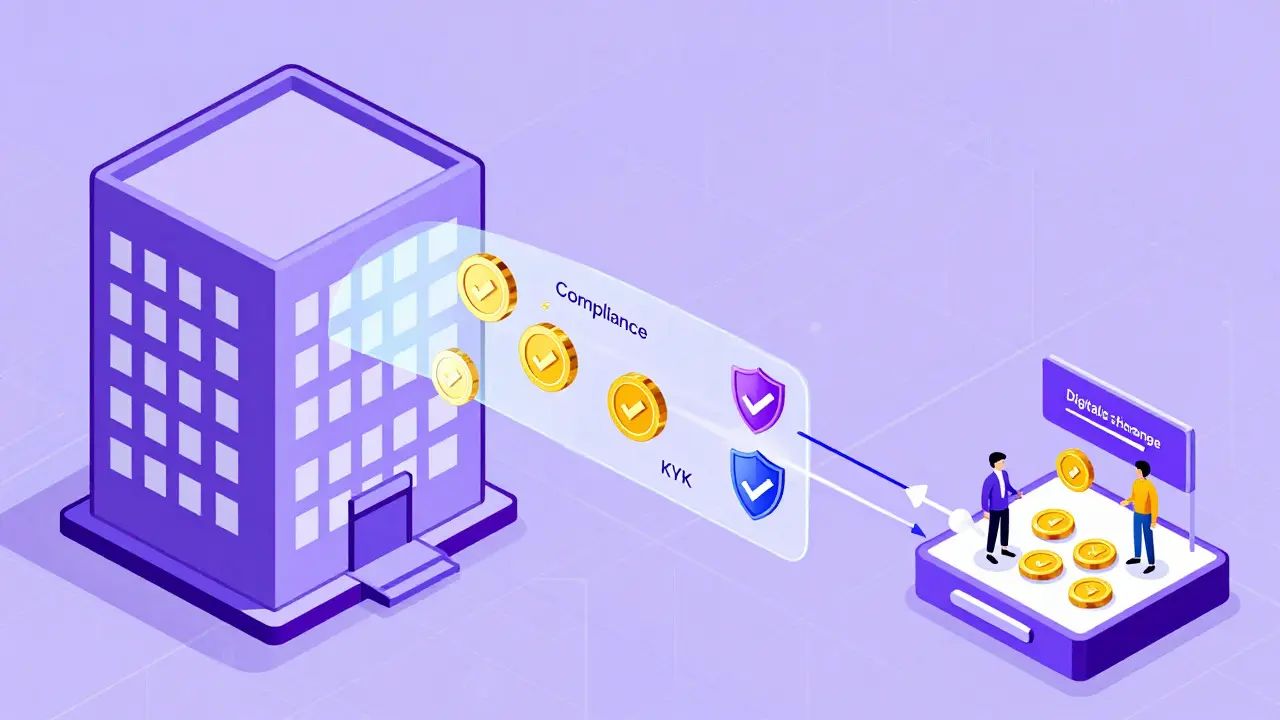
The mechanism behind MAIV involves a hybrid approach. While the token lives on-chain, the underlying assets (the private equity deals) often reside in off-chain compliance frameworks. This is crucial because private equity investments are heavily regulated. To make them tradable on a public blockchain, MAIV works with leading private equity firms across Europe and the United States.
Here is how the flow generally functions:
- Deal Sourcing: MAIV partners with institutional firms to identify lucrative commercial deals.
- Tokenization: The rights to these deals are converted into digital tokens or represented by the MAIV token structure.
- Compliance Layer: A fully compliant infrastructure handles Know Your Customer (KYC) and Anti-Money Laundering (AML) checks to ensure only eligible investors participate.
- Liquidity Provision: Investors can buy, sell, or hold their positions using the MAIV ecosystem, potentially accessing liquidity faster than traditional lock-up periods allow.
This model addresses a genuine market gap. Private equity has historically offered superior risk-adjusted returns compared to public stock markets. However, access was restricted. By leveraging Web3, MAIV hopes to lower these barriers, allowing smaller investors to benefit from institutional-grade strategies.
Market Performance and Price Analysis
Let’s look at the hard numbers, because they tell a story of high speculation and recent correction. As of May 2026, the price of MAIV fluctuates depending on which exchange you check. CoinMarketCap reported a price of approximately $0.0006377 USD, while Coinbase listed it slightly lower at $0.000606 USD. These discrepancies highlight a critical issue: low liquidity.
The market capitalization hovers around $1.08M to $1.21M, with a fully diluted valuation (FDV) of roughly $6.06M. The total supply is fixed at 10 billion coins, but the circulating supply varies by source, ranging from 1.3 billion to 1.78 billion. This variance suggests ongoing vesting schedules or locked tokens being released.
Price history reveals extreme volatility. The all-time high was $0.006005 USD, reached on December 3, 2025. Since then, the token has dropped nearly 90%. Conversely, it rose almost 285% from its all-time low of $0.0001574 USD recorded in May 2025. Such swings are typical for micro-cap cryptocurrencies but signal high risk for investors.
| Metric | Value | Note |
|---|---|---|
| Price Range | $0.00060 - $0.00068 | Varies by exchange |
| Market Cap | ~$1.08M - $1.21M | Micro-cap classification |
| Fully Diluted Valuation | ~$6.06M | Total supply valued |
| 24-Hour Volume | $42 - $2,000 | Extremely low liquidity |
| Holder Count | 1,370 | Limited retail adoption |
| All-Time High | $0.006005 | Dec 3, 2025 |
The low trading volume is a red flag for many traders. On some platforms, the 24-hour volume is under $50. This means that if you try to sell a large position, you might significantly move the price against yourself (slippage). Liquidity is currently concentrated in very few places, making execution risky.
Availability and How to Buy MAIV
Buying MAIV requires navigating a fragmented landscape. Unlike Bitcoin or Ethereum, you won’t find MAIV on every major centralized exchange. Here is where you can typically find it:
- Phantom Wallet: Lists MAIV as tradable, though marked as "unverified." This means the wallet provider hasn’t audited the contract themselves, so you must do your own diligence.
- Binance: Provides guidance for buying via credit card, Web3, or DEX options, though direct listing status may vary.
- Crypto.com: Currently lists the token as "not tradable yet," despite showing price data. Check local availability.
- Decentralized Exchanges (DEX): Since it is an ERC-20 token, it can be swapped on Ethereum-based DEXs like Uniswap, provided there is sufficient liquidity in the pool.
When purchasing, always double-check the contract address: 0x39903a1a6f289a67e0de94096915c4ccd506ab2a. Scam tokens often copy popular names, so verifying the address is non-negotiable.

Risks and Challenges Facing MAIV
No investment is without risk, and MAIV carries several specific hurdles that potential investors should weigh carefully.
Regulatory Uncertainty: Tokenizing private equity deals touches on securities law. In the US, the SEC has been scrutinizing tokenized assets closely. While MAIV claims "fully compliant infrastructure," specific regulatory approvals aren't widely publicized. Changes in regulation could impact the platform's ability to operate smoothly across borders.
Liquidity Constraints: With a market cap under $1.5M and minimal daily volume, MAIV is illiquid. This makes it difficult for larger investors to enter or exit positions without affecting the price. It also limits the platform's appeal to institutional players who require deep liquidity pools.
Adoption Metrics: Only 1,370 unique holders is a small number for a project aiming to disrupt global finance. Low holder counts suggest limited community engagement and network effects. Growth in this metric is vital for long-term success.
Project Momentum: There has been a noticeable lack of major news announcements or feature releases since the December 2025 price peak. In the fast-moving crypto world, silence can sometimes indicate stalled development or shifting priorities. Keeping an eye on the official channels for updates is important.
Competitive Landscape and Alternatives
MAIV competes in a niche space. Its rivals aren't just other crypto tokens; they include traditional alternatives for accessing private equity:
- Traditional PE Funds: High minimums, low liquidity, but established track records and regulatory clarity.
- Crowdfunding Platforms: Sites like Forge Global or Carta offer secondary market access to pre-IPO stocks and private deals with lower minimums, though fees can be high.
- RWA DeFi Platforms: Other blockchain projects focus on Real World Assets (RWA) tokenization, such as real estate or commodities. MAIV’s specific focus on private equity deals sets it apart, but it shares the broader RWA narrative.
MAIV’s theoretical advantage is combining the transparency of blockchain with the yield potential of private equity. If it succeeds, it could offer better returns than traditional savings accounts or even public equities, with more flexibility than traditional PE lock-ups. However, until adoption grows and liquidity improves, this remains a promise rather than a proven reality.
Is MAIV Right for You?
MAIV is not a set-and-forget investment. It requires active monitoring, a tolerance for high volatility, and a willingness to navigate less liquid markets. It suits investors who believe strongly in the future of tokenized private equity and are willing to take on early-stage risks for potential high rewards.
If you are looking for stability or easy liquidity, MAIV might not be the best fit. But if you want exposure to the intersection of Web3 and traditional finance, and you understand the risks involved, it represents a unique opportunity in the current crypto landscape. Always start with an amount you can afford to lose, and keep an eye on the project’s development milestones and regulatory developments.
What is the main purpose of the MAIV token?
The MAIV token serves as a vehicle for accessing tokenized private equity deals. It facilitates payments, liquidity, and participation in investment opportunities that are traditionally restricted to institutional investors.
Which blockchain does MAIV run on?
MAIV is an ERC-20 token built on the Ethereum blockchain. This allows it to be compatible with most Ethereum-compatible wallets and decentralized exchanges.
Where can I buy MAIV crypto?
You can buy MAIV on platforms like Binance (via various methods), Phantom wallet, and Ethereum-based decentralized exchanges. Availability on centralized exchanges like Crypto.com may be limited or pending.
Is MAIV a safe investment?
MAIV is considered a high-risk, high-reward asset. It has low liquidity, high volatility, and a small holder base. Regulatory risks also exist due to its focus on tokenized private equity. Thorough research and risk management are essential.
What is the difference between MAIV and traditional private equity?
Traditional private equity requires high minimum investments and has long lock-up periods with limited liquidity. MAIV uses blockchain to lower entry barriers, enable 24/7 trading, and provide greater transparency through on-chain records.
1 Comments
They are definitely hiding the real yield numbers. 🤔 The "institutional" deals are just a smokescreen to pump this token before the SEC comes knocking. I saw the contract code and it has hidden mint functions. Trust no one. 👀