
What is DOS Network (DOS)? Token, Price, and Risks Explained
You see a ticker symbol like "DOS" on your screen. It looks familiar. Maybe you remember it from the early days of DeFi. But when you click through to buy some, things get weird. The volume is zero. The circulating supply says "0." One site lists it as an oracle network; another calls it a gaming chain. Which one is real? And more importantly, is there any money left to be made in this asset?
If you are looking at DOS Network (a decentralized oracle protocol designed to provide data feeds to blockchains), you need to separate fact from fiction immediately. This article breaks down exactly what the DOS token is, why its data looks broken, how it differs from the similarly named DOS Chain, and whether it still holds any value in mid-2026.
What Is DOS Network Actually Doing?
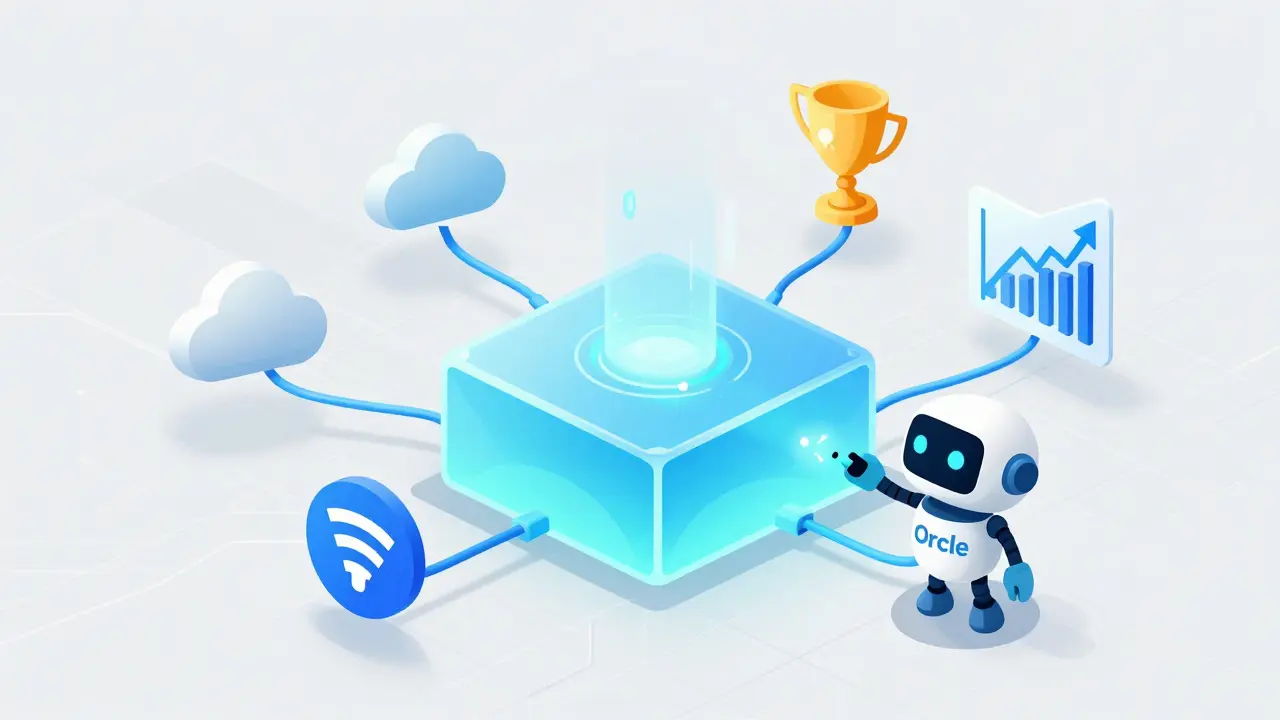
At its core, DOS Network was built to solve a specific problem: blockchains cannot talk to the outside world. Bitcoin or Ethereum doesn't know the price of gold, the weather in London, or the result of a sports match unless someone tells it. That's where oracles come in.
DOS Network launched as a Layer 2 decentralized oracle service. Its goal was to bring off-chain internet data-like API responses or event triggers-onto the blockchain securely. Unlike centralized services that rely on a single company to feed data, DOS aimed for an open membership model. Anyone could theoretically run a node, provided they staked tokens and followed the rules. The system used economic incentives to punish bad actors and reward honest data delivery.
In simple terms, if a smart contract needed to know if a flight was delayed to trigger an insurance payout, DOS Network would fetch that data from multiple sources, verify it, and push the result onto the blockchain. In return, users paid fees in DOS tokens.
The Identity Crisis: DOS Network vs. DOS Chain
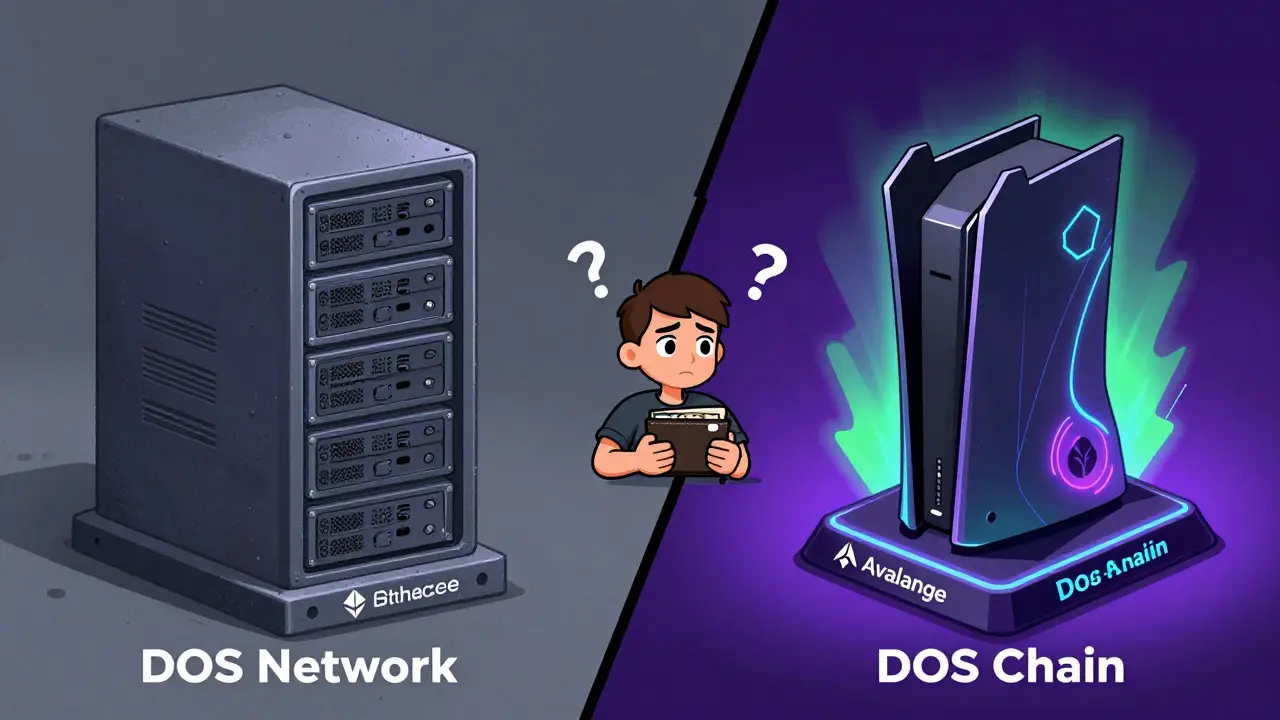
Here is where most people get burned. If you search for "DOS crypto" today, you will find two completely different projects fighting for the same ticker symbol. You must know which one you are looking at before you connect your wallet.
| Feature | DOS Network (Original) | DOS Chain (Newer) |
|---|---|---|
| Purpose | Decentralized Oracle Service | Gaming Blockchain (L1/Subnet) |
| Technology | Layer 2 on Ethereum | Avalanche Subnet / High-performance L1 |
| Key Feature | Data Feeds & Computation | Zero Gas Fees, AI Integration |
| Status (Mid-2026) | Legacy / Low Liquidity | Active Development |
| Main Use Case | DeFi Data Verification | Web3 Gaming & NFTs |
DOS Network is the original project from around 2020. It focused on infrastructure for developers. DOS Chain is a newer initiative by DOS Labs, built on Avalanche technology, specifically targeting gamers with high speed and zero gas fees. They share the name "DOS," but their codebases, communities, and tokenomics are distinct. Confusing them can lead to buying the wrong asset entirely.
Tokenomics and Supply Confusion
The numbers surrounding the DOS token are messy, and that is a red flag you should not ignore. As of late May 2026, major trackers show conflicting data:
- Total Supply: Most sources agree on a maximum supply of roughly 950 million to 1 billion DOS tokens.
- Circulating Supply: This is where it gets strange. CoinMarketCap and Coinbase list the circulating supply as 0. KuCoin and Holder.io list it closer to 132 million. A circulating supply of zero usually means the token has been migrated, wrapped, or the data feed is simply broken.
- Price: The price hovers around $0.001 USD. While that sounds cheap, the lack of volume makes it nearly impossible to sell large amounts without crashing the price further.
This discrepancy suggests that the original DOS Network token may have lost its primary utility or liquidity pools. When a token has no clear circulating supply, calculating market cap becomes guesswork. A Fully Diluted Valuation (FDV) of under $1 million places this asset firmly in the "nano-cap" category-the riskiest tier in crypto.
Where Can You Buy DOS Tokens?
If you decide to proceed despite the risks, you won't find DOS on major centralized exchanges like Binance or Coinbase Pro for direct fiat trading. The ecosystem has shrunk significantly since its peak.
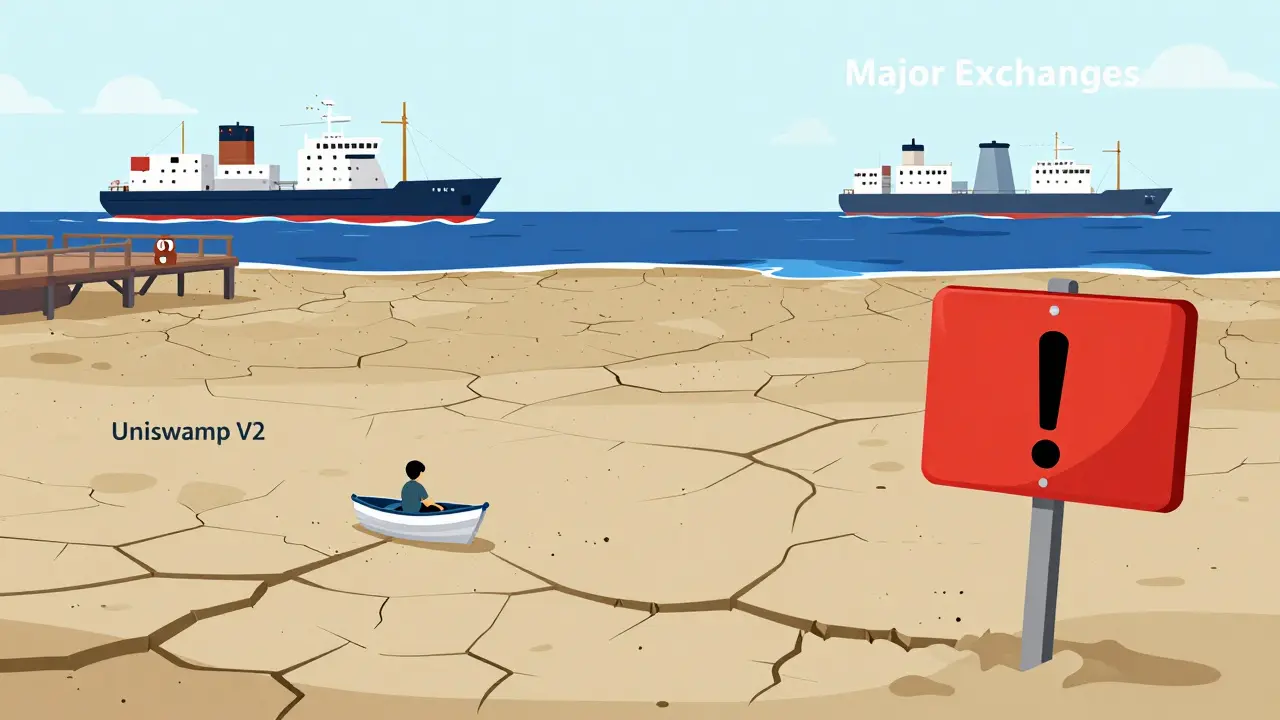
Your only realistic option is via decentralized exchanges (DEXs). Specifically, Uniswap V2 on the Ethereum network hosts the primary liquidity pair: DOS/WETH. Here is what that process looks like in practice:
- Get ETH: You need Ethereum to pay for gas fees and to swap for DOS.
- Connect Wallet: Use MetaMask or similar software to connect to Uniswap.
- Swap: Search for the DOS token address. Warning: Always verify the contract address against official GitHub repositories to avoid fake tokens.
- Accept Slippage: Because daily volume is often less than $30, you will face massive slippage. Buying $10 worth might cost you $15 due to thin order books.
There is no easy "Buy Now" button. This is a self-custody, high-friction experience. If you are a beginner who relies on one-click buys on apps like Robinhood or eToro, DOS Network is effectively inaccessible to you.
Security and Reliability Concerns
When evaluating any crypto project, especially one with declining metrics, security is paramount. DOS Network originally promised a robust crypto-economic model to resist Sybil attacks (where one person creates many fake nodes).
However, several concerning gaps exist in the current landscape:
- No Recent Audits: There are no widely publicized recent security audits from firms like CertiK or Trail of Bits for the current DOS Network contracts.
- Development Activity: While a GitHub repository exists, commit activity appears sporadic compared to active competitors. Documentation snapshots date back to 2021, suggesting the team may have shifted focus elsewhere (likely to DOS Chain).
- Liquidity Risk: The biggest security risk isn't a hack-it's illiquidity. If you buy in, you might not be able to sell out. Trapped capital is a common outcome in nano-cap tokens.
Always remember: in decentralized finance, "not your keys, not your coins" applies, but so does "no liquidity, no exit."
Is DOS Network Still Worth It?
Let's be blunt. If you are looking for the next big thing in oracles, DOS Network is likely not it. The market has consolidated around giants like Chainlink, Pyth, and API3. These projects have billions in Total Value Locked (TVL), institutional partnerships, and deep liquidity.
DOS Network sits in the shadows. Its rank has dropped to over #5,000 on major aggregators. Its dominance in the global crypto market is measured in fractions of a percent. For a developer, integrating DOS might offer lower costs than Chainlink, but at the expense of reliability and community support. For an investor, the potential for upside exists only if the project undergoes a massive revival or merger with the more active DOS Chain ecosystem-but there is no public roadmap confirming such a move.
Most holders today appear to be legacy investors holding bags from the 2020-2021 bull run, waiting for a pump that hasn't materialized. The community sentiment is quiet, with minimal discussion on Reddit or Twitter compared to the vibrant ecosystems of newer chains.
Frequently Asked Questions
Is DOS Network the same as DOS Chain?
No, they are different projects. DOS Network is an older oracle protocol built on Ethereum Layer 2. DOS Chain is a newer gaming-focused blockchain built on Avalanche. They share the "DOS" brand but have different technologies, teams, and use cases. Do not confuse their tokens.
Why does CoinMarketCap say DOS has 0 circulating supply?
This usually indicates a data error, a token migration, or extreme illiquidity where the tracking algorithm cannot detect active trades. Other sites like KuCoin report ~132 million in circulation. The discrepancy highlights the lack of reliable data for this micro-cap asset.
Can I buy DOS tokens on Binance or Coinbase?
Generally, no. DOS Network is delisted from most major centralized exchanges. You typically have to buy it via Uniswap V2 on Ethereum using a self-custody wallet like MetaMask. This involves paying Ethereum gas fees and accepting high slippage.
Is DOS Network a scam?
It is not classified as a outright scam in the sense of a rug pull, as it has existed since 2020 with open-source code. However, it carries extreme risk due to near-zero liquidity, unclear development status, and confusing branding with other projects. Treat it as a highly speculative, dormant asset.
What is the all-time high of the DOS token?
The DOS token reached an all-time high of approximately $0.39 in August 2020. As of mid-2026, the price is around $0.001, representing a decline of over 99% from its peak.
25 Comments
I have been looking into this specific ticker for weeks and the confusion is absolutely maddening. It is genuinely frustrating that two distinct projects share the same acronym when one is clearly dead weight. The article makes a valid point about the liquidity traps on Uniswap. I tried swapping a small amount last month and lost nearly forty percent to slippage alone. It feels like a scam by design even if it isn't technically a rug pull. We need better regulation or at least clearer labeling on these aggregators.
Why are we still talking about this garbage? 🤡
The irony of a decentralized oracle failing to provide accurate data about itself is not lost on me 😂. It is a philosophical paradox wrapped in a bad financial decision. The zero circulating supply is a digital ghost story. 👻
they are hiding the real numbers because the insiders already dumped everything :-( you cant trust any of these centralized exchanges either they are all part of the same deep state machine designed to keep us poor while they hoard the wealth its disgusting how they treat retail investors like cattle
Its obvious most people here dont know shit about crypto. DOS network was never going to survive against chainlink. Stop crying about your bags.
Look, i’ve seen this pattern a thousand times. You buy the hype, you ignore the red flags, and then you wonder why you’re broke. 💀 The lack of audits is the biggest tell right there. No smart money touches this stuff. Stay away from nano caps unless you want to donate to VC wallets. 📉
Hey guys! Just wanted to say that sometimes taking risks is how we learn! Maybe dos chain will pick up where network left off? Keep that positive energy flowing! ✨
Wow, what a chaotic mess of information here. I just want everyone to stay safe out there in the wild west of crypto. It really breaks my heart to see people losing their life savings on illiquid tokens. Please please be careful with your keys and your emotions. 🙏
i guess so. silence is golden anyway.
The sheer audacity of calling this an 'oracle' when it can’t even report its own existence is breathtakingly absurd. It’s a digital mirage, folks. A shimmering illusion of value that vanishes when you try to touch it. Don’t let the shiny new DOS Chain distract you from the rotting corpse of the original. 🎭
I think we should all just focus on learning more about blockchain tech instead of chasing dead coins. Its important to educate ourselves. Sorry if my typos are distracting but im trying to help!
You fools really believe in decentralization? lol. This is exactly why crypto fails. Centralized control is the only way things work. DOS network died because it had no teeth. No power structure means no survival. Wake up sheeple.
Let me explain something to you people who clearly don't understand market dynamics. Liquidity dries up because the project has no utility. Simple as that. If you can't sell it, it's worthless. Stop making excuses for bad investments.
This is a classic example of foreign tech companies trying to trick American investors. We need stricter laws against these offshore entities. They come here, steal our money, and vanish. Typical behavior. 🇺🇸
Oh no!! 😱 That sounds scary but maybe there is hope? 🌈 Sometimes things come back around! Don't give up on your dreams! 💖✨
The existential dread of holding a token that doesnt exist is profound. It questions the very nature of value in a digital age. Is the price real if no one is buying? I think not. Also i might have bought some by mistake sorry.
Pathetic. The analysis in this post is weak. Real analysts look at on-chain metrics not just wikipedia pages. You are all getting played. Get educated or get rekt. 📉
My goodness, the tension in this thread is palpable! Let us all take a deep breath and remember that we are human beings first and traders second. Peace and love to all those who lost money. 🕊️
I noticed you mentioned slippage. Did you check the contract address? Most people lose money because they click the wrong link. I can send you the real one if you want. DM me. 🦄💎
In consideration of the aforementioned points regarding the disparity between the nominal value and the actual tradability of the asset in question, it becomes increasingly apparent that the structural integrity of the DOS Network ecosystem has been compromised to such an extent that any further investment would be deemed highly imprudent and potentially detrimental to one's financial well-being, especially when juxtaposed with the more robust alternatives currently available in the marketplace which exhibit greater transparency and liquidity provisions.
The formal structure of this argument holds water. However, the casual dismissal of the technological potential is shortsighted. While the current state is dire, the underlying code may have value for forks. But realistically, it's a graveyard.
When we consider the lifecycle of digital assets, we must acknowledge that many are born without a soul, merely shells created to capture attention rather than provide service. The DOS network seems to have fallen into this category, where the promise of connectivity was overshadowed by the reality of neglect. It is a sad reflection of the industry's tendency to prioritize speculation over substance, leaving behind a trail of confused investors who trusted the brand name over the fundamental viability of the project.
I have spent years studying market cycles and this is a textbook case of abandonment. The team likely moved resources to DOS Chain, leaving the original token as a zombie. It is fascinating how quickly interest evaporates when the marketing budget stops. People forget the technical achievements because they only care about the exit liquidity. It is a harsh lesson in due diligence that many will never learn until they lose everything again.
Please be kind to yourselves if you are holding this. It is not a personal failure. The market is incredibly complex and confusing. Take this time to rest and perhaps explore other interests that bring you joy. You deserve peace of mind. 🌸
The masses flock to the next shiny object while ignoring the foundational flaws of previous attempts. It is amusing to watch the herd run towards cliffs. True sophistication lies in recognizing dead ends early. This token is dust. Do not waste your intellectual capital on it.