
What is Canadian Inuit Dog (CADINU) Crypto Coin? A Reality Check

You’ve probably seen it. Maybe you stumbled upon the ticker CADINU on a social media feed, or perhaps a friend mentioned it as a "hidden gem." The name sounds cute-referencing the sturdy Canadian Inuit Dog breed-and in the world of cryptocurrency, cute names often promise big returns. But before you transfer your savings into this token, we need to look at what CADINU actually is. Spoiler alert: it’s not an investment opportunity. It’s a textbook example of a "zombie asset" with almost zero liquidity and no real-world utility.
In this guide, we’ll break down the technical specs, the market reality, and why experts are warning investors to steer clear of tokens like CADINU. We’ll also explain how to spot these low-cap traps so you can protect your portfolio from similar pitfalls.
What Exactly Is CADINU?
At its core, Canadian Inuit Dog (CADINU) is a speculative cryptocurrency token operating on the Binance Smart Chain (BNB platform) with negligible market value and trading activity. It is classified as a BEP-20 token, which means it lives on the same blockchain network as thousands of other digital assets. However, unlike major cryptocurrencies that serve specific functions-like Bitcoin acting as digital gold or Ethereum powering smart contracts-CADINU has no discernible utility.
The token appears to be a standard "meme coin." These are cryptocurrencies created primarily for entertainment or speculation, often based on internet jokes, animal breeds, or trending topics. While some meme coins like Dogecoin (DOGE) or Shiba Inu (SHIB) have built massive communities and genuine use cases over time, CADINU lacks even the basic foundation of community interest. There is no verified partnership with canine organizations, no animal welfare initiatives, and no whitepaper outlining a future roadmap. It exists solely as a tradable symbol on a ledger.
The Market Reality: Numbers Don’t Lie
When evaluating any cryptocurrency, the numbers tell the true story. For CADINU, those numbers are alarming. As of late 2025, data from major tracking platforms like CoinMarketCap and Live Coin Watch reveals a stark picture:
- Price: Approximately $0.00000028 USD. This is effectively zero in practical terms.
- Trading Volume: $0 USD in the last 24 hours across multiple exchanges.
- Market Cap: Roughly $119,840 USD.
- Ranking: Between #7,128 and #8,021 globally, placing it in the bottom tier of all tracked cryptocurrencies.
A trading volume of $0 is a critical red flag. It means that while the price might technically exist on a chart, there are no actual buyers or sellers engaging in transactions. If you tried to sell your CADINU tokens today, you likely wouldn’t find anyone willing to buy them. This lack of liquidity makes the token illiquid and nearly impossible to exit without suffering total loss.
| Metric | CADINU | Dogecoin (DOGE) | Shiba Inu (SHIB) |
|---|---|---|---|
| Market Rank | #7,128+ | #10 | #15 |
| 24h Trading Volume | $0 | $3.5 Billion+ | $1.2 Billion+ |
| Community Presence | Non-existent | Massive global base | Large active community |
| Utility | None | Tips, payments, charity | Ecosystem, NFTs, DeFi |
This comparison highlights the vast gap between established meme coins and obscure tokens like CADINU. DOGE and SHIB have billions in daily volume because millions of people trust them enough to trade them every day. CADINU has none of that trust.
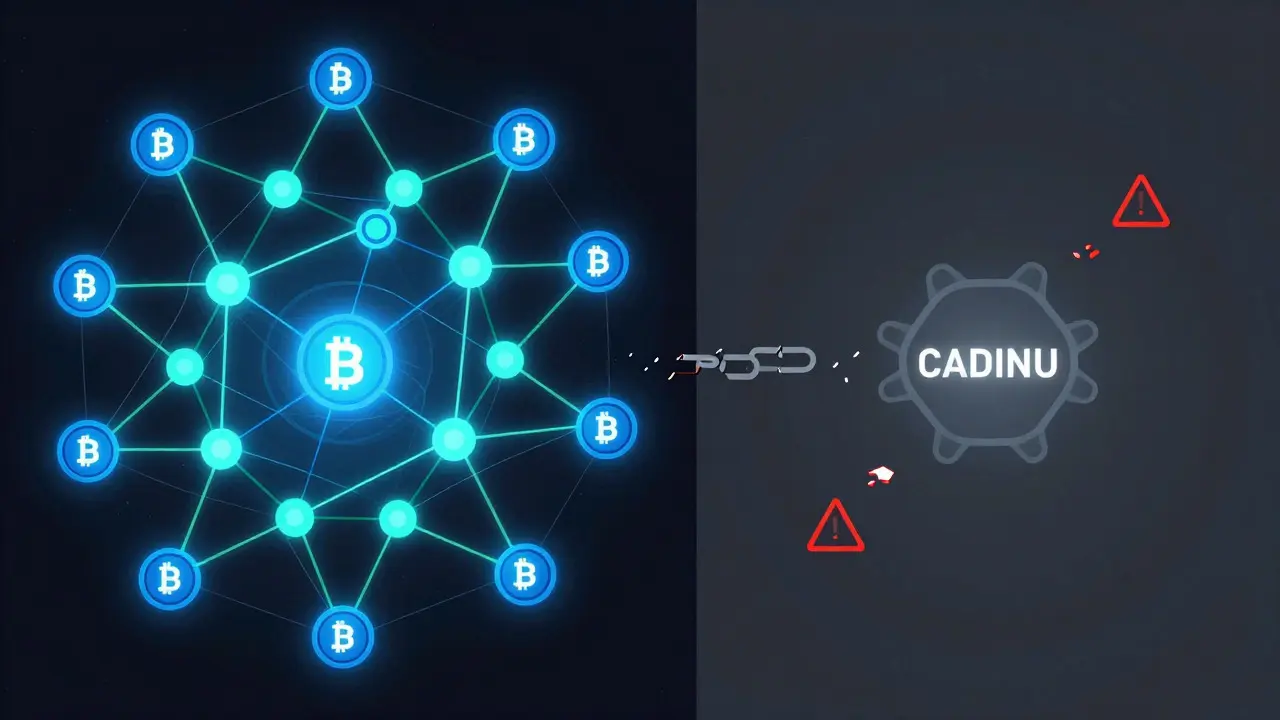
Why Is CADINU Considered a "Zombie Asset"?
The term "zombie asset" was popularized by analytics firms like Messari in their 2025 Q4 reports. They define these as tokens that have had zero or near-zero trading volume for extended periods (often 30+ days). According to their research, these assets have a 99.7% probability of permanent market irrelevance. Here’s why CADINU fits this description perfectly:
- No Development Activity: There is no public GitHub repository, no code updates, and no technical documentation. Legitimate projects show their work; CADINU shows nothing.
- No Community Engagement: A quick search on Reddit, Twitter/X, or Telegram reveals virtually no organic discussion. There are no dedicated subreddits, no influential creators talking about it, and no user reviews on platforms like Trustpilot.
- Extreme Volatility: When trades do happen, they are erratic. Binance data showed an 85.15% price drop in a single 24-hour period in November 2025. This isn’t healthy market correction; it’s manipulation or panic selling in a vacuum.
- Lack of Expert Coverage: Major financial publications like Bloomberg, Financial Times, and CoinDesk do not cover CADINU. Even niche crypto analysts ignore it because there is no fundamental basis for analysis.
Without development, community, or coverage, a token is dead weight. It occupies space on the blockchain but serves no purpose. The Token2049 industry report projects that 92% of tokens ranked below #5,000 will cease trading entirely by 2027 due to exchange delistings and market consolidation. CADINU is already well past that threshold.
Risks of Investing in Low-Cap Tokens Like CADINU
If you’re considering buying CADINU despite the warnings, you need to understand the specific risks involved. These aren’t just theoretical dangers; they are common outcomes for investors in this sector.
1. Illiquidity Traps
As mentioned, the $0 trading volume is a trap. You might see a price listed on an exchange, but when you try to sell, the order book is empty. You could hold tokens worth $10,000 on paper, but if no one buys, they are worth $0 in your pocket. This is known as an illiquidity trap.
2. Rug Pulls and Manipulation
Low-cap tokens are prime targets for "rug pulls," where developers abandon the project and drain the liquidity pool. Even if the developers haven’t explicitly stolen funds yet, the extreme volatility suggests potential wash trading (fake trades to inflate volume) or pump-and-dump schemes. Regulatory bodies like the U.S. Securities and Exchange Commission (SEC) have warned specifically about tokens with daily volumes below $1,000, citing high risks of fraud.
3. Opportunity Cost
Money tied up in CADINU is money not working for you elsewhere. By holding a zombie asset, you miss out on potential gains from stable investments or even more promising speculative plays. The psychological toll of watching a stagnant or declining asset can also lead to poor decision-making in other areas of your portfolio.
How to Spot Similar Red Flags
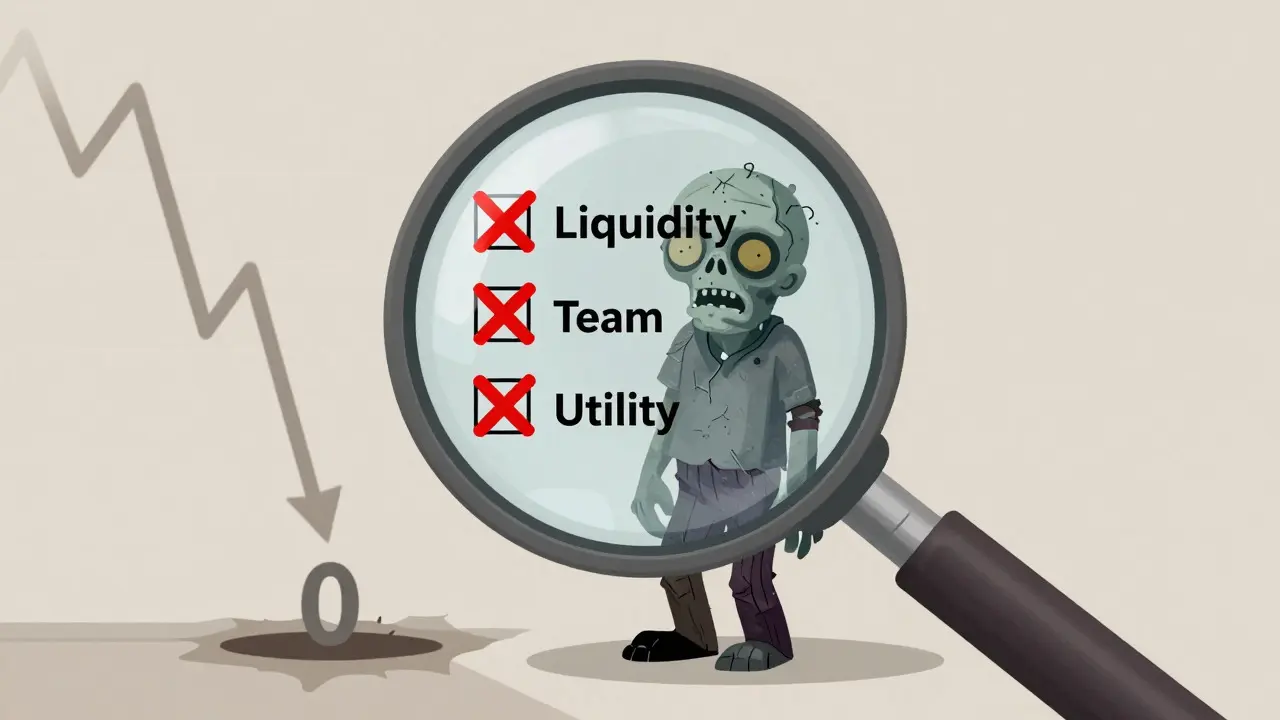
You don’t need to be a blockchain expert to avoid tokens like CADINU. Use this checklist to evaluate any new cryptocurrency you encounter:
- Check the Liquidity: Look at the 24-hour trading volume. Is it significant relative to the market cap? If volume is near zero, walk away.
- Verify the Team: Can you find real names, LinkedIn profiles, or a history of successful projects? Anonymous teams are risky, especially for low-cap tokens.
- Look for Utility: Does the token do anything? Does it grant access to a service, govern a protocol, or represent ownership? If the answer is "no," it’s pure speculation.
- Assess Community Health: Join their Discord or Telegram. Are people asking intelligent questions, or is it just bots spamming "to the moon"? Real communities discuss features, bugs, and roadmaps.
- Read the Whitepaper: Does it exist? Is it detailed and technical, or is it full of buzzwords and vague promises? Lack of documentation is a major warning sign.
Is There Any Future for CADINU?
Realistically, the outlook for CADINU is terminally bleak. Price prediction algorithms from sources like CoinCodex forecast further declines, suggesting a drop to $0.0000002357 in the near term. More importantly, the structural issues-lack of utility, no community, and zero development-are not easily fixed. Without a catalyst like a major partnership or a viral marketing campaign (which hasn’t happened), the token will likely continue to fade into obscurity.
For most investors, the best strategy is avoidance. Treat CADINU as a cautionary tale rather than an opportunity. The cryptocurrency market is vast, with over 28,000 tokens tracked as of late 2025. Your job isn’t to find every coin; it’s to find the few that have staying power. CADINU does not have that power.
Is CADINU a scam?
While not necessarily a proven "scam" in the legal sense of stolen funds, CADINU exhibits all the characteristics of a failed or abandoned project. With $0 trading volume, no team transparency, and no utility, it poses a high risk of total loss. Investors should treat it with extreme caution.
Where can I buy CADINU?
Technically, CADINU is a BEP-20 token on the Binance Smart Chain, so it can be held in any BNB-compatible wallet. However, finding a legitimate exchange to buy it is difficult due to its low liquidity. Some decentralized exchanges (DEXs) may list it, but trading there carries high slippage and risk.
What is the difference between CADINU and Dogecoin?
Dogecoin is a top-10 cryptocurrency with billions in daily trading volume, widespread merchant acceptance, and a massive global community. CADINU is a low-cap token with zero volume, no community, and no utility. Comparing them is like comparing a major airline to a private plane that never flies.
Will CADINU go to zero?
It is highly likely. With no trading activity and no development updates, CADINU fits the definition of a "zombie asset." Most such tokens eventually become completely illiquid, meaning their effective value becomes zero because they cannot be sold.
Is there a whitepaper for CADINU?
No verifiable whitepaper or technical documentation exists for CADINU. This absence is typical for many low-quality meme coins that lack a substantive plan or technology behind them.