
What Are Digital Identity NFTs? A Clear Breakdown of Blockchain-Based Identity
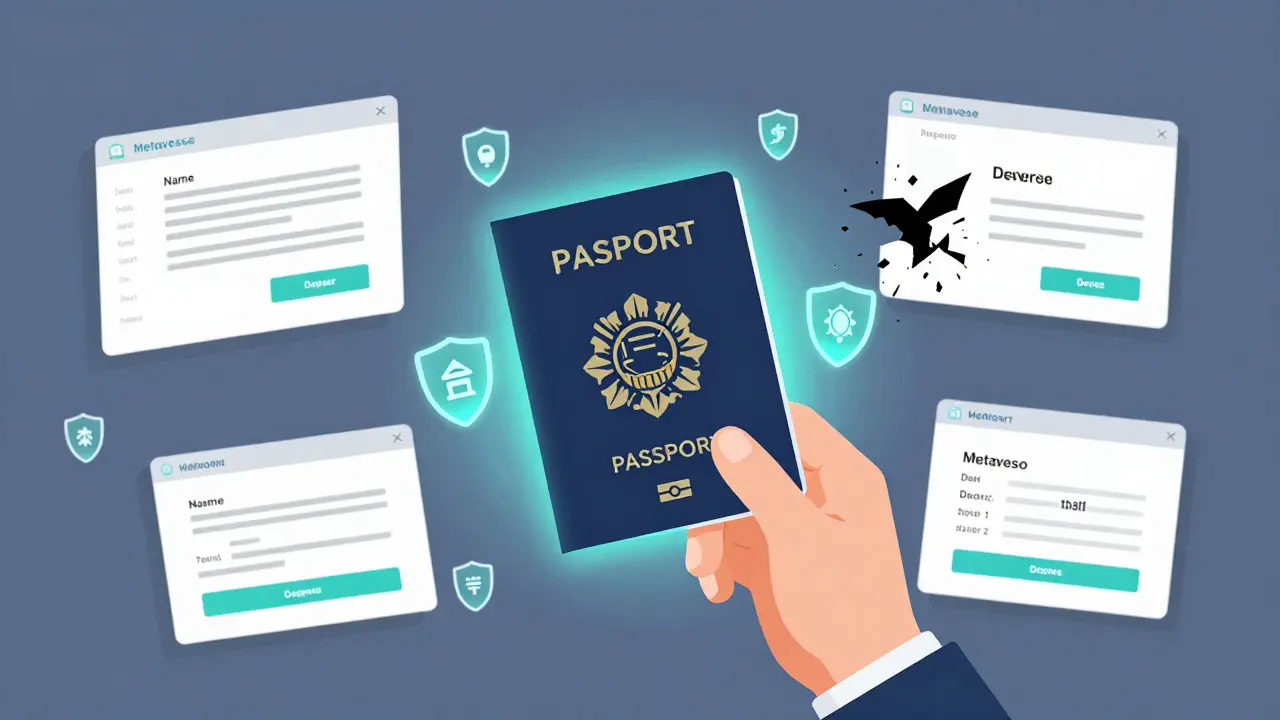
Imagine logging into every website, game, or DAO without ever typing a password again. No more forgotten passwords, no more "Verify your email" spam, no more handing over your driver’s license to some random app. Instead, you just connect your wallet - and you’re in. That’s the promise of digital identity NFTs.
What Exactly Is a Digital Identity NFT?
A digital identity NFT is not a piece of art or a pixelated ape. It’s a cryptographic credential stored on a blockchain that proves who you are online. Think of it like a digital passport that only you control. Unlike traditional logins - where Google or Facebook holds your data - this NFT lives in your wallet. You own it. You decide who sees what.
These NFTs use the same blockchain tech as CryptoPunks or Bored Apes, but instead of representing a visual asset, they represent your identity attributes: your name, age, citizenship, academic degree, or even your reputation in a DAO. They’re built on standards like ERC-721 or ERC-1155, and often follow newer protocols like ERC-735 (for claims) or ERC-780 (for URI linking).
One special type is called a soulbound token (SBT). Proposed by Vitalik Buterin and others in 2022, SBTs can’t be sold or transferred. That makes them perfect for things like diplomas, professional licenses, or verified identities - things you shouldn’t be able to hand off to someone else.
How Do They Work?
Here’s the basic flow:
- You get verified by a trusted issuer - maybe a university, government agency, or a Web3 platform like Proof of Humanity.
- They issue you a digital credential (like a certificate) encoded as metadata.
- This metadata is linked to an NFT on the blockchain - usually stored off-chain on IPFS to save space and cost.
- You store that NFT in your wallet (MetaMask, Trust Wallet, etc.).
- When you need to prove something - like your age to join a platform - you sign a message showing the NFT exists and contains valid data.
- The platform checks the blockchain. No need to see your real name, birthdate, or ID number. Just a yes or no.
This is called zero-knowledge proof verification. You prove you have the right to access something without revealing the actual data. It’s like proving you’re over 21 by showing a sealed envelope that says "yes," without opening it.
Why Are They Better Than Regular Logins?
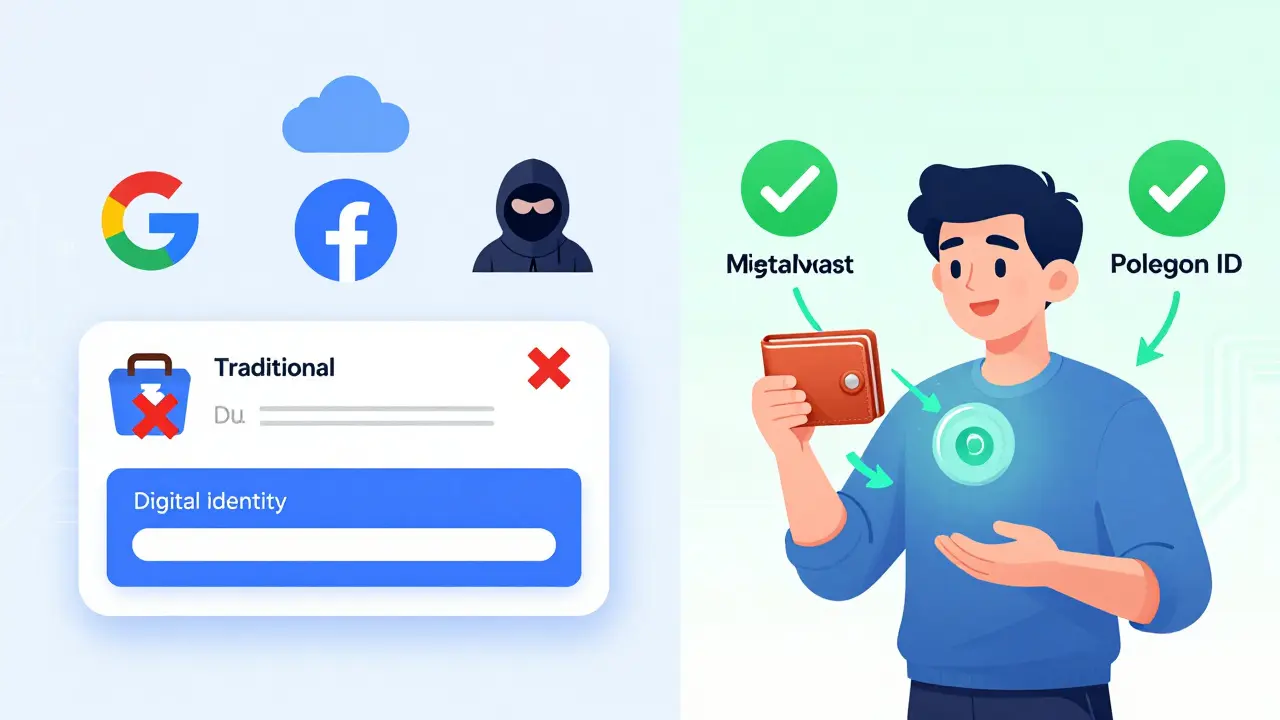
Right now, most of us rely on centralized systems: Google, Facebook, Apple, or corporate SSO tools. These companies collect your data, sell it, get hacked, or change their rules. In 2022, over 42 million Americans had their identities stolen. Credential stuffing attacks - where hackers use leaked passwords to break into other accounts - hit 2.3 billion times that year.
Digital identity NFTs fix that:
- No more data hoarding: Companies don’t store your info. You do.
- No more password resets: Your wallet is your login. If you control the private key, you control your identity.
- No more repeating KYC: If you’ve verified your identity on one platform, you can use it on another - no forms, no selfies, no delays.
Platforms like Snapshot.org already use NFTs to gate voting rights in DAOs. In Q2 2023, over 1.2 million governance votes were cast using NFT-based identity. Builders Tribe cut onboarding time from 45 minutes to 6 minutes per user and slashed impersonation attempts by 92%.
Where Are They Being Used?
Digital identity NFTs aren’t sci-fi. They’re live:
- DeFi platforms: Some lending protocols now require an NFT identity to qualify for loans - reducing fraud and fake accounts.
- Metaverse worlds: Platforms like Decentraland and Sandbox use them to verify real people, not bots.
- Government pilots: Estonia and the EU are testing blockchain-based digital IDs. Microsoft’s ION project has processed over 12,000 decentralized identifiers daily since early 2023.
- Healthcare: Hospitals in New Zealand and Canada are piloting NFT-based patient records that patients can share securely with providers.
- Education: Universities like MIT and the University of Nicosia issue diplomas as SBTs.
By late 2023, 28% of Web3 platforms had adopted some form of NFT-based identity. That number is expected to hit 45% by 2025.
What Are the Downsides?
It’s not magic. There are real problems:
- You lose your key, you lose your identity: If you misplace your seed phrase, there’s no "forgot password" button. Chainalysis found 20% of early adopters lost access permanently.
- Regulations don’t match: GDPR in Europe says you have the right to be forgotten. Blockchains are permanent. That’s a conflict. The European Data Protection Board flagged this in July 2023.
- Too complex for most people: Installing a wallet, backing up a seed phrase, understanding IPFS - it’s not user-friendly. Trustpilot reviews show 65% of users struggled with setup.
- Network limits: Ethereum processes 15-30 transactions per second. Visa does 65,000. That’s why most identity NFTs now run on Polygon or Solana, where fees are under $0.50 per transaction.
Experts like Bruce Schneier warn that immutability - the thing that makes blockchain secure - becomes a liability when you need to correct a mistake or delete data. Imagine if your NFT identity says you’re 18 when you’re actually 17. You can’t fix it.
How Do You Get Started?
If you want to try it:
- Install a wallet: MetaMask or Trust Wallet. Takes 5 minutes.
- Connect to a trusted identity provider: Try Microsoft ION, walt.id, or Polygon ID.
- Complete a simple verification: Upload a photo ID, take a liveness selfie, or link your Twitter/X account.
- Receive your NFT identity: It’ll appear in your wallet.
- Use it: Try logging into a DAO, a Web3 game, or a DeFi app that supports NFT login.
For developers: Use open-source stacks like walt.id’s or Ceramic Network. Expect to spend 80-120 hours to build a basic system. Always audit your smart contracts - 89% of enterprise projects require it.
What’s Next?
The future is hybrid. Most experts agree: NFT identity won’t replace your email password tomorrow. But it will sit beside it - becoming the trusted layer for high-stakes interactions.
Major updates are coming:
- EIP-5169 (September 2023): A new Ethereum standard to encode identity claims in NFTs.
- W3C’s Verifiable Credentials 2.0 (December 2023): Will standardize how NFT identities are formatted.
- Cross-chain bridging (2024): So your identity works on Ethereum, Solana, and Polygon.
Market analysts predict the digital identity market will grow from $15.8 billion in 2023 to $35.6 billion by 2027. Blockchain-based systems could grab 12.3% of that - still small, but growing fast.
Right now, it’s a niche tool for Web3 natives. But as wallets become as common as email, and as data privacy becomes a basic right, digital identity NFTs won’t feel like a tech experiment. They’ll feel like the only sane way to live online.
Real User Stories
u/CryptoSage99 on Reddit: "My ENS profile NFT got me instant access to 7 DAOs I’d been stuck in verification limbo with for months. No forms. No waiting. Just connect and go."
u/DeFiNewbie2023: "I spent 8 hours verifying my identity for Proof of Humanity. One wrong move with my seed phrase, and it’s gone forever. No recovery. No help. That’s the risk."
Builders Tribe’s case study: Onboarding time dropped from 45 minutes to 6 minutes. Impersonation attempts fell by 92%.
Are digital identity NFTs the same as crypto wallets?
No. A crypto wallet is like a physical keyring - it holds keys to your assets and identity. A digital identity NFT is one of the keys inside that ring. It’s a specific credential that proves who you are, not the tool that stores it.
Can I sell my digital identity NFT?
If it’s a regular NFT identity, technically yes - but it’s not designed to be sold. Most serious identity NFTs are soulbound tokens (SBTs), which are non-transferable by design. Selling your identity NFT would be like selling your passport. It defeats the purpose.
Do I need to pay gas fees every time I use my identity NFT?
No. You only pay gas when you mint the NFT or update its metadata. Verifying your identity - like logging into a site - happens off-chain using digital signatures. That’s free. You’re just proving you own the NFT, not changing the blockchain.
Are digital identity NFTs legal?
They’re not banned, but their legal status is unclear. In the U.S., only 17 states have passed blockchain identity laws as of late 2022. In the EU, GDPR conflicts with blockchain’s immutability. Most platforms operate in a gray area, using them for access control, not official government recognition.
Can I use a digital identity NFT for banking or government services?
Not yet. Banks and governments still rely on traditional IDs. But pilots are underway. Estonia’s e-Residency program and Canada’s digital health ID project are testing NFT-based verification. Widespread adoption in these sectors will take years - but it’s coming.
What happens if the blockchain fails?
Blockchains don’t "fail" like a website. They’re decentralized networks. Even if Ethereum slows down, the data still exists. Your NFT identity is stored across thousands of nodes. The bigger risk is losing your private key - not the blockchain breaking.
Is my data private with a digital identity NFT?
Yes - if done right. The NFT itself doesn’t store your name or SSN. It links to encrypted data stored off-chain (like on IPFS). When you verify, you use zero-knowledge proofs to show you have valid credentials without revealing the details. Only the platform sees "yes, this person is verified," not your real data.
How do I back up my digital identity NFT?
Back up your wallet’s seed phrase - that’s it. The NFT is tied to your wallet address. If you have the 12- or 24-word recovery phrase, you can restore your wallet on any device and regain access. Never store it digitally. Write it on paper. Keep it in a safe place.
Can I have more than one digital identity NFT?
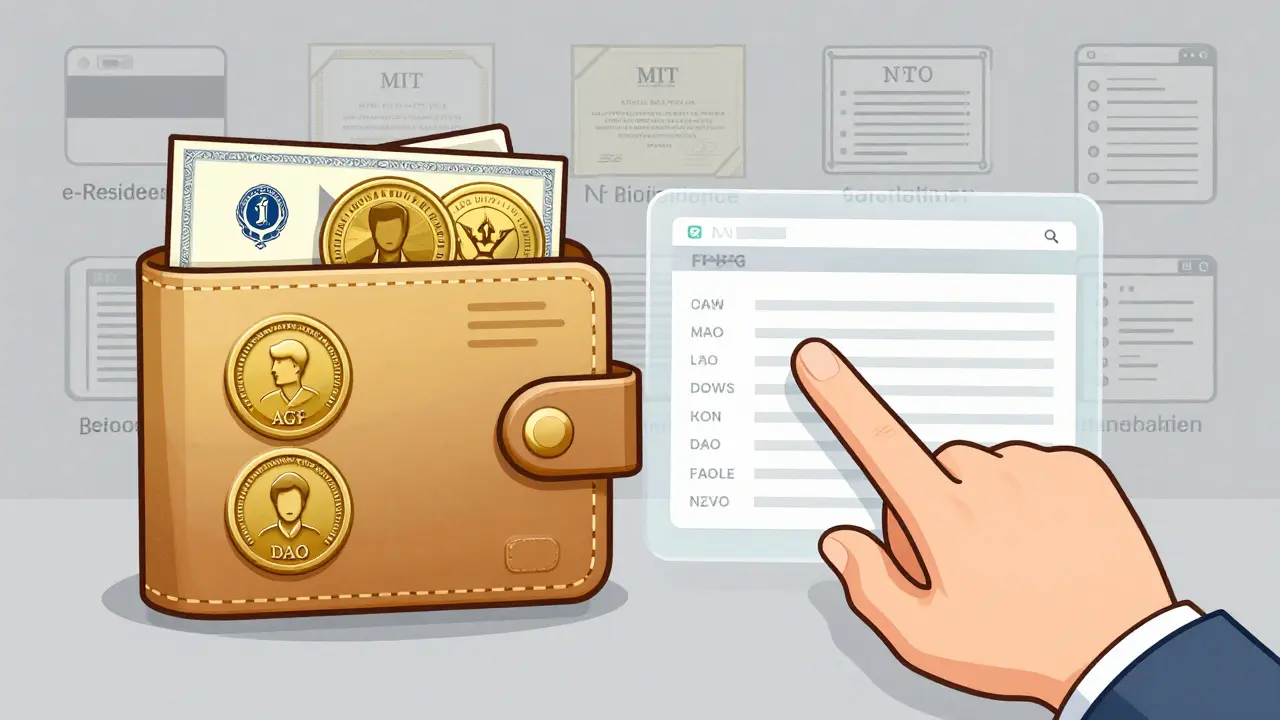
Yes. You can have one for your university degree, another for your crypto experience, and a third for your real-world ID. They’re modular. Some platforms even let you combine them into a "profile NFT" that bundles multiple claims.
What’s the difference between a digital identity NFT and a traditional digital ID?
Traditional digital IDs are controlled by companies or governments. You give them your data, and they decide who gets to see it. With a digital identity NFT, you control the key. You choose who sees what - and when. It’s not about replacing your driver’s license - it’s about giving you ownership over how your identity is used online.
Final Thoughts
Digital identity NFTs aren’t about speculation. They’re about control. Right now, your identity is scattered across 100 different platforms, each with its own password, verification process, and privacy policy. That’s broken. Digital identity NFTs offer a way to fix that - not by making things more complex, but by putting the power back in your hands.
It’s early. There are risks. But the direction is clear. The next decade of the internet won’t be about logging in. It’ll be about proving who you are - without giving anything away.
25 Comments
So you're telling me I need to memorize a 24-word phrase just to prove I'm not a bot? Cool. I'll just keep using Gmail.
This is just another Silicon Valley fantasy. The government already has your data. Blockchain won't change that. You're not owning your identity-you're just giving it to a new set of tech bros who think they're Robin Hood.
Let's cut through the hype. Digital identity NFTs aren't magic-they're just a better way to handle verifiable claims. The real win is zero-knowledge proofs. You prove you're 21 without showing your birth certificate. That's privacy. That's power. But most people don't get it because they're still stuck on 'wallets = crypto money'. It's not about trading. It's about trustless verification. And yes, losing your seed phrase = losing your life online. No recovery. No customer service. That's the trade-off. If you're not ready for that, don't touch it. But if you are? You're ahead of 95% of the internet.
One must consider the ontological implications of commodifying identity through non-fungible tokens. The very notion of a self as an asset class is a neoliberal delusion wrapped in cryptographic glitter. One cannot own one's essence any more than one can own the wind. The blockchain does not ennoble-it industrializes the soul. And yet, the irony is palpable. We seek liberation from centralized authority only to forge new chains of immutable ledger entries. The passport becomes a NFT. The soul becomes a token. Where is the dignity in that? Where is the humanity? We are not data points. We are not metadata. We are not ERC-721 compliant.
I get that this sounds wild, but think about it-what if you could prove you graduated college without handing over your transcript to every employer? Or prove you’re a real person without a selfie and a government ID? That’s not sci-fi, that’s just… smarter. I’ve seen people lose access to their accounts because they used the same password everywhere. This fixes that. Yes, it’s new. Yes, it’s weird. But so was email in 1995. Give it time. And if you’re scared? Start small. Use it for one DAO. See how it feels. You might be surprised.
so like… you pay gas to prove you exist? and if you forget your phrase you’re just… dead? cool. i’ll stick with my facebook login thanks
Man I tried setting up a wallet last year. Spent two hours. Got lost in a maze of seed phrases and IPFS links. Ended up just using Google. I’m not techy. This feels like building a rocket just to go to the corner store.
For anyone nervous about losing access-start with a hardware wallet. Ledger or Trezor. It’s $100 but it’s like a vault for your soul. And don’t just write your seed phrase on paper-make two copies. One in a safe, one with a trusted friend. This isn’t paranoia. This is responsibility. I’ve helped five friends set this up. Three of them cried. Not from joy. From realizing they’d been living online like toddlers with a box of matches. You don’t need to be a hacker to protect your identity. You just need to be careful. And that’s harder than it sounds.
In India, we have Aadhaar-biometric digital ID for 1.3 billion people. It’s centralized, flawed, hacked often-but it works. Why do we need another system? Blockchain adds complexity without solving core issues: accessibility, literacy, infrastructure. Until wallets work on a ₹10 smartphone with 2G, this is a luxury for the urban elite. Not a revolution.
Let’s be real-this is the next phase of Web3 identity infrastructure. SBTs are the missing piece for reputation systems in DAOs, DeFi lending, and credentialing. The real innovation isn’t the NFT-it’s the composability. You can layer multiple claims: education, employment, reputation, citizenship. It’s like a modular resume on steroids. The challenge? Standardization. Without W3C Verifiable Credentials 2.0 and EIP-5169, we’re just building silos with fancy crypto labels. But when it all converges? It’s game over for centralized identity providers.
I wonder if we’re romanticizing control. What if the real problem isn’t who holds our data-but that we’ve stopped asking why we should give it to anyone at all? Maybe the answer isn’t a blockchain wallet… but a cultural shift. A world where you don’t need to prove who you are to access basic services. Where identity isn’t a product, but a right. Maybe the NFT is just a bandage on a deeper wound.
I like the idea but I’m not doing this until it’s in my phone’s settings. Not in some weird wallet app. I’m not a crypto bro. I just want to log in without a password. That’s it.
They’re using this to track us. Mark my words. The EU is already pushing this because they want to control every citizen’s digital footprint. Next thing you know, your NFT says you’re "approved to breathe". They’ll tie it to taxes, voting, healthcare. It’s not freedom-it’s digital serfdom with a fancy NFT badge.
As someone who’s onboarded 200+ users into Web3 tools-this is the most underrated upgrade. No more 45-minute KYC. No more fake accounts. No more bots voting in DAOs. The 92% drop in impersonation? Real. The 6-minute onboarding? Real. It’s not perfect, but it’s the least broken system we’ve got. If you’re building something in Web3? Use this. Don’t reinvent the wheel. Use walt.id or Polygon ID. Save your sanity.
Just tried logging into a DAO with my NFT identity. No password. No email. Just a signature. Felt like magic. Then I remembered I had to back up my 12 words. And now I’m sweating. But still… worth it. This is the future. And it’s already here. You just gotta be brave enough to hold your own keys.
My grandma got her first digital identity NFT last week. She’s 78. Used her phone to take a selfie with her passport. Got verified in 10 minutes. Now she uses it to join her book club DAO. She says it’s easier than calling the library. I cried. Not because it’s techy. Because it’s human. If this works for her, it can work for anyone. Stop calling it crypto. Call it control. Call it dignity. Call it what it is.
While the technological architecture of decentralized identity presents an elegant solution to the problem of data sovereignty, one must acknowledge the sociotechnical chasm that exists between theoretical idealism and practical adoption in developing economies. The infrastructure required for seamless interaction with IPFS-hosted metadata and blockchain-based verification remains inaccessible to the majority of global citizens. Until equitable access is prioritized over speculative innovation, such systems risk becoming digital castes.
Oh wow, you’re telling me I have to be responsible for my own identity now? No one told me about this clause in the internet contract. I thought I paid for customer service. I thought someone else would fix it when I lost my keys. This is unfair. I’m not a hacker. I’m just trying to watch cat videos. Why does everything have to be so complicated? I’m emotionally drained. Someone help me.
Look-I get the fear. But here’s the truth: your data is already sold. Every time you click "Accept" on a cookie banner, you’re giving away your life. This? This is the first time you get to say NO. You get to choose who sees what. That’s not scary. That’s powerful. Start small. Use it for one thing. Then another. You’ll feel like a superhero. And if you mess up? You’ll learn. That’s how we grow.
So you're saying I need to trust a bunch of devs who can't even code a simple login? And I'm supposed to believe this is safer than Google? LOL. You guys are delusional. This is why America's tech scene is collapsing. Everyone thinks they're a genius. Meanwhile, real people just want to log in. Stop overcomplicating everything.
Okay, but what if someone hacks your wallet? What if they steal your NFT? What if they use your identity to get a loan? What if they pretend to be you and vote in a DAO? What if the blockchain gets forked? What if the metadata link breaks? What if the IPFS node goes down? What if the issuer revokes your credential? What if you’re wrongfully flagged? What if your SBT gets stuck on a chain that no one uses anymore? What if your child inherits your wallet and doesn’t know the seed phrase? What if your spouse dies and you can’t access it? What if you get arrested and the government seizes your device? What if you move to another country and your digital ID isn’t recognized? What if the algorithm that verifies your identity is biased? What if you’re transgender and your SBT says you’re male? What if you’re a refugee and you lost your passport? What if you’re poor and can’t afford a hardware wallet? What if you’re elderly and can’t remember your 24 words? What if you’re blind and can’t read the QR code? What if you’re in a war zone and your phone dies? What if you’re just… tired of this?
The notion of commodifying personal identity through blockchain technology is not only ethically dubious but fundamentally incompatible with the principles of human dignity and civil liberty. One’s identity is not an asset to be traded, stored, or verified via cryptographic hash. It is an intrinsic, immutable aspect of personhood. To reduce the self to a token is to embrace a dystopian paradigm wherein the soul is rendered transactional. This is not innovation-it is dehumanization dressed in code.
Just got my first SBT from MIT. My diploma’s on the blockchain. No PDF. No email. Just my wallet. I showed it to my boss. He didn’t understand. But he hired me anyway. I didn’t even have to send a transcript. Just connected my wallet. Felt like the future. And I’m 21. I’m not even a crypto bro. Just someone who wants to prove I earned this.
Everyone’s acting like this is the solution. It’s not. It’s a luxury for the tech-privileged. The people who need this most-refugees, the homeless, the elderly-are the ones who can’t afford a smartphone, let alone a seed phrase. This isn’t liberation. It’s exclusion with a blockchain logo. And you’re all celebrating it like it’s a new iPhone. Pathetic.
Oh great. So now my identity is a collectible NFT I can’t sell. That’s just like owning a tattoo of my social security number. Brilliant. The only thing more ridiculous than this is the fact that people think it’s revolutionary. You’re not owning your identity-you’re just renting it from a decentralized cult that thinks private keys are sacred. Meanwhile, the rest of us are just trying to pay our bills without getting hacked. Thanks for the circus, guys.