
Web3 Technology Stack Explained: A Layer-by-Layer Guide for Developers
You’ve heard the hype about Web3. You know it promises a decentralized internet where you own your data. But when you actually sit down to build something, the term "technology stack" feels like a wall of jargon. Is it just Ethereum? Is it Solidity? What happens to your database?
The truth is, the Web3 technology stack isn’t one single tool. It’s a complex, multi-layered architecture that replaces every piece of traditional web infrastructure-from servers to databases-with decentralized alternatives. If you’re coming from Web2, this shift is massive. You aren’t just changing libraries; you are changing how trust works.
This guide breaks down the Web3 stack layer by layer. We’ll look at what powers the network, how code executes on-chain, where data lives, and how users interact with it all. By the end, you’ll see exactly where each piece fits and why you need them all.
Layer 0: The Infrastructure Foundation
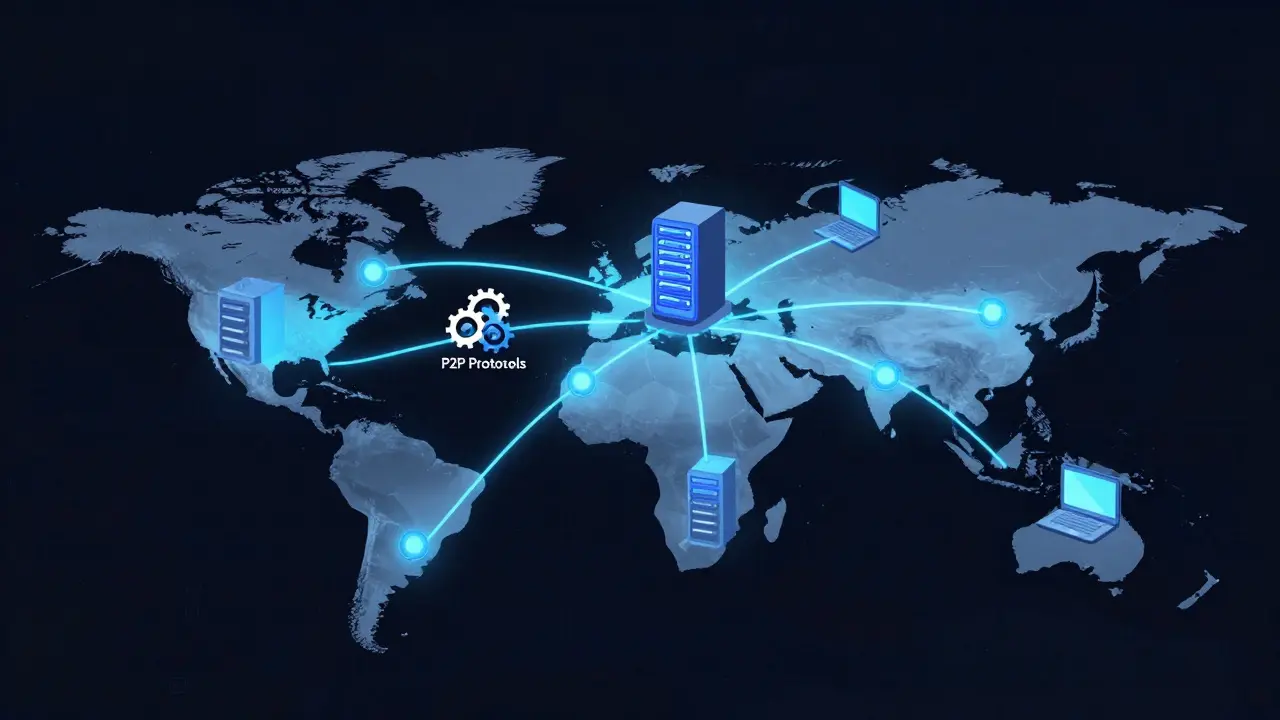
Before we talk about blockchains, we have to talk about the hardware and networking that makes them possible. This is Layer 0. In the old web, this was AWS or Azure. In Web3, this is the physical reality of nodes.
At its core, Layer 0 consists of the physical computers (nodes) running the network software. These nodes communicate via peer-to-peer (P2P) networks. Unlike a centralized server farm, these nodes are distributed globally. This distribution is what gives Web3 its resilience. If one node goes down, the network survives. If a hacker attacks one node, they haven’t attacked the whole system.
Key components here include:
- Node Hardware: Standard servers or even personal computers capable of storing the full ledger history.
- P2P Networking Protocols: Rules for how nodes find each other and share data without a central directory.
- Consensus Mechanisms: The mathematical rules (like Proof of Stake) that allow these independent nodes to agree on the state of the ledger without trusting each other.
Think of Layer 0 as the electricity grid. You don’t see it, but nothing runs without it. Without robust Layer 0 infrastructure, the higher layers collapse.
Layer 1: Blockchain Protocols
This is the most famous part of the stack. Layer 1 protocols are the base blockchains themselves. They provide the security and finality for transactions. When people say “Ethereum” or “Bitcoin,” they are talking about Layer 1.
Ethereum is the dominant Layer 1 protocol for smart contracts. It introduced the concept of programmable money. Other major Layer 1s include Solana, Cardano, and Polkadot. Each has different trade-offs in speed, cost, and decentralization.
Here is what Layer 1 actually does:
- Transaction Processing: It orders transactions into blocks.
- Security: It uses consensus mechanisms (PoS, PoW) to prevent double-spending and fraud.
- State Management: It maintains the global state of accounts and balances.
If you are building a dApp, you choose a Layer 1 based on your needs. Do you need maximum security and developer tools? Go with Ethereum. Do you need high throughput and low fees? You might look at Solana or Avalanche. This choice dictates everything else in your stack.
Layer 2: Scaling Solutions
Layer 1 blockchains have a problem: they are slow and expensive during peak times. Ethereum, for example, can only process about 15-30 transactions per second. That’s not enough for global commerce.
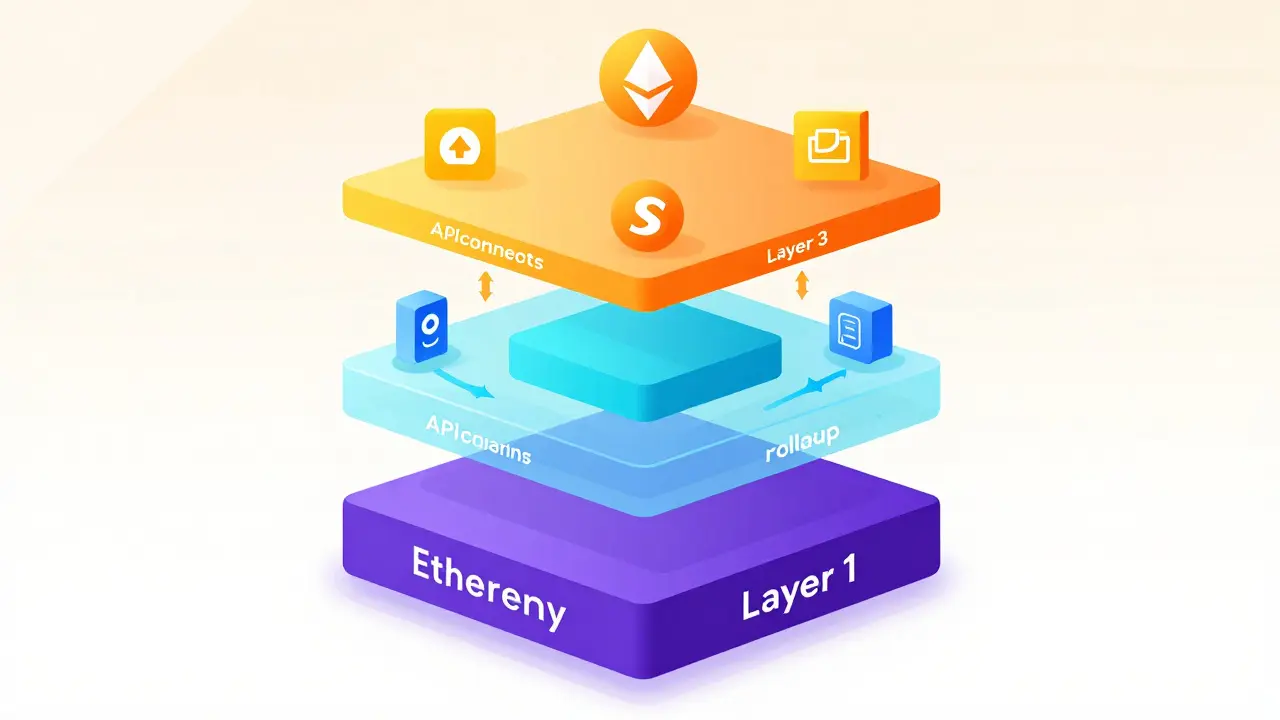
Enter Layer 2. These are protocols built on top of Layer 1 to handle more transactions. They bundle many transactions together and submit a single proof to the main chain. This keeps the security of Layer 1 but offers the speed of a centralized system.
Common Layer 2 solutions include:
- Optimistic Rollups: Assume transactions are valid unless someone proves otherwise. Examples: Arbitrum, Optimism.
- ZK-Rollups: Use zero-knowledge cryptography to prove validity instantly. Examples: zkSync, StarkNet.
- Sidechains: Independent chains that run parallel to the main chain. Example: Polygon PoS.
For most new developers, starting on a Layer 2 is smarter. Gas fees are pennies instead of dollars, and transaction confirmations take seconds. Your users will thank you.
Layer 3: Services and Developer Tools
This is where the magic happens for builders. Layer 3 includes the APIs, SDKs, and middleware that let you interact with the blockchain without writing raw RPC calls. Building directly against a node is hard and error-prone. Layer 3 abstracts that complexity.
Key tools in this layer:
- Wallet Connectors: Libraries like WalletConnect or RainbowKit that let users connect their crypto wallets to your app.
- Data Indexers: Tools like The Graph or Dune Analytics that query blockchain data efficiently. Blockchains are terrible at searching; indexers make them searchable.
- Oracles: Services like Chainlink that bring real-world data (prices, weather, sports scores) onto the blockchain.
- Smart Contract Frameworks: Hardhat or Foundry for writing, testing, and deploying contracts.
Without Layer 3, you’d be reinventing the wheel every time. These services turn raw blockchain data into usable information for your application.
Decentralized Storage and Identity
In Web2, you store images and files on Amazon S3. In Web3, putting large files on-chain is prohibitively expensive. So, where do they go?
They go to decentralized storage networks. The most popular is IPFS (InterPlanetary File System). IPFS doesn’t store files in one place. It chunks them up and distributes them across a network of nodes. You access files by content hash, not URL. This ensures censorship resistance and permanence.
Another key component is identity. In Web2, you log in with email/password. In Web3, your wallet address is your identity. But showing a long string of hex characters is bad UX. Services like ENS (Ethereum Name Service) let users buy human-readable names (e.g., alice.eth). For deeper privacy, decentralized identity protocols like uPort allow users to control their credentials without revealing their underlying wallet address.
Layer 4: The Application Frontend
Finally, we reach the user interface. This looks just like a normal website. React, Vue, or Angular frameworks work perfectly here. The difference is how the frontend talks to the backend.
Instead of calling a REST API on your server, your frontend calls smart contracts on the blockchain. Here’s what that means for UX:
- Wallet Integration: Users must connect a wallet (MetaMask, Phantom, etc.) to sign transactions.
- Async State: Transactions aren’t instant. You need loading states and pending UI while the network confirms the block.
- Error Handling: Smart contract reverts need clear feedback. “Insufficient funds” or “Approval required” messages must be helpful.
The goal is to hide the complexity. The user shouldn’t know they are interacting with a decentralized ledger. They should just click “Buy” and have it work.
| Component | Web2 (Traditional) | Web3 (Decentralized) |
|---|---|---|
| Database | PostgreSQL, MongoDB | Ethereum L1, IPFS |
| Backend Logic | Node.js, Python | Smart Contracts (Solidity) |
| Authentication | Email/Password, OAuth | Wallet Signature, ENS |
| Hosting | AWS, Vercel | IPFS, Arweave |
| Data Querying | SQL Queries | The Graph, Subgraphs |
Building Your First dApp: A Practical Checklist
Ready to start? Don’t try to build everything at once. Follow this path:
- Choose your Layer 1/Layer 2: Start with Ethereum Sepolia (testnet) or an Arbitrum testnet. Free gas makes learning easier.
- Write your Smart Contract: Use Solidity. Deploy using Hardhat. Test thoroughly. Bugs in smart contracts are permanent.
- Set up Decentralized Storage: Pin your NFT metadata or app assets to IPFS using Pinata or Web3.Storage.
- Build the Frontend: Use Next.js. Integrate RainbowKit for wallet connection. Use Wagmi for hooks to read/write chain data.
- Test the Flow: Connect MetaMask. Send a transaction. Watch it fail. Fix it. Repeat.
The biggest pitfall? Ignoring user experience. If connecting a wallet takes three clicks and confuses the user, they will leave. Make it smooth. Provide clear instructions. Handle errors gracefully.
Future Trends in the Web3 Stack
The stack is evolving fast. Two trends stand out for 2026:
Account Abstraction (ERC-4337): This allows smart contract wallets that look like regular apps. Users can recover accounts with email, pay gas in any token, and batch transactions. It removes the “seed phrase” friction.
Cross-Chain Interoperability: Protocols like LayerZero and Wormhole are making it easier to move assets and data between different blockchains. Your dApp won’t be stuck on one chain anymore.
Understanding these shifts helps you build future-proof applications. Don’t lock yourself into a single chain if interoperability is available.
What programming language do I need for Web3?
For smart contracts on Ethereum-compatible chains, you need Solidity. For the frontend, standard JavaScript or TypeScript works perfectly. Rust is used for Solana and other non-EVM chains.
Is Web3 development harder than Web2?
Yes, initially. The concepts of immutability, gas costs, and asynchronous state management are new. However, modern tools like Hardhat and Wagmi have significantly lowered the barrier to entry. Once you grasp the mental model, it becomes intuitive.
Do I need to host my dApp on a decentralized server?
Not necessarily. Many dApps host their frontend on traditional services like Vercel or Netlify for speed and ease. However, for true decentralization, you can pin your static site to IPFS and serve it via a gateway. The critical part is that your logic and data live on-chain or in decentralized storage.
What is the role of Oracles in the Web3 stack?
Blockchains cannot access external data directly. Oracles like Chainlink act as bridges, fetching real-world data (like stock prices or weather) and delivering it securely to smart contracts. Without oracles, DeFi lending and insurance apps wouldn't work.
How do I handle file uploads in Web3?
Never upload large files directly to the blockchain. Instead, upload them to a decentralized storage network like IPFS or Arweave. Then, store the resulting Content Identifier (CID) hash on the blockchain. This keeps the chain lightweight while ensuring data permanence.
13 Comments
Oh look, another guide telling us how to build a decentralized utopia while ignoring the fact that most of these protocols are run by venture capital firms with more centralized control than AWS. It’s almost poetic in its irony.
I appreciate the breakdown here, especially regarding Layer 3 tools. For anyone just starting out, don't let the jargon scare you. Start with Hardhat and Wagmi as suggested. The learning curve is steep, but the community support is genuinely helpful if you know where to look. Just remember to test your contracts thoroughly before deploying to mainnet because mistakes are expensive and permanent.
you guys really think this solves anything? it's just moving the problem from one server farm to another set of servers owned by different people who still want your data. the philosophy is sound maybe but the execution is always corrupted by greed. also ur spelling is bad
@Meg Gran I hear your frustration with the centralization issues in current infrastructure. It is a valid concern that many projects claim decentralization while relying on heavy VC backing. However, the technology itself allows for true distribution over time. We have to be patient with the evolution of the stack rather than dismissing the entire concept due to current corporate interests.
The reliance on foreign consensus mechanisms is a national security risk. We should not be building our digital infrastructure on protocols that can be censored or manipulated by entities outside our jurisdiction. This Web3 narrative is largely pushed by globalist agendas that undermine local sovereignty. Stick to domestic solutions if you value freedom.
only amateurs worry about gas fees like theyre going to the moon. real devs optimize their code and use layer 2s properly. stop whining about costs and start writing efficient solidity. if you cant handle basic optimization you dont deserve to call yourself a web3 engineer. simple as that.
Ugh, reading this makes me feel so drained. Everyone is so obsessed with technical details and forgetting the human element. Why do we need another database when we have trust issues? 😩 You people are so toxic with your constant need for validation through code. Just breathe and think about the impact on society instead of optimizing transactions per second. 🙄
i thinnk this is a really good overview! i was confused about ipfs vs arweave but this clears it up a bit. thanks for sharing this info its very helpful for someone like me who is just trying to learn. no pressure though just saying.
This article is dangerously naive. It presents Web3 as a neutral technological advancement without acknowledging the geopolitical implications. By adopting these stacks, we are effectively surrendering control of our financial and data sovereignty to unregulated international networks. A true patriot would demand strict oversight and localization of all blockchain nodes within US borders. Anything less is an act of treason against our digital independence.
Sure, Matthew, because clearly the best way to innovate is to lock everything down behind national borders. But hey, if you'd prefer your internet to be as fast and reliable as your political commentary, go right ahead. Meanwhile, the rest of us are actually building things that work across cultures and borders. Cheers to that. 🍷
It is quite amusing how many people here seem to misunderstand the fundamental purpose of oracles. They are not merely 'bridges' as some might simplistically put it; they are the critical lifeline between the deterministic world of smart contracts and the chaotic reality of external data. Without robust oracle networks like Chainlink, your DeFi application is nothing more than a toy. Educate yourselves before commenting further. 🧠
There is a profound philosophical shift happening here. We are moving from a model of trust based on institutions to trust based on mathematics and code. It reminds me of the social contract theories of old, but now enforced by algorithms rather than governments. It is fascinating to watch this unfold. 🤔
Let's cut through the noise and focus on execution. The tech stack is irrelevant if you cannot deliver a product that users actually want. Stop debating the merits of L1 vs L2 in forums and start shipping code. If your dApp doesn't solve a real problem, no amount of decentralization will save it. Get to work and prove your worth through results, not rhetoric.