
Upbit Indonesia Review: Features, Fees, and How It Stands Against Competitors
Crypto Trading Fee Calculator
Fee Comparison
Looking for a crypto exchange that blends South Korean tech muscle with local Indonesian banking? Upbit Indonesia review breaks down the platform’s strengths, fees, security, and how it compares to the big players you’ll meet on the Indonesian market.
What Is Upbit Indonesia?
Upbit Indonesia is the Indonesian arm of South Korea’s Upbit, a crypto exchange launched by fintech group Dunamu Inc. in 2017. The local subsidiary operates under PT Indonesia Digital Exchange and earned a license from the Commodity Futures Trading Regulatory Agency (BAPPEBTI) in 2021. Since its 2018 launch, Upbit Indonesia has grown to support 203 digital assets across 272 trading pairs, handling roughly 35% of Indonesia’s total crypto‑trading volume as of late 2024.
Core Trading Features and Technical Specs
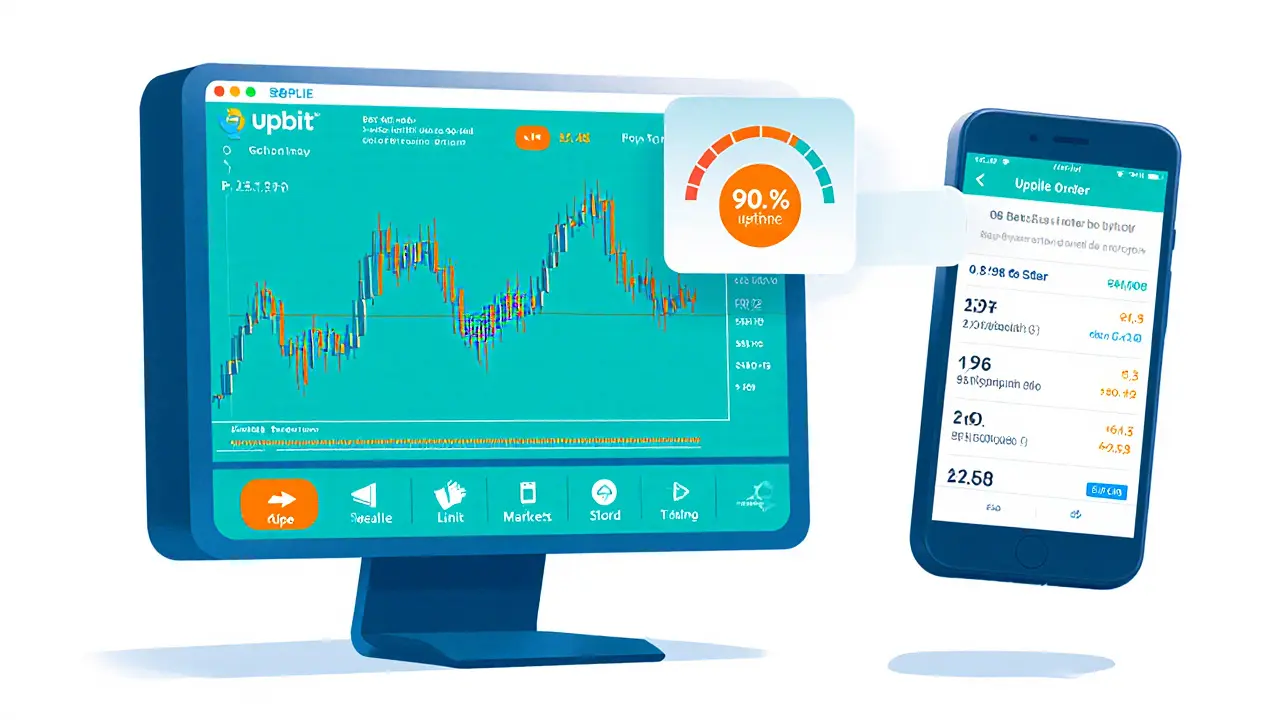
Upbit Indonesia focuses on spot trading only. Users can place limit, market, and stop‑limit orders in the three main markets: IDR, BTC, and USDT. The platform boasts a 99.99% uptime record in 2024, and order execution averages 0.8seconds even during peak traffic. For developers, a REST API is available for institutional clients, while retail traders enjoy a web interface that works on all modern browsers.
The mobile app (v4.2.1, October2024) is rated 4.7/5 on iOS and 4.6/5 on Android. It includes lock‑screen price widgets, custom price alerts, and push notifications for market moves. Minimum system requirements are Android8.0+ or iOS13.0+ with at least 2GB RAM.
Security Measures and Regulatory Compliance
Security is a headline feature. About 98% of user funds sit in geographically distributed cold wallets. Two‑factor authentication (SMS or authenticator app) is mandatory, and withdrawals above 5million IDR require a separate fund password.
Regulatory compliance is overseen by BAPPEBTI, which enforces a four‑tier KYC process. Level‑1 verification (KTP + selfie) allows daily limits of 50million IDR, while full verification raises the cap to 500million IDR after 2-3 business days of review. The exchange does not offer margin, futures, or leveraged products, staying within a 1:1 leverage policy that regulators favor.
Cybersecurity firm Fireblocks highlighted Upbit’s post‑2019 security overhaul as a benchmark, noting that 68% of top exchanges now adopt similar protocols.
Fee Structure: What You’ll Pay
Upbit Indonesia’s fee schedule is straightforward but not the cheapest. For IDR markets, maker fees sit at 0.23% and taker fees at 0.33%. BTC and USDT markets charge a flat 0.51% for both maker and taker. Deposits are free regardless of method. Withdrawal fees vary: 0.0008BTC for Bitcoin and a flat 25000IDR for fiat withdrawals.
By comparison, Binance Indonesia offers 0.1% taker fees for high‑volume traders and up to 125× leverage, while Indodax charges as low as 0.11% taker fees but supports more than 250 coins.
User Experience and Mobile App Highlights
According to the NFTEvening 2025 Crypto Exchange Report, Upbit Indonesia scores a 9.4/10 for user experience-higher than Tokocrypto (8.7), Indodax (8.2), and Pintu (8.9). The app’s lock‑screen widget and real‑time price alerts are repeatedly praised on Reddit and Trustpilot.
On Trustpilot the exchange holds a 4.1/5 rating from 1,247 reviews. Positive comments often mention fast IDR withdrawals and an intuitive interface, while complaints focus on limited customer‑support channels (email+chat only) and slower response times during high volatility.
Educational resources are a strong point: 47 interactive tutorials in Bahasa Indonesia and a dedicated “Upbit Lounge” forum (12,500 active members) help new traders reach basic competency within two hours on average.
How Upbit Stacks Up Against Local Competitors
| Feature | Upbit Indonesia | Binance Indonesia | Tokocrypto | Indodax | Pintu |
|---|---|---|---|---|---|
| Supported assets | 203 assets / 272 pairs | ~350 assets / 500+ pairs | ~150 assets / 210 pairs | ~250 assets / 300+ pairs | ~120 assets / 180 pairs |
| Maker / Taker fees (IDR) | 0.23% / 0.33% | 0.10% / 0.10% (VIP tiers) | 0.20% / 0.25% | 0.15% / 0.11% | 0.25% / 0.30% |
| Leverage / Margin | 1:1 (spot only) | Up to 125× | Up to 10× | None | None |
| Kakao integration | Yes (KakaoTalk verification) | No | No | No | No |
| Mobile app rating | 4.7 iOS / 4.6 Android | 4.5 iOS / 4.4 Android | 4.3 iOS / 4.2 Android | 4.2 iOS / 4.1 Android | 4.4 iOS / 4.3 Android |
| Customer support channels | Email, live chat | 24/7 live chat, hotline | Email, chat | Email only | Email, phone |
| Market share (trading volume) | 35% | 42% | 15% | 8% | 5% |
Pros, Cons, and Who Should Choose Upbit Indonesia
Pros
- Strong regulatory compliance under BAPPEBTI.
- Seamless IDR on‑ramp via 12 partner banks.
- High‑scoring user experience and mobile app.
- Robust security backed by Fireblocks standards.
- Educational resources in Bahasa Indonesia.
Cons
- No margin or futures products; limited appeal for high‑frequency traders.
- Higher taker fees than some local rivals.
- Customer support limited to email and chat, slower response in spikes.
- Fiat support confined to IDR only.
Best fit: Retail investors who value a regulated environment, fast IDR deposits/withdrawals, and a clean UI. Not ideal for traders chasing high leverage, complex derivatives, or the lowest possible fees.
Getting Started: A Quick Step‑by‑Step Guide
- Download the Upbit mobile app or visit upbit.co.id (web).
- Register using your email and create a strong password.
- Complete Level‑1 KYC - upload your KTP and a selfie.
- Link one of the 12 supported banks (e.g., BCA, Mandiri) for IDR deposits.
- Enable 2FA via SMS or an authenticator app.
- Deposit IDR, then trade any of the 203 listed assets.
The entire process typically takes under 30minutes for Level‑1 verification; full Level‑4 verification may require 2-3 business days.
Future Outlook
Upbit Indonesia is rolling out staking for 12 PoS coins (APY 3.5‑8.2%) and plans to integrate the national QRIS payment gateway by early 2025. The 2025 roadmap also hints at USD‑stablecoin futures pending BAPPEBTI approval, and an AI‑driven alert system for price spikes.
Given Kakao’s $3.2billion investment in Upbit’s global push and Indonesia’s low 0.11% crypto‑trading tax, the exchange is poised to keep a solid market share. Regulatory risk remains-Indonesia may implement a 0.5% capital‑gains tax in 2025-but Upbit’s compliant track record should help it navigate any changes.
Frequently Asked Questions
Is Upbit Indonesia licensed to operate in Indonesia?
Yes. Upbit Indonesia holds a BAPPEBTI license (License No. 001/BAPPEBTI/SP-ME/01/2021) and complies with the four‑tier KYC framework required for all Indonesian crypto exchanges.
What are the withdrawal fees for fiat?
Upbit Indonesia charges a flat 25,000IDR fee for IDR withdrawals. Cryptocurrency withdrawals follow coin‑specific fees, e.g., 0.0008BTC per Bitcoin withdrawal.
Can I trade on margin or futures on Upbit Indonesia?
No. Upbit Indonesia only offers spot trading with a 1:1 leverage policy. Futures and margin products are not available in the current offering.
How does Upbit’s security compare to other exchanges?
Around 98% of user funds are kept in cold wallets, two‑factor authentication is mandatory, and withdrawals over 5millionIDR need a fund password. Cybersecurity firm Fireblocks cites Upbit’s security framework as a benchmark adopted by a majority of top global exchanges.
Is there a mobile app and how good is it?
Yes. The Upbit mobile app is available on iOS (4.7/5 rating) and Android (4.6/5 rating). Users highlight lock‑screen price widgets, real‑time alerts, and a smooth onboarding experience as key strengths.
23 Comments
Upbit Indonesia is a solid option for newcomers, especially with that 99.99% uptime and the easy KYC flow – dive in, set up 2FA, and start trading without the usual headaches.
While the uptime is impressive, keep an eye on the taker fees; they sit at 0.33% for IDR pairs, which can add up if you're day‑trading large volumes.
The security architecture is worth highlighting – 98% of funds are stored in cold wallets, and the mandatory two‑factor authentication reduces the attack surface significantly. Additionally, withdrawals over 5 million IDR trigger a separate fund password, a layer most regional exchanges lack. The partnership with Fireblocks further aligns Upbit with global best practices, making it comparable to industry leaders. However, the lack of margin products means high‑frequency traders might look elsewhere for leverage. The regulatory compliance under BAPPEBTI ensures that user data handling follows strict KYC tiers, which can be both a safeguard and a hurdle for privacy‑concerned users. Overall, the trade‑off leans toward safety over raw feature set, fitting the profile of a retail‑focused platform.
Yo the app looks sleek but man its UI can feel a bit clunky when you try to switch between IDR and USDT markets – lmk if u notice the lag on my side too.
Upbit's fee tier is higher than Binance but still competitive.
I appreciate the educational tutorials in Bahasa – they really help beginners get up to speed without having to hunt for external guides.
Sure, the tutorials are decent, but the real issue is the limited support channels; email and chat can be painfully slow during market spikes.
👍 Love the lock‑screen widget on the app – it keeps me posted on price moves without opening the whole app!
Also, the 4.7 iOS rating says a lot about user satisfaction.
While the widget is nice the fee structure still feels overpriced compared to local alternatives.
One might argue that the absence of futures aligns with a more conservative investment philosophy, focusing on genuine ownership rather than speculative leverage.
Interesting take – the platform's security seems solid, though I wonder if the educational resources truly translate into better trading outcomes.
In my view the structured tutorials, combined with the Upbit Lounge forum, create a community‑driven learning environment that surpasses many generic guides found elsewhere.
The Indonesian market benefits from Upbit's Kakao integration, giving users an extra layer of verification that many competitors simply ignore.
True, though the email‑only support can feel outdated when users expect 24/7 live chat like on Binance.
Upbit's compliance record is impressive, yet the platform still lags behind in offering diverse payment options beyond the 12 partner banks.
Yeah, it's a bit old school – they'd be better off adding QRIS now instead of waiting until 2025.
From a nationalist standpoint, it's good to see a South Korean tech firm invest heavily in Indonesia's crypto ecosystem.
Let me break down why Upbit Indonesia, despite its polished interface, might not be the ultimate choice for every trader. First, the fee structure, while transparent, sits at 0.23% maker and 0.33% taker for IDR markets, which is noticeably higher than Binance's 0.10% tiered rates. Second, the platform's strict 1:1 leverage policy excludes margin and futures, denying high‑frequency traders the tools they need to maximize capital efficiency. Third, the customer support model relies solely on email and chat, leading to delayed responses during periods of heightened volatility – a critical weakness when immediate assistance is required. Fourth, the fiat on‑ramp is limited to IDR, meaning users cannot directly deposit or withdraw other stablecoins without additional conversion steps, adding friction. Fifth, while 98% of funds are stored in cold wallets, the remaining 2% in hot wallets still presents a potential attack vector, especially if the exchange faces a targeted breach. Sixth, the KYC process, though compliant, can be cumbersome for users who value privacy, as the four‑tier verification may take up to several days for full approval. Seventh, the educational content, though extensive, is primarily in Bahasa Indonesia, limiting accessibility for expatriates or English‑speaking residents. Eighth, the upcoming QRIS integration is promising but not yet live, meaning current fiat withdrawals retain the flat 25,000 IDR fee that can erode small‑scale profits. Ninth, the mobile app's performance, while generally smooth, occasionally experiences latency spikes when pulling real‑time order book data during market surges. Tenth, the lack of a native stablecoin pair hampers efficient arbitrage opportunities that savvy traders often exploit. Eleventh, the platform's roadmap hints at staking and USD‑stablecoin futures, but regulatory approval remains uncertain, potentially delaying those features indefinitely. Twelfth, the partnership with KakaoTalk for verification adds a layer of convenience for Korean users but may be redundant for the majority Indonesian base. Thirteenth, the overall market share, at 35%, is respectable but still trails Binance's 42%, indicating room for growth but also reflecting competitive pressure. Fourteenth, the community forums, while active, sometimes suffer from misinformation, requiring users to exercise due diligence. Finally, the combination of these factors creates a scenario where Upbit excels in security and user experience but falls short in fee competitiveness, product diversity, and support responsiveness, making it a solid choice for risk‑averse retail investors but a less attractive venue for power traders seeking low fees and advanced tools.
Honestly, the long‑winded breakdown sounds impressive but most users just want a low fee and fast withdrawals – the extra fluff doesn’t change the day‑to‑day experience.
One could contemplate the broader implications of regulatory compliance on user autonomy within the Indonesian crypto space.
Fees are high.
From a formal perspective, the strategic alignment between Upbit and Kakao underscores a deliberate move to cement South Korean technological influence within Southeast Asian financial markets.
Just tried the app today, the onboarding was smooth and the price alerts are handy.