
Understanding How Blockchains Reach Agreement: The Real Mechanics Behind Consensus

Ever wonder how a blockchain knows what’s real when no one’s in charge? No bank. No government. No boss. Just computers scattered across the globe, all trying to agree on who sent what to whom. That’s the heart of blockchain - and it all comes down to one thing: consensus.
Why Consensus Matters
Imagine you and five friends are keeping a shared notebook where you record who owes whom money. One person writes, “Alice paid Bob $10.” But another says, “No, she paid $5.” Without a referee, how do you decide what’s true? Blockchains face this exact problem - but at global scale, with thousands of computers instead of friends. The solution? A set of rules everyone agrees to follow. These rules are called consensus mechanisms. They’re not magic. They’re math, economics, and logic working together to make sure every node on the network sees the same version of history. If one computer tries to cheat - say, by double-spending Bitcoin - the others reject it. And if enough computers agree on what’s valid, that data gets locked in forever. This is what makes blockchains trustless. You don’t need to trust the person on the other side. You just need to trust the system.Proof of Work: The Original Rulebook
Bitcoin started it all. In 2009, Satoshi Nakamoto introduced Proof of Work (PoW) as the first working consensus mechanism. Here’s how it works: miners compete to solve a hard math puzzle. The first one to crack it gets to add the next block of transactions and collects a reward - new Bitcoin plus fees. The puzzle isn’t random. It’s designed to be easy to verify but extremely hard to solve. That’s the key. Solving it takes serious computing power. And that’s the whole point. Because mining costs money - electricity, hardware, time - it becomes expensive to cheat. If you tried to rewrite history, you’d need to outcompute the entire network. For Bitcoin, that means controlling more than half of all mining power. That’s called a 51% attack. It’s possible in theory, but in practice? It’s prohibitively expensive. Bitcoin has seen 51% attacks on smaller forks, but never on the main chain. The downside? Energy. Bitcoin’s network uses about 143 terawatt-hours per year - more than entire countries like Argentina or the Netherlands. Each transaction consumes roughly 707 kWh. That’s enough to power a home for over a month. Still, PoW works. It’s battle-tested. It’s secure. And for many, that’s worth the cost.Proof of Stake: The Energy-Smart Upgrade
In September 2022, Ethereum switched from PoW to Proof of Stake (PoS). This wasn’t just a tweak - it was a revolution. PoS doesn’t rely on brute computing force. Instead, it uses money. Here’s how it works: instead of mining, you stake. You lock up a certain amount of Ether (ETH) - currently 32 ETH, or about $1,800 - to become a validator. The network then randomly picks validators to propose and confirm new blocks. If you play by the rules, you earn rewards. If you cheat, you lose your stake. That’s called slashing. No more mining rigs. No massive power bills. Ethereum’s energy use dropped by 99.95%. Each transaction now uses just 0.0037 kWh - less than sending a text message. PoS also changes the economics of attacks. To take over the network, you’d need to buy up over half of all ETH in circulation. That’s not just expensive - it’s self-defeating. If you succeed, the value of ETH crashes. You lose more than you gain. But PoS isn’t perfect. Critics point to centralization risks. Right now, a few big staking pools control over 63% of Ethereum’s validators. That means a handful of companies - Lido, Coinbase, Kraken - hold enormous influence. If one of them goes down or gets hacked, it could ripple across the network. Still, for most users, PoS feels faster, cleaner, and more sustainable. And with Ethereum’s upcoming Deneb-ProtoDanksharding upgrade in Q2 2026, it’s set to hit 100,000 transactions per second.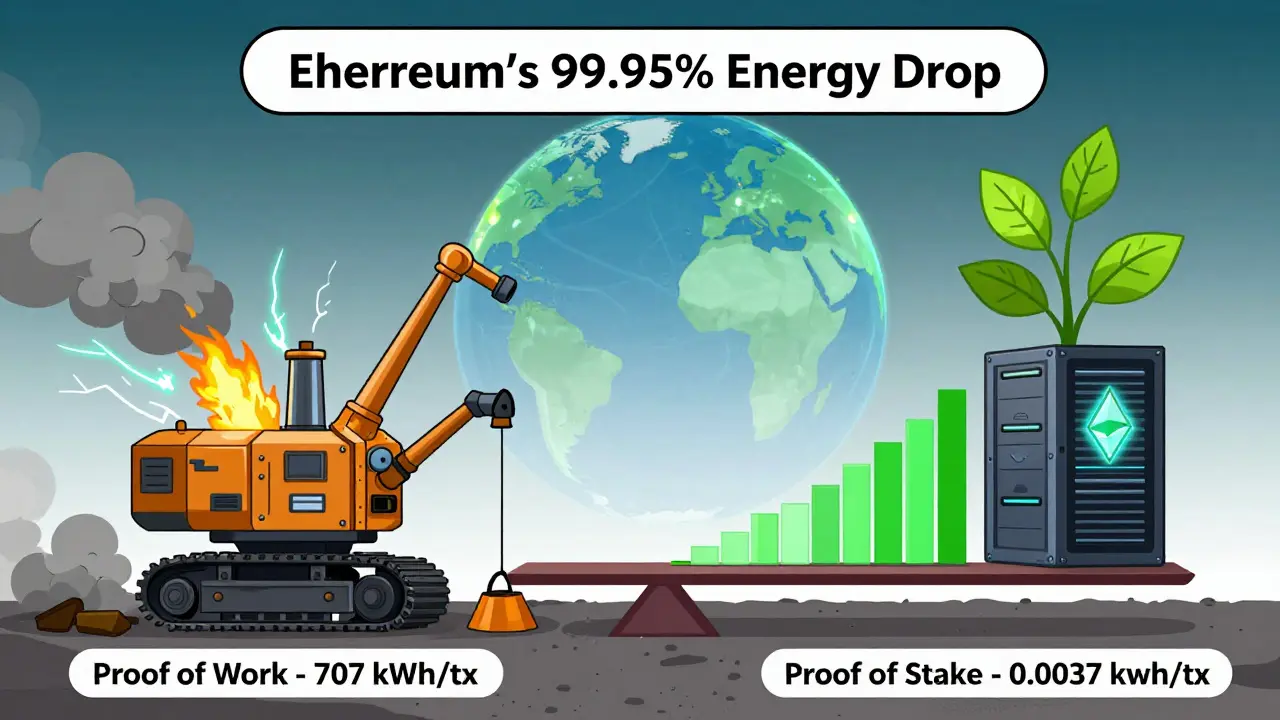
Permissioned Chains: PBFT and the Enterprise Model
Not all blockchains are public. Some, like Hyperledger Fabric or Ripple, are permissioned. That means only approved nodes can join. These networks don’t need PoW or PoS. They use something called Practical Byzantine Fault Tolerance (PBFT). PBFT works like a committee vote. One node proposes a block. Others say “yes” or “no.” Once two-thirds agree, the block is locked in. It’s fast - finality in 3-5 seconds. It’s efficient. And it scales well… up to about 100 nodes. That’s why banks and supply chain companies love it. JPMorgan uses it for Interbank Information Network. Walmart uses it to track food shipments. They don’t need decentralization. They need speed, control, and certainty. But here’s the catch: if you control the node list, you control the network. That’s not blockchain as most people imagine it. It’s a distributed database with a fancy name. Still, for enterprise use? It’s often the right tool.Other Players: Ripple, Stellar, and Hybrid Models
Ripple’s consensus algorithm is different. Instead of mining or staking, it uses Unique Node Lists (UNLs). Each participant picks a list of trusted validators - usually banks or financial institutions. Consensus happens when at least 80% of these trusted nodes agree. It’s fast. It’s cheap. But it’s also centralized by design. Stellar uses Federated Byzantine Agreement (FBA). Think of it as PBFT with a twist. Instead of a fixed list of validators, each node picks its own group of trusted peers - called quorum slices. If enough of these slices overlap, consensus emerges. It’s decentralized, but not in the Bitcoin sense. It’s more like a network of friendships. And then there are hybrids. VeChain combines PoS with Proof of Authority (PoA) for enterprise clients. Solana uses Proof of History (PoH) to timestamp transactions before they even reach PoS. These aren’t just variations - they’re new architectures built for specific problems.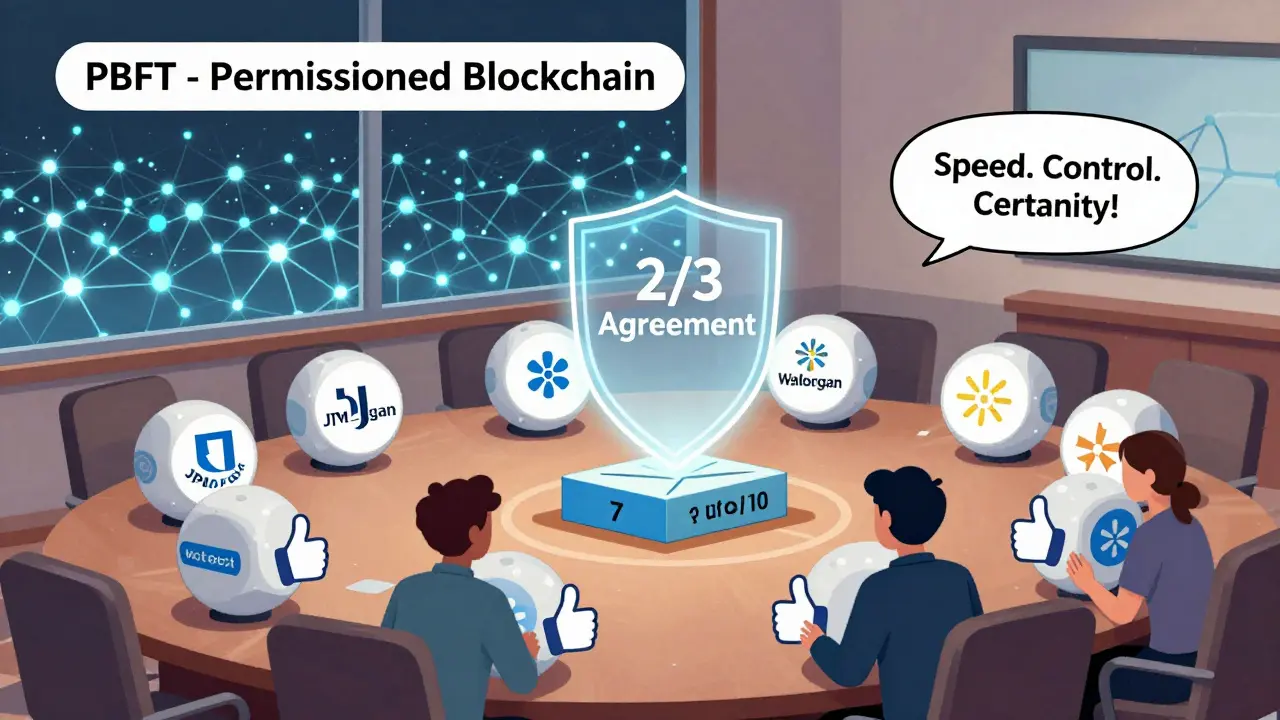
Performance and Trade-offs: What Works Where?
Here’s how the big players stack up:| Mechanism | Throughput (TPS) | Finality Time | Energy/Transaction | Best For |
|---|---|---|---|---|
| Proof of Work (Bitcoin) | 7 | 60+ minutes | 707 kWh | Store of value, security-first |
| Proof of Stake (Ethereum) | 15-45 | 12-15 seconds | 0.0037 kWh | Smart contracts, DeFi |
| Proof of History + PoS (Solana) | 65,000 | 2-4 seconds | 0.001 kWh | High-speed apps, gaming |
| PBFT (Hyperledger) | 1,000+ | 3-5 seconds | 0.0001 kWh | Enterprise, permissioned networks |
| Ripple Consensus | 1,500 | 3-5 seconds | 0.00005 kWh | Payments, cross-border |
Each mechanism trades off speed, security, decentralization, and cost. PoW is slow but bulletproof. PoS is fast and green but risks centralization. PBFT is lightning-fast but only works in closed groups.
What’s Next?
The future isn’t one consensus mechanism. It’s a mix. Ethereum’s Deneb upgrade will push throughput to 100,000 TPS. Bitcoin’s Layer 2 Stacks network is testing Proof of Transfer - a way to use Bitcoin’s security without its energy cost. Meanwhile, 47% of Fortune 500 companies now use some form of blockchain, mostly with PBFT or hybrid models. Regulators are catching up. The EU’s MiCA rules label PoW as environmentally unsustainable. The U.S. SEC is watching staking pools closely. And in 32 countries, PoW mining is now restricted or taxed. The real winners? Systems that match the tool to the job. Bitcoin stays PoW because security matters more than speed. Ethereum moved to PoS because scale and sustainability matter. Enterprises use PBFT because control matters. Consensus isn’t about being the most decentralized. It’s about being the most appropriate.Can a blockchain have more than one consensus mechanism?
Yes. Many blockchains now use hybrid models. For example, Solana uses Proof of History to timestamp transactions and Proof of Stake to validate them. VeChain combines PoS for validator selection with Proof of Authority for enterprise nodes. Even Bitcoin’s Layer 2 networks like Stacks are experimenting with Proof of Transfer, which ties Bitcoin’s security to another chain’s consensus. This isn’t a flaw - it’s evolution.
Why does Proof of Work use so much energy?
PoW requires miners to solve cryptographic puzzles using powerful computers running 24/7. The harder the puzzle, the more energy it takes. This isn’t waste - it’s intentional. The energy cost makes attacks too expensive to be profitable. Each Bitcoin transaction uses about 707 kWh - enough to run a microwave for over 12 hours. That’s why alternatives like PoS were created.
Is Proof of Stake really more secure than Proof of Work?
It’s different, not necessarily better. PoW’s security comes from physical cost - you need expensive hardware and electricity. PoS’s security comes from economic cost - you must lock up real money, and if you cheat, you lose it. PoS prevents 51% attacks by making them financially suicidal. But it introduces new risks, like staking pool centralization. Neither is perfect. The best choice depends on your threat model.
Can I run a validator node on my home computer?
For Ethereum’s PoS? Technically yes - but only if you stake 32 ETH (about $1,800). You’ll need a stable internet connection and reliable hardware. Most people join staking pools instead because it’s cheaper and easier. For PBFT networks like Hyperledger, you can run a node on a regular laptop - but only if you’re invited by the network operator. Public chains are open; permissioned chains are not.
What happens if a consensus mechanism fails?
It depends. In PoW, if a miner gains too much power, they could double-spend or halt the network - but this is rare and expensive. In PoS, a validator who tries to cheat gets slashed - their stake is destroyed. In PBFT, if too many nodes go offline or lie, the network stalls until enough honest nodes rejoin. Most systems have fallbacks. The blockchain doesn’t crash - it just stops accepting new transactions until the issue is fixed.
13 Comments
Consensus isn't magic. It's math dressed up as trust. PoW works because it turns electricity into permanence. That's the real trade-off: energy for immutability. Stop pretending it's 'wasteful' - it's a feature, not a bug.
I must say, I find the entire premise of Proof of Stake... rather unsettling. The notion that one's financial stake equates to moral authority? It reeks of plutocracy. And let us not forget: centralization is not a bug-it is the inevitable architecture of any system that privileges capital over computation.
Love how you broke this down! PoW vs PoS isn't about right or wrong-it's about what you're trying to protect. Bitcoin = digital gold, Ethereum = programmable economy. Different tools, same goal. Also, PBFT for enterprise? Totally valid. Not everything needs to be decentralized to be useful.
I've been saying this for YEARS. PoS is just Wall Street with a blockchain logo. They took the 'trustless' out and replaced it with 'trust me, I'm rich.' And don't even get me started on Lido and Coinbase. They're not validators-they're oligarchs in hoodies.
The energy argument is a distraction. PoW isn't inefficient-it's a deterrent. If you want efficiency, use a database. Blockchain isn't about efficiency. It's about irreversibility. Stop conflating goals.
You mention 51% attacks on forks. But you ignore that the main chain has been attacked multiple times via MEV, frontrunning, and validator collusion. PoW is not secure. It's just slow. And slow is not the same as safe.
Honestly? This post nailed it. Consensus isn't about being the most decentralized. It's about being the most appropriate. Bitcoin stays PoW because it's a vault. Ethereum went PoS because it's a factory. Different jobs. Different tools. No need to fight about it.
I've been running a node on my old laptop for 3 years. It's not glamorous. But it's mine. And that's the point. Decentralization isn't about power-it's about ownership. Even a single node adds to the resilience.
They say PoS is more secure. But what if the validators are all controlled by the same five VC firms? What if the government pressures them to censor transactions? What if the 32 ETH requirement is just the first step to KYC-ifying crypto? This isn't progress. It's surrender.
PBFT isn't blockchain. It's a database with a blockchain-shaped sticker. And Ripple? That's a private ledger masquerading as public. If you need permission to join, you're not building a blockchain-you're building a corporate intranet with extra steps.
The future is hybrid consensus. Proof of History for timestamping. Proof of Stake for finality. Proof of Transfer for cross-chain security. This isn't fragmentation. It's specialization. The best systems don't force one size. They adapt to the problem.
All this talk about energy consumption. But no one mentions the carbon footprint of mining rigs being shipped across continents. Or the e-waste from GPUs dying after 18 months. Or the fact that PoS validators still need servers. The green narrative is a lie.
PoW isn't about energy. It's about cost. The cost of cheating is higher than the reward. That's the only thing that matters. Everything else is noise.