
Types of Blockchain Consensus Mechanisms Explained: PoW, PoS, and More
Imagine a world where you can send money to someone across the globe without a bank, yet no one can cheat or double-spend. That’s the promise of blockchain. But how does a network of strangers agree on who owns what? They don’t use a central boss. Instead, they use blockchain consensus mechanisms. These are the rules that let computers talk to each other and agree on the truth.
If you’ve heard terms like "mining," "staking," or "validators" but felt lost, you’re not alone. The tech sounds complex, but the core idea is simple: it’s about trust in a system designed for distrust. In this guide, we’ll break down the main types of consensus mechanisms, how they work, and why they matter for the future of digital value.
What is a blockchain consensus mechanism?
A blockchain consensus mechanism is a protocol that enables distributed networks to agree on the state of a shared ledger without requiring trust between participants. It ensures data integrity, prevents double-spending, and maintains security across decentralized networks while enabling participants to collectively validate transactions.
The Core Problem: The Byzantine Generals Problem
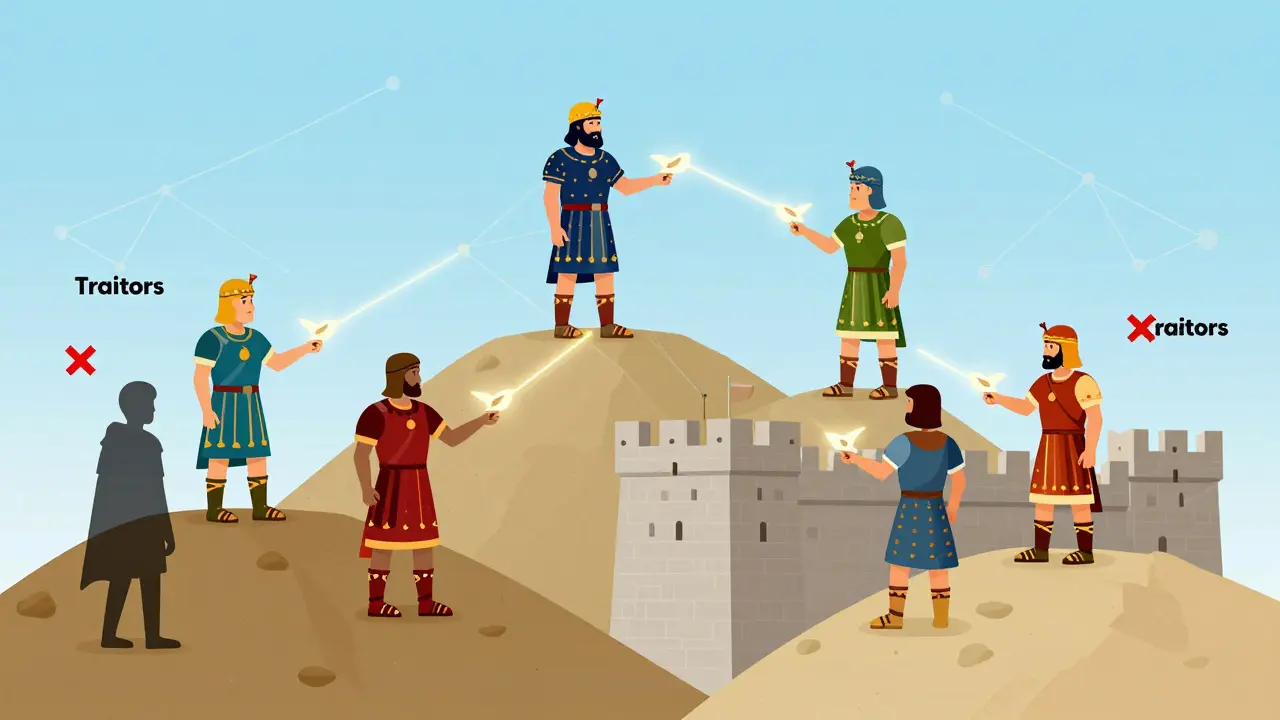
Before diving into the specific mechanisms, you need to understand the problem they solve. Computer scientists call it the Byzantine Generals Problem, which is a theoretical scenario where multiple parties must agree on a single plan of action despite potential traitors or failures among them. Imagine several generals surrounding a city. They must all attack at the same time to win. If some attack early and others late, they lose. But what if some messengers are captured or lie? How do they ensure everyone agrees?
In blockchain terms, the "generals" are the nodes (computers) on the network. Some might be offline, slow, or even malicious. A consensus mechanism ensures that even if some nodes fail or act badly, the honest majority still agrees on the correct version of the ledger. This is critical for permissionless blockchains like Bitcoin, where anyone can join, and no one knows who anyone else is.
Proof of Work (PoW): The Original Guardian
Proof of Work is the first practical implementation of a consensus mechanism in blockchain, created by Satoshi Nakamoto in 2008 for Bitcoin. It’s the method that started it all. Here’s how it works: miners compete to solve a complex cryptographic puzzle. The first one to solve it gets to add the next block of transactions to the blockchain and earns a reward. The puzzle requires massive computational power, making it expensive to try and cheat the system.
- How it works: Miners use specialized hardware (ASICs) to perform SHA-256 hashing billions of times per second.
- Security: To alter past transactions, an attacker would need more than 51% of the network’s total computing power. For Bitcoin, this would cost over $10 billion, according to a 2021 National Bureau of Economic Research study.
- Drawbacks: It consumes enormous energy. As of June 2023, Bitcoin’s PoW consumed approximately 110.25 terawatt-hours annually, comparable to the electricity usage of medium-sized countries.
- Performance: Bitcoin processes about 7 transactions per second (TPS), with finality taking around 60 minutes (6 confirmations).
Andreas Antonopoulos, author of 'Mastering Bitcoin,' argues that PoW remains the only mechanism proven secure at scale for permissionless networks over a long period. However, its environmental impact has driven many projects to seek alternatives.
Proof of Stake (PoS): The Energy-Efficient Shift
Proof of Stake is a consensus mechanism where validators are chosen to create new blocks based on the amount of cryptocurrency they hold and are willing to 'stake' as collateral. Instead of burning electricity to solve puzzles, validators lock up their coins. If they act honestly, they earn rewards. If they try to cheat, they lose their staked funds-a penalty called "slashing."
Ethereum made headlines when it completed its transition from PoW to PoS in September 2022, known as "The Merge." This shift reduced Ethereum’s energy consumption by approximately 99.95%. Here’s what you need to know about PoS:
- Requirements: On Ethereum, validators must stake 32 ETH (worth roughly $51,200 at current prices) to participate.
- Rewards: Validators can earn an annual return rate of up to 4.3%, depending on network conditions.
- Performance: Ethereum 2.0 handles 15-45 TPS with finality in 12-15 minutes.
- Challenges: Critics point to the "nothing at stake" problem, where validators might theoretically vote for multiple chain histories simultaneously since it costs them little to do so. Protocols mitigate this with slashing conditions.
Emin Gün Sirer, CEO of Ava Labs, argues that PoS provides equivalent security to PoW with orders of magnitude less energy. As environmental regulations tighten globally, PoS is becoming the dominant choice for new public blockchains.
Practical Byzantine Fault Tolerance (PBFT): Speed for Enterprises
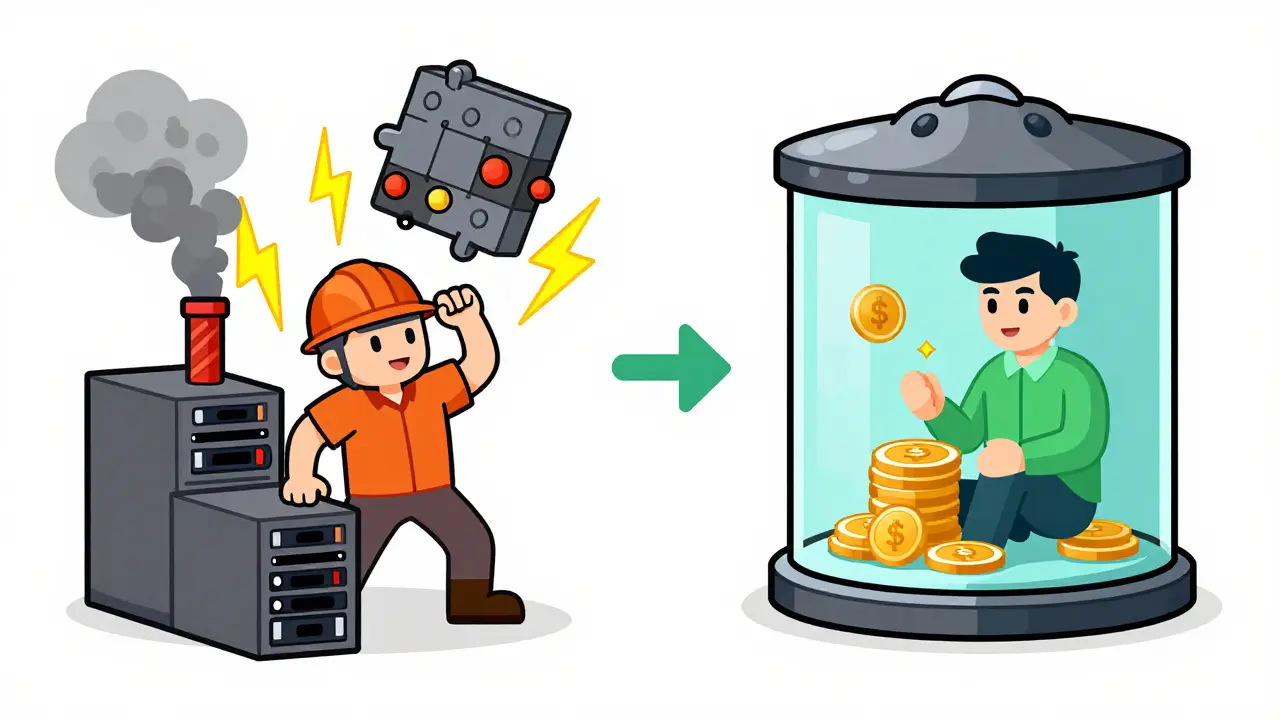
While PoW and PoS dominate public chains, enterprises often prefer Practical Byzantine Fault Tolerance, which is a consensus algorithm designed for high throughput and near-instant finality in permissioned networks. PBFT doesn’t rely on mining or staking. Instead, nodes communicate directly to reach agreement through a series of voting rounds.
- Tolerance: PBFT can tolerate up to (n-1)/3 malicious nodes in a network of n nodes. If you have 10 nodes, up to 3 can be bad, and the system still works.
- Speed: Achieves consensus in 3-4 communication steps, offering near-instant finality.
- Throughput: Implementations like Hyperledger Fabric can achieve 3,500 TPS.
- Limitation: Communication overhead limits the number of nodes. Most PBFT systems cap out at around 100 nodes because every node talks to every other node.
A Deloitte survey of 1,280 enterprise executives found that 67% of enterprise blockchain implementations use PBFT or variants. Walmart, for example, uses PBFT for its food traceability system, citing 99.99% uptime and sub-second finality. It’s fast and reliable, but it sacrifices decentralization-ideal for companies that control their own network, not for open public ledgers.
Delegated Proof of Stake (DPoS): Voting for Validators
Delegated Proof of Stake is a variant of PoS where token holders vote for a small number of delegates to validate transactions on their behalf. Think of it like a representative democracy. Instead of every coin holder validating blocks, they vote for trusted producers. This makes the network faster and more efficient but more centralized.
- Example: EOS uses DPoS, with 21 block producers elected by token holders.
- Performance: EOS can process approximately 4,000 TPS with block times of 0.5 seconds.
- Trade-off: High speed comes at the cost of decentralization. With only 21 producers, collusion or failure among a few could compromise the network.
DPoS is popular for applications needing high transaction speeds, such as gaming or social media platforms built on blockchain. However, critics argue it undermines the core ethos of decentralization.
Other Notable Mechanisms
Beyond the big three, several other consensus models serve specific niches:
- Proof of Authority (PoA): Validators are identified real-world entities. Used in VeChain, it offers 50-100 TPS with 10-second finality. It’s fast but relies on trusting a pre-approved set of validators. Alex Gluchowski, a developer, noted that PoA creates single points of failure, citing a 72-hour outage in POA Network in January 2023.
- Ripple Protocol Consensus Algorithm (RPCA): Used by XRP Ledger, it requires an 80% super-majority vote from nodes on a Unique Node List (UNL). Settlement times are under 5 seconds. However, MIT research showed 66% of UNL nodes are operated by Ripple Labs, raising centralization concerns.
- Stellar Consensus Protocol (SCP): Uses "quorum slices," where each node defines its own trusted validators. Global consensus emerges when these quorums intersect. It’s flexible but complex to configure correctly.
Comparing Consensus Mechanisms
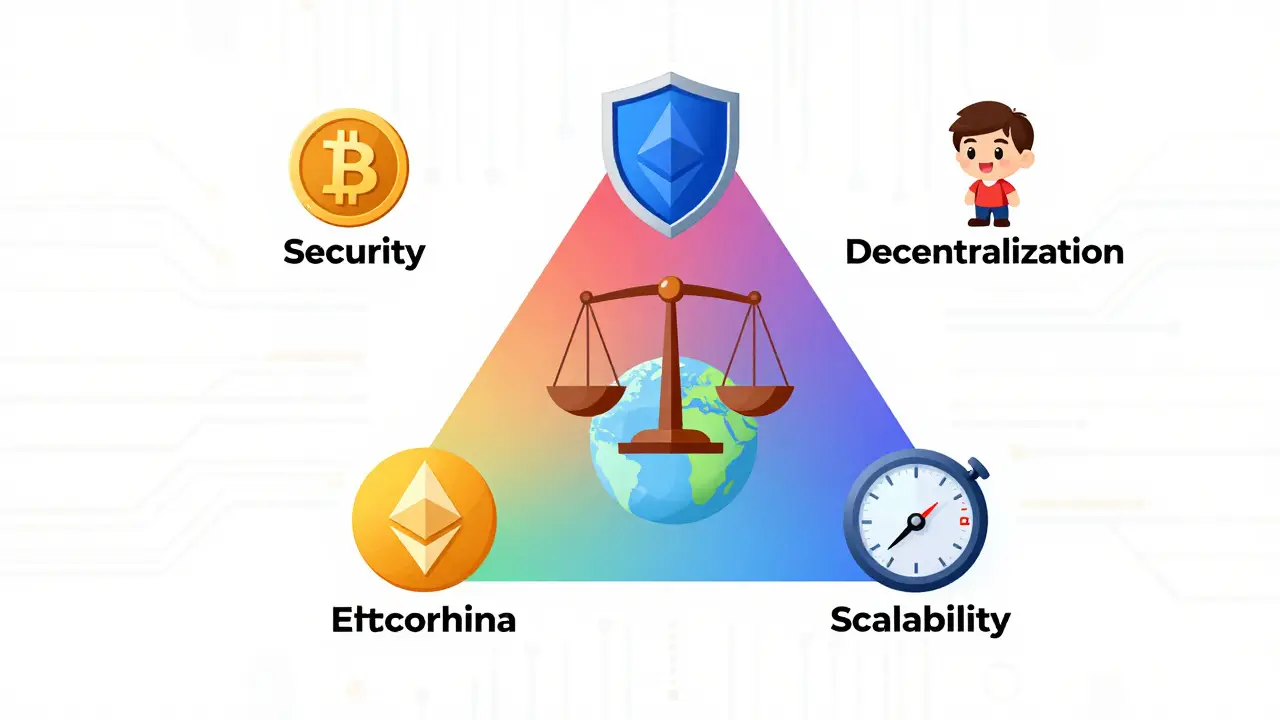
Choosing the right mechanism depends on your priorities: security, speed, or decentralization. Vitalik Buterin’s "blockchain trilemma" states you can only optimize for two of these three at any given time.
| Mechanism | Key Example | Transactions Per Second (TPS) | Finality Time | Energy Use | Decentralization |
|---|---|---|---|---|---|
| Proof of Work (PoW) | Bitcoin | ~7 | ~60 mins | Very High | High |
| Proof of Stake (PoS) | Ethereum | 15-45 | 12-15 mins | Very Low | Medium-High |
| PBFT | Hyperledger Fabric | ~3,500 | Near-instant | Low | Low (Permissioned) |
| DPoS | EOS | ~4,000 | 0.5 secs | Low | Medium |
| Proof of Authority (PoA) | VeChain | 50-100 | 10 secs | Low | Low |
Future Trends and Challenges
The landscape is evolving rapidly. Hybrid mechanisms are rising, with 37% of new projects combining PoS and PBFT elements to balance security and speed. Ethereum’s upcoming upgrades aim to push scalability to 100,000 TPS via proto-danksharding. Meanwhile, quantum computing poses a long-term threat; Google estimates quantum-resistant consensus will be necessary by 2030.
Regulatory pressures also shape choices. The EU’s MiCA regulations require PoS validators to register as service providers, potentially impacting 85% of Ethereum staking providers. In the US, PoW mining faces scrutiny over energy use, with 23 states regulating or incentivizing renewable energy for miners.
For developers and businesses, the decision isn’t just technical-it’s strategic. Do you prioritize absolute decentralization like Bitcoin, or do you need the speed of PBFT for supply chain tracking? Understanding these trade-offs is key to building resilient blockchain solutions.
Which consensus mechanism is best for beginners?
For beginners looking to participate, Proof of Stake (PoS) is generally easier. You don’t need expensive mining hardware. You can stake coins through user-friendly platforms, though solo validation requires technical knowledge. PoW requires significant investment in ASIC miners and electricity.
Is Proof of Stake really as secure as Proof of Work?
Most experts believe PoS offers comparable security to PoW for most use cases. While PoW has a longer track record, PoS introduces economic penalties (slashing) that make attacks costly. However, PoS faces unique challenges like the "nothing at stake" problem, which protocols mitigate through careful design.
Why do enterprises prefer PBFT?
Enterprises prioritize speed and predictability. PBFT offers near-instant finality and high throughput (thousands of TPS), which is crucial for financial settlements or supply chain tracking. Since enterprises control their own networks, they don’t need the extreme decentralization of public chains.
What is the "Blockchain Trilemma"?
Coined by Vitalik Buterin, the trilemma states that blockchains can only optimize for two of three properties: scalability, decentralization, and security. For example, Bitcoin maximizes security and decentralization but lacks scalability. Ethereum aims to balance all three through ongoing upgrades.
Will quantum computing break blockchain consensus?
Quantum computers could potentially break current cryptographic algorithms used in consensus mechanisms. However, researchers are already developing quantum-resistant protocols. Google estimates these will become necessary by 2030, giving the industry time to adapt.
14 Comments
Wow, this is exactly the kind of clarity I needed today! I've been staring at whitepapers for weeks and my brain just melts. The way you broke down the Byzantine Generals Problem actually made it click for me. It’s wild to think that all this complexity is just to solve a trust issue between strangers. Thank you for making this accessible!
the transition from proof of work to proof of stake represents not merely a technical shift but a philosophical evolution in how we conceptualize value and security within digital ecosystems where the energy expenditure previously served as a tangible barrier to entry now replaced by economic stake which introduces new dynamics regarding centralization tendencies and the potential for wealth concentration among early adopters who hold significant portions of the network's total supply thereby altering the democratic ideals initially proposed by satoshi nakamoto
They want you to believe PBFT is safe for enterprises but have you considered that the very nodes validating your transactions are likely owned by the same three mega-corporations that monitor your every move? The 'permissioned' aspect is just a polite term for controlled access where the generals are not independent actors but puppets dancing on strings held by regulatory bodies eager to crush any semblance of true anonymity under the guise of compliance and efficiency metrics that serve only their own auditing needs.
Great breakdown! 🚀 One thing I’d add about PoS is that while slashing conditions exist, they aren't always perfectly enforced across all chains. Some newer protocols are experimenting with 'slashing-free' models to encourage participation, though that does introduce its own risks. Also, don't sleep on Layer 2 solutions-they’re changing the TPS game regardless of the base layer consensus! 💡
I really appreciate how you highlighted the trade-offs here. It’s easy to get caught up in the hype of high TPS numbers without realizing what gets sacrificed in terms of decentralization. I’ve been following EOS closely and seeing the producer collusion issues firsthand has made me much more cautious about DPoS networks. Thanks for reminding us that there’s no free lunch in blockchain design.
Honestly, I think people overrate PoW’s security just because it’s old news. Bitcoin’s security comes from its massive market cap and network effect, not necessarily the mining process itself being superior in a vacuum. If Ethereum had started with PoW, would it be as secure today? Probably not, given the different threat models. PoS is just better suited for the modern web3 ecosystem where speed and sustainability matter more than burning coal.
This is such a helpful guide for anyone trying to understand the basics! I love how you included real-world examples like Walmart using PBFT. It helps bridge the gap between abstract theory and practical application. For those interested in getting involved, staking pools are a great entry point for PoS since you don’t need 32 ETH. Let’s keep learning together! 🌟
it is imperative to note that the delegation model inherent in dpos fundamentally undermines the cryptographic assurance provided by pure proof of stake systems as the voting mechanism introduces human error and political maneuvering into what should be an algorithmic process thereby creating a fragile hierarchy where block producers can collude or be bribed leading to a situation where the integrity of the ledger is compromised not by computational power but by social engineering and centralized control structures that mimic traditional corporate governance
typo alert: u guys keep saying finality takes 12-15 mins for eth but thats wrong if u use l2s it instant lol. also pow isnt dead yet so stop crying about energy usage when ur pos validators are just running on aws servers anyway. typical tech bro take.
Ah yes, the classic 'trust but verify' approach, except in blockchain we barely trust and definitely don't verify unless we're running a full node ourselves. 😒 The idea that quantum computing will break everything by 2030 is probably just another FUD tactic to sell quantum-resistant wallets before the tech even exists. But sure, let's panic about Schrödinger's hash functions while ignoring the fact that most of these chains are already broken by simple economic attacks.
The section on RPCA was particularly interesting. It’s fascinating how Ripple manages to maintain such fast settlement times despite the centralization concerns. While purists might argue against it, for cross-border payments, speed often trumps absolute decentralization. I wonder if the EU regulations mentioned will force other networks to adapt similar unique node lists to comply with local laws.
Thank you for this comprehensive overview. It is crucial for developers to understand that choosing a consensus mechanism is not just a technical decision but a strategic one that aligns with the specific goals of the project. For instance, if transparency and immutability are paramount, PoW or robust PoS may be preferred, whereas for supply chain logistics, the speed of PBFT is indispensable. We must respect the diversity of solutions available.
So true! Keep building! 💪
you morons dont understand the fundamental flaw in all these mechanisms is that they rely on rational actors which never exist in reality because humans are irrational and greedy and will always find a way to exploit the system regardless of whether its pow pos or pbft so the whole premise of decentralized trust is a fallacy created by computer scientists who have no idea how society actually works and will eventually collapse under its own weight leaving us back to banks which at least have lawyers to sue you if you try to cheat them unlike these anonymous code monkeys