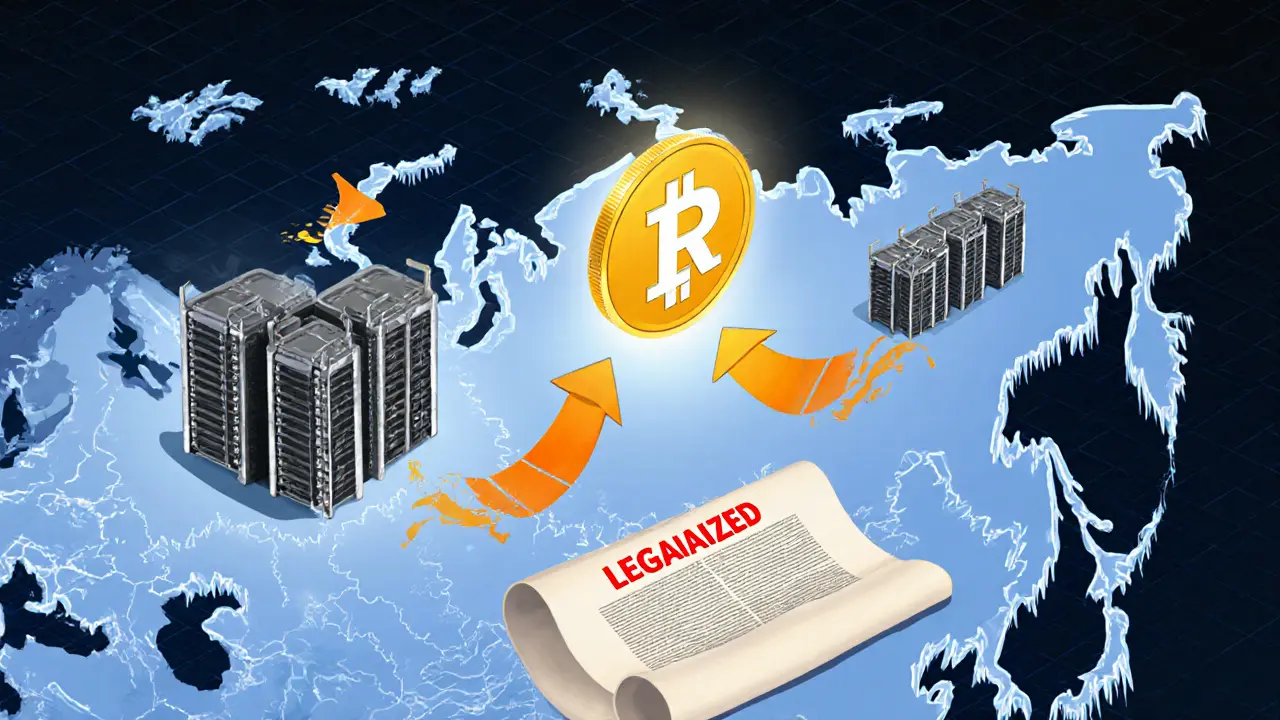
Crypto Mining Legalization: What It Means for Traders and Investors
When talking about crypto mining legalization, the effort to make cryptocurrency mining activities lawful under a specific jurisdiction’s rules. Also known as mining regulation, it sets the stage for how miners, exchanges, and investors operate. This process directly touches the core of crypto mining legalization because governments decide whether proof‑of‑work networks can run openly. The legal status determines tax treatment, licensing requirements, and the ability to secure financing for large‑scale farms.
Key Players and Policies Shaping the Landscape
One of the first concepts you’ll encounter is Proof‑of‑Work, the consensus mechanism that requires miners to solve computational puzzles to add new blocks. Because PoW consumes a lot of electricity, Energy Policy, government rules governing power generation, pricing, and environmental standards becomes a decisive factor. Countries with cheap, renewable‑heavy grids often become hot spots for mining farms, while strict carbon caps can push miners to relocate. At the same time, the type of Mining Equipment, the hardware—like ASICs or GPUs—used to perform hashing operations is regulated through import tariffs and safety standards, affecting cost structures and profit margins. Understanding how these three pieces—PoW, energy policy, and equipment rules—interact helps you gauge the risk and opportunity in any jurisdiction.
Regulatory bodies also publish specific mining licenses, environmental impact assessments, and reporting obligations. When a government issues a clear framework, miners can invest confidently, exchanges can list newly mined coins without fear of sudden bans, and investors gain price stability. Conversely, ambiguous or shifting rules create market volatility, as seen in recent mining bans and sudden policy reversals. Below you’ll find a curated set of articles that break down the latest legal developments, compare regional approaches, and offer practical tips for navigating the ever‑changing world of crypto mining legalization.
Russia's new crypto mining law lets the state generate digital currency revenue, supporting sanctions evasion via the A7A5 stablecoin and a network of sanctioned exchanges. Western sanctions target miners, exchanges, and the financial bridges enabling the scheme.
Read More