
SushiSwap on Polygon: Crypto Exchange Review for 2026

When you want to trade crypto without handing over your keys, SushiSwap on Polygon is one of the most powerful options available. It’s not just another DEX. It’s a full DeFi ecosystem built on a fast, cheap blockchain - and it’s been growing steadily since 2021. If you’ve ever paid $30 in gas fees to swap tokens on Ethereum, you already know why this matters.
What is SushiSwap on Polygon?
SushiSwap started as a fork of Uniswap in 2020. It wasn’t meant to just copy Uniswap - it was built to improve it. The big twist? It gave users a token, SUSHI, to reward them for providing liquidity. That idea caught fire. By May 2021, SushiSwap launched on Polygon, a Layer 2 scaling solution for Ethereum. That move changed everything.
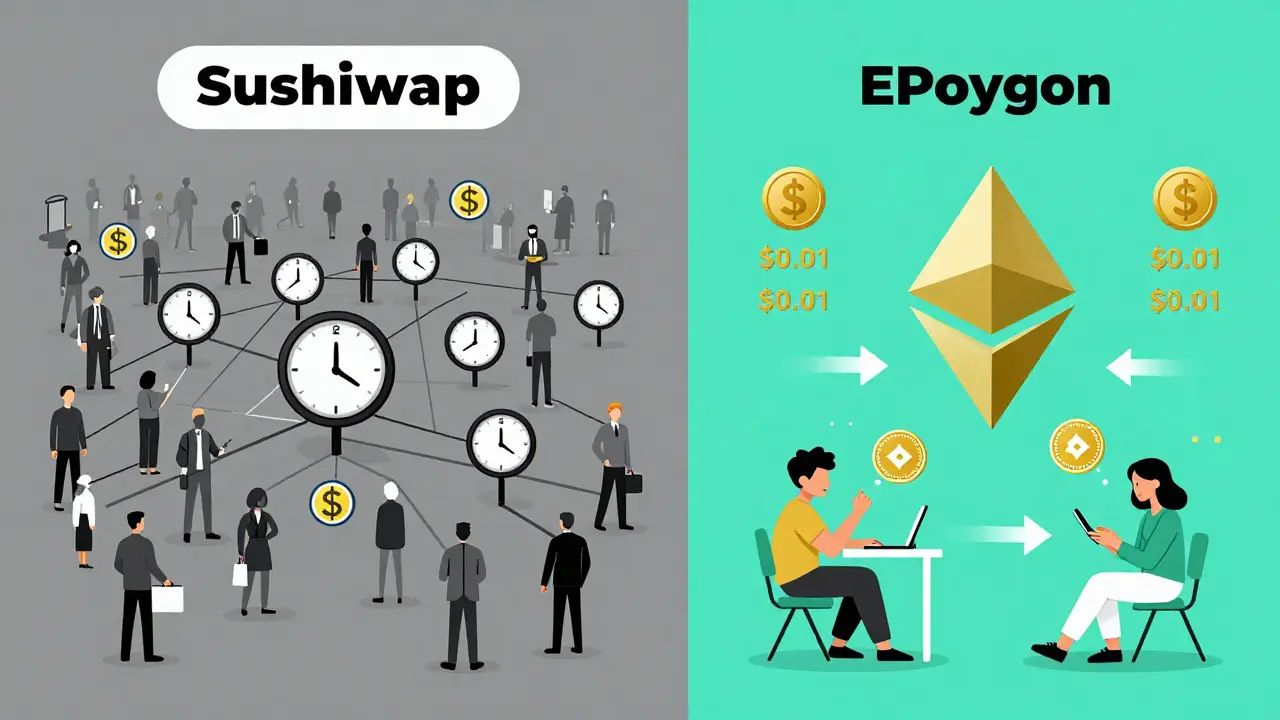
On Polygon, SushiSwap keeps the same core idea: no middlemen, no order books, just smart contracts that match trades using liquidity pools. But now, instead of paying $10-$50 per swap on Ethereum, you pay between $0.01 and $0.10. Transactions finish in 2-3 seconds, not 15+.
It’s not just swapping. SushiSwap on Polygon lets you earn by staking, lend, borrow, and farm yields - all in one place. You’re not just trading. You’re participating in a financial system built by code, not banks.
How SushiSwap Works on Polygon
At its heart, SushiSwap uses an automated market maker (AMM). That means there’s no buyer or seller waiting to match your order. Instead, pools of tokens - like USDC/ETH or WETH/USDT - are locked in smart contracts. You swap one token for another by interacting with these pools.
Here’s how it works in practice:
- You connect your wallet (MetaMask, Coinbase Wallet, or Trust Wallet).
- You pick the tokens you want to swap - say, USDC for MATIC.
- You set your slippage tolerance (usually 0.5%-1% is safe).
- You confirm the transaction. Done.
Behind the scenes, the smart contract calculates the price based on the ratio of tokens in the pool. The more people trade, the more the price adjusts. It’s simple, transparent, and automated.
The real magic? You never give up control of your crypto. Your wallet holds everything. SushiSwap never touches your funds. That’s the whole point of decentralized finance.
Why Polygon? Speed, Cost, and Scale
Polygon isn’t just a sidechain - it’s a full ecosystem built to solve Ethereum’s biggest problems: slow speeds and crazy fees.
Here’s what you get on Polygon vs. Ethereum:
| Feature | Polygon | Ethereum Mainnet |
|---|---|---|
| Average Swap Fee | $0.01-$0.10 | $10-$50+ |
| Transaction Speed | 2-3 seconds | 15-60+ seconds |
| Network Congestion | Rare | Frequent during bull runs |
| Token Compatibility | Most ERC-20 tokens | All ERC-20 tokens |
As of 2025, Polygon handles around 30-40% of all SushiSwap volume. That’s not small - it’s the backbone of its growth. Users aren’t just moving because it’s cheaper. They’re moving because it’s usable.
SUSHI Token: More Than Just a Trading Pair
The SUSHI token is the engine behind everything. It’s not just a currency - it’s a governance tool, a staking asset, and a reward mechanism.
Here’s what you can do with SUSHI:
- Stake it for xSUSHI - a tokenized version that earns you a share of platform fees.
- Vote on proposals - like which new tokens to list, how to spend the treasury, or whether to change fee structures.
- Earn rewards by providing liquidity in SUSHI pools.
As of October 2025, SUSHI trades at $2.19 with a market cap of $574 million. That’s down from its all-time high of $23.38 in 2021 - but it’s also far above its 2024 low of $0.45. The token’s value is tied directly to usage. More trades = more fee revenue = more value for SUSHI holders.
But here’s the catch: 10% of SUSHI tokens are held by just 5 wallets. That’s a risk. If those holders collude, they could push governance votes in their favor. It’s not a crisis - but it’s something you should know before diving in.
How SushiSwap Compares to Other Polygon DEXes
Polygon has over a dozen DEXes. So why choose SushiSwap over QuickSwap or Uniswap V3?
QuickSwap is faster and more native to Polygon. It’s simpler. It’s cleaner. But it’s mostly just a swap tool.
Uniswap V3 is more efficient for large trades thanks to concentrated liquidity. But it doesn’t offer staking, lending, or yield farming on Polygon.
SushiSwap? It’s the only one that gives you all of it:
- Swap
- Stake (xSUSHI)
- Farm (yield pools)
- Lend and borrow (via Kashi)
- Vote on governance
If you’re a trader who just wants to swap tokens, QuickSwap might be better. But if you want to earn, grow, and have a say in where the platform goes - SushiSwap is unmatched.
Who Should Use SushiSwap on Polygon?
It’s not for everyone. Here’s who it’s best for:
- Experienced DeFi users - You know what slippage is. You understand impermanent loss. You’ve used wallets before.
- Yield farmers - You’re looking for high APYs on stablecoin pools or SUSHI/ETH pairs.
- Long-term holders - You believe in community governance and want to earn from protocol fees.
It’s NOT for:
- Complete beginners - The interface is cluttered. You’ll get lost if you don’t know what a liquidity pool is.
- People who want customer support - There’s no phone line. No live chat. Just Discord and forums.
- Those scared of smart contract risk - Bugs happen. There have been exploits in the past. You’re responsible for your own safety.
Real User Experiences
Reddit and Discord are full of SushiSwap users. Here’s what they’re saying in 2025:
- “I swapped $5,000 of USDC for MATIC for $0.07 in fees. On Ethereum, that would’ve cost me $40.”
- “I started farming SUSHI/USDC and made 18% APY for three months. Then the price dropped and I lost value - but I still earned in fees.”
- “The interface is a mess. I spent two hours figuring out how to stake. The docs assume you already know everything.”
- “I used the bridge to move ETH from Ethereum to Polygon. Took 7 days to unlock. Frustrating, but I get why it’s there.”
Most complaints aren’t about the tech. They’re about the learning curve. If you’ve never used a wallet, you’ll need at least 2-3 hours just to get comfortable. If you want to farm or lend? Add another week.
What’s Next for SushiSwap on Polygon?
Development hasn’t stopped. In late 2024, SushiSwap V2 launched on Polygon, bringing concentrated liquidity - a feature Uniswap V3 made famous. That means better prices for large trades and less impermanent loss for liquidity providers.
Next up? zkEVM integration in 2025. That could cut fees even lower and add privacy features. It’s a big deal. If it works, SushiSwap could become the go-to DeFi hub on Polygon.
But challenges remain. Competition is fierce. Regulatory pressure is building. And SUSHI’s price volatility keeps new users away.
The real question isn’t whether SushiSwap works. It’s whether it can keep evolving fast enough to stay ahead.
Getting Started: A Simple Checklist
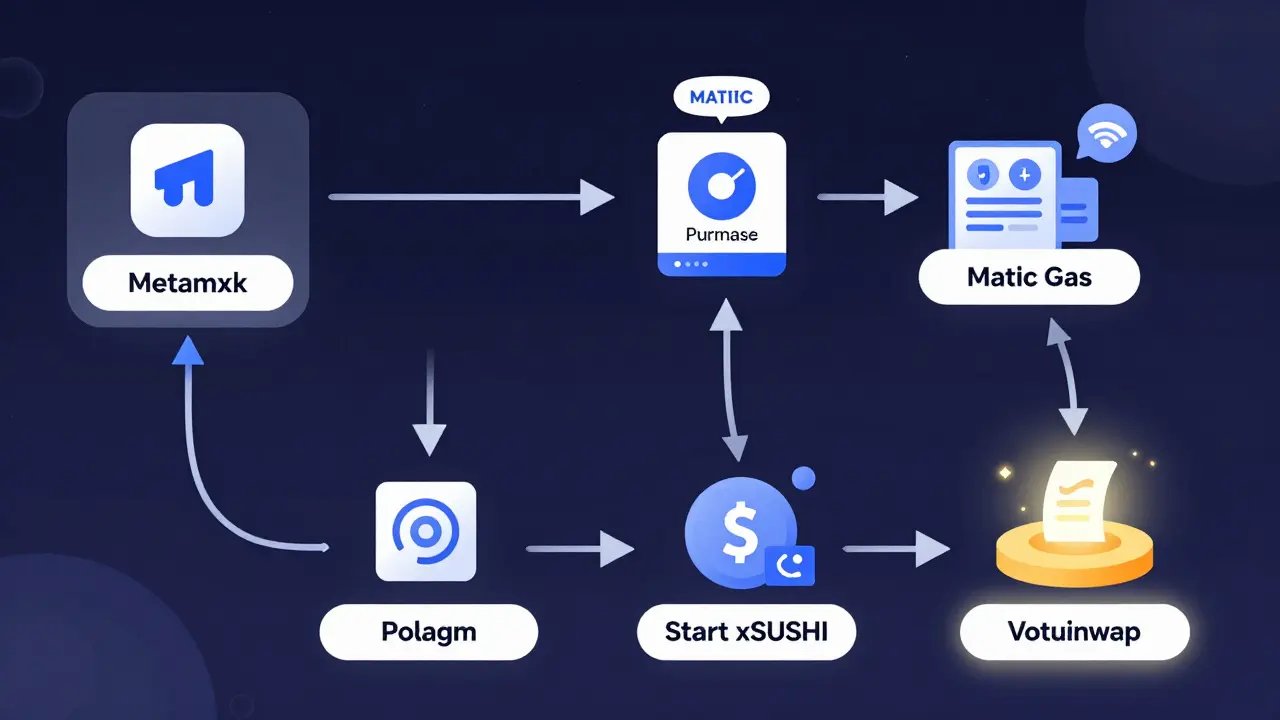
If you’re ready to try SushiSwap on Polygon, here’s how to start:
- Get a wallet: Install MetaMask or Coinbase Wallet.
- Add Polygon Network: Switch your wallet to Polygon (MATIC) mainnet.
- Buy MATIC: You need MATIC to pay for gas. Buy it on Binance, Coinbase, or Kraken.
- Go to app.sushi.com and connect your wallet.
- Swap your first token: Try USDC for WETH or USDT for MATIC.
- Explore staking: Click “Earn” and stake SUSHI for xSUSHI.
Start small. Try swapping $50 first. See how it feels. Then go deeper.
Final Thoughts
SushiSwap on Polygon isn’t perfect. It’s complex. It’s risky. It doesn’t hold your hand. But if you want a decentralized exchange that does more than swap - if you want to earn, vote, and build - it’s one of the best options on the market.
The fees are low. The features are deep. The community is active. And the tech keeps improving.
It’s not the easiest DeFi platform. But for those willing to learn, it’s one of the most rewarding.
Is SushiSwap on Polygon safe to use?
SushiSwap uses audited smart contracts and has been live since 2020. However, no DeFi platform is 100% safe. There have been past exploits, and smart contract bugs can happen. Always use small amounts first, never invest more than you can afford to lose, and never share your private key. The platform has no central authority to reverse transactions, so your safety depends on your own actions.
Do I need to own SUSHI to use SushiSwap?
No. You can swap any tokens without owning SUSHI. But if you want to earn extra rewards, stake for xSUSHI, or vote on governance, you’ll need to hold or stake SUSHI. It’s optional for trading, but essential for deeper participation.
How do I get SUSHI tokens?
You can buy SUSHI directly on SushiSwap by swapping another token like USDC, ETH, or MATIC. You can also earn it by providing liquidity to SUSHI trading pairs - for example, by adding USDC and SUSHI to a liquidity pool. Rewards are distributed automatically based on your share of the pool.
What’s the difference between SushiSwap and Uniswap on Polygon?
Uniswap V3 on Polygon is focused on efficient trading with concentrated liquidity. SushiSwap offers the same swap function but adds staking (xSUSHI), yield farming, lending (Kashi), and governance. If you only want to trade, Uniswap is cleaner. If you want to earn and influence the platform, SushiSwap has more tools.
Can I lose money using SushiSwap?
Yes. You can lose money in three ways: 1) The price of the tokens you trade drops after you swap. 2) You provide liquidity during high volatility and suffer impermanent loss. 3) You stake SUSHI and the token’s price falls. DeFi doesn’t guarantee profits - it gives you control, not protection.
How long does it take to bridge assets to Polygon?
Bridging from Ethereum to Polygon takes about 7 days for security reasons. This is a built-in delay to prevent exploits. Once assets are on Polygon, transfers between wallets or swaps on SushiSwap take under 3 seconds. If you need fast access, buy MATIC or other tokens directly on Polygon via exchanges like QuickSwap or Polygon’s own bridge.
21 Comments
Man, I swapped $2000 worth of USDC for MATIC last week and paid like 8 cents in gas. On Ethereum? That’d be a coffee and a donut right there. Polygon is the real MVP.
Stop overcomplicating it. SushiSwap on Polygon is the only way to trade if you’re not into paying $40 just to swap tokens. Get in or get out.
Look-I get that the interface is cluttered, and the docs assume you’re already a DeFi wizard-but that’s not a flaw, that’s a filter. If you’re not willing to learn how liquidity pools work, you shouldn’t be here. This isn’t Robinhood. It’s code. It’s math. It’s freedom. And freedom? It’s messy.
But once you get it? Once you stake your SUSHI, earn xSUSHI, and start voting on treasury proposals? You don’t just trade-you help build. That’s the magic. No CEO. No boardroom. Just a bunch of strangers with wallets and a shared belief that finance doesn’t need middlemen.
I’ve been in this space since 2021. I lost money on bad farms. I got rug-pulled once. But I also made 12x on a liquidity pool no one else noticed. That’s the risk. That’s the reward. And yes-it’s worth it.
Don’t let the learning curve scare you. Just start small. Swap $10. Watch the gas fee. Then try staking. Then add a pool. Slow. Steady. No FOMO. You’ll thank yourself in six months.
While the technical architecture of SushiSwap on Polygon is undeniably robust, it is imperative to acknowledge the systemic risks inherent in any non-custodial financial protocol. Smart contract vulnerabilities, governance centralization, and liquidity fragmentation remain material concerns that require rigorous due diligence prior to capital allocation.
Furthermore, the concentration of SUSHI tokens among a small number of wallets introduces a non-trivial governance risk profile that may undermine the decentralization thesis. One must also consider the regulatory arbitrage implications of deploying DeFi infrastructure on Layer 2 solutions under evolving global compliance frameworks.
That said, the composability of Kashi lending, xSUSHI staking, and yield farming mechanisms represents a significant advancement in DeFi utility. The protocol’s evolution toward zkEVM integration may further enhance scalability and privacy-two critical pillars for mainstream adoption.
SushiSwap on Polygon? More like SushiSwap on ‘Pay Me Later’-because everyone’s pretending this isn’t just a glorified gas station for degens. The ‘community governance’ is a joke-five wallets own 10% of SUSHI and they vote like it’s their personal Netflix account.
And don’t get me started on the ‘yield farming’-it’s just a fancy way of saying ‘I’m betting on a token that’ll crash next week.’ You think you’re earning? Nah. You’re just the sucker holding the bag when the liquidity dries up.
It’s not DeFi. It’s casino with a whitepaper.
Let’s zoom out. SushiSwap isn’t a DEX. It’s a social contract encoded in bytecode. It’s the embodiment of a post-bank world-where value isn’t assigned by institutions, but by consensus. Every swap is a vote. Every liquidity pool, a collective commitment to trustless exchange.
The fact that you can stake your SUSHI and earn governance power? That’s not a feature. That’s a revolution.
But here’s the existential question: Can a system built on code survive when the people behind it stop believing in its ideals? When SUSHI becomes just another speculative asset? That’s the real risk-not the gas fees, not the interface. It’s the erosion of ethos.
Are we building a financial system… or just a better ATM?
They say Polygon is safe but did you know the devs have ties to the same people who ran the Terra collapse? I mean, why else would they push this bridge delay? 7 days? That’s not security-that’s a backdoor to freeze your funds if the Feds come knocking. And don’t tell me it’s decentralized-look at the SUSHI whale addresses. They’re all from the same IP range. It’s all rigged.
Also, the SUSHI token? Totally a pump-and-dump. I’ve seen the charts. They’re manipulating the APYs to lure in newbies. They want your ETH, your USDC, your soul. Then poof-gone. Just like 2021.
Trust no one. Not even the code. 🤫
If you’re new to this, just start with $10. Swap USDC for MATIC. See how fast it is. Then try staking SUSHI for xSUSHI. It’s not scary once you do it once. I was terrified too-until I realized I wasn’t giving up my keys. I just clicked a button. And now I earn passive income just by holding. No boss. No 9-to-5. Just code working for me.
You got this. Seriously. Take one step. Then another. You’ll be surprised how far you go.
Ugh. Another ‘SushiSwap is the future’ post. Let’s be real-it’s a mess. The interface looks like a 2012 Android app. The docs are written by robots who hate humans. And don’t even get me started on the ‘community.’ It’s just a bunch of guys in Discord screaming about APYs while their wallets bleed.
It’s not revolutionary. It’s just cheaper than Ethereum. Big whoop.
I’ve been using SushiSwap on Polygon for over a year now. I don’t post often, but I wanted to say-this is the most reliable DeFi experience I’ve had. Low fees, fast swaps, and the staking rewards actually compound. I don’t chase 1000% APYs-I just keep my USDC/SUSHI pool running. It’s steady. It’s quiet. And honestly? It’s beautiful.
Everyone’s acting like SushiSwap is some kind of decentralized utopia. Newsflash-it’s just Uniswap with extra steps and a token you don’t need. The ‘governance’ is a sham. The ‘yield farming’ is a Ponzi dressed in blockchain. And the whole ‘you control your keys’ thing? Yeah, until your wallet gets phished and you lose everything because you didn’t use a Ledger.
Also, why is everyone ignoring the fact that Polygon is basically a centralized sidechain? The validators are all known entities. It’s not decentralized-it’s just faster. Big deal.
Stop drinking the Kool-Aid. This isn’t finance. It’s a tech demo with a token.
One thing people miss: SushiSwap’s real innovation isn’t the swap-it’s the way it turns users into stakeholders. You’re not just a customer. You’re a co-owner. That’s huge. Even if SUSHI’s price drops, if you’re earning fees from trades, you’re still getting value. It’s not about the token price-it’s about participation.
And the bridge delay? Yeah, it’s annoying. But it’s there for a reason. Ethereum’s security is expensive. They’re not trying to slow you down-they’re trying to keep you safe.
Just don’t rush. Learn. Then go deep.
Oh, so now we’re pretending SushiSwap is ‘empowering’? Cute. The same people who run this platform are the ones who sold you the idea that ‘DeFi is the future’ while they quietly dumped their SUSHI in 2021. You think you’re voting? You’re just the audience. The real power? Still in the hands of the whales who bought in at $0.10.
And don’t get me started on the ‘community.’ It’s a cult with a Discord server. Everyone’s chanting ‘HODL’ while their portfolio tanks. Pathetic.
Why are Americans so obsessed with this? We’ve got real DeFi on Solana and Aptos. Polygon? It’s just Ethereum’s crutch. SushiSwap? A relic. You’re all clinging to a dying model because you’re too lazy to learn something new. Get off your couch. Try a real chain.
I appreciate the depth of this breakdown, but I think it’s worth highlighting one often-overlooked point: the user experience isn’t just about functionality-it’s about dignity. SushiSwap on Polygon doesn’t treat you like a customer to be monetized. It treats you like a participant. That’s rare.
Yes, the interface is cluttered. Yes, the learning curve is steep. But that’s because it’s designed for people who want agency-not convenience. And in a world where everything is optimized for mindless consumption, that’s radical.
Also, the fact that you can earn governance rights simply by holding a token you didn’t have to buy? That’s not just innovation. That’s a new social contract.
I tried SushiSwap last month. I spent three hours trying to figure out how to stake. I clicked everything. I read the docs. I watched three YouTube videos. I almost gave up. But then I did it. And now I get this little xSUSHI balance every week. It’s not much-but it’s mine. No bank. No app. Just me and the blockchain. It’s weirdly peaceful. I don’t know why I waited so long.
so like i just swapped my usdc for matic on sushi and paid like 5 cents?? like bro that’s wild. i thought i was gonna get charged like $10. and now i’m staking sushi for xsushi and it’s just sitting there earning?? idk how it works but it feels like magic. also i spelled sushi wrong in my wallet like 3 times lol
For beginners: Always check the slippage. 0.5% is fine for stablecoins. 1-2% for volatile pairs. Never leave it at 5% unless you want to get rekt. Also, never connect your wallet to random sites. Only use app.sushi.com. And if you’re not sure, ask in the official Discord. They’re actually helpful.
Start small. You’ll thank yourself later.
I remember when SushiSwap first launched on Polygon. I thought it was a gimmick. I was wrong. The real turning point wasn’t the low fees-it was when I saw a 72-year-old woman in my Reddit group successfully stake SUSHI for xSUSHI. She didn’t know what a smart contract was. She just clicked ‘Stake’ and walked away. That’s when I realized: this isn’t for coders. It’s for people. And that’s why it’s going to win.
The tech is good. But the culture? That’s the real innovation.
Stop praising this. It’s just a tool. And tools don’t deserve praise-they deserve usage. If you’re not making money with it, you’re wasting your time.
Oh please. You think a 72-year-old woman using this means it’s the future? She probably got scammed into buying SUSHI at $5 and now she’s crying because it’s at $2. This isn’t empowerment-it’s exploitation dressed up as progress.