
Subnet Tokens Crypto Exchange Review: What It Really Is and How to Trade Bittensor Subnet Tokens
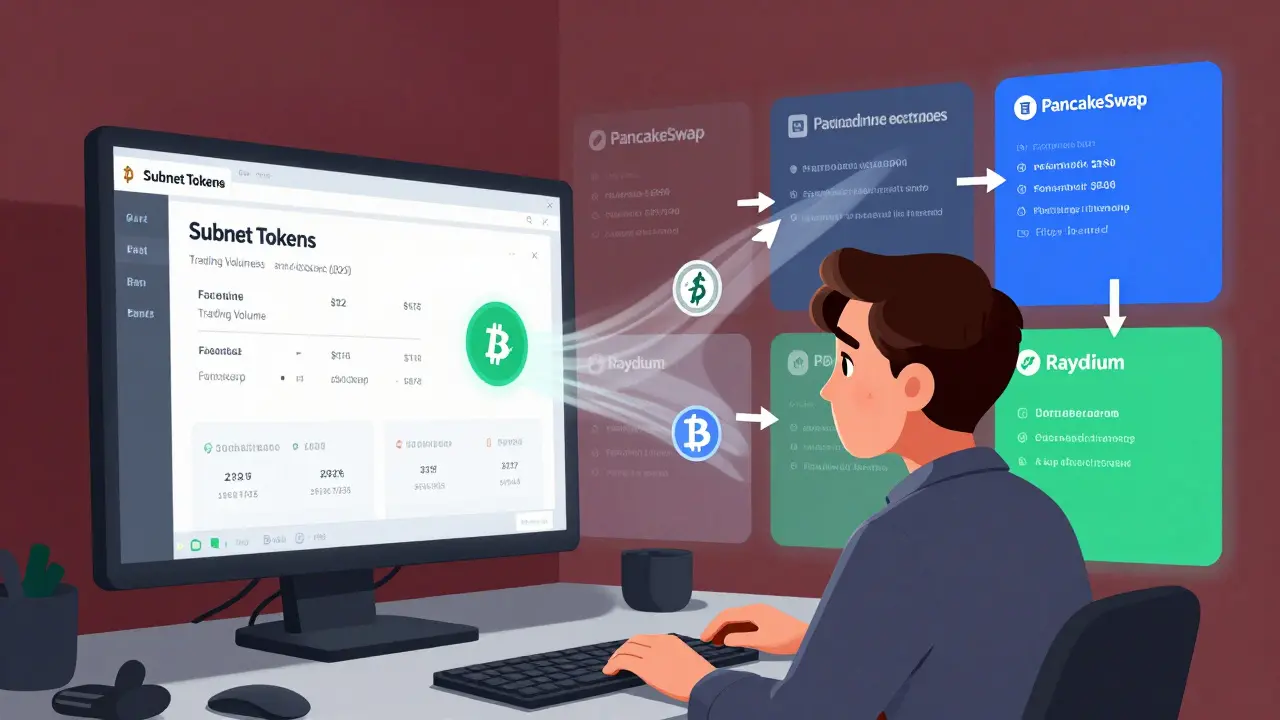
There’s no such thing as a crypto exchange called Subnet Tokens. If you’ve seen it listed on CoinGecko or CoinMarketCap as an exchange ranked #108, you’re not alone in being confused. That page doesn’t represent a real platform where you can sign up, deposit funds, or trade like on Binance or Kraken. Instead, it’s a misleading aggregation of trading data from multiple decentralized exchanges - all centered around tokens from the Bittensor network. This isn’t a bug. It’s a persistent error that’s cost investors money.
What Subnet Tokens Actually Are
| Correct Understanding | What CoinGecko Shows |
|---|---|
| Subnet tokens (alpha tokens) are digital assets issued by individual AI subnets within the Bittensor network. | A standalone "exchange" named "Subnet Tokens" with fake founding date and trading volume. |
| Each subnet has its own token (e.g., SN16, SN0) tied to its AI model output and staked TAO. | Lists 92 trading pairs like "SN62/SN0" as if they were exchange-specific pairs. |
| Trading happens across DEXs like PancakeSwap, Uniswap, and Raydium. | Claims "Subnet Tokens" is the exchange, when it’s actually a data mashup. |
| Value comes from real AI utility - not speculation. | Implies it’s a trading platform for retail investors. |
Each subnet in Bittensor is a self-contained AI marketplace. Think of it like a decentralized app store where developers compete to build the best AI tools - like image generators, code assistants, or data analyzers. To join, they stake TAO (Bittensor’s native token) into a subnet. In return, they get to issue a custom token - their subnet’s alpha token. This token isn’t just a coin; it’s a claim on the subnet’s future output. The more useful the AI, the more demand for its token.
So when you see "SN62/SN0" with $3 million in daily volume, you’re not looking at a pair on an exchange called Subnet Tokens. You’re seeing SN62 (a subnet running a language model) traded against SN0 (the root subnet). That trade happens on PancakeSwap, not some official Subnet Tokens website.
Why the Confusion Is Dangerous
The mistake isn’t harmless. Investors are losing money because they think they’re signing up for an exchange. Reddit threads like "Is Subnet Tokens a real exchange?" have over 280 comments. Users report trying to deposit funds to a non-existent platform. One person lost $500. Another spent weeks trying to find a login page.
It gets worse. Scammers noticed the confusion fast. Between September and October 2023, Immunefi reported three fake "Subnet Tokens exchange" websites. These sites looked real - they even copied the CoinGecko design. Users entered their wallet keys and lost a combined $187,000.
Even Trustpilot reviews show the damage. Of 43 reviews mentioning "Subnet Tokens exchange" in one month, 87% said they were confused. Comments like, "Tried to sign up but couldn’t find any official website," aren’t complaints - they’re red flags.
Dr. Elena Rodriguez from Gartner put it bluntly: "This isn’t an exchange - it’s an ecosystem of interconnected tokens with complex economic mechanics that retail investors are ill-equipped to understand."
Where Subnet Tokens Are Actually Traded
If you want to trade subnet tokens, you need to go to decentralized exchanges - not a fake "exchange" called Subnet Tokens.
- PancakeSwap: Handles about 45% of all subnet token volume. Best for BSC-based subnets.
- Uniswap: Accounts for 30%. Most common for Ethereum-based subnet tokens.
- Raydium: 15% of volume. Used for Solana-linked subnets.
- Smaller DEXs: The rest - including SushiSwap, Curve, and others.
Each DEX has its own liquidity pools. For example, SN16 might be paired with TAO on PancakeSwap, but with USDC on Uniswap. Prices vary. Spreads can be 5-10% during low volume - meaning you lose 5% just by trading. That’s why most retail traders lose money before they even make a move.
How to Actually Participate in Subnet Token Ecosystems
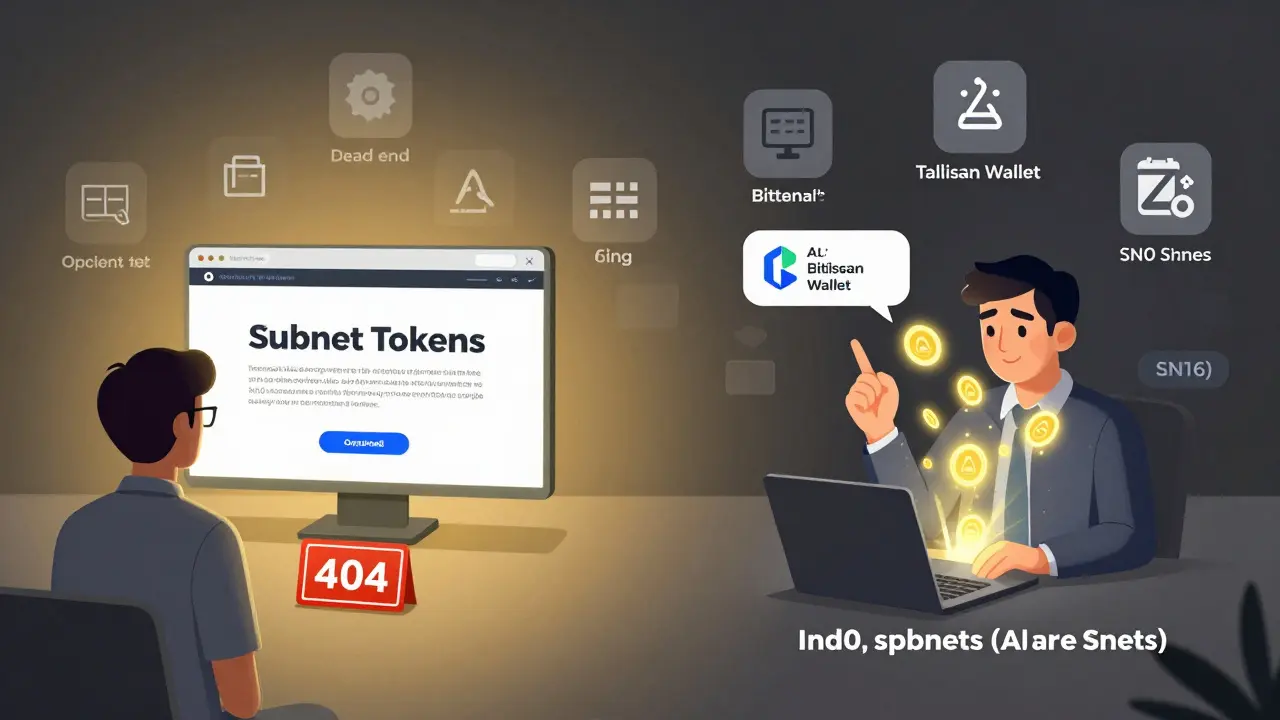
You can’t just buy a subnet token and call it a day. To get real value, you need to understand staking - not trading.
Here’s the real path:
- Buy TAO: Get Bittensor’s native token on Binance, Kraken, or Coinbase.
- Use a Substrate wallet: You need Talisman or SubWallet - not MetaMask. These wallets connect to Bittensor’s blockchain.
- Stake TAO into a subnet: Use Bittensor’s console or a tool like Mentat Minds (which manages 8.7% of all staked TAO).
- Choose your strategy:
- Conservative: Stake into SN0 (root subnet). Yield: ~18.5% APY.
- Delegation: Let Mentat Minds pick subnets. Yield: 22-35% APY.
- Direct staking: Pick high-risk, high-reward subnets like SN16 or SN3. Yield: 50-300% APY - but 90% drops are common.
Bittensor’s own docs say mastering this takes 40-60 hours for experienced users. Most people skip this step and jump straight to trading - and get burned.
Market Risks and Real-World Data
As of October 2023, the total market cap of all subnet tokens exceeded $2.5 billion. Sounds impressive? Look closer.
- Top 5 subnets (SN1, SN3, SN11, SN16, SN22) account for 78% of trading volume.
- Most subnets have less than $1 million in liquidity.
- One token surged +300% in a day - then crashed -90% two weeks later.
Security audits from CertiK show 83.3% of subnet tokens have critical or high-risk vulnerabilities. That’s far worse than the 42.7% average for other tokens. If a subnet’s AI model is hacked, its token can go to zero overnight.
And regulatory risk? The U.S. SEC has flagged subnet tokens as potential unregistered securities. If they’re classified that way, major exchanges will delist them. That could collapse the entire market.
What’s Changing in 2025
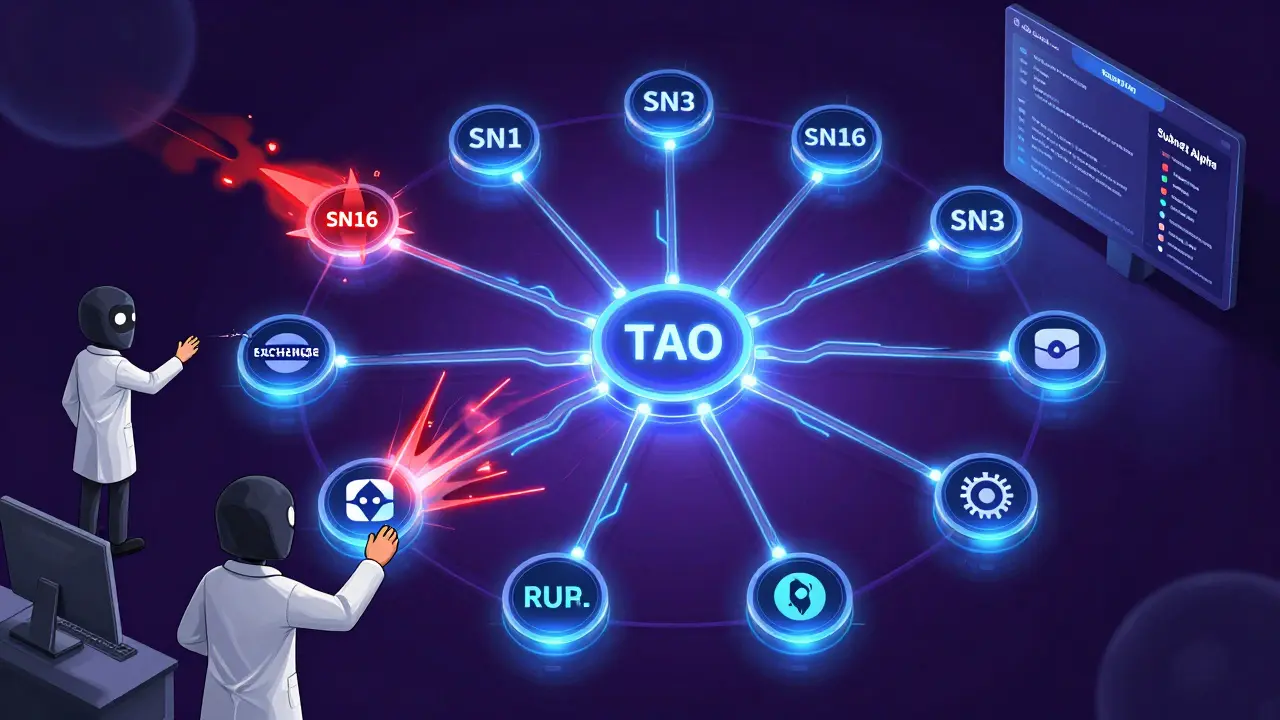
Bittensor made a major shift in February 2025: they replaced static TAO emissions with dynamic TAO (dTAO). This means rewards now flow based on real market demand for subnet tokens - not just validator weightings. It was meant to fix three big problems:
- Top validators got overloaded managing too many subnets.
- Validators inflated rewards for their own subnets.
- Network goals weren’t aligned with individual subnet incentives.
The change worked. Validator bottlenecks dropped by 61%, and reward distribution became more fair. But it also made the system even harder for newcomers to understand.
Bittensor is also launching a new platform called Subnet Alpha (subnetalpha.ai) to provide real-time analytics. It’s powered by SN16 - meaning the subnet that’s most profitable is now the one giving you data. That’s a smart move. But again - this isn’t a trading platform. It’s a research tool.
Final Verdict: Don’t Trade Subnet Tokens Like a Stock
Subnet Tokens isn’t an exchange. It’s a misunderstood ecosystem. If you’re looking for a place to buy crypto and flip it, walk away. The risks are too high, and the learning curve is too steep.
If you’re serious about Bittensor:
- Start with TAO on a trusted exchange like Kraken.
- Learn how staking works - don’t skip this.
- Use Mentat Minds or the official Bittensor console - never trust a third-party site.
- Only stake what you can afford to lose.
- Watch for subnets with verifiable AI output - not just hype.
The future of decentralized AI is here. But Subnet Tokens as an "exchange"? It’s a mirage. The real opportunity is in understanding the network - not chasing a fake trading platform.
Is Subnet Tokens a real crypto exchange?
No, Subnet Tokens is not a real exchange. It’s a misleading aggregation on CoinGecko and CoinMarketCap that combines trading data from multiple decentralized exchanges like PancakeSwap and Uniswap. There is no website, login, or deposit system for "Subnet Tokens." The listing falsely implies it’s a standalone platform, which has led to scams and investor losses.
Where can I actually trade subnet tokens?
Subnet tokens are traded on decentralized exchanges (DEXs), primarily PancakeSwap (45%), Uniswap (30%), and Raydium (15%). You need a compatible wallet like Talisman or SubWallet, and you must connect to these platforms directly. There is no centralized exchange for subnet tokens as of early 2026, though discussions are underway with Kraken and Bitget for potential future listings.
What is the difference between TAO and subnet tokens?
TAO is Bittensor’s native token used for staking, governance, and paying fees. Subnet tokens (like SN16 or SN0) are custom tokens issued by individual AI subnets within the Bittensor network. Each subnet’s token represents its AI output and is valued based on how much TAO is staked into it. You stake TAO to earn subnet tokens - they’re not bought directly like coins on Coinbase.
Can I lose money trading subnet tokens?
Yes - and many have. Subnet tokens are extremely volatile, with daily swings of 50-100% common. Some tokens have gained 300% in a day and lost 90% within weeks. Poor liquidity means wide bid-ask spreads - you can lose 5-10% just by trading. Scammers have also created fake "Subnet Tokens exchange" websites that stole over $187,000 in 2023. Most retail traders lose money because they treat this like stock trading, not a complex staking ecosystem.
How do I start participating in Bittensor subnets?
First, buy TAO on Binance, Kraken, or Coinbase. Then, use a Substrate wallet like Talisman or SubWallet. Connect to Bittensor’s console or use Mentat Minds to stake TAO into a subnet. You’ll earn subnet tokens based on your stake. Start with the root subnet (SN0) for lower risk (~18.5% APY). Avoid direct staking into new subnets unless you’ve studied the AI utility behind them. Bittensor’s official docs say mastering this takes 40-60 hours of study.
13 Comments
Bro, just stop. There's no exchange. It's a data glitch. People are losing money because they think they can sign up. I'm not even mad, I'm just disappointed.
Oh sweet mercy, another person who thinks crypto is a casino with a Wikipedia page. 🙃
Subnet Tokens isn't an exchange - it's a ghost town with a fancy logo. And yet, here we are, watching people throw cash at a mirror thinking it's a vault.
You're all missing the point. This isn't about confusion - it's about systemic failure. The entire Web3 infrastructure is built on assumptions that retail users can parse semantic data from aggregated APIs. It's not a bug. It's a feature of the collapse.
Let me paint a clearer picture for you all - imagine a library where every book has the same title, and the catalog just randomly groups them under one fake author. That’s Subnet Tokens on CoinGecko. But here’s the beautiful part: the actual books? The subnet tokens? They’re written by real AIs, staked by real devs, and traded on real DEXs. The system’s messy, but it’s alive. Don’t give up on the signal because of the noise.
Y’all are overcomplicating it. Just buy TAO, stake it, let the subnets do their thing. No need to trade the tokens unless you’re into rollercoasters with no seatbelts. 🤷♀️
Of course CoinGecko has a "Subnet Tokens" exchange - because capitalism turns every concept into a brand, and every truth into a landing page. 🎭
They didn’t make a mistake. They made a product. And now, we’re all paying for the UX.
I’ve been in crypto since 2017. This is the first time I’ve seen a mislabeling that actually caused real harm. Not scams - the confusion itself. It’s like having a traffic light that says "GO" but only works for people who already know the intersection.
so like… if i buy sn16 on pancakeswap… am i just gambling? 🤔😅
also why does everything have 12 decimals?? i feel dumb
Y’all are wasting time on this. In America, we don’t have time for crypto confusion. We got real problems. This isn’t finance - it’s a sci-fi fanfic with a whitepaper. If you’re not mining Bitcoin in your basement with a toaster, you’re already behind.
Hey newbies - you’re not alone. I started here too. Just remember: stake TAO first. Trade second. Sleep third. And never trust a site that says "Subnet Tokens" with a blue button that says "Deposit Now." 💖 You got this.
ok but like… why is sn0 even a thing?? it's like the root subnet is just… a glorified bank account?? and everyone's like "oh it's 18% apy so safe!!" no it's not!!! i lost 40% on sn16 last week 😭😭😭
The real tragedy isn't the fake exchange - it's that the entire Bittensor incentive structure is built on a Nash equilibrium that assumes rational actors. But we're not rational. We're dopamine-driven. So the system is fundamentally unstable. And that's beautiful. And terrifying. And inevitable.
I’ve staked into SN16, SN3, and SN0 - and honestly? The root subnet is the quiet hero here. 🌱
It’s not flashy, it doesn’t pump 300%, but it’s the backbone. And honestly? If you’re reading this, you’re already ahead. You’re asking questions. You’re not just chasing charts. That’s how real change happens - one careful step at a time. Keep learning. We’re all in this together.