
State Channels and Payment Channels: Scaling Blockchain for Instant Payments
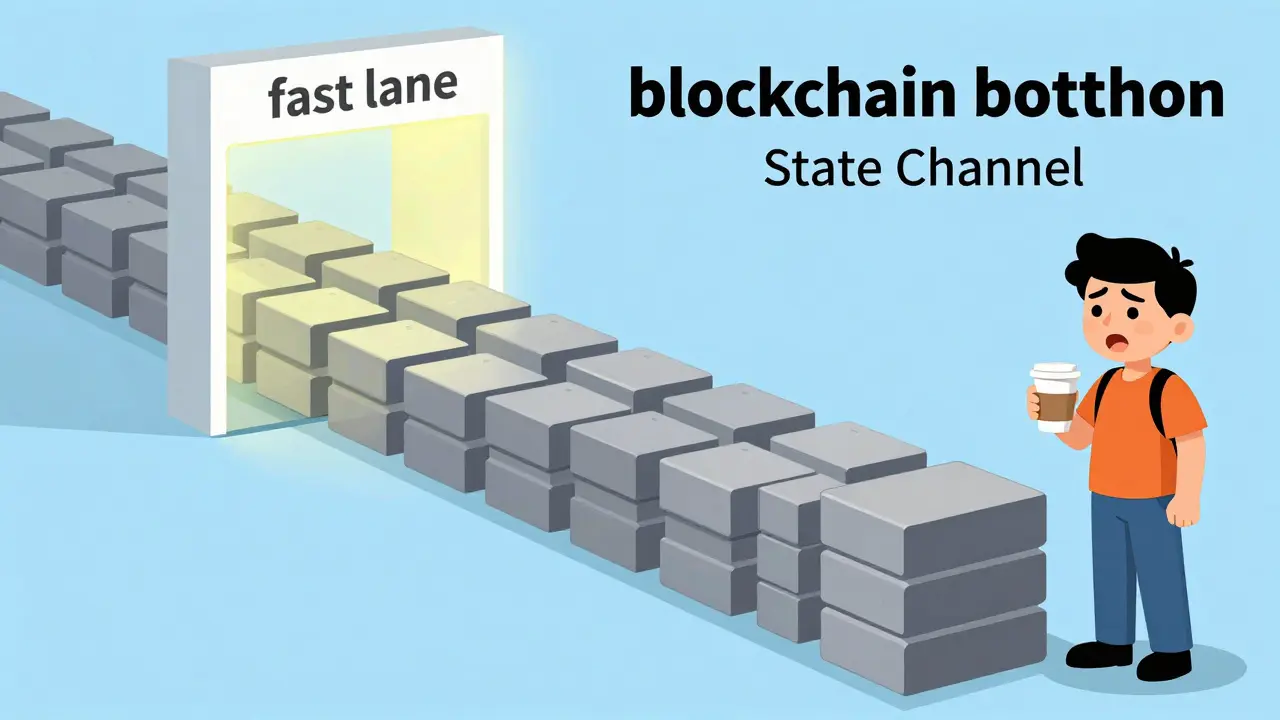
Imagine trying to buy a cup of coffee with Bitcoin. You'd have to wait ten minutes or more for the network to confirm your transaction, and by the time it's done, you might pay more in fees than the coffee actually cost. This is the classic blockchain bottleneck. While blockchains are great for security, they are notoriously slow. State Channels is a layer-2 scaling solution that allows participants to conduct multiple transactions off-chain while keeping the security of the main blockchain. Essentially, it lets you move the "conversation" about your balance off the main ledger and only tell the blockchain the final result when you're finished.
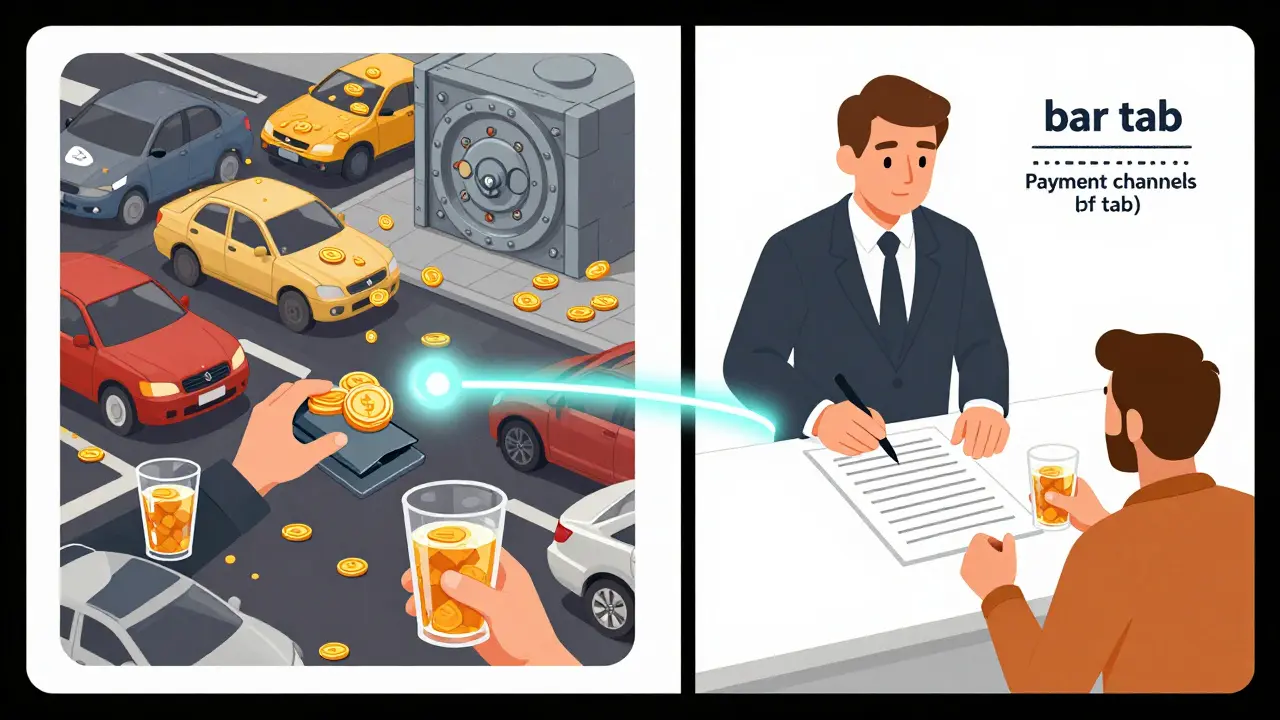
The most common version of this technology is the Payment Channel, which is a specific type of state channel designed solely for moving money. Think of it like a tab at a bar. You don't pay for every single drink individually; you open a tab, the bartender keeps a tally, and you settle the whole bill at the end of the night. This removes the need for the blockchain to process every single tiny transaction, which is how we get from a few transactions per second to thousands.
How State Channels Actually Work
To get a state channel running, you can't just start sending money. There's a specific process to ensure neither party can cheat. First, participants create a funding transaction on the main chain. They lock a specific amount of cryptocurrency into a Multisignature Smart Contract (or multisig). This contract acts as the collateral. For example, if you and a friend both put 0.5 BTC into a 2-of-2 multisig address, you've created a channel with a capacity of 1 BTC.
Once the channel is open, you stop using the main blockchain entirely. You exchange cryptographically signed messages off-chain. Each message updates the balance. If you send your friend 0.1 BTC, you both sign a new "state" that says you now have 0.4 and they have 0.6. These updates happen in milliseconds. The security comes from the fact that any party can present the latest signed state to the blockchain to claim their funds if the other person tries to cheat.
To prevent someone from broadcasting an old state (where they had more money) after you've spent it, the system uses Timelocks and Watchtowers. A timelock creates a window-often spanning 100 to 1,000 blocks-where a transaction is pending. If a party tries to cheat by submitting an outdated balance, a watchtower (a third-party monitoring service) detects this and submits the correct, most recent state to the blockchain, effectively penalizing the cheater.
The Heavy Hitter: The Lightning Network
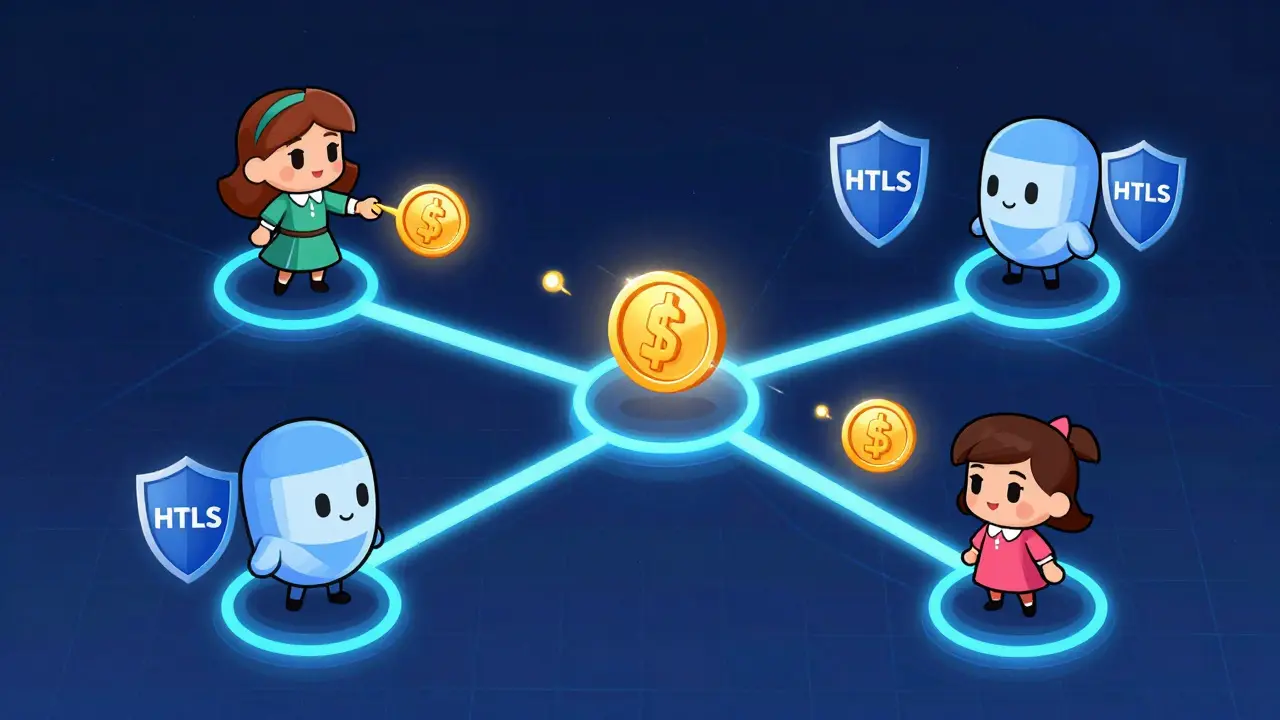
You can't talk about payment channels without mentioning the Lightning Network. Launched on the Bitcoin mainnet in March 2018, it's the most successful implementation of this tech. It doesn't just create a channel between two people who know each other; it creates a network of channels. If Alice has a channel with Bob, and Bob has one with Carol, Alice can pay Carol by routing the payment through Bob.
This routing is made possible by Hashed Timelock Contracts (HTLCs). These ensure that a payment is either delivered to the final recipient or returned to the sender, preventing intermediaries from stealing funds during the hop. The result is staggering: while Bitcoin might handle 7 transactions per second on-chain, a well-tuned Lightning channel can handle 1,000 to 5,000 transactions per second. Fees are also negligible, often just a few satoshis, compared to on-chain fees that can spike to over $50 during congestion.
| Feature | State Channels | Rollups | Sidechains |
|---|---|---|---|
| Transaction Speed | Instant (milliseconds) | Seconds to Minutes | Minutes |
| Main Chain Load | Very Low (2 tx per channel) | Medium (periodic proofs) | Medium (bridge tx) |
| Security | Directly by Main Chain | Cryptographic Proofs | Separate Consensus |
| Best Use Case | Micropayments/Gaming | General DApps/DeFi | Complex Smart Contracts |
Where State Channels Shine (and Where They Struggle)
State channels are a dream for high-frequency, low-value interactions. Think about a streaming payment model. Instead of paying a monthly subscription for a service, you could pay per kilowatt-hour of electricity or per second of a video stream. Because the transactions are off-chain and nearly free, this becomes economically viable. We see this in gaming, where in-game microtransactions can hit rates exceeding 1,000 TPS without clogging the network.
However, there is a major catch: capital inefficiency. To use a channel, you have to lock up your funds. If you want to pay 10 different people, you either need 10 different channels or a complex path of liquidity. Academic research from Cornell University's IC3 institute found that to reach 90% connectivity in a 10,000-node network, a user would need about 150 open channels. That is a lot of locked-up capital for the average person.
There's also the "online" requirement. Because you need to monitor for fraud (or pay a watchtower to do it), you can't just go offline for a year and expect your funds to be safe without some form of external monitoring. While rollups maintain a public history on-chain, state channels keep the intermediate steps private, meaning you lose that public verifiability for every single transaction.
Implementation and the Learning Curve
Setting up state channels used to be a nightmare for developers and users alike. Early adopters spent hours just trying to understand how to manage liquidity. However, things have improved. Modern tools, like those in the LND (Lightning Network Daemon), have introduced "spontaneous payments" and guided wallet interfaces, cutting the learning curve from a full day's work down to about 30 minutes.
For developers, the challenge has shifted to liquidity management. A common issue is "channel exhaustion," where one party's balance hits zero, and they can no longer send payments. This requires a process called rebalancing, which can be technically tedious. Additionally, the community is fighting "griefing" attacks, where a malicious actor forces a channel to settle on-chain just to waste the other person's money on network fees.
The Future: From Payments to General State
We are seeing a shift toward more generalized state channels. While we started with simple payments, the goal is to allow complex smart contract interactions to happen off-chain. Imagine a decentralized game where the entire match happens in a state channel, and only the final score is posted to the blockchain. This would allow for gameplay that feels like a traditional server-based game but with the trustlessness of a blockchain.
Technological upgrades are also making this easier. The Bitcoin Taproot upgrade, for instance, introduced Schnorr Signatures, which reduced the size of channel-opening transactions by up to 30%. This makes the process cheaper and more private. Meanwhile, the Ethereum community has largely pivoted toward rollups for general scaling, but as Vitalik Buterin has noted, state channels remain essential for those specific patterns that require true, sub-second instantaneity.
What is the main difference between a state channel and a payment channel?
A state channel is the broad concept of moving any shared state (like a game board or a contract) off-chain. A payment channel is simply a specific type of state channel where the only "state" being tracked is the balance of funds between two parties.
Do I need to be online to use a state channel?
Technically, yes, or you need a service called a "watchtower" to be online for you. Since the blockchain doesn't know the current state of your off-chain channel, you (or your watchtower) must be able to detect and challenge a fraudulent attempt by your counterparty to close the channel with an old balance.
Is the Lightning Network safe?
Yes, because it is secured by the underlying Bitcoin blockchain. As long as you have the latest signed state of your channel or a reliable watchtower, you can always reclaim your funds on-chain, even if the other party disappears or tries to cheat.
Why aren't all blockchain transactions done through channels?
Because of liquidity and setup costs. You have to lock up funds to open a channel, and you can only send as much as the channel's capacity allows. For one-off payments to strangers, on-chain transactions or rollups are much more practical.
How fast are state channel transactions?
They are near-instant. Since they don't require network-wide consensus and only require the two participants to sign a message, settlement finality is measured in milliseconds.
Next Steps for Users and Developers
If you're a user wanting to try this out, start with a Lightning-enabled wallet. Focus on simple payments first and avoid locking up more capital than you're comfortable with in a single channel. If you're a developer, look into the LND documentation and explore how to integrate HTLCs for multi-hop payments.
If you run into issues with "insufficient liquidity," don't panic. It just means the path between you and the recipient doesn't have enough funds moving in that direction. You can either open a new direct channel or use a liquidity provider to rebalance your channels. As the network grows, these manual steps will likely be automated by smarter wallet software.
15 Comments
This is such a great breakdown! 🚀 I love how it simplifies the whole concept for everyone. Scaling is definitely the way to go for mass adoption! 🌟✨
The analogy of a bar tab is fundamentally oversimplified. While it captures the essence of off-chain settlement, it completely ignores the cryptographic commitment schemes and the actual risk profile regarding channel closure. One must be precise when discussing the mathematical guarantees of Layer 2 solutions, otherwise, we are just speculating.
Typical. People act like Lightning is some magic bullet, but let's be real, managing liquidity is a total nightmare. I've spent way too many hours trying to rebalance channels just to move a few bucks. It's basically a full-time job if you actually want a functional node. Honestly, most people just don't get how tedious this is in practice.
Imagine actually thinking that locking up your capital is a 'solution.' It's absolute madness. You're basically giving your money hostage to a smart contract just to buy a digital coffee. Total failure of design.
I can see why it's frustrating, but the tech is evolving so fast! Maybe we can find a way to make liquidity more automated together. Let's stay positive about the progress!
pure alchemy for the masses lol. the sheer hubris of thinking a few nodes can save the chain from its own bloated nature is just poetic. keep dreaming in satoshis kids
The part about watchtowers is a bit off. You just need a node that checks the chain. It is not that hard to understand if you just read the whitepaper again.
Spot on. Very concise.
My country is leading the way in blockchain adoption and these state channels will make our digital economy the most powerful in the world! It is a glorious time for tech! 🇮🇳
I humbley suggest that one should be careful with the terminolgy here... the use of multisig is lapping the core of the security model and it is truly an exilirating time to be a developer in this space!!
I've skimmed through this and it's just a basic overview.
Honestly, if you've spent any real time in the DeFi space, this is all elementary. The author spends way too much time on the 'coffee' analogy which is just so cliché at this point. It's almost exhausting to see the same metaphors repeated every single time someone explains Layer 2. Why do we always go back to the coffee shop? It's such a lazy way to explain a complex state machine. I'm barely awake reading this. The table is the only part that's even remotely useful, and even then, it's just a surface-level comparison. I'd expect a much deeper dive into the actual game-theoretic implications of griefing attacks. Instead, we get a 'next steps' section that sounds like a generic tutorial. It's a bit beneath the level of discourse I usually engage with. Quite a bore really. Next time, maybe skip the fluff and get into the actual math of the HTLCs. This whole approach is just... pedestrian.
this is such a vibey way to explain a tough topic! i love how it breaks down the scary parts into something actually usable
really helpful for me
It is simply the moral thing to use a decentralized system. If you prefer the centralization of rollups, you are just compromising your values for a few seconds of speed.
One must consider the ethical implications of liquidity providers in this ecosystem. It is important to mentor new users on the risks of channel exhaustion. :)