
Software Wallets: Convenience vs Security - What You Really Need to Know
Crypto Wallet Risk Assessment Tool
How secure is your software wallet?
This tool calculates your personal security risk based on your holdings and security practices. Remember: only keep what you can afford to lose in a software wallet.
Your Risk Assessment
Score: 0/10Recommendations
Follow these security best practices to keep your crypto safe.
Imagine this: you wake up, open your phone, and in seconds you’re swapping tokens, staking ETH, or buying an NFT-all without touching a single piece of hardware. That’s the power of a software wallet. But what happens when your phone gets infected with malware, or you accidentally click a fake link that steals your seed phrase? Suddenly, that convenience turns into a $10,000 mistake. This isn’t hypothetical. In 2023, over $50 million was lost by users who trusted software wallets without understanding the risks.
What Exactly Is a Software Wallet?
A software wallet is any digital tool that stores your cryptocurrency private keys on a device connected to the internet. That means it runs on your phone, computer, or even inside your browser as an extension. Unlike hardware wallets that keep keys locked in a physical device, software wallets are always online. This makes them fast, easy to use, and perfect for everyday crypto activity. Popular examples include MetaMask a browser extension and mobile app that connects to Ethereum and EVM-compatible blockchains, with over 30 million monthly active users as of 2024, Trust Wallet a mobile-first wallet owned by Binance, supporting 65 blockchains and over 4,500 tokens, and Exodus a desktop and mobile wallet known for its clean interface and built-in exchange. These aren’t just apps-they’re your gateway to DeFi, NFTs, and Web3.Why People Love Software Wallets
The biggest reason people choose software wallets is speed. You don’t need to plug in a device, confirm transactions on a screen, or wait for Bluetooth pairing. With a tap or click, you’re done. That’s why 65% of all crypto transactions in 2024 happened through mobile software wallets, according to DappRadar. If you trade frequently, use decentralized exchanges like Uniswap or PancakeSwap, or play games like Axie Infinity, you need a software wallet. Hardware wallets simply can’t keep up. MetaMask processes over 1 million transactions daily. Trust Wallet’s built-in Web3 browser lets you interact with dApps without leaving the app. For active users, that’s a game-changer. They’re also free. A hardware wallet costs $59 to $200. Software wallets? Zero upfront cost. For beginners, that’s huge. You can set up MetaMask in under five minutes. No technical skills needed. You get instant access to the entire crypto ecosystem-tokens, NFTs, staking, lending-all from your pocket.The Hidden Dangers
Here’s the catch: being always online makes software wallets the #1 target for hackers. Malware can silently steal your seed phrase while you sleep. Clipboard hijackers swap your wallet address when you copy-paste it-so when you send ETH to a friend, it goes to a hacker instead. Phishing sites look identical to MetaMask or Trust Wallet login pages. Even legitimate browser extensions have been compromised. In 2023, over 2 million MetaMask users were affected by malicious extension updates, according to SlowMist. Android phones are especially risky. Their open ecosystem lets you install apps from anywhere. A fake crypto app with a fake seed phrase recovery screen? It’s out there. iOS is safer, but jailbroken devices or malicious apps from unofficial stores can still steal keys. And don’t trust cloud backups. If you store your 12-word recovery phrase on iCloud, Google Drive, or even a screenshot in your photo gallery, you’re handing your crypto to anyone who gets into your account. Security experts agree: your seed phrase should live on paper, in a safe, or in a fireproof box-never on a device connected to the internet.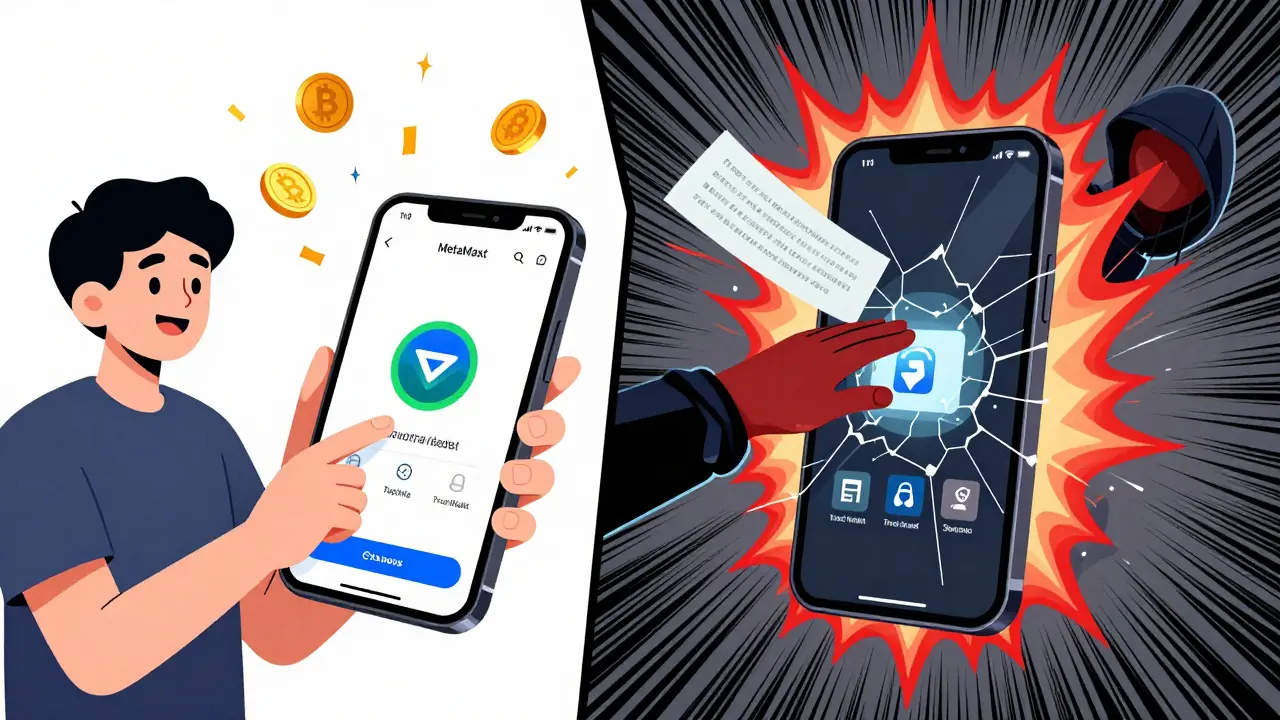
Real User Experiences
Reddit’s r/CryptoCurrency community has over 850,000 members. Scroll through their posts, and you’ll see the same pattern: excitement over DeFi yields, followed by horror stories of stolen funds. One user posted they lost $8,000 after clicking a fake “MetaMask update” link. Another lost their entire NFT collection after their Android phone got infected with screen-recording malware. Meanwhile, others rave about how easy it is to swap tokens on Uniswap or claim rewards from a DeFi protocol. Trustpilot ratings tell a similar story. MetaMask has a 2.8 out of 5 stars from over 4,200 reviews. Sixty percent of the negative reviews mention security breaches. Trust Wallet scores higher at 4.1 out of 5, thanks to Binance’s customer support. Exodus gets 4.3 out of 5 for its design, but users complain it doesn’t support newer tokens as quickly as competitors. The message is clear: people love software wallets for what they do-but they hate them for what they can lose.When to Use a Software Wallet
Not all crypto needs the same level of protection. Think of your holdings like cash in your wallet versus money in a bank vault. Use a software wallet for:- Money you plan to trade or spend within days or weeks
- Active participation in DeFi (yield farming, liquidity pools, staking)
- Buying, selling, or displaying NFTs
- Playing play-to-earn games that require frequent transactions
How to Stay Safe
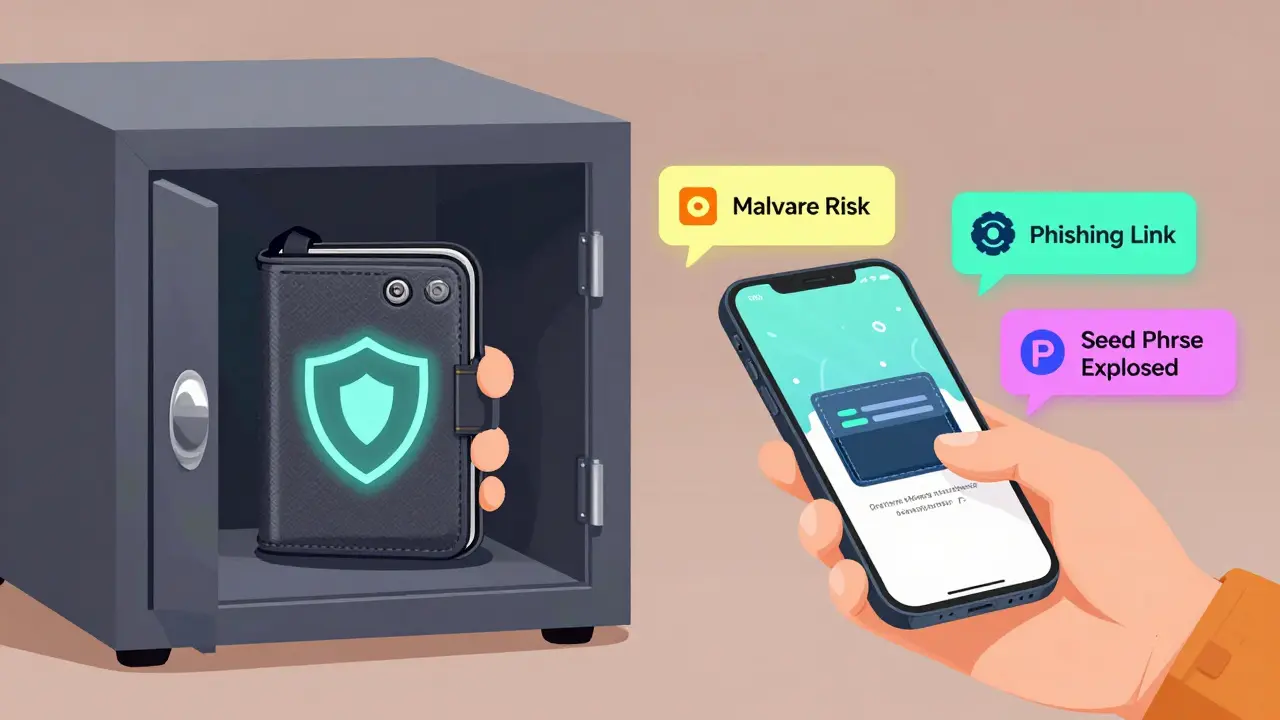
If you’re using a software wallet, you need to treat it like a loaded gun. Here’s how to reduce your risk:- Never store your seed phrase digitally. Write it on paper. Store it in a safe place.
- Enable biometric login and two-factor authentication (2FA) if your wallet supports it.
- Only download wallets from official sources: Apple App Store, Google Play, or the wallet’s official website. Never click links from Twitter, Discord, or Telegram.
- Use a separate device for crypto if possible. Don’t use your main phone for both banking and crypto.
- Check transaction details before confirming. Look at the full address, not just the first and last few characters.
- Keep your phone’s OS and wallet app updated. Outdated software has known exploits.
- Use a dedicated browser profile for crypto. Don’t log into your wallet while browsing random sites.
The Future of Software Wallets
The tech is improving. Zero-knowledge proofs are being tested to hide transaction details. Biometric login is becoming standard. Some premium phones now include hardware security modules (HSMs) that can protect keys even in software wallets. But here’s the hard truth: as long as a wallet connects to the internet, it can be hacked. No amount of AI, encryption, or blockchain magic can fully fix that. The trade-off between convenience and security isn’t going away. It’s the core of crypto. Future wallets might feel safer, but they won’t be invincible. That’s why the smartest users don’t rely on one tool. They use both: software for daily activity, hardware for long-term storage.Final Advice
If you’re new to crypto, start with a software wallet. It’s the easiest way to learn. But don’t stop there. Learn how to use a hardware wallet too. As your holdings grow, move the bulk of your assets offline. Don’t fall for the myth that “I’m careful, so I’m safe.” Hackers don’t target careless people. They target predictable behavior. If you store your seed phrase in your email, you’re not careless-you’re just following the crowd. Your crypto isn’t like a bank account. There’s no customer service to call when it’s gone. Once your keys are stolen, they’re gone forever. Use software wallets for speed. Use hardware wallets for safety. And never, ever trust the internet with your seed phrase.Are software wallets safe for storing large amounts of crypto?
No. Software wallets are designed for convenience, not long-term storage. They’re always connected to the internet, making them vulnerable to malware, phishing, and hacking. Even the most secure software wallet can be compromised if your device is infected. For large holdings, use a hardware wallet that stores keys offline.
What’s the difference between MetaMask and Trust Wallet?
MetaMask is a browser extension and mobile app focused on Ethereum and EVM chains, with over 30 million monthly users. It’s the go-to for DeFi and NFTs. Trust Wallet is a mobile-first wallet owned by Binance, supporting 65 blockchains and 4,500+ tokens. It has a built-in Web3 browser and better customer support. Both are secure if used properly, but Trust Wallet offers broader token support, while MetaMask dominates the Ethereum ecosystem.
Can I recover my crypto if I lose my phone?
Yes-if you have your 12- or 24-word seed phrase written down. Your wallet is tied to the seed phrase, not your device. Install the same wallet app on a new phone, enter your seed phrase, and your funds return. If you didn’t write it down and lost your phone, your crypto is gone for good. Never rely on cloud backups or screenshots.
Why do software wallets have lower Trustpilot ratings than hardware wallets?
Because users lose money. Hardware wallets are harder to hack, so complaints are rare. Software wallets, while convenient, are targeted by phishing scams and malware. MetaMask’s 2.8/5 rating reflects thousands of users who lost funds due to social engineering or infected devices. Trust Wallet scores higher because Binance provides customer support and has stronger brand trust, but security issues still dominate negative reviews.
Should I use a software wallet if I’m not a trader?
Only if you’re holding small amounts you’re okay losing. If you’re just buying Bitcoin or Ethereum to hold for years, a hardware wallet is safer and just as easy to use. Software wallets are overkill for passive holders. The risk of losing your keys through a simple mistake or phishing attack isn’t worth it for funds you don’t plan to use often.
Are browser extensions like MetaMask safer than mobile apps?
Neither is inherently safer. Browser extensions are vulnerable to malicious website scripts and compromised updates, as seen in the 2023 MetaMask extension attacks. Mobile apps are vulnerable to malware from sideloaded apps or jailbroken devices. Both require the same precautions: never share your seed phrase, keep your device updated, and avoid suspicious links. The key is behavior, not platform.
What’s the biggest mistake people make with software wallets?
Storing their seed phrase digitally. Screenshots, emails, cloud backups, notes apps-any of these can be accessed by hackers if your device is compromised. The seed phrase is the master key to your crypto. If it’s stored online, it’s already half-stolen. Always write it on paper and keep it in a secure, offline location.
26 Comments
Look, I get it-software wallets are convenient. But let’s be real: if you’re storing more than $500 in one, you’re already playing Russian roulette with your keys. I’ve seen too many people lose everything because they took a screenshot of their seed phrase ‘just in case.’ Spoiler: it’s never just in case. It’s always ‘oops, my laptop got hacked.’
MetaMask isn’t magic. It’s a browser extension. And browsers? They’re the most vulnerable piece of software on your entire device. Every time you click a shady link or visit a sketchy NFT drop site, you’re giving hackers a backdoor. And no, biometrics won’t save you if the app itself is compromised.
People act like hardware wallets are ‘too complicated.’ Nah. You plug it in. You confirm the transaction. You unplug it. Done. It’s not rocket science. It’s just not as addictive as tapping ‘swap’ on your phone while scrolling TikTok.
The real problem? We’ve normalized risk. We treat crypto like a game where you can respawn after you die. But there’s no respawn button. Once your keys are gone, your life savings are gone. Forever.
And don’t even get me started on cloud backups. iCloud? Google Drive? You might as well put your wallet address on a billboard in Times Square.
It’s not about being paranoid. It’s about being smart. If you wouldn’t leave your house keys under the mat, why are you leaving your crypto keys in your email?
Use software wallets for small, active trades. Keep the rest offline. Simple. Effective. Non-negotiable.
And if you think you’re ‘too careful’ to get hacked? You’re the exact person hackers are targeting. Because you’re predictable. You’re the norm.
Wow. Just… wow. You wrote an entire essay on something that’s been obvious since 2017. Did you really need 2,000 words to say ‘don’t store your seed phrase on your phone’? I mean, really? This is like writing a 10-page manual on ‘don’t put your wallet in the toilet.’
Also, MetaMask has 30 million users? So… what? That means 29.9 million are idiots? Maybe the problem isn’t the wallet-it’s the users. And the fact that we still treat crypto like a casino where you can just ‘try again’ next week.
Also-why is everyone so shocked that people lose money? It’s not a bug. It’s a feature of the system. If you don’t understand that, you shouldn’t be here.
ok so i just lost my whole portfolio bc i clicked a link that said 'claim your airdrop' and now im crying in my hoodie and i just wanna know if anyone else feels like the entire crypto world is just one giant trap designed to make you feel dumb?? like i read all the 'be careful' posts but then i saw the 20% APY and i was like 'this is my chance' and now i'm just… gone. like, why do we keep doing this to ourselves??
There’s something deeply human about this whole dilemma. We crave convenience because we’re tired. We’re overwhelmed. We don’t want to manage another layer of security when we’re already managing jobs, relationships, bills, mental health. So we take the easy path-even when we know it’s dangerous.
It’s not just about crypto. It’s about how we relate to technology. We outsource our safety to apps, to algorithms, to convenience. And then we’re shocked when it fails.
Maybe the real question isn’t ‘how do we make software wallets safer?’
It’s: ‘how do we make people feel safe enough to be cautious?’
Because fear doesn’t teach responsibility. Empathy does.
Okay but let’s be real-this whole ‘hardware wallet’ thing is just a scam to sell you a $100 piece of plastic. The real threat isn’t your phone-it’s the government, the banks, the Fed. They’re the ones who want you to think you need a ‘secure’ wallet so they can track your every move. You think MetaMask is spying on you? Try using a hardware wallet. They’ll log every transaction and send it to the IRS. You think you’re safe? You’re just handing over your data to a bigger monster.
Also, why do people always blame the user? If a wallet lets you lose your money because you clicked a link, that’s a design flaw. Not a ‘user error.’
And don’t even get me started on ‘write it on paper.’ What if your house burns down? What if you die? Who gets your crypto? Your family? They don’t even know what a seed phrase is. So now you’ve killed your own legacy.
Stop pretending this is about safety. It’s about control. And the people pushing hardware wallets? They’re not your friends. They’re gatekeepers.
The post contains several grammatical inconsistencies and redundant phrasing. For example, the phrase 'all without touching a single piece of hardware' is semantically redundant, as software wallets, by definition, do not involve hardware. Additionally, the claim that 'over $50 million was lost' lacks a cited source or methodology. Trustpilot ratings are not peer-reviewed data and are susceptible to review bombing. The assertion that '65% of all crypto transactions in 2024 happened through mobile software wallets' is unsupported by any authoritative source from DappRadar’s public reports.
Furthermore, the conflation of 'security' with 'convenience' is a false dichotomy. Security is not a binary state. Risk mitigation is a spectrum, and user behavior is the most significant variable-not the wallet type.
Recommendation: Cite primary sources. Avoid emotional language. Clarify terminology. This is not a technical article. It is a polemic dressed as education.
Hey Sarah, I feel you. I lost $3k last year to a fake MetaMask update. I cried for a week. But here’s the thing-I didn’t stop using crypto. I just got smarter. Now I use a burner phone just for wallets. No banking apps. No social media. No screenshots. Just a paper copy in a ziplock in my safe. It’s not glamorous, but it works.
And yeah, the 20% APY is a trap. But so is not trying. The trick is to only risk what you can afford to lose. Like, if you’d be fine losing $500, go for it. But if you’re putting your rent money in? That’s not crypto. That’s gambling.
You’re not dumb for falling for it. You’re human. And humans are the reason crypto is alive. We just gotta learn how to play the game without getting burned.
Also-emoji for solidarity: 🫂
Ugh. Another ‘Western-centric’ lecture on crypto safety. Meanwhile, in India, people use WhatsApp to send seed phrases because it’s the only app everyone has. You think they care about ‘hardware wallets’ when they’re sending remittances to their families? You think they care about ‘cloud backups’ when they’re paying for school fees with crypto because the bank froze their account?
This isn’t about ‘being careful.’ It’s about survival. And if your solution is ‘buy a Ledger’ while ignoring the global reality-that’s not education. That’s colonialism.
Stop pretending crypto is a game for tech bros in Silicon Valley. It’s a lifeline for billions. And if you can’t see that, you’re part of the problem.
As someone from India, I’ve seen friends lose everything-but also seen grandmas send money to their grandchildren using Trust Wallet because they can’t use Western apps. The problem isn’t software wallets. The problem is that no one teaches people how to use them safely. We need community-led safety workshops, not just blog posts.
My aunt thought ‘seed phrase’ meant a password. She typed it into a Google Form. Lost $2k. Now she won’t touch crypto again.
We need to make this accessible-not scary. Not ‘you’re stupid for clicking a link.’ Just… show them. Like how you’d show someone how to lock their door.
I love how this post says ‘use hardware wallets for long-term’-but doesn’t explain how to actually do it. Most people don’t know how to set one up. No tutorials. No step-by-step. Just ‘buy one.’
Here’s what actually works: buy a Ledger Nano S. Plug it in. Install Ledger Live. Create a new wallet. Write down the seed phrase. Never connect it to the internet again. Use it only to send from your software wallet to the hardware wallet.
That’s it. No magic. No fear. Just steps.
And if you’re scared to do it? Ask a friend who’s done it. Crypto isn’t supposed to be lonely. It’s supposed to be shared.
Let’s cut through the noise: software wallets are not ‘convenient.’ They’re lazy. And lazy is the most expensive trait in crypto. Every time you tap ‘confirm’ without verifying the address, you’re not being efficient-you’re being reckless. And the ecosystem rewards that behavior with losses.
Hardware wallets aren’t ‘hard.’ They’re just not addictive. That’s the point. You have to *choose* to interact with them. That’s security by friction. And friction is the only thing that saves people from themselves.
Also, ‘trust Binance’? Please. Binance got fined $4.3 billion. Their ‘customer support’ is a chatbot that says ‘please contact your local exchange.’
Stop outsourcing your security to brands. Your keys. Your responsibility. No exceptions.
Y’all are making this so complicated. Let me break it down like I’m talking to my cousin who just bought her first ETH:
1. Your seed phrase = your crypto bank account number + PIN + password + security question.
2. Never type it anywhere online. Not even in a ‘private’ note.
3. If you can’t write it on paper, you’re not ready.
4. Use software wallets for spending money. Hardware for savings.
5. If you lose it? You lose it. No refunds. No pity.
That’s it. No jargon. No fear-mongering. Just clarity.
You got this. 💪
Software wallets are an illusion of control. The moment you connect to the internet, you surrender sovereignty. The blockchain is decentralized. Your wallet is not. This is not a technical issue. It is a philosophical one.
True ownership requires isolation. Not convenience. Not speed. Not UI/UX.
Hardware wallets are not tools. They are symbols. Symbols of autonomy.
Those who choose otherwise are not users. They are tenants.
I’ve been in crypto since 2017. I’ve lost wallets. I’ve recovered wallets. I’ve watched friends get scammed. And here’s what I’ve learned: the people who survive aren’t the ones with the fanciest wallets. They’re the ones who talk about it. They’re the ones who ask questions. They’re the ones who don’t pretend they know everything.
So if you’re reading this and you’re scared? Good. That means you’re paying attention.
Don’t let the ‘know-it-alls’ make you feel stupid. We’re all learning. Even the ones who sound like they’ve got it all figured out? They’ve probably lost money too.
Just keep asking. Keep sharing. Keep checking addresses. And never, ever store your phrase on your phone.
That’s the real secret.
As someone who’s helped my mom set up a wallet, let me say this: you can’t just drop a 2,000-word essay on someone and expect them to understand. You need to sit with them. Show them. Walk them through it. Use analogies. ‘Your seed phrase is like the key to your house-but if you lose it, no locksmith can help.’
Also-don’t call them ‘noobs.’ They’re not. They’re just new. And crypto needs them. Not just the tech bros.
Teach with kindness. Not condescension.
And yes-paper is still the best tech we’ve got.
It’s funny how we treat crypto like it’s this wild frontier, but we still act like we’re in a bank. We want safety without responsibility. We want freedom without discipline.
Maybe the real lesson here isn’t about wallets.
It’s about how we want to live.
Do we want convenience? Then accept the risk.
Do we want security? Then accept the effort.
You can’t have both.
And that’s okay.
Hardware wallets are a scam. They’re just glorified USB sticks. If your phone is compromised, they can still steal your keys during transaction signing. The only real solution is air-gapped devices. And even then, someone could physically steal it.
Stop pretending there’s a safe way. There isn’t. Crypto is dangerous. Get used to it.
And if you’re still using a software wallet? You’re already dead money.
Why are we still talking about seed phrases like they’re the end-all? We need social recovery. We need multi-sig. We need recovery via trusted friends. Paper is medieval. We’re in 2025. Why are we still writing things down?
Also-MetaMask is fine. The problem is people don’t use the built-in phishing detector. Turn it on. It’s right there.
Stop blaming users. Fix the tools.
I lost $1,200 last year. I didn’t click a link. I just forgot to check the address. I sent ETH to a wallet that looked like mine. One letter off.
I didn’t feel stupid. I felt human.
Now I always read the full address out loud before I confirm. And I use a separate browser profile. And I don’t use my main phone.
It’s not about being perfect. It’s about building habits.
You can do this. I did.
💛
Let me be the one to say it: this whole ‘software vs hardware’ debate is a distraction. The real enemy is centralized exchanges. The real threat is KYC. The real danger is when you link your identity to your crypto. Your wallet is the least of your problems.
Stop blaming the tool. Start blaming the system.
And if you’re still using Coinbase or Binance? You don’t own crypto. You own a receipt.
There’s a deeper layer here: software wallets democratize access. They allow people in rural areas, in developing nations, to participate in global finance. To say they’re ‘dangerous’ is to say those people shouldn’t be allowed in.
Yes, they’re risky. But so is driving a car. So is using a credit card.
The solution isn’t to ban them. It’s to educate. To build better UX. To make safety intuitive-not punitive.
Don’t punish the user for the system’s failures.
Here’s what I think no one’s saying: we’re not just storing keys. We’re storing trust. Trust in technology. Trust in ourselves. Trust that we won’t make a mistake.
But we will. We’re human.
So maybe the goal isn’t to avoid mistakes.
It’s to build systems that forgive them.
That’s the future of crypto-not better wallets. Better grace.
I use a software wallet for small swaps. Hardware for everything else. Simple. I don’t need a lecture. I just need to remember: if I didn’t write it down, it’s not mine.
Thanks for the reminder.
Bro, I lost $8k last year. Now I have a fireproof safe. I have two paper copies. I have a backup in my mom’s safe. I have a friend who knows where they are. I don’t trust tech. I trust people.
And I don’t care what you think. I’m still here. And I’m still holding.
So yeah. I’m paranoid. But I’m rich.
What’s your excuse?
India has 800 million unbanked people. Software wallets are their only access to global finance. You think they care about Ledger? They care about sending money to their sister in Mumbai. So stop lecturing. Start building.
Security is a luxury. Access is a right.
And for anyone who thinks ‘social recovery’ is the answer-tell that to the guy whose ‘trusted contact’ got hacked and drained his wallet. Or the one whose friend moved to another country and vanished.
Human trust is fragile. Blockchain isn’t.
Don’t replace one vulnerability with another.