
Singapore Crypto Tax: No Capital Gains for Individuals

Imagine selling Bitcoin after a massive bull run, pocketing six figures in profit, and owing the government absolutely nothing. For most of the world, this is a fantasy. In the US, you might owe up to 20% federal plus state taxes. In Germany, you pay if you sell within a year. But in Singapore, a city-state known for its robust financial infrastructure and business-friendly policies, individual investors often face zero capital gains tax on their digital assets. This isn't a loophole; it's a deliberate feature of one of the world's most sophisticated regulatory frameworks.
If you are a trader or long-term holder wondering whether moving your operations or residency to the Lion City makes sense, you need to understand the nuance. It is not just about "no tax." It is about how the Monetary Authority of Singapore (MAS) defines what you do with your coins. Are you an investor? Or are you running a business? The answer changes everything.
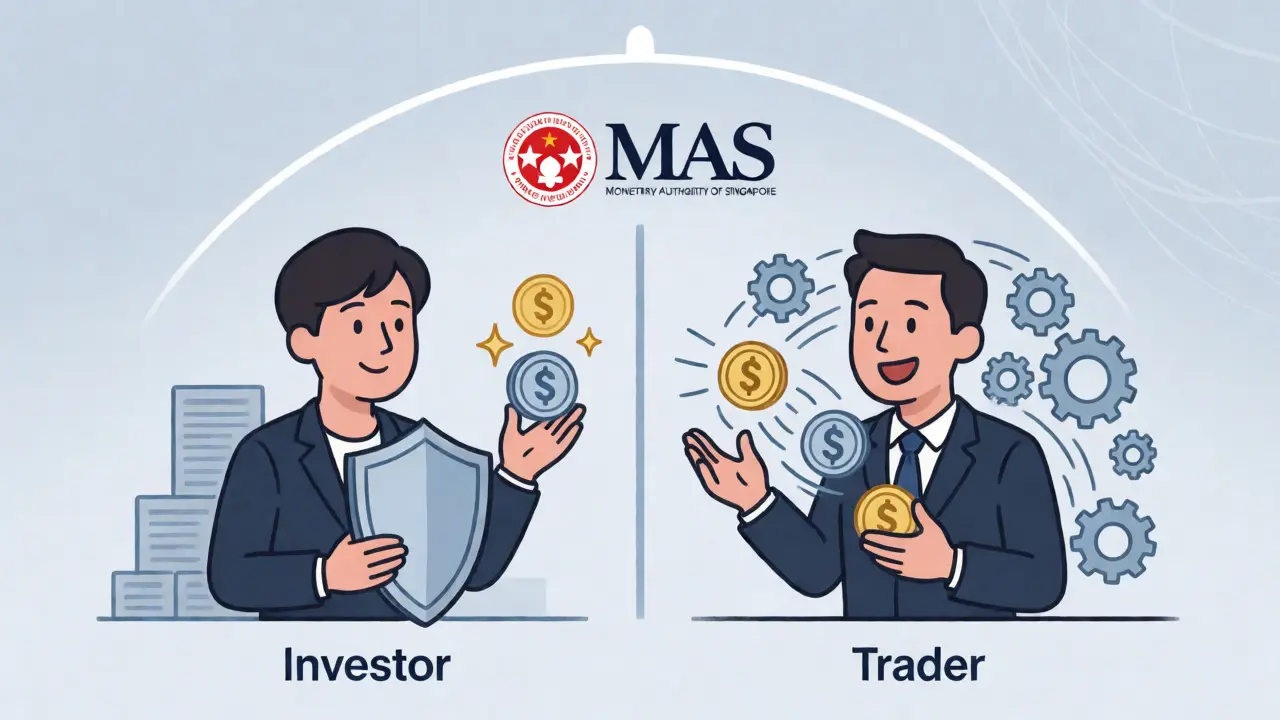
The Core Rule: Investors vs. Traders
Here is the golden rule of Singapore crypto taxation: Individuals do not pay tax on capital gains from selling cryptocurrencies. If you bought Ethereum in 2021 and sold it in 2026 for a 300% profit, that gain is generally untaxed. The Inland Revenue Authority of Singapore (IRAS) treats cryptocurrency as intangible property, not legal tender. Therefore, profits from disposing of this property are considered capital gains, which are not taxable in Singapore unless specific conditions apply.
But hold on. There is a catch that trips up many newcomers. The tax-free status applies strictly to investors. If IRAS decides your trading activity resembles a business-meaning you trade frequently, use leverage, have a structured approach, and rely on these profits for your primary income-they may classify you as a trader. In that case, your profits become taxable income under the personal income tax regime, which ranges from 0% to 24% depending on your total earnings.
| Activity Type | Tax Status | Key Criteria | Regulatory Body |
|---|---|---|---|
| Individual Investor | 0% Capital Gains Tax | Long-term holding, infrequent trading, passive intent | IRAS / MAS |
| Active Trader (Personal) | Taxable Income | High frequency, short holding periods, professional conduct | IRAS |
| Crypto Business | Corporate Income Tax (17%) | Accepting crypto as payment, mining, exchange services | MAS / IRAS |
Why Singapore Stands Out Among Global Jurisdictions
You might ask, "Are there other places like this?" Yes, but few combine zero capital gains tax with such high regulatory clarity. Let’s look at the competition.
The Cayman Islands offers zero tax on almost everything, including crypto. However, it lacks the deep banking infrastructure and global connectivity of Singapore. If you want to open a bank account easily or interact with institutional finance, Singapore wins.
Portugal used to be a favorite, but rules tightened. Now, short-term gains (held less than a year) are taxed at 28%. You only get the exemption for long-term holdings. Germany exempts gains if you hold for over a year, but tracking those dates across multiple wallets is a nightmare.
Singapore’s advantage isn't just the tax rate; it's the stability. The Monetary Authority of Singapore (MAS) regulates digital tokens under the Payment Services Act. This means you aren't operating in a wild west environment. You have clear laws, consumer protections, and a government that actively courts fintech innovation.
When Do You Actually Pay Tax?
Just because capital gains are free doesn't mean all crypto activities are tax-exempt. Here is where you need to watch your step:
- Trading as a Business: If you quit your job to day-trade crypto full-time, IRAS will likely view your profits as employment-like income. They look at factors like the volume of transactions, the sophistication of your strategy, and whether you treat it as a profession.
- Mining and Staking Rewards: If you mine Bitcoin or stake Solana, the rewards you receive are typically treated as income at the market value when received. When you later sell them, any additional appreciation might be a capital gain (tax-free), but the initial receipt is taxable.
- Business Acceptance: If you run a coffee shop in Singapore and accept Bitcoin for a latte, that transaction is treated as a barter. You must recognize the revenue in SGD terms. While the crypto itself isn't taxed upon receipt, the underlying sale of goods is subject to standard corporate tax and potentially Goods and Services Tax (GST).
A common misconception is that spending crypto triggers a tax event. In many countries, yes. In Singapore, if you buy a car with Bitcoin, you are essentially exchanging one asset for another. As an individual, no capital gains tax applies to the disposal of the Bitcoin used for purchase. However, keep meticulous records. If IRAS challenges your status as an "investor," they will scrutinize every move.
The Regulatory Landscape: MAS and Licensing
For individuals, regulation feels invisible. For businesses, it is heavy. Any company dealing with digital tokens in Singapore must obtain a license from the MAS under the Payment Services Act. This includes exchanges, brokers, and custodians.
The process is rigorous. You need to demonstrate strong Anti-Money Laundering (AML) and Counter-Financing of Terrorism (CFT) controls. This has driven out many fly-by-night operators. Major players like Binance, Crypto.com, and Coinbase have set up significant operations here, citing regulatory certainty as a key factor. Over 100 payment service licenses have been issued since the Act took effect, signaling a mature market.
If you are planning to start a crypto venture, budget for compliance. Setting up a licensed entity can cost between SGD 50,000 and SGD 200,000 initially, covering legal fees, audit requirements, and qualified personnel. It is not cheap, but it buys you legitimacy in a region where trust is currency.
Practical Steps for Crypto Residents
Thinking of making Singapore your home base? Here is how to optimize your position:
- Establish Tax Residency: You generally need to spend at least 183 days in Singapore per year. Alternatively, show strong economic ties, such as having a local bank account, lease agreement, or family presence.
- Define Your Intent: Keep documentation that shows your investment strategy. A simple spreadsheet noting "buy and hold" intentions for major assets helps distinguish you from active traders.
- Separate Personal and Business: If you freelance and accept crypto, consider incorporating a private limited company. Corporate tax is flat at 17%, and you can deduct business expenses. Mixing personal investments with business receipts complicates audits.
- Use Local Exchanges Carefully: While international exchanges operate here, using locally licensed platforms simplifies reporting if you ever need to prove source of funds to banks.
One pro tip: Avoid complex derivatives if you are trying to maintain "investor" status. Frequent futures trading looks like speculation, which pushes you toward the "trader" classification. Stick to spot trading for long-term holds if you want to maximize the tax-free benefit.
Future Outlook: Will the Rules Change?
Governments love money, so skepticism is healthy. Could Singapore introduce a capital gains tax? Unlikely in the near term. The country competes globally for talent and capital. Introducing a tax now would hurt its competitive edge against Dubai, Switzerland, and emerging hubs like Thailand, which recently announced a five-year exemption for digital asset gains.
Instead, expect refinements in anti-money laundering rules and perhaps stricter reporting for large transactions. The MAS has signaled support for blockchain innovation through regulatory sandboxes. The trend is toward clearer definitions, not higher taxes. For now, Singapore remains a premier destination for anyone wanting to keep more of their crypto profits.
Do I pay tax on crypto staking rewards in Singapore?
Yes, generally. Staking rewards are typically treated as ordinary income at the fair market value when you receive them. Subsequent gains when you sell those reward tokens are usually considered capital gains and are tax-free for individuals.
What counts as a crypto trader rather than an investor?
IRAS looks at several factors: frequency of trades, duration of holdings, volume of transactions, and whether you use technical analysis or systematic strategies. If you trade daily and rely on it for living expenses, you are likely a trader subject to income tax.
Is GST applicable when buying things with crypto?
If a business accepts crypto, they must charge GST on the value of the goods or services provided. The crypto transaction itself is treated as a barter exchange. The buyer does not pay GST on the crypto disposal, but the seller collects GST on the sale.
How long do I need to live in Singapore to be tax resident?
Typically, you need to be present in Singapore for at least 183 days in a calendar year. Other indicators include having a permanent residence, center of life interests, or significant economic ties to the country.
Can foreign companies avoid tax by routing through Singapore?
Not automatically. Singapore follows territorial principles for some aspects but requires substance for others. Companies must have real operations, employees, and decision-making power in Singapore to benefit fully. Shell companies without substance may still face tax liabilities elsewhere or fail licensing checks.