
Sidechains vs Layer 2: Which Blockchain Scaling Solution Wins in 2026?
Remember the summer of 2021? You tried to swap tokens on Ethereum, and your wallet asked for $70 in gas fees. It felt like paying rent just to buy a coffee. That pain point birthed two distinct paths to fix blockchain congestion: Layer 2 solutions, which sit directly on top of Ethereum to inherit its security, and sidechains, which run as independent parallel networks. In 2026, choosing between them isn't just about speed; it’s a trade-off between absolute security and maximum flexibility. If you are building a DeFi protocol holding billions in assets, or launching a high-frequency gaming app, picking the wrong architecture could cost you everything.
The Core Difference: Security vs. Independence
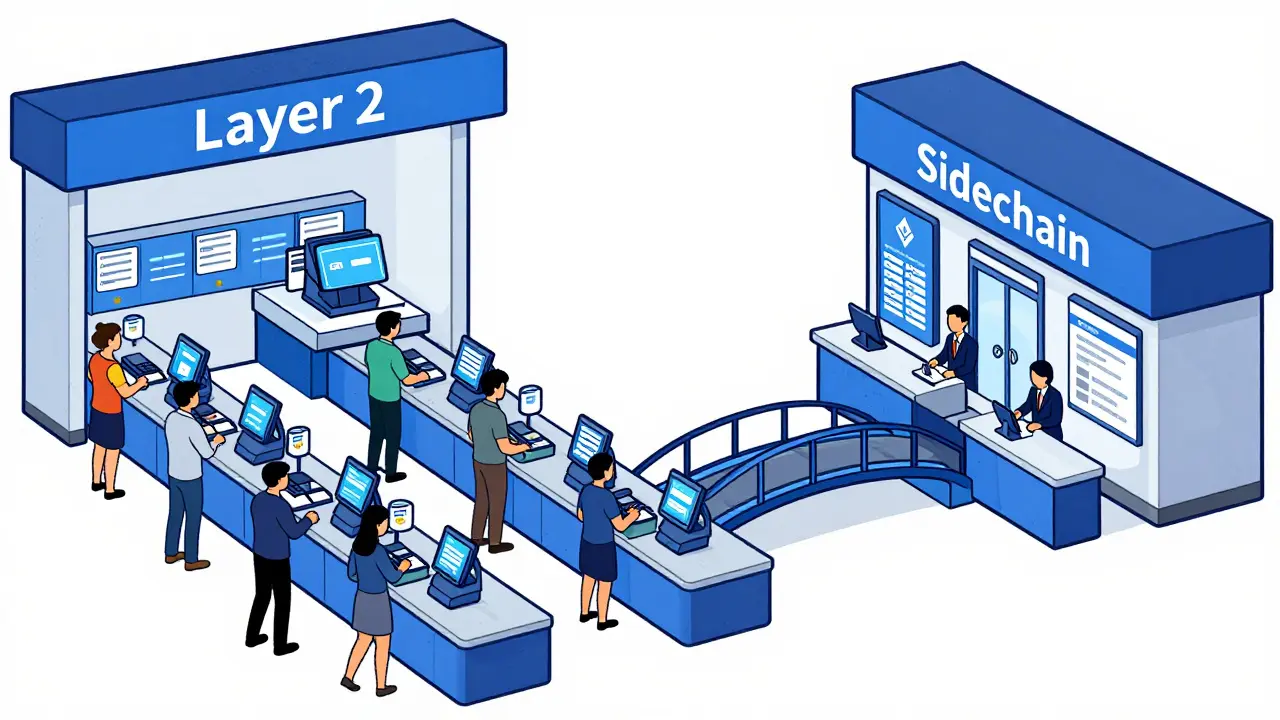
To understand why these technologies diverge, you have to look at how they handle trust. Layer 2 (L2) is a scaling protocol built directly on top of a main blockchain, processing transactions off-chain but posting data back to the mainnet for security. Think of L2s like express checkout lanes in a supermarket that still use the same cash register system as the main store. They rely entirely on the underlying chain-usually Ethereum-for finality and security. If Ethereum goes down, the L2 stops working securely.
In contrast, a Sidechain is an independent blockchain with its own consensus mechanism, connected to the mainnet via a two-way bridge. Sidechains are like opening a completely new branch of the bank nearby. They have their own tellers (validators), their own rules, and their own security model. The connection to the main bank exists only to move money in and out. This independence gives sidechains freedom to change rules quickly, but it also means if the local branch gets robbed, the main bank isn’t liable.
This fundamental architectural split creates the primary decision matrix for developers and users in 2026:
- Layer 2: High security inheritance, lower flexibility, dependent on mainnet congestion for data availability.
- Sidechain: Lower security (dependent on specific validators), high flexibility, independent performance.
Technical Architecture: How They Actually Work
Under the hood, the engineering choices differ drastically. Most major Layer 2 solutions today use one of two methods: Optimistic Rollups or ZK-Rollups. Optimistic Rollups (like Arbitrum and Optimism) assume transactions are valid unless someone proves otherwise within a challenge period (usually 7 days). This keeps costs low but introduces a delay in finality. ZK-Rollups (like zkSync and StarkNet) use cryptographic zero-knowledge proofs to verify transactions instantly, offering immediate finality but requiring more complex hardware to generate those proofs.
Sidechains, such as Polygon PoS or Gnosis Chain, typically run their own Proof-of-Stake (PoS) consensus mechanisms. For example, Polygon PoS uses a set of roughly 100 validator nodes to secure the network. Because they don’t need to post every single transaction detail back to Ethereum mainnet (they only post state roots or checkpoints), they can process data much faster. However, this means the security guarantee comes from those 100 validators, not from Ethereum’s 800,000+ stakers.
| Feature | Layer 2 Solutions | Sidechains |
|---|---|---|
| Security Source | Ethereum Mainnet (Inherited) | Own Validators (Independent) |
| Data Availability | On Mainnet (Calldata/Blobs) | On Sidechain Only |
| Transaction Finality | Seconds to Days (depending on type) | Seconds (2-3s typical) |
| Consensus | Relies on L1 Consensus | Independent (e.g., PoS, DPoS) |
| Customization | Limited (Must follow EVM/L1 rules) | High (Can modify VM/Consensus) |
Cost and Speed: The User Experience Reality
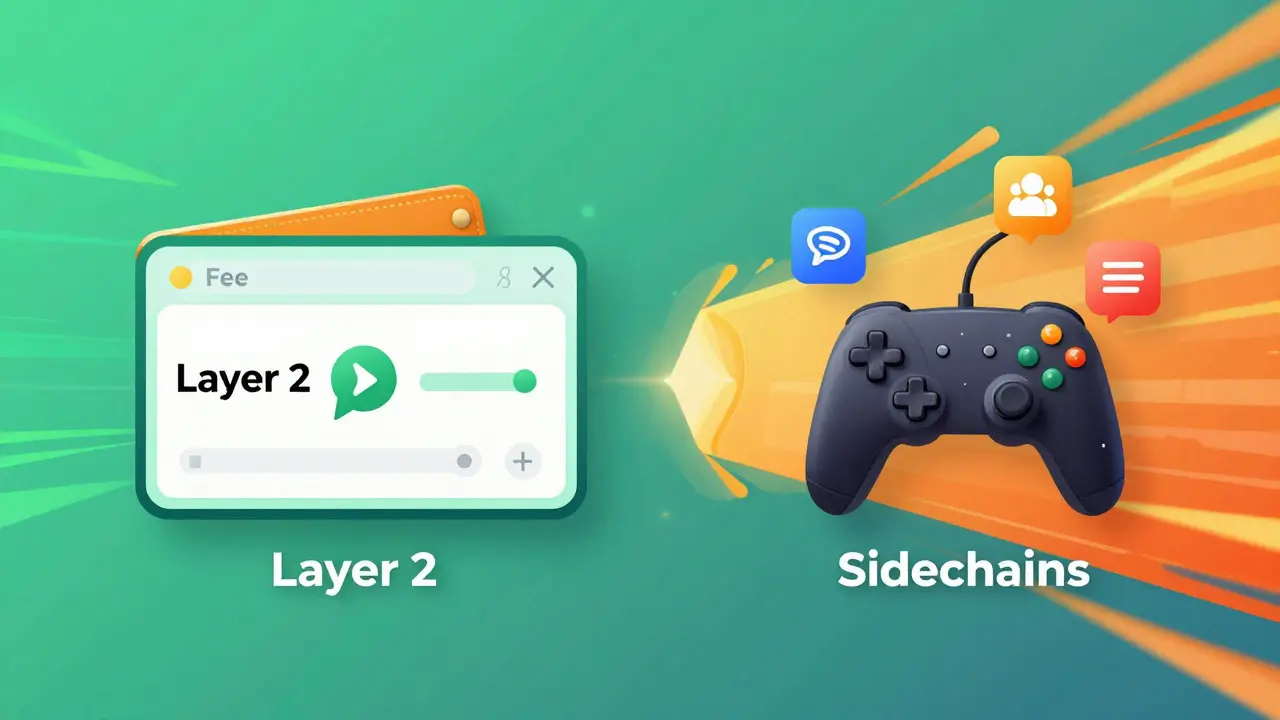
For the average user, the debate often boils down to: "How fast is it, and how much does it cost?" Here, sidechains often win on raw metrics, but Layer 2s are catching up thanks to Ethereum upgrades like EIP-4844 (Proto-Danksharding).
In 2024-2025 data, Layer 2 transactions typically cost between $0.05 and $0.50, depending on network congestion. Optimistic rollups might take hours to finalize withdrawals due to fraud proof windows, though deposits are instant. ZK-rollups offer faster finality but historically had higher compute costs. Meanwhile, sidechains like Polygon PoS consistently deliver transactions for $0.005 to $0.02 with near-instant finality (under 3 seconds). This makes sidechains incredibly attractive for micro-transactions, such as in-game purchases or social media tips, where even a $0.10 fee feels excessive.
However, speed comes with a caveat. When Ethereum mainnet is congested, Layer 2 costs rise because they must pay gas to post data to Ethereum. Sidechains are immune to Ethereum’s gas spikes because their fees are determined by their own network demand. This independence is a double-edged sword: it protects users from Ethereum volatility but exposes them to sidechain-specific risks.
Security Risks: Where the Money Goes Wrong
This is the most critical section for anyone managing significant capital. The security models are fundamentally different, and history shows where the vulnerabilities lie.
Layer 2 solutions benefit from Ethereum’s massive economic security. As of late 2024, over $40 billion was secured across major L2s. To attack an L2, you would essentially need to attack Ethereum itself, which is economically unfeasible. The primary risk for L2s is not the chain itself, but the bridges connecting to it. Bridge hacks account for the majority of losses in the scaling space, but these are isolated incidents rather than systemic failures of the L2 architecture.
Sidechains carry higher centralization risks. Because they rely on smaller validator sets (e.g., 100 validators vs. 800,000+), a colluding group of validators could theoretically censor transactions or steal funds if the economic incentives aren’t aligned. The Harmony bridge hack in 2022, which resulted in a $600 million loss, highlighted the dangers of sidechain bridge implementations and validator key management. While modern sidechains have improved security audits, the principle remains: you are trusting a smaller group of entities.
If you are storing life savings, Layer 2 is generally considered safer due to deeper security guarantees. If you are playing a game or using a dApp where losing $50 wouldn’t ruin your life, sidechains offer a smoother experience.
Developer Perspective: Building on Both
For developers, the choice depends on what you are building. Layer 2s are EVM-equivalent (mostly), meaning you can deploy Solidity smart contracts with minimal changes. Tools like Hardhat and Foundry work seamlessly. However, you must account for unique L2 quirks, such as delayed message passing between chains and specific gas optimization techniques for calldata compression.
Sidechains offer more room for innovation. You can tweak the block time, change the consensus algorithm, or even switch to a different virtual machine if needed. This flexibility is why many gaming projects and enterprise solutions choose sidechains. But this flexibility requires more work. You need to manage validator sets, ensure cross-chain communication protocols are robust, and handle the complexity of maintaining an independent node infrastructure. According to developer surveys in 2024, deploying to a sidechain takes 4-6 weeks longer than deploying to an established Layer 2 due to these integration complexities.
Market Trends in 2026: Convergence and Interoperability
The lines between Layer 2 and sidechains are blurring. In 2026, we see the rise of "Intent-centric" architectures and shared sequencers. Projects like Polygon’s AggLayer aim to unify liquidity across multiple chains, making them feel like a single ecosystem. Similarly, Ethereum’s SUAVE framework allows for shared sequencing, reducing fragmentation among Layer 2s.
Regulatory clarity has also shifted the landscape. In 2024, the U.S. SEC classified many sidechains as separate securities offerings, requiring individual compliance. Layer 2s, being extensions of Ethereum, often fall under broader regulatory frameworks. This has pushed institutional adoption toward Layer 2s, particularly for DeFi applications where compliance and security are paramount. Conversely, sidechains continue to dominate in gaming and consumer apps where speed and low cost outweigh strict regulatory scrutiny.
As we move further into 2026, the distinction matters less for end-users who will interact with abstracted interfaces. But for builders and investors, understanding the underlying mechanics-security inheritance versus operational independence-remains crucial for long-term viability.
Is Polygon a Layer 2 or a Sidechain?
Polygon operates both. Polygon PoS is technically a sidechain because it has its own consensus mechanism and validators. However, Polygon also runs Polygon zkEVM, which is a true Layer 2 solution using zero-knowledge proofs. Most users refer to "Polygon" generally, but the security model differs significantly between the two.
Which is cheaper: Layer 2 or Sidechain?
Generally, sidechains are cheaper, often costing fractions of a cent per transaction. Layer 2 fees are slightly higher ($0.05-$0.50) because they must pay to post data to Ethereum mainnet. However, with Ethereum’s EIP-4844 upgrade, Layer 2 costs have dropped significantly, narrowing the gap.
Are Layer 2s safer than sidechains?
Yes, for most users. Layer 2s inherit Ethereum’s security, meaning they are protected by hundreds of thousands of validators. Sidechains rely on smaller, independent validator sets, making them more vulnerable to collusion or attacks if the validator set is not sufficiently decentralized.
What happens if Ethereum goes down?
If Ethereum halts, Layer 2 solutions cannot finalize transactions securely because they depend on Ethereum for data availability and security. Sidechains can continue operating independently, but users may be unable to withdraw their assets back to Ethereum until the mainnet recovers.
Why do some projects prefer sidechains despite lower security?
Projects prioritize sidechains for greater customization and higher throughput. Gaming apps, for example, need thousands of transactions per second and low latency, which sidechains provide more efficiently than current Layer 2 architectures. Additionally, sidechains allow for experimental consensus mechanisms that aren’t possible on rigid Layer 2 frameworks.