
Self-Hosted Crypto Billing: xpubs, Keys, and Why They Matter

Imagine a scenario where you run an online store, but instead of handing over your revenue to a payment processor that holds it in escrow, every satoshi lands directly in a wallet only you control. No middlemen. No frozen accounts. This is the promise of self-hosted crypto billing. It sounds like a dream for merchants who value sovereignty, but it comes with a steep technical learning curve. The secret sauce that makes this possible without exposing your private keys is a concept called the xpub, or extended public key.
If you are looking to accept cryptocurrency on your own terms, understanding how these keys work is non-negotiable. You need to know why separating your public identity from your private signing authority allows you to automate thousands of invoices while keeping your funds safe in cold storage.
The Core Problem: Scaling Without Compromising Security
In the early days of Bitcoin, creating a new address meant generating a brand-new private key and backing it up separately. If you were a merchant processing hundreds of transactions a day, you would quickly drown in a mess of keys. Losing one meant losing access to those specific funds forever. Backing them all up securely was a logistical nightmare.
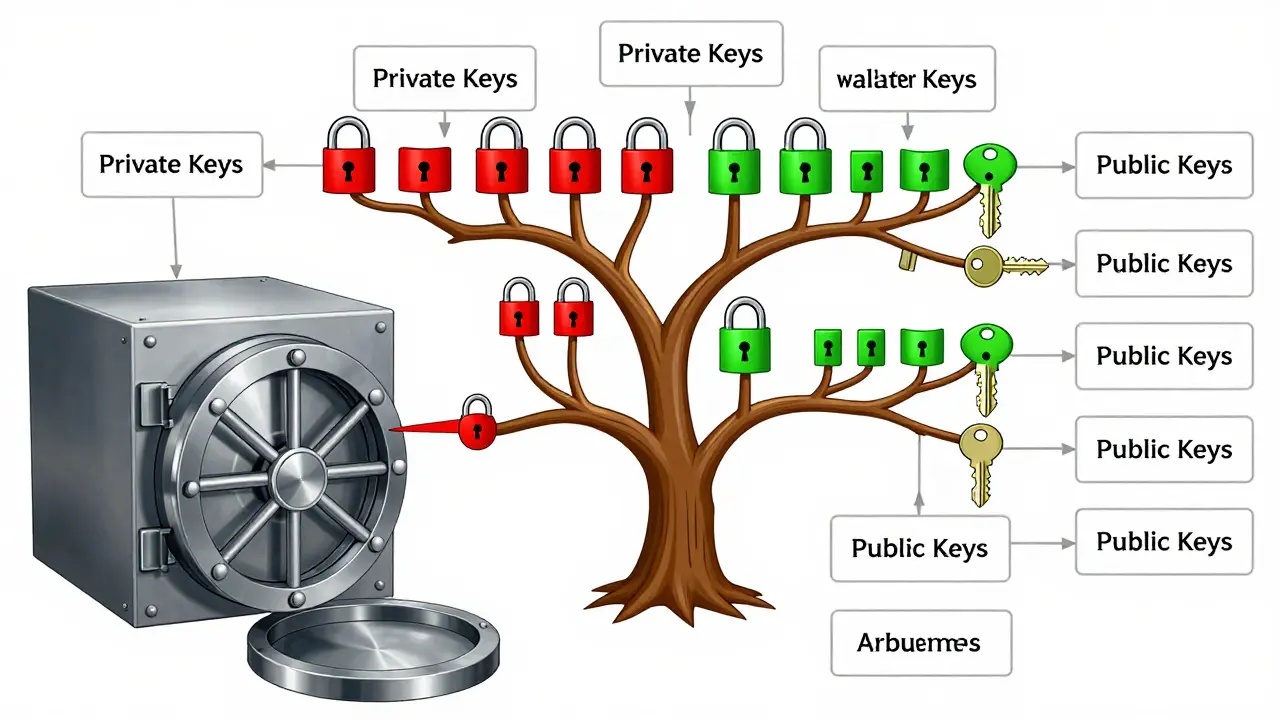
This changed with the introduction of Hierarchical Deterministic (HD) wallets, defined in BIP32 by Pieter Wuille and others in 2013. HD wallets allow you to generate a near-infinite tree of key pairs from a single seed phrase (usually 12 or 24 words). This means you can back up one seed and recover every single address ever derived from it.
For self-hosted billing, this structure is vital. It allows software to generate a fresh, unique receiving address for every single invoice automatically. This enhances privacy by preventing address reuse-a major tracking vector on the blockchain-and simplifies accounting by linking every transaction to a specific customer order.
Anatomy of an Extended Key
To understand how self-hosted billing works, you have to look at what an extended key actually contains. An extended private key (xprv) is a 78-byte structure that includes your 256-bit private key plus a 256-bit chain code. The chain code is the magic ingredient; it adds entropy so that deriving child keys becomes a one-way mathematical function.
From the xprv, you can derive both child private keys and child public keys. However, from an extended public key (xpub), you can only derive child public keys. You cannot go backward. This asymmetry is the foundation of secure, self-hosted commerce.
- Private Key: Required to sign transactions and spend funds. Must stay offline.
- Public Key: Used to verify signatures and receive funds. Can be shared publicly.
- Chain Code: Ensures that knowing a parent key doesn't let you guess sibling or child keys easily.
When you set up a self-hosted billing system, you export the xpub from your hardware wallet (like a Ledger or Trezor) and paste it into your server. Your server now has the power to generate millions of valid receiving addresses for your business. But if a hacker breaches your server, they can see your balance and transaction history-they cannot steal your coins because they lack the xprv needed to sign a withdrawal.
Derivation Paths and Address Types
Not all xpubs are created equal. The prefix of the key tells you which derivation standard and address type it uses. Using the wrong one will result in "lost" payments because your hardware wallet won't recognize the addresses generated by your billing software.
| Prefix | BIP Standard | Address Type | Use Case |
|---|---|---|---|
xpub |
BIP44 | P2PKH (Legacy) | Older wallets, higher fees |
ypub |
BIP49 | Nested SegWit (P2SH-P2WPKH) | Compatibility with older nodes |
zpub |
BIP84 | Native SegWit (Bech32) | Modern standard, lower fees |
vpub |
BIP86 | Taproot (Bech32m) | Latest tech, enhanced privacy |
Most modern self-hosted setups use zpub (BIP84) for Bitcoin because it offers smaller transaction sizes and lower fees. When configuring your billing software, ensure the derivation path matches your key. A common path for Bitcoin native SegWit is m/84'/0'/0'. The first zero is the coin type (Bitcoin), the second is the account index, and the third is the change chain. Your billing software will increment the final index to create new addresses for each invoice.
Why Self-Hosting Beats Custodial Processors
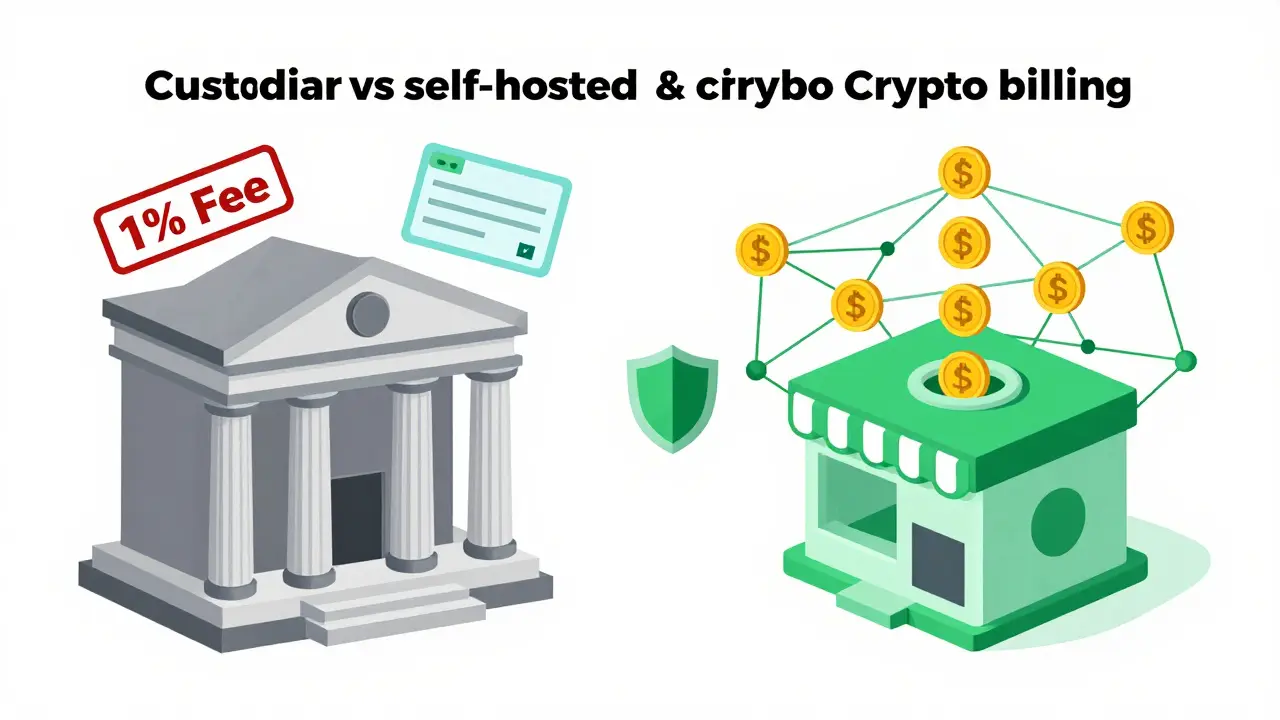
You might wonder why anyone would bother setting up their own infrastructure when services like BitPay or Coinbase Commerce exist. The answer lies in three areas: censorship resistance, cost, and custody.
Custodial processors act as banks. They hold your funds, take a cut (often around 1%), and reserve the right to freeze your account if they deem your business risky. We saw this happen with several organizations during geopolitical conflicts, where processors blocked payments based on policy decisions rather than network rules. With a self-hosted stack, no central entity can stop you from accepting money. The Bitcoin network doesn't care who you are or what you sell.
Cost-wise, self-hosting eliminates the 1% processing fee. You only pay the minimal network miner fee (satoshis per byte) and your own hosting costs. For high-volume merchants, saving 1% on every transaction adds up to significant margins over time.
Finally, there is the issue of counterparty risk. In a custodial model, your money is an IOU from the processor. In a self-hosted model, your money is on-chain, waiting in addresses you control. If the processor goes bankrupt, your funds are safe because they were never theirs to begin with.
Architecture of a Self-Hosted Stack
Setting up self-hosted billing isn't just about pasting an xpub. You need a few components working together:
- A Bitcoin Node or API Service: You need something to watch the blockchain for incoming payments. You can run a full node (requires 500GB+ disk space) or use a lightweight client that connects to public Electrum servers. Software like BTCPay Server handles this abstraction well.
- The Billing Application: This is the interface that creates invoices, generates QR codes, and updates order status. Open-source options like BTCPay Server are popular because they integrate deeply with e-commerce platforms like WooCommerce and Magento.
- Watch-Only Wallet Configuration: Your server imports your
xpubto create a watch-only wallet. It can see balances and UTXOs (Unspent Transaction Outputs) but cannot sign spending transactions. - Hardware Signer: Your Ledger or Trezor stays offline or disconnected until you want to move funds. When you decide to sweep your revenue to cold storage, you connect the device, and it signs the transaction using the private keys that never left its secure element.
Some modern gateways, like TxNod, simplify this architecture by handling the blockchain monitoring via third-party providers while still enforcing a non-custodial model. They allow you to connect your Ledger or Trezor via WebHID or WebUSB, ensuring that only your public keys ever touch their servers. This reduces the operational burden of running a full node while maintaining the security benefit of self-custody.
Privacy Risks and Mitigation Strategies
There is a catch with xpubs. While they can't spend your money, they reveal everything. Anyone with your xpub can see every address you've ever used, every transaction you've received, and your total balance. On a transparent ledger like Bitcoin, this data is permanent.
If you host your own billing server, you are essentially giving your server operator (you) full visibility into your financial history. If you hire a developer or use a managed service, you must trust them not to misuse that data. To mitigate this, follow these best practices:
- Segregate Accounts: Use different account indices for different purposes. For example, use
m/84'/0'/0'for daily sales andm/84'/0'/1'for long-term savings. Never share thexpubfor your savings account with your billing software. - Rotate Regularly: If you suspect your server logs have been compromised, generate a new account index and update your billing software. Old addresses remain valid, but future transactions will flow to a new branch of the tree.
- Limit Exposure: Only share the
xpubwith systems that absolutely need it. Do not post it on public forums or GitHub repositories.
Remember, the goal of using unique addresses per invoice is partly privacy. By funneling all those distinct addresses through a single xpub on your server, you cluster them internally. This is fine for accounting, but it means your internal database becomes a honeypot for detailed financial profiling if breached.
Multisig for Enhanced Security
For businesses holding significant capital, a single hardware wallet might not be enough. Multisignature (multisig) wallets require multiple keys to authorize a transaction, such as a 2-of-3 setup where any two of three devices must sign. This protects against theft, loss, or coercion of a single device.
In a multisig context, your billing software needs the xpubs from all participating keys to construct the correct P2SH or Taproot addresses. The process is slightly more complex but follows the same principle: the server sees the addresses and balances, but no single party can move the funds alone. Tools like Unchained Capital specialize in collaborative custody models that make managing these multisig vaults easier for teams.
Getting Started: Practical Steps
If you are ready to move away from custodial processors, here is a simplified roadmap:
- Choose Your Hardware: Buy a reputable hardware wallet like Ledger or Trezor. Set it up and write down your seed phrase on metal or paper. Store it safely.
- Select Your Software: Decide between running a full open-source stack like BTCPay Server on your own VPS, or using a lighter, non-custodial gateway that abstracts the node complexity.
- Export Your xpub: Connect your hardware wallet to your computer. Navigate to the Bitcoin account settings and export the extended public key. Note whether it is an
xpub,ypub, orzpub. - Configure the Gateway: Input the
xpubinto your billing software. Verify the derivation path matches your wallet's configuration. - Test with Small Amounts: Create a test invoice. Send a small amount of Bitcoin to it. Confirm that the payment appears in your billing dashboard and that your hardware wallet recognizes the address and balance.
- Go Live: Integrate the billing API or plugin with your website. Start accepting real payments.
The initial setup takes time, especially if you are syncing a full node. However, once configured, the system runs autonomously. You generate invoices, customers pay, and the software tracks confirmations. You retain full control over your assets at all times.
Future-Proofing with Lightning Network
While on-chain Bitcoin billing is robust, fees and confirmation times can be barriers for micro-transactions. The Lightning Network solves this by enabling instant, low-cost off-chain payments. Interestingly, Lightning also relies on xpub-derived on-chain addresses for funding channels.
Many self-hosted solutions now support hybrid billing: offering Lightning for small purchases and on-chain Bitcoin for larger ones. This requires managing both a Lightning node (like LND or c-lightning) and your on-chain HD wallet. The underlying principle remains the same-your private keys stay offline, and your public keys enable the infrastructure to interact with the network on your behalf.
Can someone steal my Bitcoin if they have my xpub?
No. An xpub (extended public key) can only generate receiving addresses and view balances. It cannot sign transactions. To spend Bitcoin, you need the corresponding xprv (extended private key), which should remain offline on your hardware wallet.
What is the difference between xpub, ypub, and zpub?
These prefixes indicate different derivation standards and address types. xpub usually refers to legacy P2PKH addresses (BIP44), ypub to nested SegWit (BIP49), and zpub to native SegWit Bech32 addresses (BIP84). Zpub is generally preferred today due to lower transaction fees and better efficiency.
Do I need to run a full Bitcoin node for self-hosted billing?
Not necessarily. While running a full node offers maximum privacy and decentralization, it requires significant disk space and bandwidth. Many self-hosted solutions allow you to connect to trusted Electrum servers or use lightweight clients that relay blockchain data, reducing the hardware requirements significantly.
How does self-hosted billing handle chargebacks?
Bitcoin transactions are irreversible once confirmed. There are no chargebacks in the traditional sense. This is a major advantage for merchants, eliminating the risk of fraudulent reversals common with credit card processors. However, it also means you must resolve disputes before confirming payment, as you cannot force a refund on-chain.
Is it safe to share my xpub with third-party analytics tools?
Sharing an xpub reveals your entire transaction history and balance for that specific account. While it doesn't compromise fund security, it severely impacts privacy. Only share xpubs with trusted services, and consider using separate account indices for different integrations to limit data exposure.