
Ramses Crypto Exchange Review: How ve(3,3) Tokenomics Is Changing Decentralized Trading

Most crypto exchanges are either centralized platforms like Binance or basic decentralized ones like Uniswap v2. But Ramses isn’t either. It’s something more complex - and potentially more powerful. If you’ve heard of ve(3,3) tokenomics, bribes, veNFTs, or concentrated liquidity, Ramses is one of the first DEXs built entirely around those ideas. This isn’t just another crypto exchange. It’s a governance-powered liquidity engine designed for users who want control, not just trades.
What Is Ramses, Really?
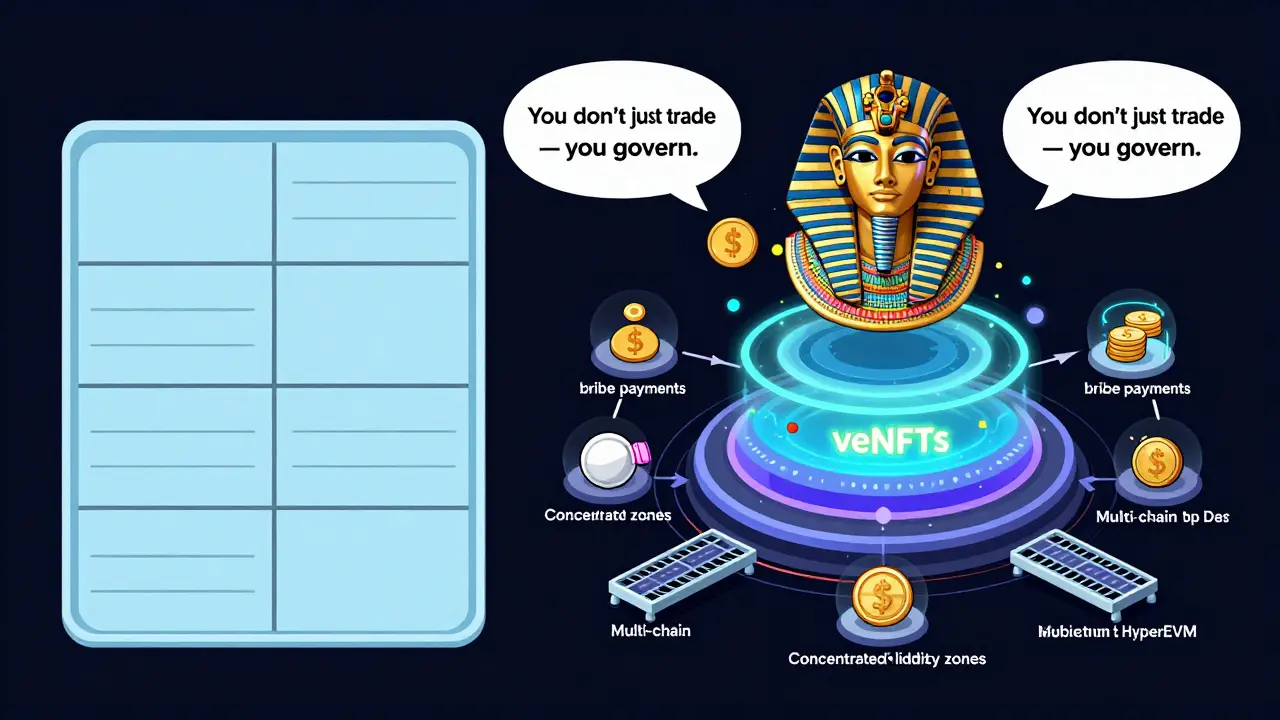
Ramses is a decentralized exchange (DEX) that runs on Arbitrum and HyperEVM. It doesn’t use order books or traditional liquidity pools. Instead, it uses Uniswap v3’s concentrated liquidity model - meaning liquidity providers can pin their funds to specific price ranges - and layers on the ve(3,3) system. That’s short for vote-escrowed 3,3, a tokenomics framework created by Andre Cronje. It’s not just about locking tokens. It’s about voting with your locked tokens to decide where fees and emissions go.
The native token, RAM, has a max supply of 200 million. Right now, 120 million are in circulation. You don’t earn rewards just by holding RAM. You earn them by locking it up for up to four years to create a veNFT - a non-fungible token that represents your voting power. The longer you lock, the more weight your vote carries. This isn’t a gimmick. It’s designed to stop short-term speculators from hijacking governance.
How ve(3,3) Tokenomics Works on Ramses
On most DEXs, trading fees are split evenly among all liquidity providers. On Ramses, it’s different. Here’s how it works:
- You lock RAM to get a veNFT.
- You vote on which liquidity pools get boosted with RAM emissions (newly minted tokens).
- Those pools then receive a share of swap fees - but only from traders who use them.
- Projects can pay “bribes” - usually in their own tokens - to get you to vote for their pool.
This last part is huge. If a new DeFi project wants liquidity, they don’t just dump tokens into a pool. They offer bribes to veNFT holders to vote for their pair. That means early projects get real, sustainable liquidity - not just a flash-in-the-pan pump. And you, as a veNFT holder, get paid in two ways: from swap fees and from the bribes.
This system turns passive liquidity provision into active governance. You’re not just a provider. You’re a decision-maker.
Why Ramses Is Different From Uniswap or SushiSwap
Let’s compare Ramses to two major DEXs:
| Feature | Ramses | Uniswap v3 | SushiSwap |
|---|---|---|---|
| Liquidity Model | Concentrated + ve(3,3) incentives | Concentrated | Standard AMM |
| Fee Distribution | Only to voted pools | Even split | Even split |
| Tokenomics | veNFT voting, bribes, rebases | No native token | Native token (SUSHI) with staking |
| Community Control | High - council + veNFT voting | Low - mostly centralized | Medium - DAO voting |
| Best For | Active DeFi users, liquidity miners | Experienced LPs | Stakers and casual traders |
Ramses doesn’t just let you trade. It turns you into a participant in the protocol’s economy. If you’re someone who farms yield, manages positions, or cares about where your tokens go, this is the closest thing to a true decentralized exchange.

Multi-Chain Strategy: Arbitrum and HyperEVM
Ramses didn’t stop at Arbitrum. In June 2025, it launched on HyperEVM - a blockchain built to connect with Hyperliquid’s derivatives platform. This isn’t just expansion. It’s strategy. Arbitrum is one of the most popular Layer 2s for DeFi. HyperEVM brings in users from centralized derivatives markets who want decentralized access.
This dual-chain approach means Ramses can pull liquidity from two different user bases:
- Arbitrum users who want high-yield, low-fee DeFi.
- Hyperliquid traders who want to move their assets into a DEX without leaving the ecosystem.
It’s rare for a DEX to successfully bridge two distinct user communities. Ramses is doing it - and that’s why its TVL keeps growing.
Partnerships That Matter
Ramses isn’t working alone. It’s integrated with some of the biggest names in DeFi:
- Liquity - for borrowing against collateral
- Frax Finance - for stablecoin swaps
- Yearn - for automated yield strategies
- Olympus DAO - for bond and treasury integrations
- 1inch, Paraswap - for aggregated swaps
- LayerZero, Axelar - for cross-chain asset movement
These aren’t marketing partnerships. These are technical integrations. If you’re using Yearn to auto-compound your yield, you can now do it directly through Ramses pools. If you’re using LayerZero to move assets across chains, Ramses lets you swap them without leaving the bridge. That kind of ecosystem depth is why institutions are paying attention.
The Downsides: Complexity and Risk
None of this comes easy. Ramses is powerful - but it’s also complicated.
- You need to understand veNFTs, locking periods, and vote weighting.
- You have to monitor bribes and change your votes regularly - otherwise, you miss out on fees.
- Impermanent loss calculations are harder with concentrated liquidity.
- Large veNFT holders can dominate voting - which raises concerns about centralization.
It’s not for beginners. If you’ve never used a DEX before, Ramses will overwhelm you. But if you’ve been in DeFi for a while and want to go deeper, this is where the real rewards are.
Who Is Ramses For?
Ramses isn’t trying to be everything to everyone. It’s built for:
- Active liquidity providers who want to maximize yield.
- Token holders who care about governance, not just price.
- DeFi power users who don’t mind spending time managing positions.
- Projects that need real, sustainable liquidity - not just hype.
If you’re looking for a simple place to swap ETH for USDC? Use Uniswap. If you want to earn bribes, vote on pools, and be part of a decentralized economy? Ramses is one of the few places that actually delivers on that promise.
What’s Next for Ramses?
The roadmap is clear: more chains, better UI, and deeper integrations. The team is working on:
- A simplified dashboard for new users to understand veNFTs without reading whitepapers.
- Automated voting tools to help users optimize without constant monitoring.
- Integration with more Layer 2s and rollups beyond Arbitrum and HyperEVM.
- On-chain identity systems to reduce the risk of vote manipulation.
The goal? To make ve(3,3) tokenomics accessible - without losing its power. If they pull it off, Ramses could become the default DEX for advanced DeFi users.
Is Ramses a safe crypto exchange?
Ramses uses battle-tested code from Uniswap v3 and Solidly, both of which have been audited and used by millions. Its smart contracts are open-source and have been reviewed by multiple DeFi security firms. However, like all DeFi protocols, it carries smart contract risk. There’s no insurance fund or centralized backup. If something goes wrong, you lose your funds. Use only what you can afford to lose.
How do I start using Ramses?
First, get some ETH or USDC on Arbitrum or HyperEVM. Then connect your wallet (MetaMask, WalletConnect). Go to the Ramses app, swap tokens to buy RAM, then lock it to create a veNFT. Choose which liquidity pools to vote for, and start earning fees and bribes. There’s a detailed guide on their official docs site - read it before locking tokens.
Can I lose money on Ramses?
Yes. If you provide liquidity in volatile pairs (like new tokens), you can suffer impermanent loss. If you vote for a pool that gets abandoned, you earn less. If you lock RAM too early and prices drop, your veNFT loses value. This isn’t a passive investment. You’re managing a position, not just holding. Always research the tokens you’re providing liquidity for.
Do I need to hold RAM to use Ramses?
No. You can trade on Ramses without holding RAM. But if you don’t hold and lock RAM, you won’t get voting rights, bribes, or fee shares. To earn more than basic swap fees, you need RAM and a veNFT.
Is Ramses better than Velodrome?
It depends. Velodrome is older and has higher TVL on Arbitrum. Ramses is newer, has a more flexible bribe system, and is expanding to HyperEVM. If you’re only on Arbitrum, Velodrome might be simpler. If you want to use multiple chains and benefit from cross-ecosystem bribes, Ramses offers more upside. Both are top-tier ve(3,3) DEXs - but Ramses is pushing further.
Ramses isn’t the future of crypto exchanges - it’s the present. It’s the first DEX that makes governance feel valuable, not just theoretical. If you’re ready to stop being a passive user and start being a participant, Ramses is one of the few places that lets you do it - and actually get paid for it.
13 Comments
This is 🔥! ve(3,3) is the real deal - finally, liquidity providers get paid for thinking, not just depositing. Bribes? Yes please. 🚀
i just tried ramses and wow i had no idea voting could make me money... kinda feels like being in a crypto senate lol
The elegance of ve(3,3) is that it transforms passive capital into active sovereignty... You're not merely a liquidity provider-you're a constitutional delegate of decentralized governance. The lock-up period isn't a barrier; it's a sacred covenant between the protocol and its stewards. And the bribes? They're not corruption-they're market-based meritocracy. Every dollar a project spends to influence votes is a vote of confidence in the community's wisdom. This isn't finance. This is political philosophy with gas fees.
If you're still using Uniswap v3 like it's 2021, you're leaving 300% of your yield on the table. Ramses isn't a DEX-it's a wealth redistribution engine. Get in now or get left behind.
Let's be honest-the veNFT system is just a fancy way to let whales vote while pretending it's democratic. The whole 'bribe' mechanism is just a backdoor for venture capital to manipulate yields. And don't get me started on HyperEVM integration-this smells like a desperate attempt to piggyback on centralized liquidity
I'm sorry, but you're all missing the point. The ve(3,3) model is fundamentally flawed because it assumes rational actors in a zero-sum game. In reality, humans are irrational, emotionally driven, and easily manipulated by token incentives. This isn't innovation-it's behavioral exploitation dressed up as decentralization.
I’ve been using Ramses for 6 months. I locked 15k RAM for 3 years. My monthly bribe income is now higher than my salary. The UI is clunky, yes-but once you understand the vote weighting curves and set up alerts for new bribes, it’s pure alpha. You’re not just farming-you’re running a micro-fund.
I see a lot of people saying 'this is complicated'-and yes, it is. But complexity isn't a bug, it's a feature. The reason most DeFi fails is because it's too easy. Ramses forces you to engage, to learn, to care. If you're not willing to spend 20 minutes a week managing your veNFT, then maybe you shouldn't be in DeFi at all. Growth requires discomfort.
Y’all are acting like Ramses is some kind of magic bean. Nah. It’s a high-stakes poker game where the house always wins-except here, YOU’RE the house. And if you don’t know how to read the table? You’re gonna get crushed. But if you do? You’re not just winning-you’re rewriting the rules. This isn’t crypto. It’s a revolution with a dashboard.
As someone who has advised institutional clients on DeFi infrastructure for over five years, I must emphasize that Ramses represents a paradigm shift in liquidity incentive design. The ve(3,3) model introduces a temporal alignment between governance participation and economic reward that is mathematically optimal for long-term protocol stability. Furthermore, the integration with LayerZero and Axelar enables cross-chain governance arbitrage-a feature absent in all prior DEX architectures. The UI challenges are temporary; the economic architecture is enduring. I recommend a minimum 12-month observation period before forming a definitive opinion.
I was skeptical at first. But after locking my RAM and seeing how the bribes flowed in-especially from Frax and Olympus-I realized this is what DeFi was supposed to be. No hype. No rug pulls. Just smart people getting paid to make good decisions. Took me a week to get the hang of it, but now I help my friends set it up. It’s not for everyone-but if you’re ready to level up? This is it.
The entire ve(3,3) framework is an elaborate Ponzi scheme disguised as governance. The bribes are just recycled emissions. The veNFTs are rent-seeking mechanisms for early adopters. The 'community control' is a marketing slogan. And the 'multi-chain strategy'? A desperate scramble for relevance. This isn't innovation. It's entropy with a whitepaper.
I’m from the US but my mom in India just started using Ramses. She didn’t understand any of the tech-but she loved that she could earn extra money just by voting. She says it’s like a game, but with real rewards. I’m proud of her. This is what crypto should be: simple, fair, and for everyone.