
Proof of Stake Energy Efficiency: Why It Matters for Blockchain
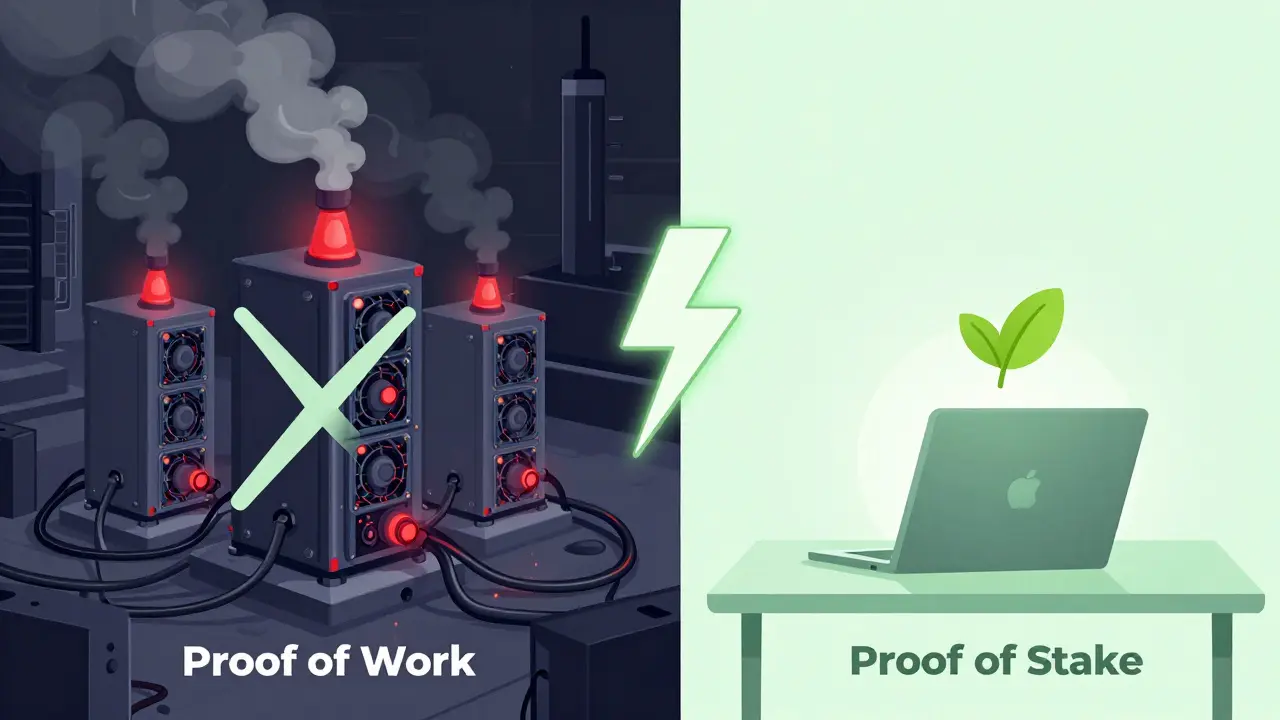
Imagine a system that secures global financial transactions using less electricity than your average American household. That is the reality of Proof of Stake, a blockchain consensus mechanism that selects validators based on their staked cryptocurrency rather than computational power. For years, the idea that digital money required massive amounts of energy was a major sticking point for critics and environmentalists alike. But the landscape has shifted dramatically since September 2022, when Ethereum completed "The Merge," transitioning from the energy-intensive Proof of Work model to the efficient Proof of Stake architecture.
This shift wasn't just a technical update; it was a fundamental change in how we think about blockchain sustainability. If you are looking at blockchain technology for business, investing, or personal use, understanding the energy advantages of Proof of Stake is no longer optional-it's essential. The numbers don't lie, and they paint a picture of a much greener future for decentralized networks.
The Core Difference: Mining vs. Staking
To understand why Proof of Stake is so much more efficient, you first need to look at what it replaced: Proof of Work, a consensus algorithm where miners compete to solve complex cryptographic puzzles to validate transactions and create new blocks. In a Proof of Work system like Bitcoin, thousands of powerful computers race against each other to find the next block. This competition requires specialized hardware called ASICs (Application-Specific Integrated Circuits) that consume thousands of watts of electricity. Only one miner wins the reward, but everyone else burns energy for nothing. It’s an arms race with no end in sight.
Proof of Stake flips this model entirely. Instead of competing with hardware, participants lock up, or "stake," their own cryptocurrency as collateral. The network then randomly selects these validators to propose and attest to new blocks. There is no race. There is no wasted computation. A validator doesn't need a supercomputer; they just need a standard laptop or desktop computer running continuously. According to analysis by Bitwave.io in 2023, a Proof of Stake node can run on a machine with as little as 8 GB of RAM. Compare that to Bitcoin mining rigs that draw between 1,000 and 3,000 watts per unit, and the difference in energy demand becomes obvious immediately.
By the Numbers: The 99.95% Reduction
When experts talk about the efficiency of Proof of Stake, they aren't using vague marketing terms. They are citing specific, measurable data. The most famous example is Ethereum. Before its transition in 2022, Ethereum's network consumed approximately 5.13 gigawatts of continuous power under Proof of Work. After switching to Proof of Stake, that number dropped to just 2.62 megawatts.
That is a reduction factor of roughly 1,957 times. In percentage terms, the Ethereum Foundation and independent auditors like EY confirmed that the network uses 99.95% less energy. To put that in perspective, if you had a tank of gas and used 99.95% less fuel, you could drive across the country multiple times on a single drop. FTSE Russell’s 2023 research paper backed this up, showing that Ethereum’s Proof of Work network consumed about 2,000 times more energy than its parallel Proof of Stake testnet.
| Metric | Bitcoin (PoW) | Ethereum (Post-Merge PoS) |
|---|---|---|
| Annual Energy Use | ~112 TWh | ~0.0025 TWh (2.5 GWh) |
| Energy Per Transaction | ~830 kWh | ~0.036 kWh |
| Hardware Requirement | Specialized ASIC Miners | Standard PC (8GB+ RAM) |
| Carbon Footprint (Annual) | ~62.5 Million Tonnes CO2e | Equivalent to ~200 US Households |
The transaction-level data is even more striking. Carl Beekhuizen, a researcher at the Ethereum Foundation, calculated that a single Bitcoin transaction consumes about 830 kilowatt-hours of energy. That is enough power to run a typical US home for nearly three weeks. An Ethereum transaction on Proof of Stake uses about 0.036 kilowatt-hours. You could process millions of Ethereum transactions for the same energy cost as sending one Bitcoin payment.

Environmental Impact and Carbon Footprint
Energy consumption directly translates to carbon emissions, especially when the electricity grid relies on fossil fuels. The Crypto Carbon Ratings Institute (CCRI) published a comprehensive study in 2023 that measured the actual carbon footprints of major blockchain networks. Their findings were clear: Proof of Stake networks have a negligible environmental impact compared to their Proof of Work counterparts.
Polkadot, another major Proof of Stake network, emitted only 33 tonnes of CO2 equivalent annually. Solana, which processes high volumes of transactions, emitted 934 tonnes. Even combined, the major Proof of Stake networks (including Ethereum, Cardano, Tezos, and Polkadot) produce emissions equivalent to just 200 US households. Contrast this with Bitcoin, which produces over 62 million tonnes of CO2 annually-roughly the same amount as medium-sized countries like Argentina or Norway.
This drastic reduction matters because it changes the narrative around cryptocurrency. Institutional investors, who are increasingly bound by Environmental, Social, and Governance (ESG) criteria, found it difficult to justify large allocations to Proof of Work assets. Fidelity’s 2023 ESG report explicitly stated that Ethereum’s dramatic reduction in energy consumption was critical to their clients accepting it as a viable investment. Today, 73% of companies holding cryptocurrency prioritize Proof of Stake assets for ESG compliance, up from just 28% in 2021, according to Bitwave.io’s 2024 corporate treasury report.
Barriers to Entry: Who Can Participate?
One of the hidden advantages of Proof of Stake’s energy efficiency is how it lowers the barrier to entry for network participation. In Proof of Work, you need to buy expensive, specialized hardware. As of mid-2024, a top-tier Bitcoin miner like the Bitmain Antminer S21 Hydro costs thousands of dollars and consumes over 5,000 watts. This creates a centralized industry dominated by large mining farms with access to cheap industrial electricity.
In Proof of Stake, the primary requirement is capital, not hardware. To become a solo validator on Ethereum, you need to stake 32 ETH (which fluctuates in value but was around $102,400 in late 2024) and a standard computer. The setup takes a few hours, and the ongoing operational cost is just the electricity to keep your PC running 24/7. This allows individuals to participate in securing the network without building a power plant.
For those who don’t want to manage hardware or lock up large sums of money, staking-as-a-service providers and liquid staking derivatives offer alternatives. Platforms like Coinbase and Lido allow users to stake small amounts-even as low as $10-and earn rewards. This democratization of security is a direct result of removing the energy-intensive hardware race. However, it does introduce new dynamics. As of June 2024, staking service providers controlled about 32% of all staked ETH, raising some concerns about centralization, though no major network has yet shown significant security issues due to this concentration.

Scalability and Future Upgrades
Energy efficiency isn't just about saving power; it enables scalability. Because Proof of Stake nodes don't struggle with intense computational loads, they can handle more data and transactions efficiently. Ethereum currently processes between 15 and 45 transactions per second on its base layer, but the roadmap includes features like sharding and proto-danksharding (implemented in the Dencun upgrade in February 2024) that aim to push throughput toward 100,000 transactions per second while maintaining low energy use.
The Dencun upgrade itself reduced the energy cost per transaction by an additional 10%. Future upgrades, such as Verkle Trees expected in 2025, will further optimize storage and validation efficiency. Gartner predicted in their 2024 outlook that by 2027, 95% of enterprise blockchain implementations will use Proof of Stake or its variants, driven largely by these efficiency gains and regulatory pressures.
Regulators are taking notice too. The European Union’s MiCA regulations treat Proof of Stake validators differently from Proof of Work miners, recognizing the lower environmental risk. In the US, legislation like the Pro-Proof-of-Stake Act introduced in 2023 seeks to clarify the legal status of staking, separating it from securities laws that often apply to mining operations. This regulatory clarity encourages broader adoption.
Common Concerns and Trade-offs
No technology is perfect, and Proof of Stake has its critics. Some argue that Proof of Work provides stronger security guarantees because attacking the network would require controlling physical hardware and energy resources, which is costly and detectable. In Proof of Stake, the cost of attack is purely financial-you need to acquire 51% of the staked coins. Critics worry this could lead to "nothing at stake" problems or long-range attacks, although modern implementations include slashing conditions (penalties) that make such attacks economically unviable.
There is also the issue of wealth concentration. Since you need coins to stake, those with more coins can earn more rewards, potentially leading to a rich-get-richer dynamic. While this is a valid concern, it hasn't resulted in significant centralization in practice. Major networks remain relatively distributed among thousands of validators. Additionally, the ability to stake small amounts through pooled services mitigates this for retail users.
Another trade-off is complexity. Running a solo validator requires technical knowledge to maintain uptime and avoid penalties. This has led to the rise of custodial staking services, which reintroduces some trust elements into a trustless system. Users must weigh the convenience of easy staking against the ideological purity of self-custody.
Is Proof of Stake truly secure without energy consumption?
Yes. Security in Proof of Stake comes from economic incentives rather than energy expenditure. Validators risk losing their staked funds (slashing) if they act maliciously. This economic penalty is often more effective than the energy cost in Proof of Work, as it directly impacts the attacker's capital. Networks like Ethereum have maintained high security levels post-Merge without any major breaches.
How much energy does a Proof of Stake node actually use?
A typical Proof of Stake validator node uses about 10-20 watts of power, similar to a standard desktop computer or a smart TV. Annually, this amounts to roughly 10.6 MWh per validator. Compared to Bitcoin miners using 1,000-3,000 watts, this is a fraction of the energy. The entire Ethereum network uses less energy than a small town.
Can I stake cryptocurrency with a small amount of money?
Yes. While solo staking on Ethereum requires 32 ETH, you can use staking pools or exchange-based services to stake smaller amounts. Platforms like Coinbase, Lido, or Rocket Pool allow you to start with as little as $10-$50. You earn proportional rewards, though fees may apply to the service provider.
Why did Ethereum switch to Proof of Stake?
Ethereum switched primarily to improve scalability and reduce environmental impact. The energy inefficiency of Proof of Work was becoming unsustainable and hindered institutional adoption. The Merge allowed Ethereum to prepare for future scaling solutions like sharding, making the network faster and cheaper to use while drastically cutting energy use by 99.95%.
Are there any risks associated with Proof of Stake?
Risks include potential centralization if a few entities control large portions of staked assets, and the technical complexity of running a validator. There are also smart contract risks if you use third-party staking services. However, the core consensus mechanism itself is considered secure, with no successful 51% attacks on major PoS networks to date.