
Play-to-Earn Gaming Economics: How Players Earn Real Money in Blockchain Games
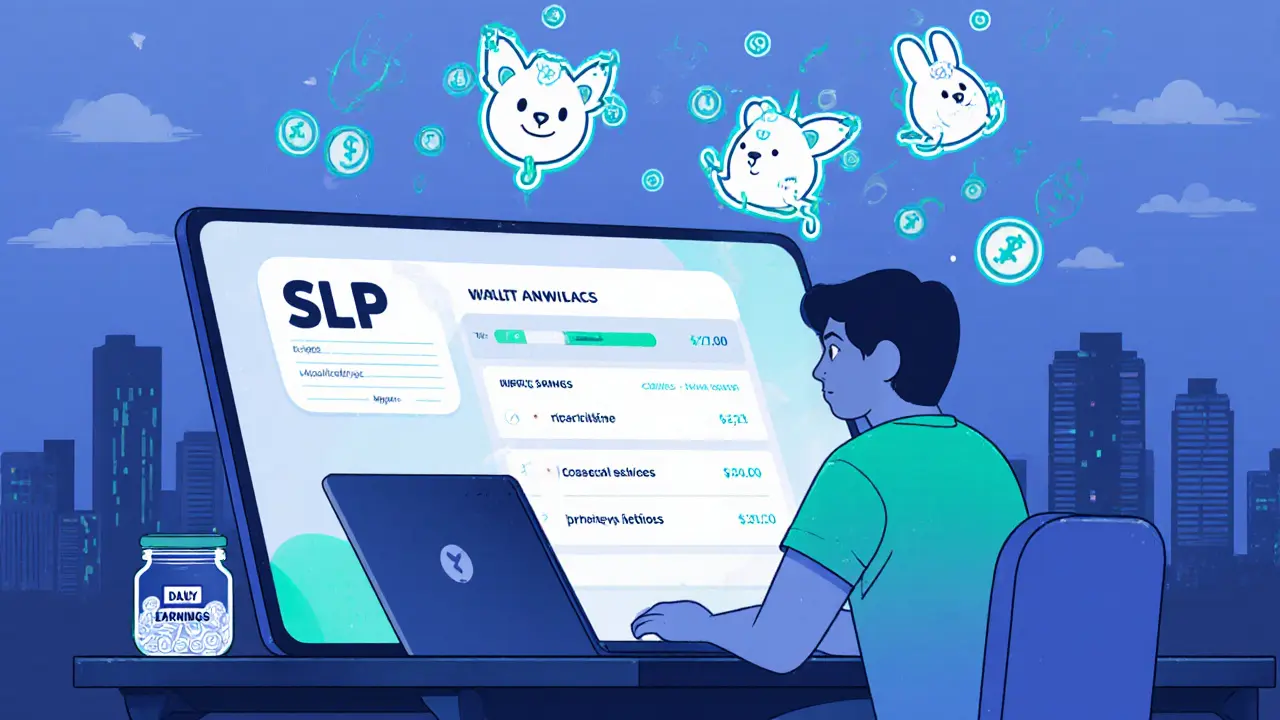
For most people, video games cost money. You buy the game, pay for subscriptions, spend on skins or loot boxes - and that’s it. But in play-to-earn gaming, the tables turn. You don’t just spend - you earn. Real money. In your wallet. Not points. Not virtual currency that vanishes when the server shuts down. Actual cryptocurrency you can trade, spend, or save.
This isn’t a side hustle. For thousands of players in the Philippines, Nigeria, and Venezuela, P2E games are their primary income. One player in Manila told a reporter he made more from playing Axie Infinity than he did working two part-time jobs. That’s not an outlier. It’s the new reality.
How Play-to-Earn Actually Works
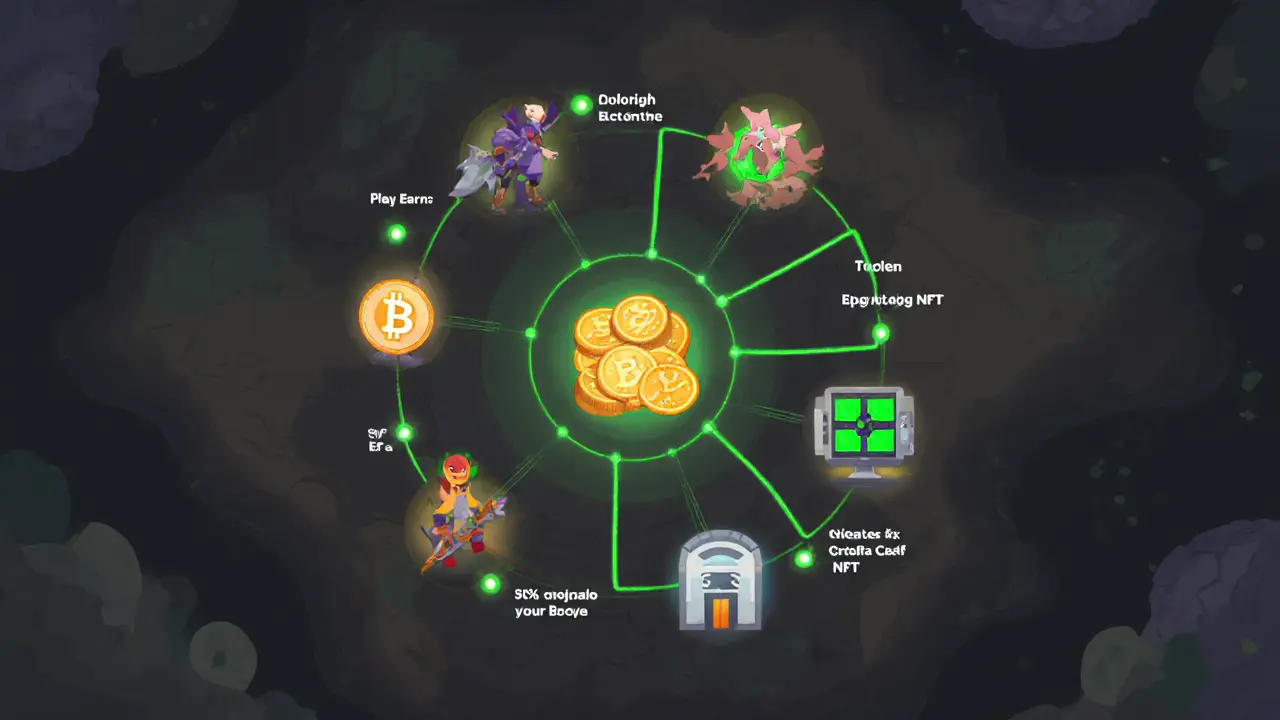
At its core, play-to-earn (P2E) gaming uses blockchain to give players real ownership of in-game items. Instead of the game company owning your sword, armor, or land, you do. These items are NFTs - unique digital tokens stored on a blockchain. They can’t be copied, deleted, or taken away by a developer. You control them.
These NFTs aren’t just for show. They’re tools. You use them to play, compete, and earn. Every time you win a battle, complete a quest, or breed a new creature, you get rewarded with utility tokens - the game’s internal currency. These tokens have value because they’re scarce, tradable, and accepted on decentralized exchanges.
Think of it like this: In a regular game, you spend $50 on a character skin. You never see that money again. In a P2E game, you spend $50 on a character NFT. You use it to earn $10 a day. After five days, you’ve broken even. After ten days, you’re ahead. And you still own the NFT.
The Engine Behind the Earnings
Behind every P2E game is a carefully built economic system - called tokenomics. It’s not magic. It’s math. Developers design it to balance supply and demand so the game doesn’t collapse.
There are two main types of tokens:
- Utility tokens - earned through play. Used to buy items, upgrade characters, or pay for entry into tournaments.
- NFTs - unique assets like characters, weapons, or virtual land. You buy them upfront or earn them over time. They can be sold or rented out.
Here’s how the money flows:
- You spend $100 on three Axie NFTs to start playing.
- You complete daily quests and earn 50 SLP tokens per day.
- You sell those tokens on a crypto exchange for $15.
- You reinvest $5 into upgrading your Axies to earn more.
- You keep $10 profit.
After 10 days, you’ve earned $100 - enough to cover your initial cost. Now you’re playing for free, and every day after that is pure profit.
But it’s not that simple. If too many people start earning tokens and flooding the market, the price drops. That’s why smart games limit how many tokens you can earn per day, or require you to stake your tokens to earn more. It’s like controlling inflation in a real economy.
How Developers Make Money
People think P2E games are charity. They’re not. Developers make money - and they make it well.
Most P2E games charge a small fee every time an NFT is sold. This is called a royalty. Say you buy an NFT sword for $200. When you later sell it for $300, the game’s creator gets 5% - $15 - automatically. Every single time that sword changes hands, the developer gets paid.
This creates a long-term revenue stream. Unlike traditional games that make money on day one and fade, P2E games grow richer as their community trades more. The more active the player economy, the more the developer earns.
Some games also sell starter NFT packs directly. Others charge gas fees for transactions or take a cut from in-game marketplaces. The key is alignment: the developer’s income rises when players succeed.
Who’s Playing - And Why
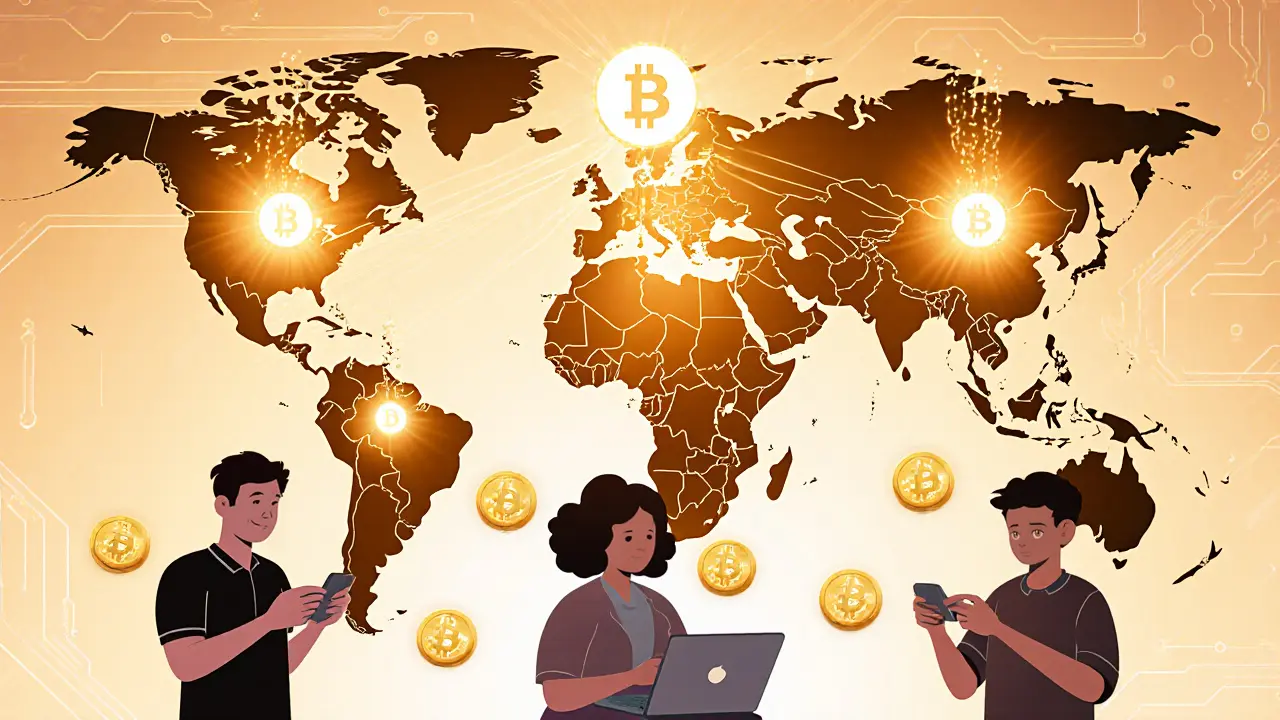
P2E gaming didn’t take off in Silicon Valley. It exploded in countries where the average wage is low, and opportunities are scarce.
In the Philippines, over 1 million people played Axie Infinity at its peak. Many were students, stay-at-home parents, or gig workers who turned gameplay into a full-time job. In Nigeria, players formed guilds - groups that loan NFTs to new players in exchange for a share of earnings. It’s like a microloan system powered by blockchain.
These players aren’t just chasing fun. They’re chasing survival. A single NFT character can be worth more than a month’s rent. Earning $10 a day isn’t luxury - it’s stability.
But it’s not just the Global South. In the U.S. and Europe, players are using P2E games as side gigs. They trade NFTs during lunch breaks. They farm tokens after work. They join Discord groups to learn the best strategies. It’s work - but it’s work you enjoy.
The Hidden Costs
Don’t be fooled. P2E isn’t free money. There’s a steep entry barrier.
First, you need a crypto wallet - like MetaMask or Phantom. You need to buy cryptocurrency (usually Ethereum, Solana, or Polygon) to pay for gas fees. Those fees can be $5-$20 per transaction, depending on network traffic.
Second, many games require you to buy NFTs to start. Axie Infinity once required three Axies to play - costing $300-$1,000. That’s a huge barrier for most people. Some games now offer “scholarship” models where you borrow NFTs. But even then, you’re sharing your earnings.
Third, you need to understand markets. Token prices swing wildly. A game might pay $20/day today and $2/day next month. If you don’t know when to sell, you lose money.
And if the game fails? Your NFTs might become worthless. There’s no refund. No customer service. You’re on your own.
What Makes a P2E Game Last
Most P2E games die within a year. Why? They focus too much on earning and too little on fun.
Players will stick around if the game is enjoyable. If it’s repetitive, boring, or glitchy, they’ll leave - even if they’re making money. The best P2E games blend addictive gameplay with smart economics.
Examples:
- Axie Infinity - Combines turn-based battles with breeding mechanics. High entry cost, but deep strategy.
- Stepn - Rewards walking or running with tokens. Uses real-world movement as input. Controversial, but innovative.
- The Sandbox - Lets players build, own, and monetize virtual land. More like a digital real estate game.
The winners aren’t the ones with the highest payouts. They’re the ones that keep players engaged - with evolving quests, community events, and regular updates.
Is This the Future of Gaming?
Traditional gaming is built on extraction: companies take your money, your time, your attention - and give you nothing tangible in return. P2E flips that. You own your time. You own your effort. You own your earnings.
It’s not perfect. It’s volatile. It’s complex. But it’s real.
By 2031, the P2E market could be worth over $6 billion. That’s not a bubble. That’s a shift. A shift in who controls value in digital spaces.
Maybe one day, your kid will say, ‘I’m not going to college. I’m going to play.’ Not because they’re lazy. Because they’ve seen the math. And they’ve seen people doing it.
The line between work and play is fading. And in P2E gaming, you don’t have to choose one.
Can you really make a living from play-to-earn games?
Yes - but not for everyone. Players in countries with lower wages, like the Philippines and Nigeria, have turned P2E into full-time income. Some earn $5-$15 a day, which can be more than local jobs pay. In wealthier countries, it’s usually a side income. Success depends on skill, time investment, and understanding token economics. It’s not passive income - it’s work with a digital twist.
Do I need to spend money to start playing?
Most P2E games require an upfront investment. You need a crypto wallet, some cryptocurrency for gas fees, and often NFTs to play - which can cost $100-$1,000. But some games now offer scholarship programs where you borrow NFTs and split earnings. Others have free-to-play modes with lower rewards. You can start small, but true earning potential usually requires an initial outlay.
Are P2E games safe or just gambling?
They’re not gambling - but they carry similar risks. Unlike casinos, P2E games reward skill, strategy, and time. But token prices can crash, games can shut down, and NFTs can lose value. There’s no guarantee. Treat it like investing in a startup: do your research, start small, and never risk more than you can afford to lose.
What’s the difference between utility tokens and NFTs in P2E games?
Utility tokens are like in-game currency - you earn them by playing and use them to buy upgrades or enter events. They’re fungible, meaning one token equals another. NFTs are unique digital items - like a rare sword or a piece of virtual land. Each NFT is one-of-a-kind and can be bought, sold, or rented. You need NFTs to play most games, and you earn utility tokens by using them.
Why do some P2E games fail while others succeed?
Games that focus only on earning collapse fast. Players leave when the rewards drop or the gameplay gets boring. Successful games balance fun with economics. They update regularly, build strong communities, and offer meaningful progression. Axie Infinity and The Sandbox lasted because they’re actually fun to play - not just because you can make money.
Is P2E gaming legal?
It’s legal in most countries - but regulations are changing. Some governments classify P2E earnings as taxable income. Others are cracking down on NFTs as unregistered securities. In the U.S., the IRS treats crypto earnings as property. In the Philippines, the government officially recognizes P2E as a legitimate income source. Always check your local laws and report earnings if required.
18 Comments
P2E isn't magic, it's just work with better accounting.
I've seen this play out in rural Nigeria. Guys who couldn't afford data plans are now running 3 Axie teams on borrowed phones. They don't care about blockchain theory-they care about feeding their kids. The tech is just the vehicle. The real innovation is giving dignity to labor that was invisible before.
Oh great. So now we're glorifying crypto hustles as economic empowerment? Next you'll tell me selling knockoff AirPods on Instagram is a startup. You're not building wealth-you're betting on a Ponzi dressed in NFTs.
They say it's 'ownership' but the devs control the smart contracts. They can change rewards, burn tokens, or just vanish. It's not capitalism-it's feudalism with gas fees. 😒
Did you know the Philippines government quietly banned Axie payouts last year? The IMF flagged it as a currency destabilizer. They just didn't tell you because the narrative is too profitable. This isn't liberation-it's financial colonialism wrapped in Web3 jargon.
It's important to distinguish between the mechanics and the outcomes. The tokenomics model is flawed in most cases, but the underlying principle-player sovereignty over digital assets-is revolutionary. Traditional games treat players as consumers; P2E treats them as stakeholders. That shift, even if imperfectly implemented, deserves serious consideration.
I started playing Stepn last year with $200 in sneakers. First month I made $80, paid my rent, felt like a genius. Then the token dropped 70% because everyone and their dog jumped in. I got scared, sold everything, lost half my stake. Now I play for fun, not profit. The real lesson? Don't gamble your rent on a game that can change its rules tomorrow. And yeah, I still log in every morning. It's weirdly calming. Like gardening, but with more crypto charts.
Just got back from Lagos. Met a guy who runs a P2E guild with 47 kids. He loans them Axies, takes 30% of earnings, teaches them English and crypto basics. These aren't gamers-they're micro-entrepreneurs. One girl, 16, made enough to buy her mom a fridge. That's not a game. That's a lifeline. The West talks about 'decentralization' like it's a tech trend. In places like this, it's survival.
The notion that P2E gaming is a viable long-term economic model ignores the fundamental issue of scalability. When thousands of players flood a token economy, inflation becomes inevitable. The game developers, incentivized by royalties, have no motivation to stabilize the economy-only to maximize transaction volume. This is not a sustainable system; it is a high-frequency extraction mechanism disguised as innovation.
Let’s be real. Most of these games are designed to extract money from the desperate. The developers know the math. They know the poor will risk everything for a shot. They don’t care if you lose. They get their cut every time you trade. This isn’t empowerment. It’s predation with a blockchain logo.
Look at the token decay curves. Axie’s SLP peaked at $0.18 and is now at $0.003. That’s a 98% devaluation in 18 months. Players who invested $800 in NFTs are now earning $1.20 a day. The ROI curve isn’t just negative-it’s catastrophic. This isn’t a game. It’s a financial graveyard with a Discord server.
There’s real value in giving people agency over their digital time. Even if the systems are flawed, the idea that your effort can translate into tangible assets is powerful. Maybe the model needs regulation, not rejection. Maybe we need public utility tokens, or community-run economies. But don’t dismiss the hope here. People are building something new, even if it’s messy.
Tokenomics is just a fancy word for pyramid scheme with smart contracts. The only ones profiting are the early whales and the devs. The rest are liquidity. You think you’re playing a game? You’re a node in a distributed extraction network. The blockchain doesn’t make it fair-it just makes it harder to trace.
Y’all act like P2E is the second coming. Bro, I played a game where I had to grind 6 hours a day to earn $3. I cried. My dog left. My girlfriend broke up with me. I’m still paying off the gas fees. This isn’t freedom. It’s digital sharecropping with extra steps.
Ever wonder why all the P2E devs are based in Singapore and Dubai? Coincidence? The same countries that banned crypto gambling? They’re building exit ramps. The moment the game collapses, they vanish. The NFTs? Worthless. The players? Left holding the bag. This isn’t innovation. It’s a global confidence trick with a whitepaper.
Ownership is an illusion when the keys are held by a foundation controlled by venture capital. The blockchain is not a liberator-it is a ledger of exploitation. The workers in Manila do not own their labor. They are paid in tokens that can be devalued at will. The true owners are those who created the system and hold the governance tokens. The players are merely the labor force in a new digital plantation
They say the government in the Philippines supports P2E but they're also monitoring wallet addresses. They're tracking every transaction. They're building a digital surveillance state under the guise of economic reform. This isn't empowerment-it's data harvesting with a side of crypto. Your earnings are being used to build behavioral profiles for future credit scoring. You think you're winning? You're being mapped.
yo i just got a new axie and its so cool i made like 20 bucks in a day but then my wallet got hacked and i lost it all and now i have to start over again but i think i can do it this time