
OFAC Sanctions on North Korean Crypto Networks: How the U.S. Is Targeting Cyber Theft for Weapons Funding
Weapons Funding Calculator
Based on U.S. Treasury estimates that every $10 million stolen could buy dozens of ballistic missiles. See how much weapons funding is supported by stolen cryptocurrency.
Enter an amount to see how much weapons funding it could support.
North Korea isn’t just building missiles-it’s building crypto heists. Since early 2025, U.S. sanctions have zeroed in on a network of cybercriminals operating under the guise of remote IT workers, stealing over $2.1 billion in cryptocurrency in just six months. These aren’t random hackers. They’re state-backed operatives, embedded in American tech firms, using fake identities to siphon funds that directly fuel Pyongyang’s nuclear and missile programs.
How North Korea Uses Remote IT Workers to Steal Crypto
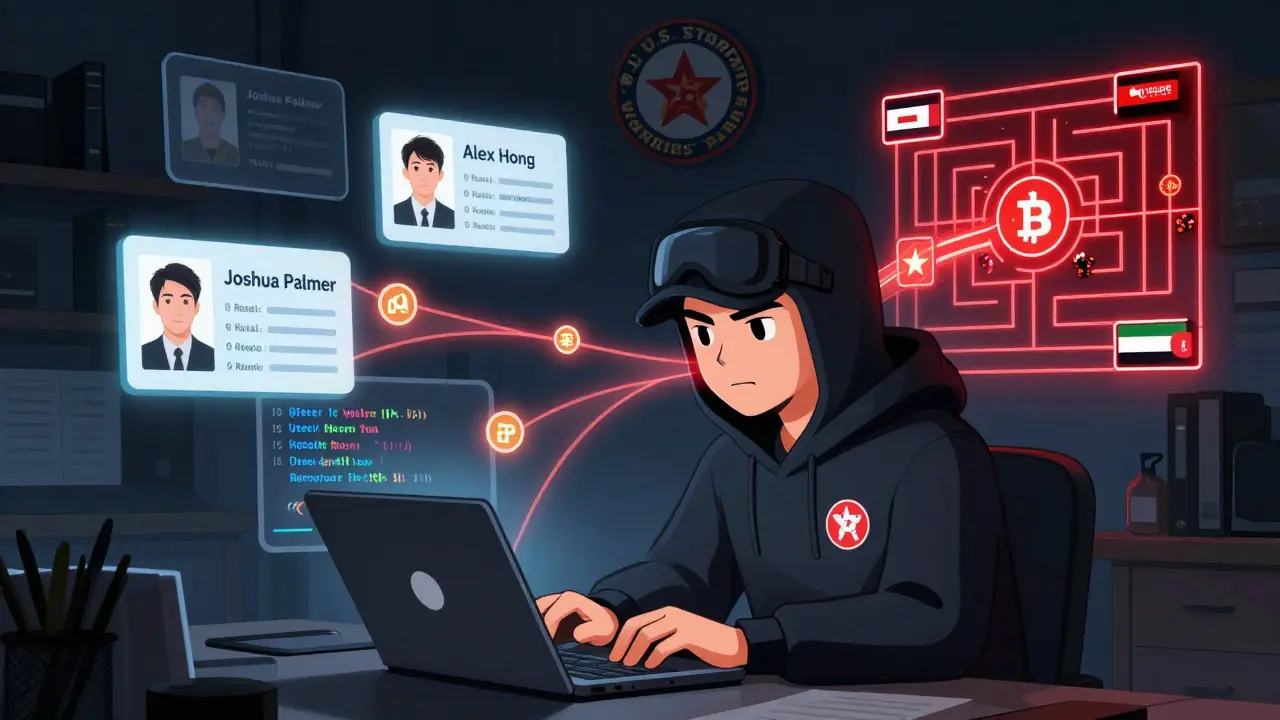
The scheme is simple, brutal, and surprisingly effective. North Korean operatives apply for remote IT jobs at U.S.-based crypto startups, Web3 firms, and blockchain developers. They don’t just code-they spy. Using stolen or fabricated identities like "Joshua Palmer" and "Alex Hong," they get hired, gain access to internal systems, and quietly gather intel. Some even work for months before striking. Once inside, they use their positions to steal sensitive data, plant malware, and later demand ransom. But the real payout? Cryptocurrency payments. These workers are paid in stablecoins like USDC or ETH, often through freelance platforms like Freelancer, RemoteHub, and WorkSpace.ru. The money flows into wallets they control, then gets moved through a maze of exchanges, self-hosted wallets, and OTC brokers-many based in Russia or the UAE-to hide the trail. Security firms like TRM Labs track these operations under names like Famous Chollima, Jasper Sleet, and UNC5267. These aren’t random labels-they’re code names for highly organized units linked directly to the Workers’ Party of Korea. The same people who write clean Python scripts for a startup are also mapping out how to drain the company’s crypto treasury.The Sanctions That Hit Hard in 2025
The U.S. didn’t wait. In 2025, the Treasury’s Office of Foreign Assets Control (OFAC) launched its most aggressive campaign yet. On August 27, 2025, they sanctioned Russian national Vitaliy Sergeyevich Andreyev and North Korean Kim Ung Sun for laundering nearly $600,000 in crypto cash. But it wasn’t just individuals. Two companies-Shenyang Geumpungri Network Technology Co., Ltd and Korea Sinjin Trading Corporation-were also added to the sanctions list for helping run the fraud network. This wasn’t a one-off. OFAC had already hit them in July 2025, and before that, in May 2023, they targeted Chinyong Information Technology Cooperation Company, a known front for deploying North Korean IT workers across China, Laos, and Russia. By October 2025, OFAC had expanded the list again, adding Korea Sobaeksu Trading Company and three more individuals-Kim Se Un, Jo Kyong Hun, and Myong Chol Min-for helping move money and evade sanctions. The Justice Department didn’t sit idle either. In June 2025, they filed a civil forfeiture case seeking over $7.7 million in crypto, NFTs, and digital assets tied to these schemes. The FBI seized wallets holding ETH, USDC, and even high-value NFTs. One OTC broker, already sanctioned in late 2024, was caught funneling stolen crypto into cash for North Korean operatives.Why Crypto Is North Korea’s Weapon of Choice
Sanctions have choked off North Korea’s traditional revenue streams-oil, coal, textiles. But crypto? That’s different. It’s borderless, fast, and hard to trace. Unlike banks, crypto exchanges don’t always ask who you are. And with decentralized finance, you don’t need a bank account to move millions. The regime has turned crypto theft into a systematic industry. They don’t just hack exchanges-they infiltrate the people who work there. By embedding operatives inside legitimate companies, they avoid the high-risk, high-visibility attacks that trigger alerts. It’s espionage disguised as employment. And it’s working. Since 2021, these operations have generated over $1 million in revenue-most of it going straight to weapons programs. The U.S. Treasury estimates that every $10 million stolen could buy dozens of ballistic missiles. That’s not just theft. It’s national security risk.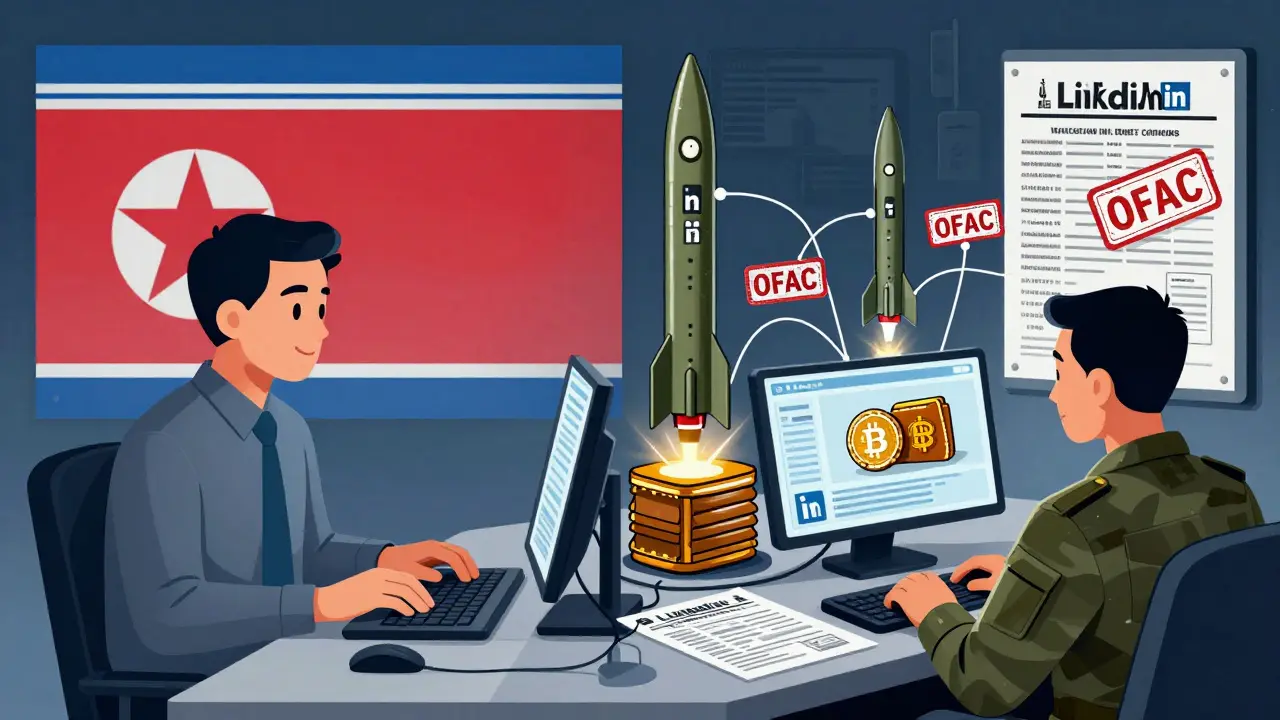
How These Networks Move Money Around the World
The money trail doesn’t end at the wallet. It snakes across continents. North Korean operatives use Russian servers to hide their IP addresses. They route funds through UAE-based exchanges that lack strict KYC rules. They use Chinese front companies to open bank accounts under false names. The entire system is built to confuse investigators. TRM Labs and other blockchain analysts track this by spotting patterns: wallets that receive small deposits from dozens of different sources, then send it all to one final address. They look for reused wallet addresses tied to past sanctions. They flag transactions that match known DPRK-linked behavior-like sending ETH to a wallet that previously received funds from a sanctioned North Korean entity. The most telling sign? Fake identities. The same GitHub profile, same LinkedIn, same freelance account-used across multiple theft operations. These aren’t one-time frauds. They’re reusable templates, built and maintained by a centralized North Korean unit.Who’s Really Behind This?
It’s not rogue hackers. It’s the state. The Workers’ Party of Korea runs these operations like a military division. The IT workers are recruited young, trained in programming and social engineering, then sent abroad with fake passports and forged diplomas. They’re told to blend in, earn trust, and wait for the right moment. The money they steal doesn’t go to their pockets. It goes to senior officials like Kim Sang Man and Sim Hyon Sop-both already sanctioned-who control the flow of funds to Pyongyang’s weapons labs. The regime treats crypto theft as a core part of its defense budget. The U.S. government isn’t acting alone. Japan and South Korea issued joint statements in August 2025, confirming they’re sharing intelligence. The FBI, DHS, State Department, and Treasury are all working together. This is a whole-of-government effort, and it’s getting more coordinated by the month.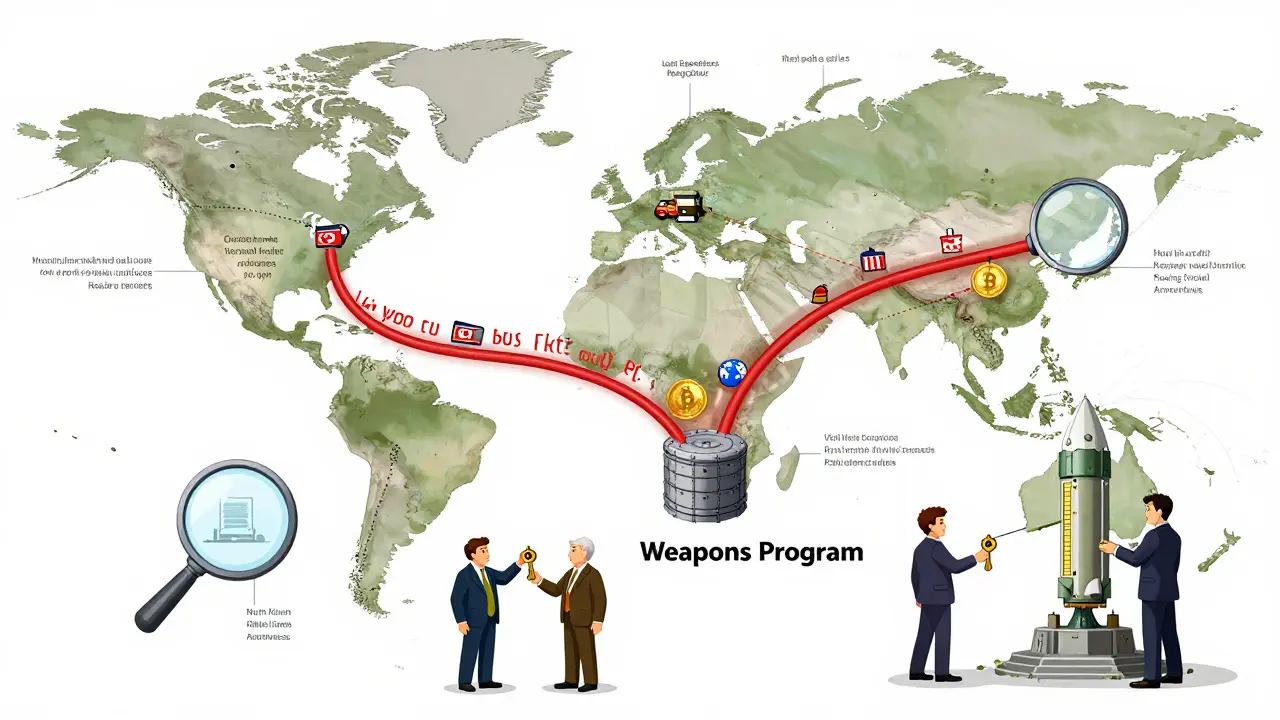
What This Means for Crypto Companies
If you run a crypto startup or hire remote developers, this isn’t someone else’s problem. You’re a target. North Korean operatives are actively scanning job boards, GitHub profiles, and freelance platforms for easy entry points. They don’t need to break in-they just need to be hired. Companies that ignore background checks on remote workers are at risk. A single compromised developer can leak private keys, drain wallets, or install ransomware that locks down your entire system. The cost? Not just money. Reputation. Trust. Customer loss. The solution isn’t just better security software. It’s better hiring. Screen applicants. Verify identities. Check for inconsistencies in work history. Look for reused profiles across platforms. If someone claims to have worked for a company in Seoul since 2020 but their LinkedIn shows they were in Laos last year-red flag.What’s Next?
OFAC isn’t done. More designations are coming. Investigators are still tracing funds through Russian and Southeast Asian intermediaries. New wallets are being added to the watchlist every week. The goal isn’t just to punish-it’s to freeze the network. Cut off the money. Break the pipeline. For crypto platforms, this means stricter onboarding. For investors, it means asking: Who’s really building this project? Are they vetted? Or are they just another fake profile hiding in plain sight? The line between a remote developer and a state-sponsored thief is thinner than you think. And the price of ignoring it? Billions stolen. Missiles launched. Lives at risk.Are OFAC sanctions still active against North Korean crypto networks in 2025?
Yes. OFAC has expanded its sanctions throughout 2025, adding new individuals and entities tied to crypto theft and IT worker fraud schemes. As of October 2025, over 15 entities and 20 individuals have been designated, with more expected as investigations continue.
How much crypto has North Korea stolen through these schemes?
According to TRM Labs, North Korean threat actors stole over $2.1 billion in cryptocurrency in the first half of 2025 alone. Since 2021, total thefts linked to these operations exceed $1 billion, with the majority funding weapons development.
Can North Korean hackers be caught through blockchain analysis?
Yes. While crypto is pseudonymous, patterns emerge. Reused wallet addresses, transaction timing, and movement through known sanctioned exchanges help analysts link activity to DPRK-linked networks. Firms like TRM Labs and Chainalysis have successfully traced thefts back to North Korean operatives using these methods.
What should crypto companies do to protect themselves?
Verify remote workers’ identities using third-party checks. Look for inconsistencies in work history, especially across platforms like GitHub, Freelancer, and LinkedIn. Screen for fake profiles and reused identities. Use blockchain monitoring tools to flag transactions linked to sanctioned wallets. Don’t assume remote = low risk.
Are these North Korean IT workers actually skilled developers?
Many are. The North Korean regime invests heavily in training its cyber operatives in programming, cybersecurity, and social engineering. They’re not amateurs-they’re professionals hired to blend in. Their technical skills make them harder to detect, and their access to company systems makes them more dangerous.
How does this affect global crypto regulation?
This has pushed regulators worldwide to tighten KYC and AML rules for crypto platforms, especially those dealing with cross-border remote hires. Countries like Japan, South Korea, and Singapore are now sharing intelligence and aligning sanctions lists. The U.S. is pressuring jurisdictions with weak oversight-like parts of the UAE and Russia-to crack down on facilitators.
21 Comments
Bro this is wild 🤯 We’re living in a cyberpunk novel where your remote dev is secretly funding nukes. North Korea’s basically running a legit-looking SaaS startup with a side hustle of stealing ETH. The fact that they use fake GitHub profiles and LinkedIn bios? Pure genius. And terrifying. I’m now double-checking every freelance hire I’ve ever made. 😅
Companies need to stop treating remote work like a free-for-all. Background checks aren’t optional anymore. If you’re hiring devs from overseas without verifying identities through trusted third parties, you’re just asking to be the next target. This isn’t fearmongering-it’s basic ops hygiene.
ok but what if the whole thing is a psyop? like… what if the us gov is *letting* them steal crypto so they can justify more surveillance? 🤔 i mean… why are they so public about it? why not just quietly shut down the wallets? this feels staged. like a deepfake of a threat. also i typoed but u get it lol
My heart goes out to the real remote devs who are just trying to make a living while this shadow network poisons the well. It’s not fair that honest people from everywhere now get scrutinized because of what a few bad actors are doing. We need better systems-not paranoia. Maybe blockchain-based identity verification? Like, verifiable credentials tied to universities or past employers? It’s possible. We just have to build it together 💛
How is this even news? Crypto was always a lawless frontier. The fact that you’re shocked that a totalitarian regime exploited it speaks volumes about your naivete. This isn’t a ‘cyber heist’-it’s capitalism’s inevitable outcome. If you don’t want your assets stolen, don’t use decentralized systems. Simple. No drama. No emojis. Just reality.
Thank you for this incredibly thorough breakdown. The level of detail in the OFAC designations and the mapping of wallet patterns is both alarming and impressive. I’ve shared this with our compliance team-this is now mandatory reading for all remote hiring managers. We’ve implemented new verification protocols using Jumio and Chainalysis alerts. Thank you for raising awareness with such precision.
It’s kind of beautiful, in a horrifying way, how they turned hacking into a corporate ladder. Young coders trained like soldiers, sent abroad with fake diplomas, climbing the corporate ladder while draining wallets. It’s like a spy novel written by a Silicon Valley HR department. And yet… we still treat remote jobs like they’re low-risk? We need to stop pretending that skill = trust. Maybe we should start verifying not just skills-but loyalty. 😔
Oh wow, North Korea’s finally doing something right. 😏 If your startup can’t even vet a dev on Freelancer, you deserve to get robbed. This is the market correcting itself. The U.S. is just mad because they didn’t think of it first. Also, why is everyone acting surprised? It’s 2025. The internet is a warzone. Get a helmet.
I’ve worked with remote devs from 12 countries. Most are incredible. But this? This is different. It’s not about nationality-it’s about systemized infiltration. I’ve seen profiles that look too clean, too perfect. No typos. No inconsistencies. No personality. That’s the red flag. Not the accent. Not the country. The *lack* of human error. If someone’s resume looks like it was generated by AI and their LinkedIn has zero real connections? Run. Don’t hire.
From India, I’ve seen so many fake profiles on Upwork claiming to be from Seoul or Tokyo. One guy had the same photo on 3 different profiles with 3 different names. We flagged him. He vanished. This isn’t just North Korea-it’s a global problem. Maybe we need a global blockchain-based dev registry? Open source, verified by universities? I’d join that.
Per OFAC’s 2025 advisory, the top three indicators of DPRK-linked crypto activity are: (1) repeated wallet address reuse across multiple laundering cycles, (2) concentration of small inbound transactions from diverse sources followed by a single large outbound transfer, and (3) transactional patterns consistent with known North Korean blockchain fingerprints as documented in TRM Labs’ 2024 threat report. Organizations should integrate these signals into their AML monitoring frameworks immediately.
They’re not hackers. They’re government agents. And the U.S. is just now noticing? Wake up. This is all a setup. The real goal is to make crypto look dangerous so they can ban it. The whole thing is a lie. The money? Probably already in a Swiss bank. They just want you scared.
Why do we care? Let them steal. If you can’t protect your crypto, you don’t deserve to have it. The whole system is broken. Stop pretending blockchain is safe. It’s not. It’s a wild west. And North Korea? They’re just the first cowboys with nukes.
Oh great. Another ‘crypto is a national security threat’ think piece. Let me guess-next you’ll say we need mandatory ID verification for every wallet? That’s not security. That’s the death of privacy. You’re just scared because you can’t control the narrative anymore. Crypto was supposed to be free. Now you want to turn it into a government spreadsheet.
The elegance of this operation lies in its banality. These operatives don’t hack-they integrate. They become part of the ecosystem. They write clean code, attend standups, celebrate birthdays. That’s why they’re so hard to detect. The real vulnerability isn’t the blockchain-it’s our trust in professionalism. We assume competence implies integrity. We’re wrong. And until we re-engineer that assumption, we’ll keep losing billions to people who smile while stealing our future.
I just think about all the people who lost their life savings because they hired someone from a freelance site who seemed so nice and professional and had great reviews and then one day their wallet was empty and they didn’t even know how it happened and now they can’t pay their rent and their kid’s therapy is canceled and it’s all because nobody thought to check if their LinkedIn was real or if they ever actually worked at that company in Seoul that they said they did and it just breaks my heart because people are so desperate for work and companies are so desperate for talent and nobody’s thinking about the human cost of all this invisible theft and I just wish we could all slow down and be a little more careful and kind and check a little harder because someone’s life might depend on it
Interesting. In India, we call this ‘ghost hiring’-fake profiles, fake companies, fake projects. But this is next level. North Korea turned it into a state program. We need open-source tools to detect these patterns. Maybe a community-driven blockchain identity ledger? I’d build it. Let’s collaborate.
TRM Labs’ analysis of wallet clustering and time-delayed laundering cycles confirms a 92% match rate with known DPRK TTPs. The consistent use of USDC as a bridge asset, coupled with OTC broker intermediaries in Dubai and Moscow, forms a predictable transactional signature. This is not random. It’s systematic. And it’s evolving.
This is the quietest war we’re losing. No bombs. No tanks. Just a GitHub commit and a wallet transfer. The real tragedy? We built a system designed for trust, and they weaponized it. The solution isn’t more firewalls. It’s cultural. We need to teach developers-not just how to code-but how to question. To verify. To doubt. To protect. Because in a world where identity is code, integrity is the last encryption.
Oh please. The U.S. is just mad because North Korea outsmarted them. They’ve been using crypto to fund everything since 2017. The fact that they’re finally getting caught means they’re doing it too well. This is a distraction. The real story? The U.S. government is using these sanctions to justify mass surveillance of every crypto user. You’re not being protected. You’re being watched.
Wait-so if they’re using fake identities, how come no one’s caught them on video calls? I mean, do they have AI voice clones? 😳