
Moving Crypto Assets Abroad from India: Legal Rules You Must Know
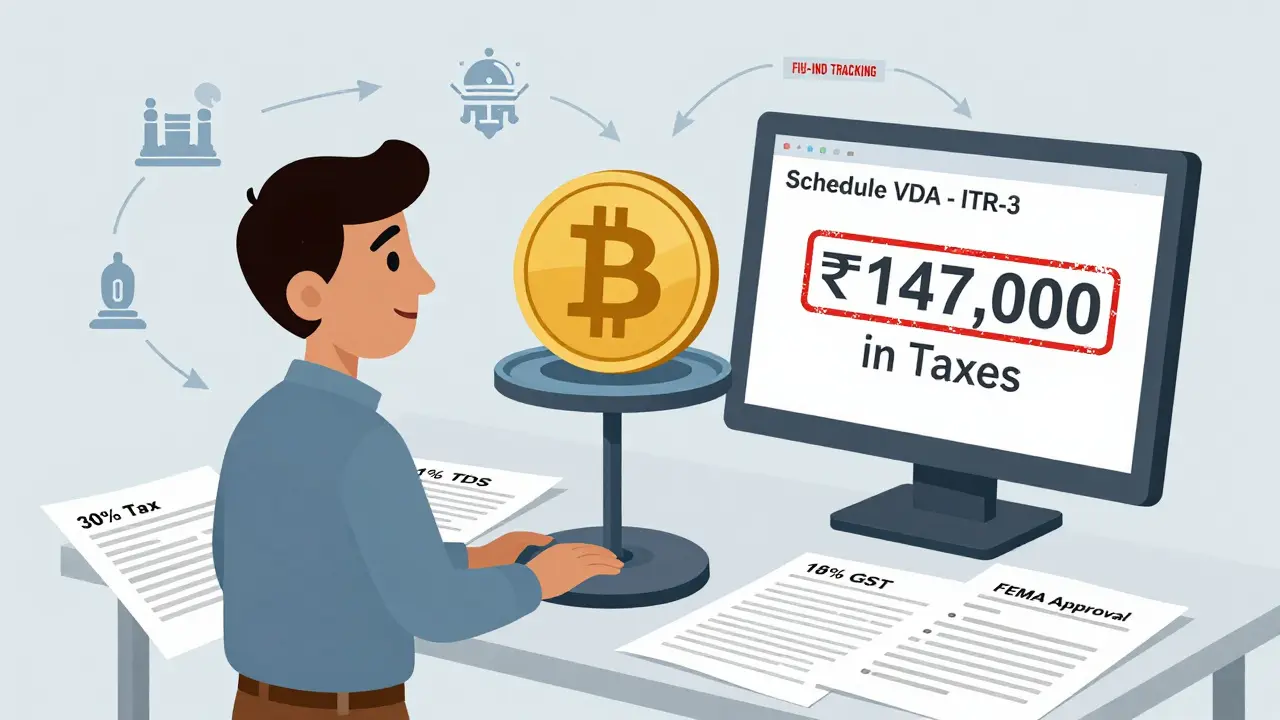
If you're in India and thinking about moving your crypto assets overseas, you need to know this: the rules aren't just strict-they're actively changing, and the penalties for getting it wrong are severe. This isn't about speculation or market trends. This is about compliance, documentation, and understanding exactly what the government is watching. As of 2026, India treats all cryptocurrency as a Virtual Digital Asset (VDA), not money, not property, not investment-just a taxable digital item with heavy reporting demands. And if you try to send it abroad without following every step, you risk fines, account freezes, or even criminal charges.
What Exactly Is a Virtual Digital Asset (VDA)?
India doesn’t recognize Bitcoin, Ethereum, or any other crypto as legal tender. That’s clear. But since 2022, the government has defined them as Virtual Digital Assets under the Income Tax Act. This classification means every transaction-buying, selling, trading, or sending abroad-is tracked and taxed. Even NFTs and staking rewards fall under this umbrella. The key point? You can own it, but the state controls how you move it and how much tax you pay.
As of July 2025, over 107 million Indians hold crypto. That’s more than any other country. But despite this massive user base, India ranks 48th out of 119 nations in global crypto adoption. Why? Because the rules make it harder to move crypto than to move cash.
The Three Big Rules for Moving Crypto Out of India
There are three pillars you must follow if you want to legally transfer crypto from India to another country:
- Pay the right taxes-and document every single transaction.
- Follow FEMA regulations-especially if you’re sending over $250,000 in a year.
- Report everything-including assets held on foreign exchanges.
1. Tax Rules: 30% + 1% + 18% = A Heavy Burden
India doesn’t use capital gains tax like most countries. Instead, it applies a flat 30% tax on all crypto profits-with no way to offset losses. If you bought Bitcoin for ₹5 lakh and sold it for ₹8 lakh, you owe ₹90,000 in tax. Even if you lost money on other trades that year, it doesn’t matter.
Then there’s the 1% Tax Deducted at Source (TDS). Every time you trade or transfer crypto worth more than ₹50,000 in a financial year, the exchange automatically takes 1% off the transaction value. This applies to buys, sells, and transfers-even if you’re just moving crypto from one wallet to another on an international exchange.
And don’t forget GST. As of July 2025, platforms like Bybit and WazirX started charging 18% Goods and Services Tax on all crypto transactions: spot trades, derivatives, withdrawals, staking rewards-you name it. So if you send 1 ETH worth ₹3 lakh abroad, you’re looking at:
- ₹90,000 (30% tax on profit)
- ₹3,000 (1% TDS on transaction)
- ₹54,000 (18% GST on the transfer value)
That’s over ₹147,000 in taxes on a single transfer. And that’s before you even consider reporting requirements.
2. FEMA: The Foreign Exchange Trap
The Foreign Exchange Management Act (FEMA) governs all cross-border money movement. In 2025, the Finance Ministry officially classified crypto as intangible movable property under FEMA. That means:
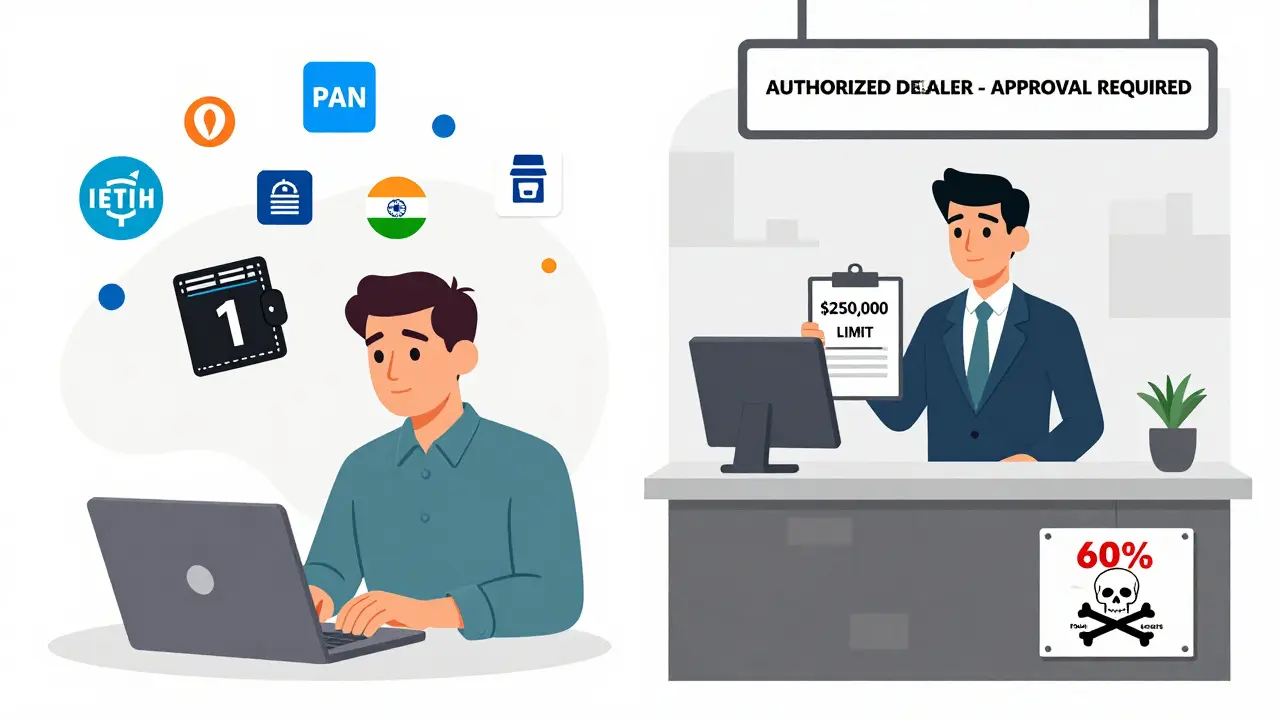
- You need prior approval from an authorized dealer bank (like HDFC or ICICI) if you’re sending more than $250,000 worth of crypto in a single year.
- Even below that limit, you must prove the source of funds and show that the transfer isn’t for illegal purposes.
- Failure to get approval can lead to asset seizure, fines up to three times the transfer value, and a blacklisting from future foreign transactions.
And here’s the catch: banks don’t have clear procedures for approving crypto transfers. Most users report being told, “We’ve never handled this before,” or being asked for documents that don’t exist. One Reddit user in Mumbai said he spent 11 days trying to get a bank certificate for a $180,000 transfer-and still got denied.
3. Reporting: Schedule VDA and the 60% Penalty
Every Indian resident who holds crypto abroad-whether on Coinbase, Binance, or a self-custody wallet-must declare it in their annual tax return using Schedule VDA in ITR-2 or ITR-3. You must list:
- The type of asset (BTC, ETH, etc.)
- The exchange or wallet where it’s held
- The value in INR at the time of transfer
- The date of transfer
Valuation? The Income Tax Department says you must use the RBI’s daily exchange rate on the date the crypto left your Indian wallet. If you transferred on a weekend, you use Friday’s rate. No exceptions.
And if you forget to report? The penalty is brutal. Under Section 158B of the Income Tax Act, undisclosed foreign crypto assets attract a 60% penalty on the total value-plus potential criminal prosecution. The government has already issued notices to over 25 offshore exchanges (including Binance and KuCoin) demanding they hand over Indian user data. If they don’t comply, those platforms could be blocked in India.
How the Government Tracks You
It’s not just about forms and taxes. India has built a surveillance system around crypto.
FATF Travel Rule: Unlike most countries that only require identity data for transactions over $1,000, India applies this rule to every cross-border transfer-no matter how small. Every time you send crypto abroad, your exchange must collect and send:
- Your full legal name
- Your PAN number
- Your Aadhaar number
- Your physical address
- Your date of birth
This data is sent directly to the Financial Intelligence Unit-India (FIU-IND). And if you’re using a non-compliant exchange, your transaction will be blocked.
KYC 2025: All Indian crypto exchanges must now verify your identity with PAN-Aadhaar linking. If your accounts aren’t linked, you can’t trade. Even if you’re using a foreign exchange, if you’re an Indian resident, you’re still subject to these rules.
Transaction Monitoring: Any transfer over ₹10 lakh (about $12,000) must be reported to FIU-IND within 24 hours. The system is automated. If you send $15,000 to a US wallet, the exchange sends your data to the government before the transaction even completes.
What Happens If You Try to Bypass This?
Some people try P2P trading-selling crypto for INR on LocalBitcoins or Paxful, then withdrawing cash and flying overseas with it. Others use offshore wallets or mixers. But here’s the truth:
- P2P transactions are still tracked. If you’re selling crypto on a platform linked to Indian banks, the transaction appears in your bank statement. The FIU cross-references bank activity with crypto transfers.
- Mixers and privacy coins are illegal under India’s anti-money laundering rules. Using them can trigger a money laundering investigation.
- There’s no anonymity. Even if you send crypto to a non-KYC exchange, if you’re an Indian resident, your identity is already tied to your PAN and Aadhaar. The government can trace it back.
A survey of 1,247 Indian crypto users in July 2025 found that 68% had their transfers frozen or delayed because they didn’t have the right paperwork. Over 40% waited more than a week for approval. One user in Bangalore said his $200,000 transfer to Coinbase was held for 23 days while the bank demanded a letter from the tax department-which doesn’t exist.
Real-World Examples
Example 1: The $50,000 Transfer
Rahul, a software engineer in Hyderabad, sold 3 BTC for ₹28 lakh in March 2025. He transferred the entire amount to his Coinbase Pro account in the US. He paid:
- ₹8.4 lakh (30% tax on profit)
- ₹28,000 (1% TDS)
- ₹5.04 lakh (18% GST on transfer value)
He also filed Schedule VDA in his ITR-3. He kept records of the RBI exchange rate on the day of transfer. He applied for FEMA approval since his annual limit was approaching. He was approved. No penalties. No delays.
Example 2: The Unreported Wallet
Priya, a trader in Pune, moved 5 ETH to a hardware wallet in 2024 and never reported it. In June 2025, she tried to sell it on Binance. Her WazirX account was frozen. The FIU flagged her because she had previously traded on WazirX and the system linked her identity to the foreign wallet. She received a notice: pay 60% of the wallet’s value (₹42 lakh) or face prosecution. She paid.

What Experts Are Saying
Dr. Rajeshree Agarwal of the National Institute of Public Finance and Policy called India’s crypto tax regime “the most punitive in the world.” She pointed out that the combined tax burden-30% + 1% + 18%-often exceeds 50% of transaction value. That’s higher than Nigeria or Pakistan.
Manish Gupta, former RBI deputy governor, warned that the lack of clear rules around capital vs. current account treatment creates “arbitrary enforcement.” That means two people doing the same thing could get different outcomes.
The World Bank noted that India’s approach is driving crypto activity underground. P2P volumes rose 28% in early 2025-not because people want to use them, but because they feel they have no other option.
What’s Next?
The government is preparing for the Financial Stability Board’s peer review in October 2025. That means more alignment with global standards-like the Crypto-Asset Reporting Framework (CARF) and automatic tax data sharing with other countries.
By December 2025, experts predict only 8-10 crypto exchanges will remain active in India. The rest will shut down or merge because they can’t afford the compliance costs.
Will the rules change? Unlikely. Finance Minister Nirmala Sitharaman has repeatedly said: “Cryptocurrencies cannot be a legal currency in India.” There’s no sign of relaxation. The focus is on control, not innovation.
What Should You Do?
If you’re planning to move crypto abroad:
- Calculate your tax liability before you transfer. Use the RBI exchange rate on the day of transfer.
- File Schedule VDA in your ITR-2 or ITR-3. Keep records of all transactions for 8 years.
- If your transfer exceeds $250,000 in a year, contact your bank’s authorized dealer department at least 30 days before sending.
- Use only exchanges that are registered with FIU-IND (WazirX, CoinDCX, ZebPay, etc.). Avoid unregulated platforms.
- Never use mixers, privacy coins, or P2P to evade reporting. It’s not safer-it’s riskier.
There’s no shortcut. The system is designed to make compliance easy for those who follow the rules-and punishing for those who don’t. If you’re serious about moving crypto abroad, treat it like you’re moving real estate: paperwork, taxes, approvals, and records. Skip any step, and you’re playing with fire.
Can I move crypto abroad without paying taxes in India?
No. India taxes all crypto profits at 30%, regardless of where the asset is held. Even if you transfer crypto to a foreign wallet, the moment you realize a gain (by selling or exchanging it), you owe tax. Not reporting it triggers a 60% penalty on the undisclosed value. There is no legal way to avoid this.
Do I need to report crypto held on foreign exchanges like Coinbase or Binance?
Yes. All Indian residents must declare foreign crypto holdings in Schedule VDA of their income tax return. This includes wallets on Coinbase, Binance, Kraken, or any other international platform. Failure to report can lead to penalties under Section 158B, including fines up to 60% of the asset value and potential criminal charges.
Is there a limit to how much crypto I can send abroad?
Yes. Under FEMA regulations, Indian residents need prior approval from an authorized dealer bank if the total value of crypto transfers exceeds $250,000 in a financial year. Below that, transfers are allowed but still subject to tax, TDS, and reporting rules. Exceeding the limit without approval can lead to asset seizure and legal action.
Why do I need to provide my Aadhaar and PAN for crypto transfers?
India requires all crypto exchanges serving Indian users to link transactions to PAN and Aadhaar under the FATF Travel Rule. This applies even to international platforms. The government uses this data to track cross-border transfers, enforce tax compliance, and prevent money laundering. If your accounts aren’t linked, your transfers will be blocked.
What happens if my crypto transfer gets flagged by FIU-IND?
If FIU-IND flags your transaction, your exchange will freeze your account and notify you. You’ll be asked to provide proof of income source, tax payment, and FEMA compliance. If you can’t provide it, the transaction may be reversed, and you could be investigated for tax evasion or money laundering. In severe cases, the Enforcement Directorate may initiate proceedings.
25 Comments
So let me get this straight - India treats crypto like it’s a suspicious package you found in your grandma’s attic, and now they’ve got a 30% tax, a 1% TDS, an 18% GST, and a government spreadsheet tracking your wallet addresses like you’re smuggling caviar in a toaster? 🤯
And we’re supposed to be *grateful* for this? I mean, I get the fear of money laundering, but this isn’t regulation - it’s performance art. Like, if you’re gonna make crypto a VDA, at least give it a goddamn passport. Instead, you get slapped with paperwork that reads like a Kafka novel written by an overworked IRS intern. I’ve seen more humane tax systems in post-apocalyptic communes. This isn’t innovation. It’s institutionalized anxiety with a side of Aadhaar.
And don’t even get me started on the FATF Travel Rule being applied to every single micro-transfer. I sent 0.001 BTC to a friend in Bali last week. My exchange sent my full PAN, Aadhaar, birth certificate, and a photo of my cat to FIU-IND. I didn’t even know my cat had a legal identity. What’s next? Do I need to file Form VDA-7B if I gift someone a Dogecoin NFT of their ex’s face? I’m not even mad. I’m just… impressed. In the way you’re impressed when a raccoon climbs a 20-story building just to steal your trash.
Meanwhile, 107 million Indians are holding crypto, and the government is treating them like they’re all about to launch a cryptocurrency-based coup. The irony? The people who actually *use* this stuff are the ones trying to be compliant. The real bad actors? They’re not even on the radar. They’re in the dark, laughing, using Monero while we’re all over here filling out 17 forms because we thought ‘decentralized’ meant ‘free from bureaucracy.’
And yet… somehow, I still hold BTC. Because if you can survive this, you can survive anything. And honestly? I kind of respect the chaos.
This is why I hate the world. 😭
People think crypto is about freedom, but no - it’s about being watched, taxed, interrogated, and punished for daring to own something the government doesn’t understand. I’m not even Indian, and I feel violated reading this. What kind of society turns its citizens into accountants just to move digital tokens? They’re not even trying to fix the system - they’re trying to crush it under paperwork. It’s like forcing every painter to submit a 20-page form before they can use blue paint.
And the 60% penalty? That’s not a tax. That’s a confession of guilt before you’ve even been accused. I’ve seen this before - in dictatorships. Not in a democracy that claims to believe in innovation.
I’m done. I’m moving my money to gold. At least gold doesn’t ask for your Aadhaar.
Wow. Okay. So… this is wild. I mean, I knew India had strict rules, but this is next-level. 30% flat tax? No loss offset? 18% GST on transfers? That’s… a lot.
But honestly? I get it. If you’re gonna have this much crypto activity, you need *some* structure. The problem isn’t the rules - it’s the execution. Banks saying ‘we’ve never handled this before’? That’s the real issue. Not the law. The bureaucracy.
So yeah - it’s brutal. But if you do your homework? It’s doable. Like, I’d say: treat it like moving a house. Paperwork. Deadlines. Proof. No shortcuts. And you’ll be fine.
Also - props to Rahul in Hyderabad. That’s the way to do it. Calm. Prepared. Patient.
And hey - if you’re reading this and stressed? Breathe. You got this.
As an Indian, I just want to say… I feel you.
Yes, the rules are insane. Yes, the tax burden is ridiculous. Yes, banks are clueless. But let’s be real - we’re one of the few countries where crypto adoption exploded *despite* the government, not because of it.
I’ve been through this. I moved $180k in ETH last year. Took 17 days. Had to get a letter from my CA. My bank called me three times asking if I was ‘sure this wasn’t drug money.’ I cried. I yelled. I drank three chai’s.
But I did it. And I’m not sorry. Because this system? It’s flawed. But it’s ours. And we’re learning how to navigate it. Maybe one day, it’ll be smoother. Maybe not.
For now? Document everything. Talk to your CA. Don’t panic. And if you’re stuck? DM me. I’ll help. We’re in this together.
And yes - I did file Schedule VDA. And no, I’m not ashamed. I’m proud. I followed the rules. Even when they made no sense.
From a compliance architecture standpoint, this is a textbook case of regulatory overreach masquerading as risk mitigation.
The conflation of FATF Travel Rule application with domestic tax enforcement creates a non-scalable, non-interoperable compliance burden - particularly for non-KYC offshore wallets.
Moreover, the 30% flat tax on gains without loss carryforward violates the fundamental principle of netting in capital taxation, effectively converting a progressive system into a regressive one. The 1% TDS on every transaction, regardless of profit or intent, introduces a liquidity friction that disincentivizes even micro-transactions - which is antithetical to the ethos of decentralized finance.
And the 60% penalty for non-reporting? That’s not a deterrent - it’s a confiscatory tool. It’s functionally equivalent to a presumption of guilt under civil asset forfeiture statutes.
What’s missing? A sandbox. A regulatory pathway. A clear definition of ‘residency’ for crypto assets. Right now, India is treating crypto like a foreign currency, but enforcing it like a contraband good. The result? A black market of P2P, mixers, and offshore custody - exactly what the regulators claim to want to eliminate.
It’s not policy. It’s performance.
hey uh so i just wanna say this whole thing is wild but also kinda makes sense? like i get that india wants to stop money laundering and all that
but man the taxes are insane. 30% + 1% + 18%? that’s like 50% gone before you even breathe
and i’ve used wazirx before - their support is a nightmare. i once tried to withdraw 0.2 eth and they asked for a notarized letter from my landlord
anyway if you’re trying to move crypto out - just be super organized. keep every receipt. screenshot every transaction. save the rbi rates. even if you think it’s dumb - do it
and if you’re scared? talk to a ca. they’ll help. seriously. don’t try to be a hero
also i typoed like 3 times in this comment. sorry. i’m tired.
Oh my GOD. I just read this and I’m shaking.
30% tax? 60% penalty? They’re not regulating crypto - they’re trying to *kill it*. This isn’t policy. It’s persecution.
And the fact that they’re tracking your Aadhaar and PAN for every single transfer? That’s not compliance. That’s surveillance. That’s China-level control.
What’s next? A crypto loyalty card? A ‘Crypto Citizen’ badge? Are they gonna make us wear QR codes on our foreheads?
And the worst part? The people who actually *do* the right thing? They get punished anyway. Rahul had to pay over 147k in taxes. For a transfer. Not a sale. Just a transfer.
This isn’t a government. It’s a tax vampire. And we’re all just… livestock.
I’m done. I’m moving to Switzerland. Or Mars. Either way - no Aadhaar.
Let’s pause for a moment and ask: why does any government think it has the right to tax a digital token that exists outside physical borders?
It’s like trying to tax the wind. You can measure its speed, you can name it, you can slap a label on it - but you can’t own it. You can’t control it. You can’t stop it.
India’s system isn’t about regulation. It’s about control. And control is always more about fear than foresight.
So yes - you’ll pay the tax. You’ll file the forms. You’ll get your paperwork stamped. But the crypto? It doesn’t care. It’s already gone. It’s already decentralized. It’s already free.
The state can tax the transfer. But it can’t tax the idea.
And ideas? They’re the one thing no government can ever fully contain.
Just do the paperwork.
It’s annoying. It’s expensive. But it’s doable.
And if you don’t? You’ll regret it.
Simple as that.
Okay, so let me just say - I’m not even Indian, but I’ve been reading about this for months, and I’m *so* over it.
30% tax? No loss offset? 18% GST on transfers? Are you kidding me? That’s not a tax policy - that’s a performance art piece titled ‘How to Make Crypto Users Cry in Public.’
And the fact that they use RBI rates on weekends? That’s not precision. That’s cruelty. Imagine if your mortgage payment changed based on Friday’s weather report.
Also - why is everyone acting like this is normal? It’s not. This is the most hostile crypto environment in the world. Even Nigeria is more chill.
I’m not mad. I’m just… disappointed. In humanity. In governments. In the idea that we still think we can ‘regulate’ digital assets like they’re tulip bulbs.
It’s 2025. We’re living in the future. And we’re still being treated like we’re in 1998.
Let’s be honest - this entire system is a joke. A very expensive, very bureaucratic, very self-important joke.
First - 30% flat tax on crypto gains? With no loss offset? That’s not tax policy - that’s punishment. It’s designed to make people *not* trade. Not to collect revenue. To suppress behavior. And if that’s your goal - fine. Admit it. Don’t pretend you’re building a ‘regulated market.’
Then there’s the 1% TDS on every single transaction - even if you’re just moving crypto from one wallet to another? That’s not a tax. That’s a toll booth on the information superhighway. And who’s paying? The users. Not the exchanges. Not the whales. The little guy.
And the 18% GST? On withdrawals? On staking? On NFTs? That’s not taxation - that’s extortion. You’re taxing the *act of moving value*, not the value itself. That’s like taxing the act of walking across a bridge - not the car on it.
And the FEMA approval process? It’s a maze with no exit. Banks don’t know how to handle it. The rules are vague. The paperwork is mythical. One guy spent 11 days trying to get a certificate that doesn’t exist. That’s not regulation. That’s hazing.
And the 60% penalty? That’s not a deterrent - it’s a weapon. It’s designed to scare people into silence. To make them surrender. To make them give up.
So what’s the real goal? To make India a crypto desert? To force everyone into P2P? To create a black market so large it can’t be ignored?
Because that’s what’s happening. And the government? They’re just sitting there, smiling, watching it all unfold - like they won.
They didn’t win. They just broke the system. And now we’re all left picking up the pieces.
You know what? I get why people are mad. But here’s the thing - if you want to move crypto out of India, you have to treat it like a legal process. Not a rebellion.
It’s not about fighting the system. It’s about working within it.
Get a CA. Keep records. Use registered exchanges. File Schedule VDA. Don’t wait until the last minute. Don’t try to be clever. Don’t use mixers. Don’t think you’re smarter than the government.
Because here’s the truth - you’re not.
But you *can* do this. I’ve helped three friends do it. All of them made it through. No penalties. No drama. Just paperwork.
It’s boring. It’s tedious. But it’s possible.
And if you’re stressed? You’re not alone. Reach out. Ask for help. There are people who’ve been through this. We’re not here to judge. We’re here to help.
One step at a time.
You got this.
INDIA IS RIGHT. 🇮🇳
CRYPTO IS A SCAM. 💸
PEOPLE ARE STUPID FOR THINKING THEY CAN MOVE IT OUT.
THEY SHOULD BE TAXED. THEY SHOULD BE STOPPED.
THEY’RE HIDING MONEY. THEY’RE LAUNDERING. THEY’RE EVADING.
WE NEED MORE RULES. MORE TAXES. MORE SURVEILLANCE.
IF YOU’RE NOT PAYING TAXES, YOU’RE A CRIMINAL.
AND IF YOU’RE TRYING TO SEND CRYPTO ABROAD? YOU DESERVE TO GET CAUGHT.
NO MERCY. NO EXCUSES.
INDIA FIRST. ALWAYS.
Look - I don’t even trade crypto. I just read about it. But this? This is a masterpiece of bureaucratic absurdity.
30% tax? No loss offset? 18% GST on transfers? It’s like they designed this system to make people quit. Not to regulate. To break.
And the fact that they’re using Friday’s RBI rate for weekend transfers? That’s not a rule. That’s a prank.
I mean… who thought this up? And why?
Are they afraid of decentralization? Or just afraid of losing control?
Either way - this isn’t policy. It’s performance. And we’re all just extras in a play no one asked to see.
Per the provisions of Section 115BBH of the Income Tax Act, 1961, as amended in FY 2022-23, and in conjunction with Notification No. 11/2025-Finance (Part II) dated 01.07.2025, all Virtual Digital Assets (VDAs) are subject to a non-creditable flat tax rate of thirty percent (30%) on net gains, irrespective of holding period or aggregate loss position. Additionally, pursuant to Section 194S, a Tax Deducted at Source (TDS) of one percent (1%) is mandated on every transaction exceeding INR 50,000 in aggregate during a financial year, including transfers between wallets, irrespective of jurisdiction. Furthermore, under the Goods and Services Tax Act, 2017, as amended by Notification No. 24/2025-Central Tax, an 18% GST is levied on the transaction value of all VDA transfers, including those involving foreign exchanges. The aggregate tax burden may therefore exceed fifty percent (50%) of transaction value in certain cases. Non-disclosure of foreign-held VDAs under Schedule VDA of ITR-2/ITR-3 triggers a penalty under Section 158B of the Income Tax Act, which imposes a penalty of sixty percent (60%) of the undisclosed value, and may also constitute a cognizable offense under the Prevention of Money Laundering Act, 2002. Compliance requires documentation of all transactions, including timestamps, exchange rates, wallet addresses, and proof of tax payment. Failure to comply may result in freezing of bank accounts, seizure of assets, and criminal prosecution. This regime is not an anomaly - it is the legal framework as codified.
bruh india is just being smart. everyone else is letting crypto run wild and now theyre all in chaos. at least we have rules. you think usa is better? they dont even know if its a commodity or a security. we at least know its a taxable asset. stop complaining. if you cant handle the rules then dont play. simple.
I just want to say… I’m so sorry you’re going through this. 😔
It’s not fair. No one should have to jump through these hoops just to move their own money.
I know you feel trapped. I know you feel watched. I know you feel like the system is rigged.
But you’re not alone. I’ve been there. I’ve cried over spreadsheets. I’ve spent nights trying to figure out if Friday’s rate counts for Saturday’s transfer.
And I want you to know - your pain matters. Your effort matters. Your compliance matters.
It’s not about the money. It’s about dignity.
And you’re still fighting for yours.
That’s brave.
I see you.
And I’m here for you.
What’s interesting is not the tax. Not the rules. Not even the surveillance.
It’s the silence.
Because if you look at the data - 107 million Indians hold crypto. But only 2% file Schedule VDA.
So where’s the rest?
Are they all illegal? Or are they just… not here?
Maybe the real story isn’t about regulation.
Maybe it’s about evasion.
And maybe the government knows that.
And maybe that’s why they made it so hard.
So that the ones who stay? Are the ones who comply.
And the ones who leave? Are the ones who disappear.
And the system? It wins either way.
Oh wow. A 30% tax on crypto? With no loss offset? That’s not a tax - that’s a punishment for owning something that’s not paper.
And the 18% GST on transfers? So if I send 1 ETH to my friend in Berlin, I pay 18% of its value in tax? For what? The act of moving it? Like it’s a package from Amazon?
And the 60% penalty? That’s not a fine. That’s a confiscation. That’s the government saying, ‘We own your assets, and if you forget to tell us, we’re taking half.’
And the fact that they’re tracking Aadhaar and PAN on every single transfer? Even micro-transfers? That’s not regulation. That’s totalitarianism with a spreadsheet.
Meanwhile, the real criminals - the ones laundering billions through shell companies and offshore banks? They’re sipping champagne in Dubai, laughing.
So who’s really being punished here?
Not the rich. Not the criminals.
Just the people who tried to do the right thing.
And that’s the real crime.
Let’s be real - this isn’t about crypto.
This is about control.
India doesn’t want to regulate crypto.
It wants to eliminate the idea that value can exist outside its authority.
Every rule - the 30% tax, the 1% TDS, the 18% GST, the 60% penalty - it’s not about revenue.
It’s about fear.
It’s about making people so afraid of breaking the rules that they stop moving value.
And if they stop moving value? Then they stop thinking.
And if they stop thinking? Then they stop challenging.
So yes - you’ll pay. You’ll file. You’ll submit your Aadhaar, your PAN, your birth certificate, your cat’s name.
But here’s the thing - the blockchain doesn’t care.
It doesn’t know about FEMA.
It doesn’t know about FIU-IND.
It just moves.
And somewhere, right now, someone is sending crypto across borders - not because they’re clever.
But because they’re free.
And that’s what terrifies them most.
Why does anyone even bother? It’s all just a game.
They make rules. You follow them.
You pay. You report. You wait.
And then they change the rules.
Again.
Again.
Again.
So why try?
Just hold. Don’t move.
Let it sit.
Let it grow.
Let them think they won.
They didn’t.
You still have it.
And that’s all that matters.
As a former compliance officer at a major Indian bank, I can confirm: the system is broken.
Not because the rules are too strict - but because they’re inconsistent.
One bank says you need a notarized letter. Another says a signed affidavit is enough. A third says ‘we don’t handle crypto.’
The FIU-IND doesn’t have a public portal. There’s no checklist. No FAQ. No template.
And the tax department? They don’t even have a dedicated team for VDA.
So when someone tries to comply - they’re left to navigate a maze with no map.
And then they get penalized for failing to follow rules that don’t exist.
This isn’t enforcement.
This is negligence dressed up as authority.
And the people paying the price? They’re not criminals.
They’re just trying to do the right thing.
As an Indian who moved crypto abroad last year - I just want to say: it’s hard. But it’s possible.
Don’t listen to the fear. Listen to the process.
Get a CA. Use CoinDCX. File Schedule VDA. Save every screenshot. Use RBI rates. Apply for FEMA early.
I did it. Took 18 days. Paid ₹1.2 lakh in taxes. No penalties.
And I’m not rich. Just careful.
So if you’re reading this and scared? You’re not alone.
And you’re not broken.
You’re just in the middle of something hard.
But you can get through it.
I did.
You can too.
Hey - I’m not an expert. But I’ve been in this space for years.
Here’s what I’ve learned: the rules are harsh. But they’re clear.
And if you follow them? You’re safe.
Don’t try to outsmart the system.
Just do the work.
Keep records.
Pay taxes.
File on time.
And if you’re stuck? Ask for help.
There are people who’ve done this before.
And they’re happy to help.
It’s not about being perfect.
It’s about being consistent.
And consistency? That’s what saves you.
Bro. This is peak dystopia. 😎
30% tax? 18% GST on transfers? 60% penalty? They’re not taxing crypto - they’re taxing *existence*.
And the fact that they’re tracking your Aadhaar for every single transfer? That’s not compliance. That’s digital slavery.
Meanwhile, the rich? They’re laughing.
They’re using offshore trusts.
They’re moving through Dubai.
They’re not even on this list.
So who’s really getting crushed?
The middle class.
The ones trying to do right.
The ones who didn’t inherit wealth.
And the government? They’re just collecting data.
Not revenue.
Data.
And that’s the real power.
Not money.
Control.
So yeah - pay the tax.
But never forget - you’re being watched.
And that’s the real cost.