
Merchant Adoption of Payment Cryptocurrencies: Why Businesses Are Going Beyond Credit Cards

By 2025, if you run a small online store, a gaming platform, or even a freelance marketing agency, not accepting crypto payments means you’re leaving money on the table. It’s not about being tech-savvy anymore-it’s about staying competitive. More than 659 million people worldwide now hold cryptocurrency, and nearly 40% of Gen Z and Millennials say they’ll shop more often at stores that take Bitcoin, Ethereum, or USDC. That’s not a niche trend. It’s a shift in how people want to pay.
Why Merchants Are Switching to Crypto Payments
Traditional payment processors like PayPal, Stripe, and Square still dominate. But they come with hidden costs. High-risk businesses-think online casinos, supplement sellers, or forex brokers-often get frozen accounts or forced into reserve requirements that tie up their cash. Crypto payments bypass all that. No middlemen. No chargeback wars. No 30-day holding periods. Funds arrive in minutes, not days. For international sales, the savings are even clearer. A merchant in New Zealand selling to a customer in Nigeria used to pay 5-7% in currency conversion and wire fees. Now, with USDC, they get paid in full, instantly. No bank delays. No hidden FX charges. That’s why 70% of crypto payment volume now flows through stablecoins. They keep the speed and decentralization of crypto without the rollercoaster price swings of Bitcoin.How It Actually Works (No Tech Degree Needed)
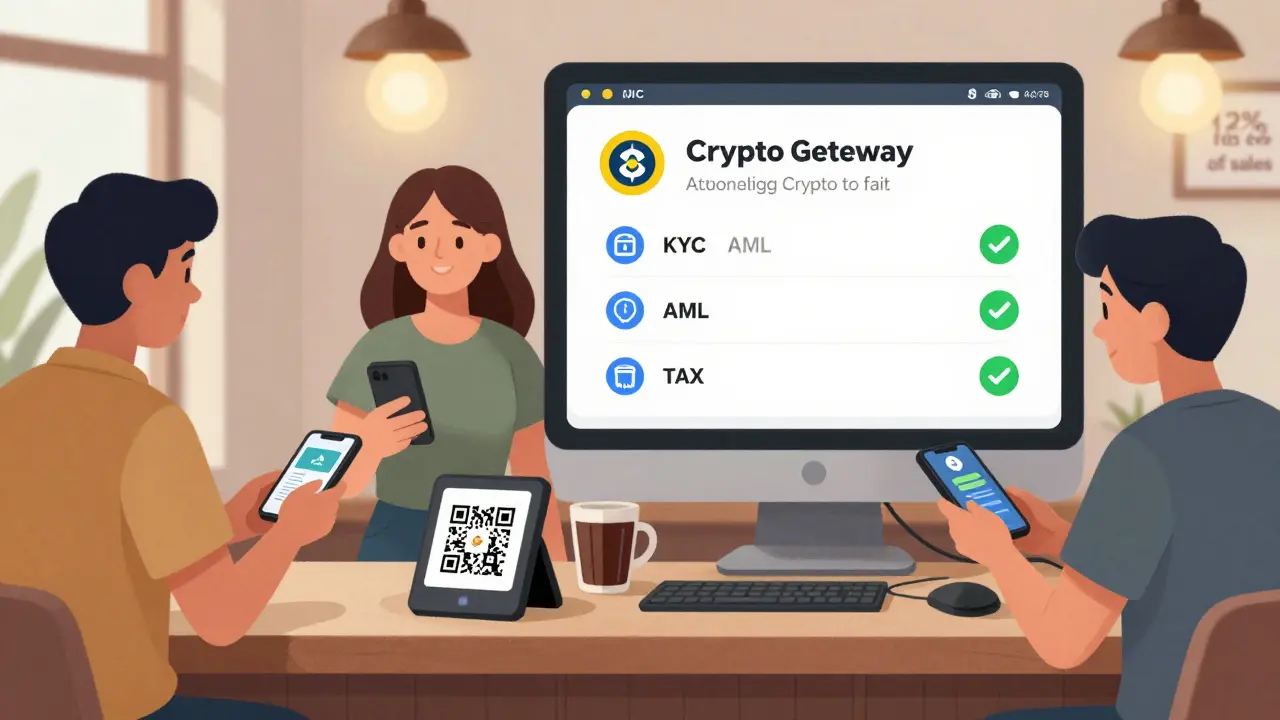
You don’t need to run a blockchain node to accept crypto. Most merchants use a crypto payment gateway-think of it like Stripe, but for digital money. Platforms like CoinsPaid, BitPay, and NOWPayments handle everything: wallet creation, transaction verification, and automatic conversion to fiat or stablecoins. You set your prices in USD, EUR, or NZD. The customer pays in Bitcoin, Ethereum, or USDC. The gateway converts it on the fly and deposits clean dollars into your bank account. You never touch crypto unless you want to. Mobile is where it’s happening. 87% of crypto payments in 2025 are made on phones. QR codes, wallet apps, and one-click checkout are replacing credit card forms. A coffee shop in Wellington started accepting USDC last year. Their daily crypto sales now make up 12% of revenue-mostly from tourists and remote workers who use crypto apps daily.
Who’s Leading the Charge?
It’s not just tech startups. The biggest adopters are businesses that live on global cash flow:- Gaming platforms: Players buy skins, loot boxes, and subscriptions in ETH or USDC. No chargebacks. No regional payment blocks.
- Freelancer marketplaces: Writers, designers, and developers get paid directly from clients in 80+ countries without waiting for SWIFT transfers.
- Marketing agencies: 70% of marketers targeting Millennials in 2025 now list crypto payments as a standard option. It’s a trust signal.
- SaaS companies: Subscription fees in stablecoins reduce payment failures and eliminate currency risk for global customers.
The Real Barrier? Not Tech-It’s Perception
The tech is simple. The real problem? People don’t trust it. Many merchants still think crypto means volatility, hacking, or government crackdowns. But here’s what’s changed:- Volatility is managed: 80% of shoppers now prefer stablecoins. You get paid in USD-pegged coins, not Bitcoin.
- Security is better: Crypto transactions are irreversible. No fake chargebacks. No disputed payments.
- Compliance is built-in: Top gateways handle KYC, AML, and tax reporting automatically.
What’s Holding Back Wider Adoption?
Even with all the growth, crypto payments still only make up about 2.6% of U.S. consumer spending. Why? Three things:- Consumer confusion: Many crypto owners don’t know where to spend it. If your store doesn’t advertise it, they won’t try.
- Merchant hesitation: Some fear regulatory risk-even though the rules are clearer than ever.
- Limited support: Smaller gateways offer poor customer service. If your payment system goes down, you lose sales.
The Future Isn’t About Replacing Cards-It’s About Adding Choice
Crypto won’t kill credit cards. But it will become another option-like Apple Pay or PayPal. For businesses that serve global customers, high-risk industries, or younger demographics, it’s already essential. The $1.68 billion crypto payment gateway market by 2025 isn’t a bubble. It’s infrastructure being built. And the winners will be the merchants who act now-not those waiting for everyone else to catch up.Right now, if you’re not offering crypto payments, you’re not just missing out on tech-savvy customers. You’re missing out on lower fees, faster settlements, and global access. The tools are here. The customers are ready. The question isn’t whether you should adopt crypto payments. It’s when you’ll start.
22 Comments
Crypto payments are definitely gaining traction, especially for global freelancers and small businesses. I’ve seen a few UK-based designers switch to USDC and cut their transaction fees by over half. No more waiting weeks for international wires.
It’s not magic, but it’s practical.
I love how this breaks down the real benefits without the hype. So many people think crypto = volatility, but stablecoins are the quiet hero here.
My cousin runs a small Etsy shop and started accepting USDC last year - now 15% of her sales are crypto, mostly from Europe and Canada. She says the customers are happier, and she’s less stressed about chargebacks.
It’s not about being ‘techy.’ It’s about being customer-ready.
Oh wow, another ‘crypto is the future’ piece. Let me guess - you also think NFTs are art and Bitcoin is digital gold?
2.6% of U.S. spending? That’s not adoption, that’s a footnote.
Meanwhile, my local bakery still takes cash because people don’t want to fiddle with wallets.
Wake up.
Listen - I used to be skeptical too. Thought crypto was just for degens and hackers.
Then my freelance design client in Brazil paid me in USDC. I got the full amount in 8 minutes. No fees. No bank drama.
I didn’t even have to touch the crypto - the gateway auto-converted it to USD.
Now I put a ‘Crypto Accepted’ badge on my site. Guess what? More clients from Nigeria, Argentina, Philippines.
It’s not about belief. It’s about access. And honestly? It’s kind of beautiful.
OMG YES. I’ve been screaming this from the rooftops since 2022!
My gaming store got frozen by Stripe for ‘high risk’ - turns out selling skins to teens is ‘fraudulent’ to them? LOL.
Switched to CoinsPaid. Instant. No reserve. No drama.
Now I make more from crypto than PayPal. And guess who’s complaining? The 18-year-old in Germany who just bought a skin with his ETH.
They don’t care about your ‘regulations.’ They care about their loot.
Adopt or die.
Important note: Most gateways now support multi-chain - so you can accept BTC, ETH, USDT, USDC, SOL, and even TRX - and auto-convert to your local currency.
And yes, they handle tax reporting. You don’t need to be a blockchain expert. You just need to click ‘enable’ in your Shopify app store.
It’s literally easier than setting up Google Analytics.
Stop using ‘I don’t understand it’ as an excuse. You don’t need to understand it - just use it.
The macroeconomic implications are profound. Decoupling from SWIFT and traditional banking rails enables financial sovereignty for emerging markets.
Stablecoin adoption in India and Nigeria is accelerating due to FX volatility and capital controls.
Merchants leveraging crypto payment infrastructure are effectively bypassing colonial-era financial architecture.
This isn’t a trend - it’s a systemic reconfiguration of value exchange.
Those who resist are not just behind - they’re structurally obsolete.
My grandma asked me last week if she could use crypto to pay for her Netflix. 😅
I showed her how to scan a QR code with her phone. She paid $5 in USDC. Got her receipt instantly.
She said, ‘This is better than my credit card - no weird fees!’
It’s not about tech. It’s about ease.
And if grandma can do it… we’re already past the tipping point.
🚀
Let’s be real - this is just a fancy way for crypto bros to avoid taxes and launder money.
‘No chargebacks’? That’s great for scammers.
‘No middlemen’? Cool, so who’s responsible when someone gets ripped off?
And ‘Trump’s 2025 rules’? Bro, that’s fiction. He’s not even running.
This whole thing is a house of cards built on hype and bad math.
I run a small coding tutorial site in India. We started accepting USDC last month. 30% of our new users are from Africa and Southeast Asia.
Before, they couldn’t pay because their cards got declined or the fees were too high.
Now they just use their phone. No bank. No hassle.
It’s not about crypto. It’s about inclusion.
And honestly? It feels good to help people who were left out.
Oh, so now we’re supposed to believe the U.S. government suddenly supports crypto? Please.
They’re just letting it grow so they can tax it later - and then shut it down when it gets too big.
And ‘stablecoins’? That’s just another Ponzi scheme with a fancy name.
Don’t be fooled. This is the same old scam, repackaged for TikTok.
It’s amusing how the article treats crypto as if it’s a new invention. The technology has existed for over a decade.
Meanwhile, traditional finance has adapted - faster payments, real-time settlements, FedNow.
Why are we pretending crypto is revolutionary when it’s just a niche alternative with higher volatility and lower liquidity?
It’s not infrastructure. It’s a cult with a whitepaper.
Y’all are so naive.
‘No chargebacks’? That’s a feature for criminals.
‘No middlemen’? So who’s stopping the money laundering?
And ‘trust signal’? Bro, if I see ‘Crypto Accepted’ on your site, I assume you’re either a scammer or a crypto bro.
You think this is progress? It’s regression.
And don’t even get me started on ‘Trump’s 2025 rules’ - that’s made-up nonsense.
Wake up. This isn’t innovation. It’s exploitation.
Look, I get it - you’re excited about crypto because it feels like rebellion. Like you’re breaking free from the system.
But here’s the thing: the system doesn’t care. Banks still control the rails. Exchanges still KYC you. Governments still tax you.
And if you think stablecoins are ‘decentralized’ - you’ve never read the whitepaper.
USDC? Backed by USD. Issued by a private company. Regulated by the SEC.
It’s not crypto. It’s a digital IOU.
So why are we pretending this is a revolution? It’s just a rebrand.
And don’t get me started on the environmental impact - you know Bitcoin mining uses more energy than Argentina, right?
So yeah. You’re not saving the world. You’re just buying a new toy.
They’re lying. Crypto payments are a surveillance tool.
Every transaction is tracked. Every wallet is linked.
They want you to think it’s anonymous - it’s not.
And ‘no chargebacks’? That’s how they trap you.
They’re building a financial dictatorship with blockchain glitter.
Wake up. This isn’t freedom. It’s control with a crypto logo.
So you’re telling me a coffee shop in Wellington gets 12% of sales from crypto? That’s impossible.
Most people don’t even know what USDC is.
And who’s actually using this? A handful of tech bros and tourists who got free ETH from a giveaway.
It’s a vanity metric.
Real adoption? You’d see it in Walmart. You’d see it in gas stations.
Until then, it’s theater.
There’s a deeper truth here: money is a social contract.
For centuries, we trusted banks, governments, institutions.
Now we’re being asked to trust code, algorithms, and anonymous validators.
That’s not just a payment shift - it’s a philosophical one.
Are we ready to let machines decide the value of our labor?
Or are we just trading one form of control for another - faster, but colder?
It’s not about convenience.
It’s about identity.
And I’m not sure we’ve asked the right questions yet.
They say ‘crypto is the future’ - but the future already tried this. Remember PayPal in 2000? Everyone thought it would kill credit cards.
It didn’t.
It just became another option.
Same thing here.
And if you think stablecoins are safe - you haven’t seen what happened to Terra.
Trust is fragile.
And this whole thing feels like a pyramid scheme dressed in blockchain.
I’ve been accepting USDC for my freelance writing for 6 months.
It’s quiet. Reliable.
People from Japan, Brazil, Kenya - they all pay without drama.
My bank account doesn’t care where the money came from.
And honestly? I don’t think about it anymore.
It just works.
Maybe that’s the point.
It’s not about being cool.
It’s about not thinking about payments at all.
My mate runs a surf shop in Cornwall. Started taking USDC last year.
Now 8% of sales are from travelers with crypto wallets.
They scan a QR code. Done.
He doesn’t even check his wallet.
It auto-converts to pounds.
He says the best part? No more ‘I’ll pay you in cash’ after the surf session.
Simple. Clean. Works.
👍
ok so i just signed up for coinspaid like 2 mins ago and added it to my shopify store
it was so easy i almost cried
no dev team no headache
just click click click
and now my customer in mexico can pay me without his bank blocking it
thank you god
im not smart but this works
Just read @GaryGately’s comment - and I’m smiling.
That’s exactly it.
It’s not about being an expert.
It’s about being open.
My friend thought crypto was ‘too complicated’ - until he tried it.
Now he says, ‘Why didn’t I do this sooner?’
It’s not magic.
It’s just better.
And the people who need it most? They don’t care about the tech.
They just want to get paid.
So if you’re still hesitating?
Just try it.
One button.
That’s all it takes.