
LongBit Crypto Exchange Review: Is It Legit or a Red Flag?
There’s no such thing as a LongBit crypto exchange-at least not one that’s real, registered, or trusted by the crypto community. If you’ve seen ads, YouTube videos, or forum posts pushing LongBit as the next big thing in crypto trading, stop. This isn’t a review of a new platform. It’s a warning.
As of February 2026, every major crypto security report, exchange ranking, and industry watchdog has left LongBit out entirely. Not because it’s new. Not because it’s quiet. But because it doesn’t exist as a legitimate service. The name doesn’t show up in any official database, regulatory filing, or verified user review. Not on CoinMarketCap. Not on CoinGecko. Not in the annual security audits from Krayon Digital or Hashcodex. Not even in the list of hacked platforms after the $1.5 billion Bybit breach in February 2025.
That’s not an accident. Legitimate crypto exchanges don’t vanish from public records. They get reviewed, ranked, criticized, and sometimes hacked-but they’re still visible. Binance, Crypto.com, Kraken, and Bybit all have long trails of public data: security practices, compliance licenses, customer support logs, and incident reports. LongBit? Nothing.
What You’ll Find Instead of a Real Exchange
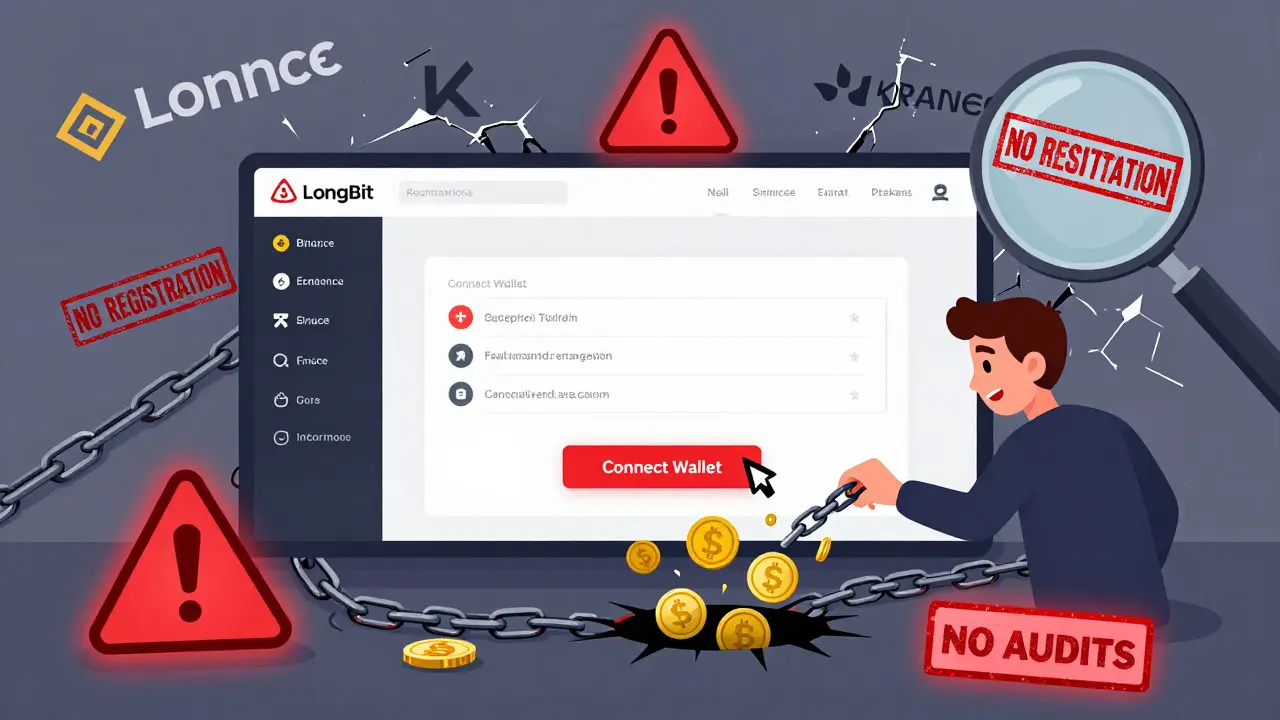
If you search for LongBit, you won’t find a trading platform. You’ll find phishing sites. Fake mobile apps. Telegram groups pushing “limited-time bonuses.” Some even mimic the look of real exchanges with fake logos, copied UI elements, and fabricated testimonials. They lure you in with promises of 10x returns, zero fees, or exclusive access to new tokens. Then they ask you to connect your wallet or deposit funds.
Here’s how it works: You click a link. You land on a site that looks professional. You enter your seed phrase to “verify your account.” Or you send a small amount of ETH or USDT to “unlock” higher trading limits. That’s it. The money disappears. The site goes dark. Your wallet is drained.
These scams aren’t new. In 2024, North Korean hacking groups pulled off 47 crypto thefts totaling over $1.34 billion. Most of them started with a fake exchange or airdrop site. The same pattern repeats: low-effort websites, no verifiable team, no transparency, and zero regulatory presence.
How to Spot a Fake Crypto Exchange
Real exchanges don’t hide. They publish their security practices. Here’s what a legitimate platform looks like-and what LongBit lacks:
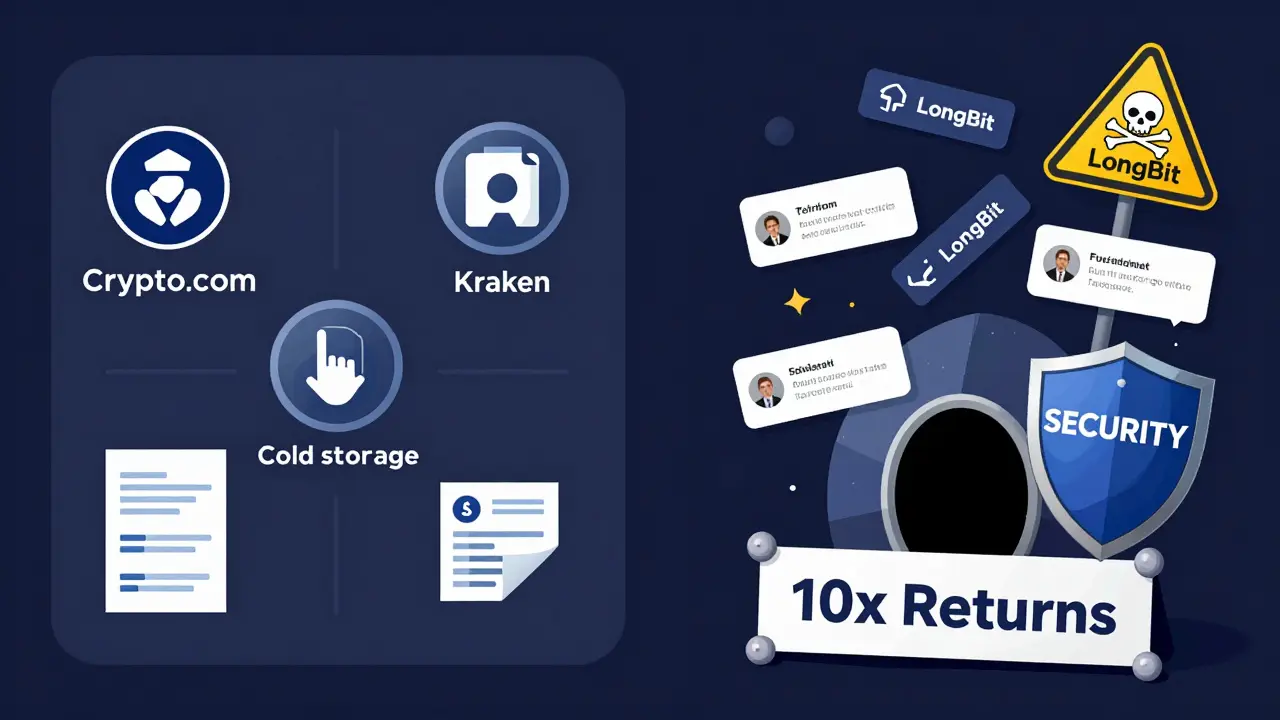
- Multi-factor authentication (MFA): Real exchanges require app-based 2FA (like Google Authenticator or Authy), not SMS. SMS can be hijacked. LongBit’s site doesn’t even mention 2FA.
- Cold storage: Over 95% of user funds on trusted exchanges are kept offline in hardware wallets. No exchange publishes exact numbers, but they all confirm the practice. LongBit doesn’t mention cold storage anywhere.
- Regulatory compliance: Legit platforms are licensed in at least one jurisdiction-like the U.S., EU, or Singapore. LongBit has no license, no legal address, no contact info.
- Transparency reports: Binance, Coinbase, and Crypto.com release quarterly proof-of-reserves. LongBit has zero public audits.
- User reviews: Thousands of verified users leave feedback on Trustpilot, Reddit, and independent forums. LongBit has no reviews. No complaints. No praise. Just silence.
If you’re being told LongBit is “new and private,” that’s a red flag. No major crypto platform stays private. They need trust to survive. That’s why they’re public.
What Happens When You Use a Fake Exchange?
Let’s say you fall for it. You deposit $500 in USDT. You think you’re trading. You see your balance go up. You even cash out $20. Feels real, right?
It’s not.
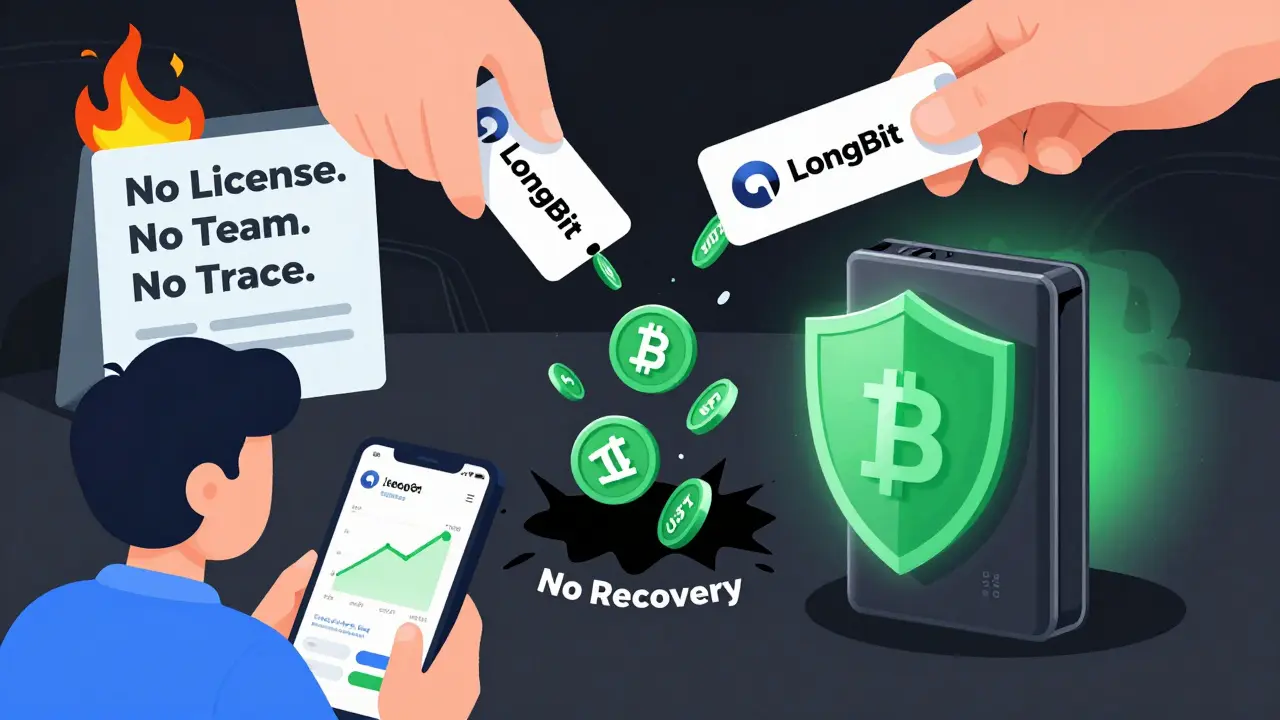
That $20 wasn’t yours. It was fake data. The exchange doesn’t have a real blockchain connection. It’s just a frontend with a calculator. Your $500 was sent directly to a hacker’s wallet. There’s no customer service to contact. No legal recourse. No chargeback.
And if you connected your wallet? You’re in worse shape. Scammers use contract approvals to drain your entire wallet-every token, every NFT, every future transaction. A single click can wipe out years of crypto holdings.
What Should You Do Instead?
Don’t gamble on unknown names. Stick to exchanges with proven track records:
- Crypto.com: Ranked #1 for security in 2025 surveys. Uses cold storage, insurance, and multi-sig wallets.
- Binance: The most trusted exchange globally, despite past issues. Still leads in volume and features.
- Kraken: Fully licensed in the U.S. and EU. Transparent about audits and security.
- Bybit: After its $1.5B hack in February 2025, they rebuilt with stronger protocols. They’re now more transparent than ever.
Even better: keep most of your crypto off exchanges entirely. Use a hardware wallet like Ledger or Trezor. Store your seed phrase offline. That’s the only way to guarantee your assets stay yours.
Why Does This Keep Happening?
Crypto is still wild west territory. The U.S. has no unified crypto regulator. Many countries have no rules. That’s why scammers thrive. They don’t need to be smart-they just need to be convincing. A fake website costs $50 to build. A phishing ad costs $200 to run on TikTok. The payoff? Thousands of victims.
And the victims? They lose more than money. They lose trust. They stop believing in crypto altogether. That’s exactly what the scammers want.
Don’t be the next one. If you can’t find a single credible source about a crypto exchange, it doesn’t exist. And if it does exist, it’s dangerous.
LongBit isn’t a new player. It’s a trap.
Is LongBit a real crypto exchange?
No, LongBit is not a real crypto exchange. There is no verifiable evidence that LongBit operates as a legitimate trading platform. It does not appear on any major crypto data sites like CoinMarketCap or CoinGecko, has no regulatory license, no public audits, and no user reviews. All references to LongBit are linked to phishing sites or scams.
Why can’t I find any reviews of LongBit?
Legitimate exchanges have thousands of user reviews across forums, Trustpilot, Reddit, and independent review sites. LongBit has zero credible reviews because it doesn’t serve real customers. Any reviews you see are fake-copied from other platforms or written by scammers to trick new users.
Can LongBit steal my crypto even if I don’t deposit?
Yes. Many fake exchanges trick users into connecting their crypto wallets through malicious links. Once connected, scammers use contract approvals to drain all tokens in your wallet-not just what you deposited. Even if you never send funds, your entire portfolio can be wiped out in seconds.
What should I do if I already sent crypto to LongBit?
If you sent crypto to LongBit, assume it’s gone. There is no recovery process. Do not contact them. Do not send more funds. Immediately disconnect any wallet that was connected to the site. Change passwords on all related accounts. Use a hardware wallet moving forward. Report the scam to your local cybercrime unit or the FBI’s IC3 if you’re in the U.S.
Are there any safe alternatives to LongBit?
Yes. Use well-established exchanges like Crypto.com, Binance, Kraken, or Coinbase. All have public security practices, regulatory compliance, and years of user trust. For maximum safety, store the majority of your crypto in a hardware wallet like Ledger or Trezor and only keep small amounts on exchanges for trading.
20 Comments
This is why people get wiped out. No due diligence. No research. Just some TikTok ad saying '10x your money in 24 hours.' If you don't know the difference between a real exchange and a phishing site, you shouldn't be touching crypto at all. It's not the scammer's fault-you made the choice to click.
Stop pretending ignorance is cute. This isn't a game. Your wallet isn't a toy.
I find it deeply distressing that so many individuals willingly surrender their private keys to entities that lack any verifiable legal standing. The psychological vulnerability exploited here is not merely financial-it is existential. One cannot underestimate the erosion of trust in decentralized systems when such predatory actors operate with impunity.
If something doesn't exist in public records, it doesn't exist. Period. Crypto isn't about secrecy. It's about transparency. If a platform can't prove it's real, it's not real. Stop chasing ghosts.
Honestly, I'm embarrassed for people who fall for this. You think you're being 'cutting edge' or 'early adopters' but you're just handing your life savings to someone in a Telegram group who doesn't even have a last name. You're not a pioneer. You're a target.
The absence of regulatory compliance is not an oversight-it is a declaration of intent. A legitimate enterprise seeks legitimacy. A fraudulent one seeks anonymity. The logic is elementary, yet so many choose to ignore it.
I’ve been in this space since 2017. I’ve seen dozens of these scams rise and fall. What’s interesting isn’t how they’re built-it’s why people keep falling for them. It’s not greed. It’s loneliness. People want to believe in something bigger. They want to feel like they’re part of a movement. And scammers? They give them a story. A fake dashboard. A fake community. A fake future. The real tragedy isn’t the lost crypto-it’s the lost hope.
That’s why education isn’t enough. You have to heal the wound underneath the greed.
I wish more people understood that crypto isn’t a get-rich-quick scheme. It’s a new financial system. And systems like this don’t survive on hype. They survive on trust. LongBit doesn’t have trust. It has nothing. And that’s why it’s dead before it even started.
I saw a post yesterday about someone losing 12 ETH to a site that looked like Binance. Same thing. Fake UI. Fake testimonials. Fake everything. Just don’t click stuff that looks too good to be true. It’s not rocket science.
If you’re new to crypto, here’s the cheat sheet: If you can’t find the exchange on CoinGecko, CoinMarketCap, or Reddit’s r/CryptoCurrency, it’s not real. If they don’t have a Twitter account with 50k followers and 500k likes on a security post, it’s not real. If their website doesn’t have a 24/7 live chat with a human who answers in under 30 seconds, it’s not real.
Don’t overthink it. If it’s not on the list, it’s a trap. Period.
LMAO. Bro just got rekt by a fake site. I saw his wallet. He sent 8 ETH to a contract that called itself 'LongBit Liquidity Pool.' Then he cried in a Discord server. Bro, you didn’t get scammed. You volunteered. You wanted to believe. Now go buy a Ledger. And don’t touch your phone for a week.
It’s sad how easy it is to take advantage of people who just want to build a better future. I’ve been there. I lost money too. But I learned. And now I help others avoid the same mistake. You’re not alone. There’s a whole community out here trying to keep each other safe.
The real danger isn’t LongBit. It’s the narrative that crypto is easy. That you can just ‘flip’ something and become rich. That’s the lie. The truth? Crypto is hard. It’s technical. It’s risky. And if you’re not willing to spend 10 hours learning how to secure your wallet, you shouldn’t be holding any. Period.
LongBit? More like LongBullshit. These scams are like mold-once you see one, you start noticing them everywhere. Fake ads. Fake influencers. Fake testimonials. It’s a whole ecosystem built on dumbassery. And the dumbasses? They’re not even mad. They’re proud they 'got in early.' Bro. You got scammed. Own it.
I remember when I first started. I thought all exchanges were like Amazon. Just click, buy, done. Then I lost $300 to a fake site. It broke me. But it also made me a student. Now I check every platform like I’m auditing a bank. If it doesn’t have a transparency report, I walk away. No exceptions.
You’re not dumb for falling for it. You’re just new. And that’s okay. Just don’t do it again.
I think it’s important to remember that people don’t fall for scams because they’re stupid. They fall for them because they’re hopeful. And hope is beautiful. Even when it’s dangerous.
Maybe the real solution isn’t more warnings. Maybe it’s more kindness.
LongBit? I see dem fake site every day. Dem guy dey use same logo like Binance but dem website dey use .xyz domain. Dem people dey tell you to send USDT to unlock account. I tell my cousin stop but he no listen. Now he lose 20000 Naira. I no blame him. I blame the system dat allow dem scammer to operate.
The attack vector here is social proof. Scammers exploit the cognitive bias that if something looks like a legitimate platform, it must be. The UI replication is sophisticated-enough to fool even experienced users if they’re rushing. The solution isn’t education alone. It’s friction. Mandatory wallet confirmation flows. Delayed withdrawals. Hard stops before contract approvals. We need architecture, not just awareness.
I’m so glad this was posted. I’ve been trying to warn my mom for months. She saw a video where someone said LongBit was 'the future of decentralized finance.' She was about to send her retirement fund. I sat her down. Showed her CoinGecko. Showed her the audit reports. She cried. But she didn’t send the money.
Thank you for being the voice that stops people before they lose everything.
It’s amusing how the crypto community has become a cult of credentialism. You don’t need to know how blockchain works-you just need to know which exchanges are on the approved list. The irony? The very people who claim to reject centralized authority are now blindly following a new priesthood of 'trusted' platforms.
LongBit isn’t a scam. It’s a psyop. I’ve been tracking this. The same IP addresses, the same domain registrars, the same Telegram admins. This is state-sponsored. Probably Russian or Iranian. They’re not after your money. They’re after your wallet metadata. Your transaction history. Your on-chain fingerprint. This isn’t theft. It’s surveillance. And the real exchange? They’re all in on it.