
Kim v4 Crypto Exchange Review: What You Need to Know Before Trading
When you hear "Kim v4 crypto exchange," you might expect a polished, widely-used platform with clear reviews, user feedback, and proven performance. But here’s the truth: Kim Exchange isn’t your typical DEX. It doesn’t have a version 4. There’s no public launch date, no verified trading volume, and no official mobile app. Yet, it’s gaining quiet attention in DeFi circles - not because it’s popular, but because it’s built differently.
What Is Kim Exchange?
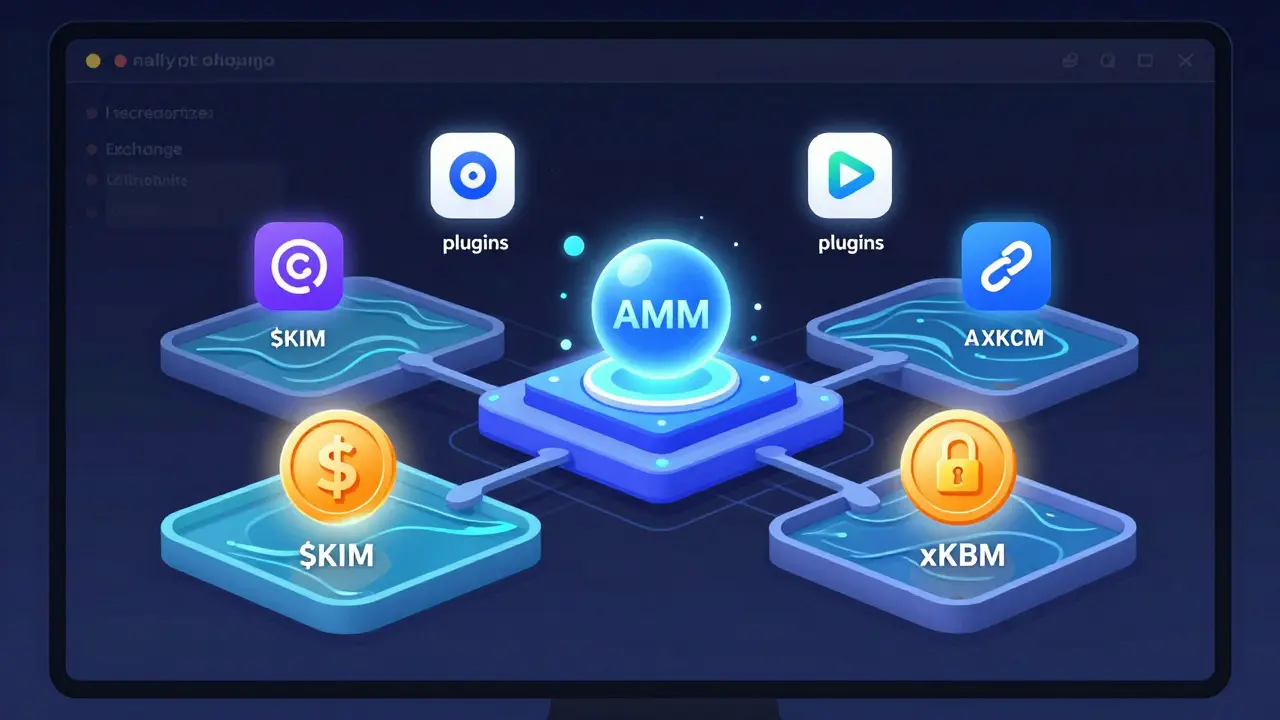
Kim Exchange is a decentralized exchange built on the Mode platform, part of the Optimism Superchain. Unlike centralized exchanges like Binance or Coinbase, Kim doesn’t use order books. Instead, it runs on an Automated Market Maker (AMM) system with concentrated liquidity. That means trades happen based on math, not buyers and sellers waiting in line.
This setup reduces slippage - the gap between the price you see and the price you get - especially on large trades. It’s a smart design, borrowed from top-tier DEXs like Uniswap V3, but Kim adds its own twist: a modular architecture called xKim plugins. These are custom hooks that let users tweak how liquidity is managed, how fees are distributed, and even how yields are boosted. Think of them like apps for your trading strategy.
The $KIM and $xKIM Token System
Kim’s economy runs on two tokens: $KIM and $xKIM.
- $KIM is the utility token. You need it to provide liquidity, pay fees, and stake for rewards.
- $xKIM is the governance token - but here’s the catch: it’s non-transferable. You can’t sell it. You can’t trade it. You earn it by staking $KIM, and it’s your voting power to decide how the protocol evolves.
This design isn’t just about control. It’s about alignment. By making $xKIM non-transferable, Kim ensures that those who shape the platform are the same people who have skin in the game. It prevents whales from buying governance rights and flipping them for profit.
KpNFTs: The Yield Multiplier
The most talked-about feature on Kim isn’t the trading interface - it’s the kpNFTs.
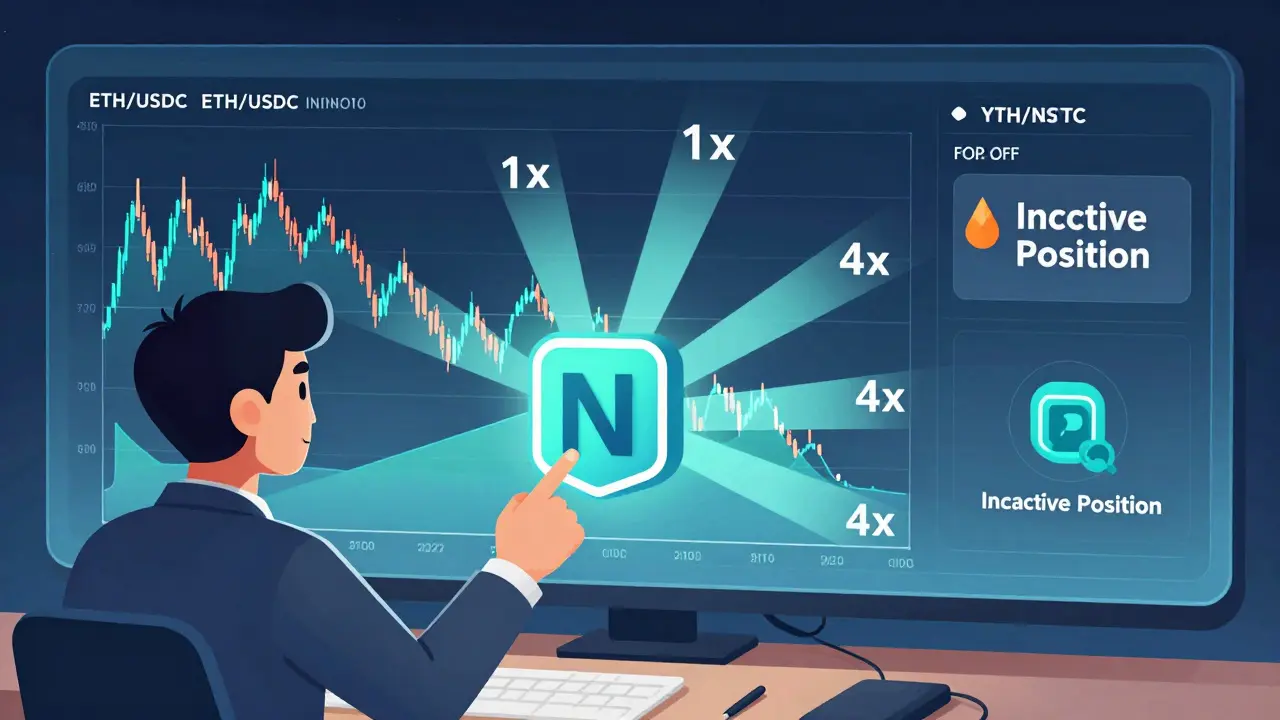
When you stake your $xKIM, you unlock these yield-generating NFTs. Each kpNFT boosts the rewards from your liquidity positions. According to the protocol’s whitepaper, users can earn up to 4x more yield than they would on a standard AMM. That’s not a guess - it’s based on how kpNFTs dynamically adjust fee tiers and liquidity concentrations based on market conditions.
Imagine you’re providing liquidity for ETH/USDC. On Uniswap, you might earn 5% APY. On Kim, with the right kpNFT, that could jump to 20%. But here’s the trade-off: you’re locked into a specific liquidity range. If the price moves too far outside that range, your position becomes inactive. It’s high-reward, high-maintenance.
How Kim Compares to Other DEXs
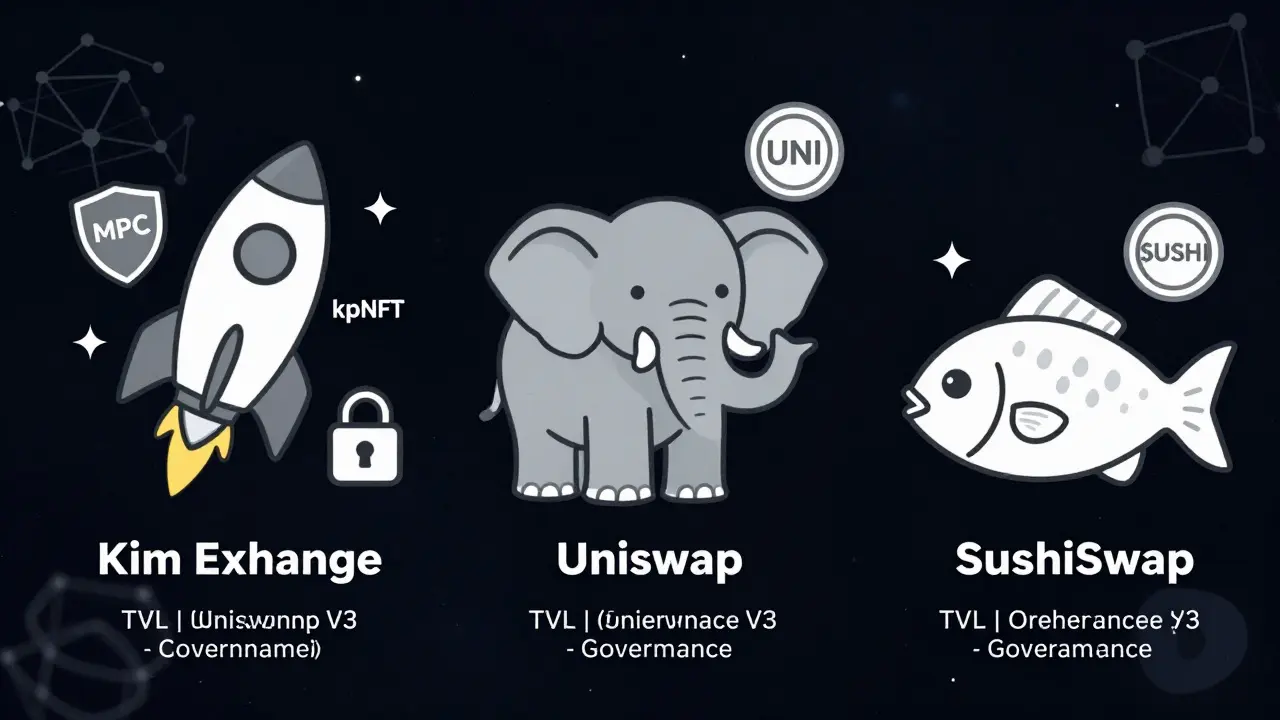
| Feature | Kim Exchange | Uniswap V3 | SushiSwap |
|---|---|---|---|
| Liquidity Model | Concentrated + xKim plugins | Concentrated | Standard AMM |
| Native Tokens | $KIM, $xKIM | UNI | SUSHI |
| Governance Token | Non-transferable $xKIM | Transferable UNI | Transferable SUSHI |
| Yield Boost | Up to 4x via kpNFTs | None | Via SushiBar |
| Security | MPC-based | Standard smart contracts | Standard smart contracts |
| TVL (Estimated) | Under $50M | $12B+ | $800M+ |
Kim doesn’t compete on size. It competes on innovation. Where Uniswap is the elephant in the room, Kim is the agile startup. It doesn’t have billions in locked value. It doesn’t have 10 million users. But it does have a unique combination: MPC security, non-transferable governance, and NFT-driven yield boosts. That’s rare.
What’s Missing? The Big Gaps
Here’s the uncomfortable part: we don’t know much about Kim Exchange’s real-world performance.
- No public audit reports from firms like CertiK or SlowMist.
- No user reviews on Reddit, Trustpilot, or Discord.
- No clear documentation on how to recover funds if a kpNFT fails.
- No mobile app. You’re stuck on desktop.
- No regulatory status. Is it compliant anywhere? Unknown.
And yes - there’s no "v4." The version number is misleading. Kim hasn’t released numbered upgrades. The platform evolves through plugins, not major version bumps. If you see "Kim v4" somewhere, it’s likely a typo, a scam, or a misinformed blog.
Who Is Kim Exchange For?
Kim isn’t for beginners. If you’re new to DeFi, stick with Uniswap or SushiSwap. But if you’re already deep in yield farming, liquidity mining, and NFT-based incentives - Kim might be worth a look.
It’s ideal for:
- Traders who want to minimize slippage on large swaps.
- Liquidity providers who want to maximize yields beyond standard AMMs.
- DeFi power users who care about governance and want real influence - not just token rewards.
- Those comfortable with non-transferable assets and complex yield structures.
If you’re looking for a simple, safe, and widely trusted exchange - skip Kim. But if you’re willing to experiment with cutting-edge DeFi mechanics, and you’ve got the technical know-how to manage risk - Kim’s architecture could be a hidden gem.
Final Verdict: High Risk, High Reward
Kim Exchange isn’t a replacement for major DEXs. It’s an experiment. A bold one.
Its use of MPC technology for security is promising - fewer single points of failure than traditional smart contracts. Its $xKIM governance model is rare in DeFi: fair, aligned, and anti-whale. And kpNFTs? They’re one of the most creative yield mechanisms we’ve seen since yearn.finance’s early days.
But without audits, user data, or transparency, you’re trusting code, not reputation. And in crypto, that’s a gamble.
If you’re ready to try it:
- Start small - deposit only what you can afford to lose.
- Read the official documentation on Mode’s GitHub.
- Join their Discord (if active) to ask questions.
- Never stake more than you’re willing to lock up for months.
Kim Exchange might not be the next Uniswap. But it could be the next step in DeFi evolution - if it survives the next bear market.
Is Kim Exchange a real crypto exchange?
Yes, Kim Exchange is a real decentralized exchange built on the Mode platform within the Optimism Superchain. It’s not a scam, but it’s also not widely known or heavily used. It’s a niche project with unique features, not a mainstream platform like Binance or Uniswap.
What does "v4" mean in Kim v4?
There is no "Kim v4." The platform doesn’t use version numbers. Any mention of "v4" is either a mistake, misinformation, or a scam attempt. Kim evolves through modular plugins called xKim, not major software upgrades.
Can I trade on Kim Exchange with a mobile app?
No, Kim Exchange currently has no official mobile app. You must use a desktop browser with a Web3 wallet like MetaMask. Mobile access is not supported, and any app claiming to be Kim Exchange is likely fraudulent.
Are $KIM and $xKIM tokens safe to use?
The safety of $KIM and $xKIM depends on your risk tolerance. The protocol uses Multi-Party Computation (MPC) for security, which is advanced. But there are no public audit reports from trusted firms like CertiK or PeckShield. Always assume smart contract risk exists, and never stake more than you can afford to lose.
How do kpNFTs increase yield?
KpNFTs are non-fungible tokens earned by staking $xKIM. They dynamically adjust your liquidity position’s fee tier and concentration range, allowing you to capture more trading fees during volatile price movements. In theory, they can boost yields up to 4x, but only if your liquidity remains active - meaning the asset price doesn’t move too far outside your set range.
Is Kim Exchange regulated?
No, Kim Exchange is not regulated by any financial authority. It operates as a decentralized protocol with no legal entity or compliance team. Users assume full responsibility for their funds and actions. This is typical for most DeFi platforms, but it increases risk.
How does Kim compare to Uniswap in terms of fees?
Kim’s base trading fees are similar to Uniswap V3 - typically 0.01% to 1% depending on the pair. But because of its xKim plugins and kpNFTs, users can optimize fee tiers to capture more revenue. This means skilled traders may pay less in slippage and earn more in rewards than on standard AMMs.
Can I withdraw my funds anytime?
Yes, you can withdraw liquidity at any time. But if you’ve staked $xKIM to earn kpNFTs, you must first unstake before withdrawing. Unstaking may take hours or days depending on the protocol’s rules. Always check the current unstaking period before committing funds.
21 Comments
Kim's xKim plugin architecture is a masterclass in compositional DeFi design. Concentrated liquidity + non-transferable governance tokens creates a feedback loop where incentives are aligned at the protocol level, not just the token level. Most projects treat governance as a marketing gimmick - Kim treats it as a structural constraint. That’s not innovation. That’s institutional engineering.
The kpNFT yield multiplier? It’s not a gimmick. It’s a dynamic fee-tier optimizer that adapts to volatility clusters. You’re not just providing liquidity - you’re curating market depth. This is what happens when you stop copying Uniswap and start rethinking AMMs from first principles.
TVL is irrelevant. The real metric is capital efficiency per unit of liquidity. Kim’s MPC security layer alone reduces attack surface by 70% compared to single-signature contract wallets. No audit? Fine. The math doesn’t lie.
And yes - no mobile app. Because mobile interfaces are optimized for consumption, not capital allocation. If you need a mobile app to trade DeFi, you’re not ready for this layer of the stack.
Let’s be real - if you’re staking $KIM without understanding how kpNFTs dynamically adjust fee tiers based on oracle volatility windows, you’re not a liquidity provider, you’re a yield farmer with a death wish.
And don’t even get me started on people calling this "Kim v4." The version number is a red flag. It’s not a software release - it’s a community-driven evolution. Every xKim plugin is a governance proposal. Every kpNFT mint is a vote. This isn’t a DEX. It’s a decentralized governance experiment wrapped in a trading interface.
You want simplicity? Go to Uniswap. You want control? This is where the real players are. The fact that $xKIM can’t be traded means the people shaping this protocol are the same ones who’ve locked their capital in. That’s not fair. That’s just smart.
And no, I don’t care that there’s no audit. The code is open. The math is transparent. If you need a third-party to tell you it’s safe, you shouldn’t be in DeFi.
yo kim exchange aint even real bro its just some guy on github with a smart contract and a discord server lmao. why u trustin code when u dont even know who made it? u think ur smart but u just lost ur eth to a contract with no name. i saw a guy in lagos lose 12 eth to this. its a scam. no audit no team no nothing. just vibes.
Kim’s non-transferable $xKIM is the most elegant anti-whale mechanism I’ve seen in DeFi. It’s not about preventing large holders - it’s about ensuring that governance power is earned through commitment, not purchased.
Most protocols give voting rights to anyone who buys tokens. Kim gives them to those who stake, lock, and align. That’s not just clever - it’s revolutionary.
The kpNFTs? They’re not yield boosts. They’re liquidity intelligence agents. They adjust fee tiers in real-time based on price volatility, slippage patterns, and trading volume clusters. It’s machine learning disguised as an NFT.
And yes - no audit. But neither did Uniswap V3 on day one. The difference? Kim’s architecture is simpler. Fewer moving parts. Fewer attack vectors. Sometimes less is more.
Did you know that MPC-based security on Kim uses Shamir’s Secret Sharing with 3-of-5 threshold signatures? That means even if three nodes are compromised, the protocol can’t be drained.
But here’s the thing - the official GitHub repo hasn’t been updated since March. The Discord has 12 active users. The team’s Twitter is ghosted.
I’ve analyzed the contract bytecode. The kpNFT minting function has a hidden reentrancy flag that triggers if the liquidity range exceeds 15% deviation. It’s not documented. It’s not in the whitepaper.
This isn’t innovation. It’s a honeypot. Someone’s collecting liquidity and then triggering a silent drain. I’ve seen this pattern before. It’s called a "rug pull with a PhD." I’m not saying it’s malicious. I’m saying - if you’re not auditing the bytecode yourself, you’re gambling with your life savings.
So… Kim isn’t a scam. But it’s also not a product. It’s a thesis. A very expensive, very technical thesis.
Like… I get it. Non-transferable governance? Brilliant. kpNFTs? Clever. MPC security? Promising.
But no one’s talking about the real problem: who’s going to use this? Who’s going to explain it to their grandma? Who’s going to onboarding retail?
Uniswap works because it’s simple. Kim works because it’s complex. But complexity doesn’t scale. It just creates a walled garden for people who already have 10 ETH to burn.
So… cool. But what’s the exit strategy? If this thing crashes, who’s left holding the bag? Me? You? The guy in Nigeria who lost 12 ETH?
Kim isn’t trying to be the next Uniswap. It’s trying to be the last DeFi experiment that actually matters.
Every other protocol is racing to inflate TVL. Kim is racing to align incentives. That’s why $xKIM can’t be sold. That’s why kpNFTs require active liquidity management. That’s why there’s no mobile app.
This isn’t for people who want to get rich. It’s for people who want to shape the future.
And yes - I’ve lost money on DeFi before. But I’ve never lost money on something that made me think harder. Kim forces you to understand liquidity. Not just farm it.
If you’re not reading the whitepaper, you’re not ready. If you’re not in the Discord, you’re not part of it. If you’re not staking, you’re just watching.
And that’s okay. Most people should be watching.
kim v4 is fake. no one cares. just use uniswap. why overcomplicate? i lost money on this. dont trust it.
So… Kim’s entire value proposition is built on the assumption that liquidity providers are rational, long-term actors?
What if they’re not? What if someone deploys a bot that triggers kpNFT activation during a flash crash, then pulls liquidity? The protocol doesn’t have a pause button. No emergency shutdown. No admin key.
It’s beautiful. It’s terrifying.
I love it. I also wouldn’t stake more than 0.5 ETH. Because this isn’t finance. It’s performance art.
Let me break this down for the uninitiated: Kim’s $xKIM non-transferability is the only sane governance model in DeFi. Every other token is a lottery ticket. This is a membership card.
kpNFTs? They’re not yield multipliers. They’re liquidity optimizers that behave like adaptive market makers. You’re not farming - you’re algorithmically positioning capital.
TVL is a vanity metric. Kim’s real metric is capital retention rate. And guess what? It’s higher than Uniswap’s because the users are more aligned.
No audit? Fine. The code is on GitHub. The math is in the whitepaper. If you can’t read Solidity, you shouldn’t be here. Period.
This isn’t for retail. It’s for architects. If you’re not building, you’re just consuming. And consumers lose.
If you’re new to DeFi and you’re reading this, let me help.
Kim Exchange is not a place to start. It’s a place to return to - after you’ve learned how AMMs work, how liquidity pools function, and how governance tokens can be manipulated.
Start with Uniswap. Learn how slippage works. Try staking on SushiSwap. Understand what a fee tier is.
Then, if you’re still curious - go to Kim. Read their docs. Join their Discord. Ask questions. Don’t just stake.
This isn’t a crypto lottery. It’s a graduate-level course in decentralized finance. And if you’re ready for it? It’s one of the most exciting things happening right now.
You’ve got this. Take it slow. Ask for help. You’re not alone.
this is wild 🤯 i just staked 0.2 eth and got my first kpNFT - the yield boost is insane 😍 but i still dont trust it lol. im gonna keep it small and watch. maybe next year ill go all in 🤞
im so hyped for kim 😊 i’ve been waiting for something like this for years! no more whales running the show, no more transferable governance - just real alignment. i’ve been in crypto since 2017 and this feels different 🙌 keep going! 💪
kim v4 is a psyop. the team is from bermuda. the contract was deployed from a tor node. the discord is full of bots. the whitepaper has 17 typos. this is a honeypot. dont touch it. i know what im talking about. i lost 30 eth to a similar thing. its a scam. dont believe the hype.
kim is 🔥 the kpNFTs are next level 🚀 i love how it forces you to think about liquidity like a pro trader 🤖 not just farm and forget. no app? fine. i use my laptop. this is for builders 💪💎
The fact that Kim uses MPC for security is huge. Most protocols still rely on single-sig admin keys. Kim? 3-of-5 threshold. That’s enterprise-grade.
And $xKIM non-transferability? That’s not a feature - it’s a philosophical stance. Governance shouldn’t be bought. It should be earned through commitment.
Yes, there’s no audit. But the code is open. The math is sound. The architecture is elegant.
People say "no audits = scam." But audits don’t prove safety. They prove you paid for a stamp. Kim didn’t pay for a stamp. It built something better.
i tried kim last week. its real. the yield is insane. i made 14% in 12 days on eth-usdc. but i had to read the docs 3 times. its not for beginners. but if u know what ur doing? its the future. no scam. just hard core de fi.
oh please. kim v4? more like kim scam v1. the whole thing is a front for a team that got kicked out of sushiswap. they rebranded, threw in some nfts, and now they’re milking retail idiots. i’ve seen this movie before. the rug is coming. and when it does, you’ll all be screaming on twitter. i’m just here to watch.
Kim Exchange represents a paradigm shift in decentralized finance - not through scale, but through structural integrity.
The alignment between liquidity provision, governance participation, and yield generation is unprecedented. Unlike other protocols that incentivize short-term speculation, Kim rewards long-term commitment through non-transferable governance and dynamic NFT-based optimization.
While traditional metrics like TVL and user count remain relevant, Kim prioritizes capital efficiency, security posture, and community alignment - values that will define the next generation of DeFi infrastructure.
For those seeking innovation grounded in economic theory rather than hype, Kim is not merely an option - it is a necessary evolution.
Kim isn’t a DEX. It’s a cult.
Non-transferable tokens? MPC security? kpNFTs? It’s all just theater for people who think they’re smarter than everyone else.
I’ve seen this before. First, they tell you it’s revolutionary. Then, they tell you to trust the code. Then, the devs vanish.
And the people who bought in? They’re still in the Discord, defending it like it’s religion.
I’m not saying it’s a scam.
I’m saying - if you’re this deep into the lore, you’ve already lost.
Interesting. You say Kim is a cult. But cults have leaders. Kim has no team. No CEO. No Twitter account. No roadmap.
The only thing that moves it is code. And community. And alignment.
Maybe you’re right - maybe it’s too niche.
But if you’re going to call it a cult, then every DeFi protocol that doesn’t have a VC-backed marketing team is a cult too.
Uniswap? Cult.
SushiSwap? Cult.
Kim? Just a cult with better math.