
Iranian Rial Crypto Trading Restrictions: What You Need to Know in 2026

Iran’s approach to cryptocurrency is unlike any other country’s. While most governments either ban crypto outright or try to embrace it, Iran does both - at the same time. The government allows massive cryptocurrency mining operations but blocks ordinary citizens from using crypto to protect their savings. This contradiction isn’t a mistake. It’s a strategy. And it’s reshaping how Iranians survive economic collapse.
Why Iran Banned Crypto-to-Rial Trading
On December 27, 2024, Iran’s Central Bank shut down every website that let people trade cryptocurrency for Iranian rials - and vice versa. No more buying Bitcoin with rials. No more cashing out crypto into local currency. The move wasn’t about stopping crypto. It was about stopping the rial from collapsing faster.
The Iranian rial has lost over 90% of its value since 2018. Inflation is running at over 40% annually. People are losing savings every day. So they turn to Bitcoin, Ethereum, and especially Tether (USDT) to hold value. But when millions of Iranians trade rials for crypto, they drain the country’s last remaining foreign currency reserves. The Central Bank couldn’t stop the panic - so it stopped the channel.
The result? Iranians still trade crypto. But now they have to use underground channels, peer-to-peer apps, or foreign exchanges. It’s harder. It’s riskier. But it’s still happening.
The $5,000 Stablecoin Cap
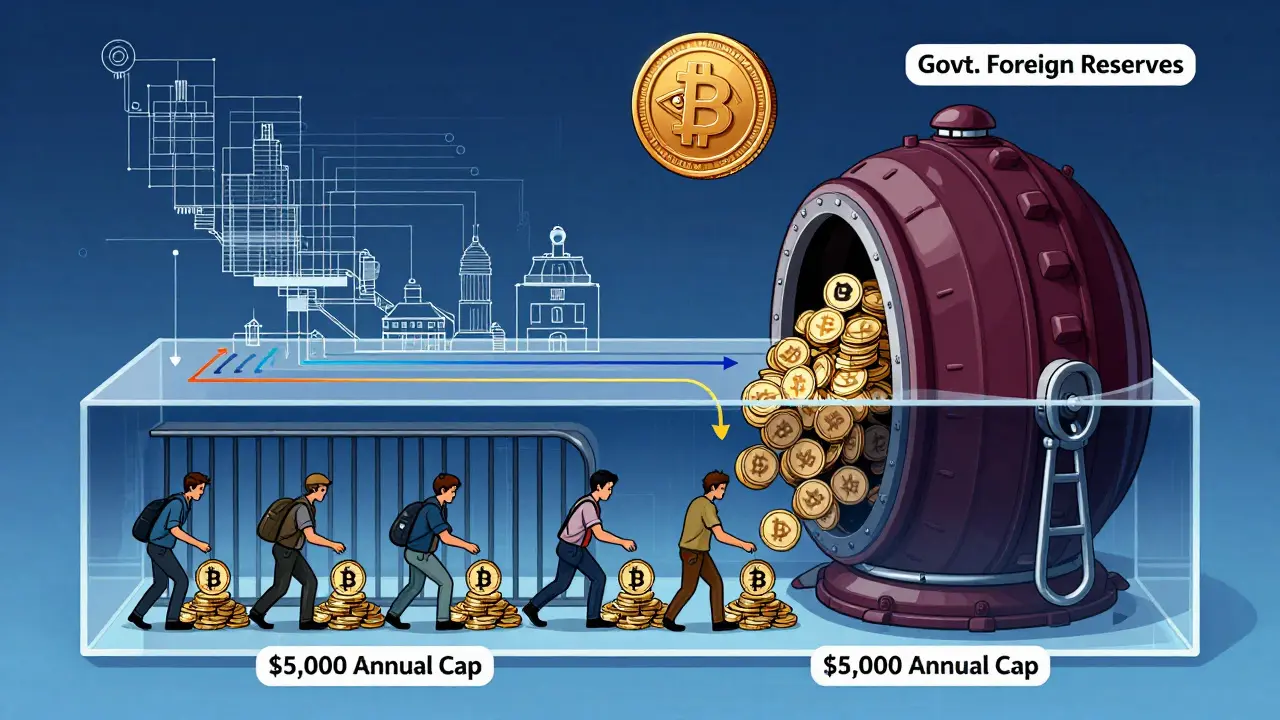
On September 27, 2025, Iran dropped its heaviest restriction yet: no one can own more than $10,000 in stablecoins. And you can only buy $5,000 per year. That’s not a suggestion. It’s a law. Violate it, and you risk having your funds frozen - or worse.
This rule targets USDT, the most popular stablecoin in Iran. Why? Because Tether (USDT) is the only thing keeping millions of Iranians from losing everything. A family in Tehran might use $1,000 in USDT to pay rent, buy medicine, or send money to a relative abroad. Now, they can’t even top up their wallet beyond $5,000 in a year.
The government says this prevents capital flight. But in practice, it punishes ordinary people trying to survive. Meanwhile, state-linked mining operations continue to pump out Bitcoin - often sold abroad for hard currency that goes straight into government coffers.
Advertising Ban: Silence the Message
In February 2025, Iran banned all cryptocurrency advertising. No YouTube videos. No Instagram posts. No billboards. Even crypto influencers had to delete their content. The goal? Make crypto invisible. Out of sight, out of mind.
But the ban backfired. Instead of reducing interest, it turned crypto into a forbidden fruit. Underground Telegram groups exploded. Word-of-mouth networks grew. Iranians learned how to trade without ads - using encrypted chats, private forums, and burner phones.
The government didn’t just ban ads. It banned the *idea* that crypto could be useful. And that’s why the ban matters more than the rules. It’s psychological warfare.
Miners Are Still Welcome - Here’s Why
Iran is one of the top five Bitcoin mining countries in the world. Why? Cheap electricity. Government tolerance. And a clear incentive: mining generates hard currency.
Iranian miners produce about $1 billion in Bitcoin annually. That’s 4.5% of global mining output. The government doesn’t tax miners. It doesn’t regulate them. It lets them run 24/7 - because when they sell Bitcoin overseas, they bring in dollars. Dollars that the state needs to buy food, medicine, and weapons.
Meanwhile, the average Iranian can’t legally convert $100 of crypto into rials to pay for groceries. The system is designed to extract value from the people - not protect them.
The Digital Rial: A Government-Controlled Alternative
Iran isn’t just fighting crypto. It’s trying to replace it. Meet the Rial Currency - Iran’s own central bank digital currency (CBDC). Unlike Bitcoin, you can’t mine it. You can’t trade it freely. It’s just digital rials - controlled entirely by the Central Bank.
The government launched a pilot on Kish Island, a tourist zone where foreign visitors use dollars. The idea? Replace dollar transactions with digital rials. No more cash. No more crypto. Just government-monitored payments.
But here’s the catch: no one trusts it. Why would you use a digital rial when the paper rial is falling apart? The digital version doesn’t solve the core problem: lack of value. It just adds surveillance.

How Iranians Are Adapting - and Evading
When Tether froze over 40 Iranian-linked wallets in July 2025, panic spread. But Iranians didn’t give up. They moved.
Within weeks, thousands switched from USDT to DAI - a decentralized stablecoin built on the Polygon network. Why? Because DAI isn’t controlled by a single company. It’s harder to freeze. And Polygon is faster and cheaper than Ethereum.
People started using decentralized exchanges (DEXs) like SushiSwap and Uniswap. They traded via peer-to-peer apps like LocalBitcoins and Paxful. Some even used crypto ATMs in neighboring countries.
The government thought it had sealed the borders. But crypto doesn’t need borders. It just needs a phone, a Wi-Fi signal, and a reason to survive.
Taxing Crypto: The New Control Tool
In August 2025, Iran passed its first crypto tax law. Speculative gains from Bitcoin, Ethereum, and even NFTs are now taxed like gold or real estate. The tax rate? 15% on profits.
This isn’t about fairness. It’s about control. The government wants to track every transaction. It wants to know who owns what. And it wants a cut.
But here’s the irony: if you’re buying crypto to protect your savings from inflation, you’re not making a profit - you’re avoiding a loss. Yet the tax law treats you like a gambler.
Enforcement is still patchy. But the message is clear: the state is no longer ignoring crypto. It’s claiming ownership.
The Bigger Picture: A Model for Sanctioned Nations
Iran’s approach isn’t random. It’s a blueprint. Other sanctioned countries - Venezuela, North Korea, Russia - are watching closely.
They see how Iran uses mining to generate foreign currency. They see how it blocks retail access to prevent capital flight. They see how it taxes and tracks crypto to maintain control.
Iran proves you don’t have to ban crypto to control it. You just have to make it useless for ordinary people - while letting the state profit from it.
The result? A two-tier system: one for the government, one for the people. And the people are losing.
14 Comments
This is such a mess. I mean, sure, mining is cool and all, but banning regular people from using crypto? That's not policy. That's just cruelty wrapped in econ jargon. I'm done.
This is wild. 🤯 Iran's playing 4D chess while the rest of the world is still trying to figure out if crypto is a pyramid scheme or a revolution. The fact they let miners run free but choke off retail access? That's not hypocrisy - that's *strategy*. And honestly? Kinda genius. In a terrifying way.
I just want to say - this is heartbreaking. People are using crypto to buy medicine, pay rent, feed their kids. And the government is treating them like criminals. There’s a real human cost here that no one talks about. We need to remember that behind every transaction is someone trying to survive.
You know what? This is actually a really smart move from the government’s perspective - I mean, think about it. If you’re a country under sanctions and your currency is falling apart, you need hard currency to survive. Mining Bitcoin? That’s your lifeline. But letting ordinary people convert it to rials? That’s like letting your heart pump blood out of your body. So yeah, it’s harsh, but it’s not random. It’s survival math. 🤔
I find it deeply concerning that the state is so willing to weaponize financial access. This isn't just economic policy - it's social engineering. And the fact that they're simultaneously banning advertising while ignoring the underground networks? That's textbook authoritarian control. The digital rial isn't a solution. It's a cage.
Let me tell you something - this whole thing is a psyop. The government doesn’t even care about mining. They’re using it as a smokescreen. The real goal? To create a cashless society where every digital movement is tracked. The stablecoin cap? The tax law? The ad ban? It’s all leading to one thing: total surveillance. And the next step? They’ll tie the digital rial to your ID card, your biometrics, your social credit score. You think this is about economics? Nah. This is the beginning of the digital police state. And we’re all just watching.
I just feel so bad for people in Iran. 🥺 They’re not trying to get rich - they’re trying not to starve. Crypto isn’t a gamble to them. It’s oxygen. And the government is cutting the hose. I hope someone finds a way to help.
This isn’t capitalism. It isn’t socialism. It’s something else - a post-economic dystopia where value is extracted not through labor or innovation, but through desperation. The Iranian state has turned its population into a human battery: drained of liquidity, charged with fear, and wired to a mining rig that only the regime gets to plug into. It’s Kafka meets blockchain. And it’s horrifyingly beautiful.
Let’s be real - the ‘digital rial’ is just a blockchain-enabled surveillance tool with a nationalistic brand. They’re not trying to stabilize currency. They’re trying to stabilize control. The mining ops? That’s the state’s offshore crypto hedge fund. The $5k cap? That’s the leash on the proletariat. The tax law? A compliance trap disguised as fiscal responsibility. This isn’t economics. It’s algorithmic authoritarianism.
I just want to say - you’re not alone. People in Iran are some of the most resilient, creative, and resourceful humans on the planet. The fact that they’ve built entire underground crypto networks with Telegram and burner phones? That’s innovation under pressure. And honestly? It’s inspiring. Keep going. The system wants you to quit. Don’t let it win.
Oh please. This is just another ‘poor country’ sob story. The real issue? Iran’s government is a corrupt mess. They don’t care about their people. They care about weapons and power. If they really wanted to help, they’d stop being tyrants. Instead, they blame crypto for their own failure. Pathetic.
I dont get why everyone is so upset. If your currency is trash then you shouldnt be using it. Why not just move to another country? Or get a real job? This is why the west is tired of bailing out failed states. Stop crying and figure it out.
Honestly? This is exactly what happens when you let people get too much freedom. Crypto isn’t a solution - it’s a symptom of moral decay. People should be working, saving, trusting institutions. Not hiding behind blockchain and Telegram bots. This isn’t innovation. It’s chaos with Wi-Fi.
This whole thing is rigged. The government is mining Bitcoin while families in Tehran are choosing between food and medicine. The digital rial? It's a trap. They're tracking every single transaction. Your grocery purchase. Your kid's medicine. Your rent. They know everything. And when they decide you're not useful anymore? Your wallet gets frozen. Your phone gets blocked. Your life gets erased. They're not trying to fix the economy. They're trying to turn every Iranian into a digital slave. And no one is talking about it. Because the world is too busy watching the next Elon tweet.