
Iranian Energy Subsidies for Crypto Mining Operations
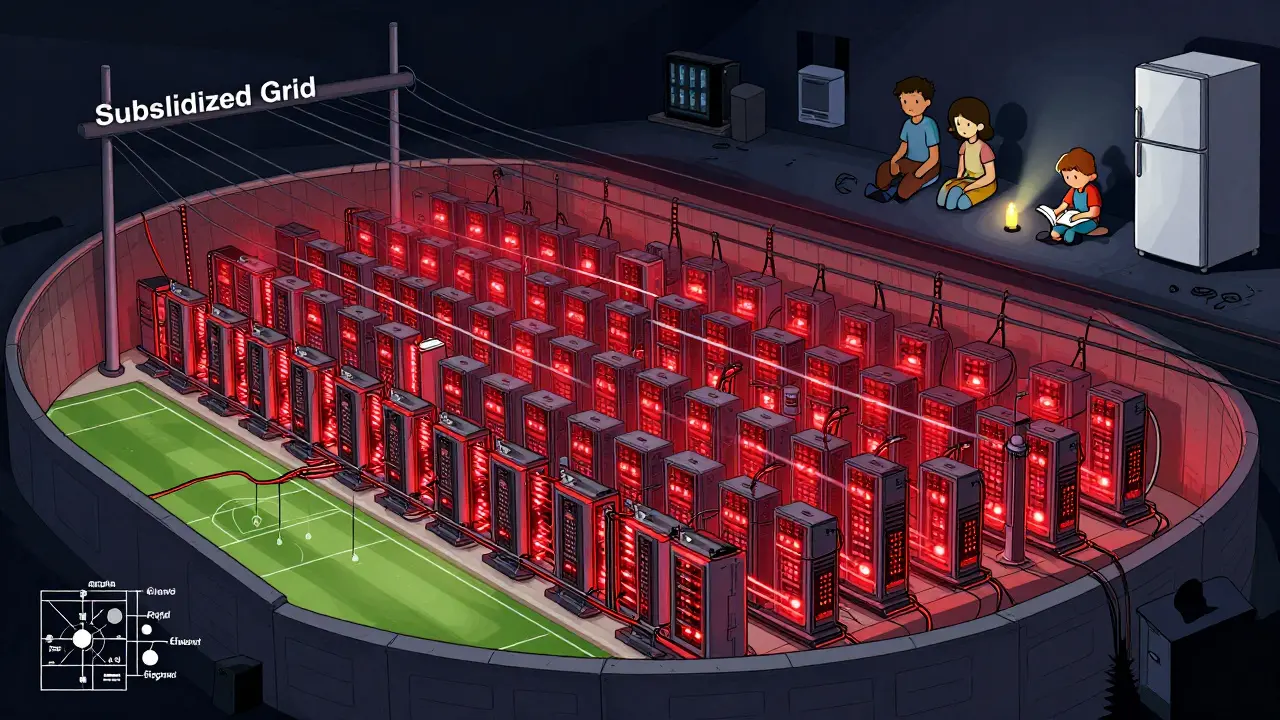
Iran doesn’t just allow cryptocurrency mining-it encourages it. At least, that’s what the numbers suggest. While most countries struggle to balance energy use and environmental concerns, Iran has turned its cheap electricity into a global advantage for Bitcoin miners. The result? A booming underground industry that’s draining the national grid while ordinary Iranians face 12-hour blackouts. This isn’t just policy-it’s a high-stakes gamble with real consequences.
How Cheap Is Electricity in Iran for Miners?
For a Bitcoin miner in Iran, electricity costs as little as $0.01 per kilowatt-hour. That’s not a typo. Compare that to $0.30 in the U.S., $0.45 in Germany, or even $0.08 in Kazakhstan. In Iran, you’re paying less than one-tenth of what miners pay in most other countries. This isn’t accidental. The government deliberately keeps industrial power prices low for mining operations, even as household rates hover around $0.02. The difference? Licensed miners get access to subsidized grid power meant for public use.
Why does this matter? Because mining a single Bitcoin takes over 300 megawatt-hours of electricity. That’s enough to power 35,000 Iranian homes for a day. At $0.01/kWh, the cost to mine one Bitcoin in Iran is roughly $1,300. Meanwhile, Bitcoin trades between $30,000 and $40,000. That’s a profit margin of over 2,000%. No wonder over 4 million ASIC mining rigs are running across the country.
Who’s Really Behind the Mining Boom?
It’s not just small-time hobbyists. About 55-65% of Iran’s mining operations are controlled by the Islamic Revolutionary Guard Corps (IRGC), either directly or through shell companies. These aren’t mom-and-pop operations. They’re industrial-scale farms-some hidden in tunnels beneath sports stadiums, others tucked into abandoned factories. The IRGC uses mining to generate hard currency, bypassing international sanctions that freeze Iran’s access to global banking.
When Iran’s Central Bank bans domestic cryptocurrency payments but allows miners to sell their coins for cross-border trade, it’s not a loophole-it’s a strategy. In 2024, roughly $700 million in crypto was used to pay for sanctioned imports like medicine, machinery, and food. The IRGC takes a cut. The government takes a cut. The public? They just get the lights turned off.
The Grid Is Breaking Down
Iran’s power grid was already aging before mining took off. Decades of underinvestment, sanctions on equipment imports, and poor maintenance left the system running at 60-70% of capacity. Then came the miners.
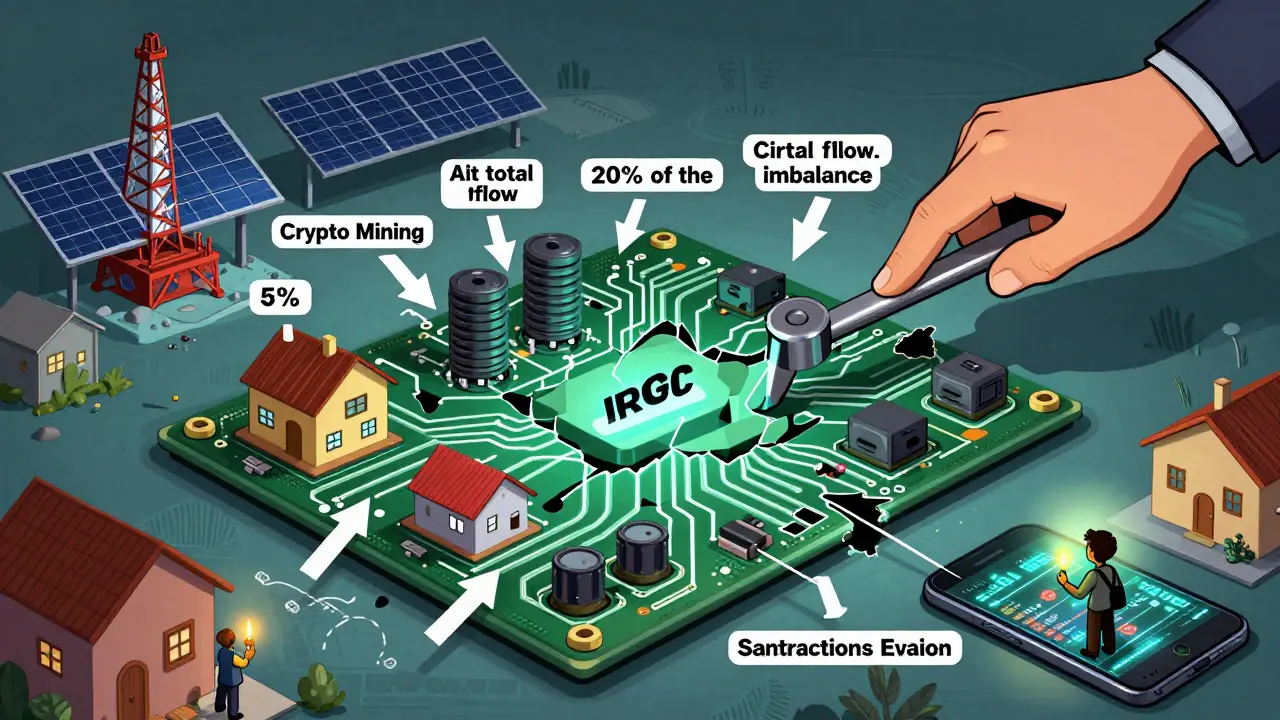
By 2025, cryptocurrency operations were consuming nearly 2,000 megawatts of electricity-about 5% of Iran’s total power generation. But here’s the kicker: they account for 15-20% of the country’s electricity imbalance. That means when demand spikes, the grid doesn’t just struggle-it collapses.
During the nationwide internet blackout in mid-2025, power usage dropped by 2,400 MW overnight. Why? Because over 900,000 illegal mining devices shut down. That’s not a coincidence. It’s proof that mining isn’t just using power-it’s destabilizing the entire system. In Tehran, where 9 million people live, illegal miners alone are consuming as much electricity as the entire city.
Blackouts, Anger, and Public Outcry
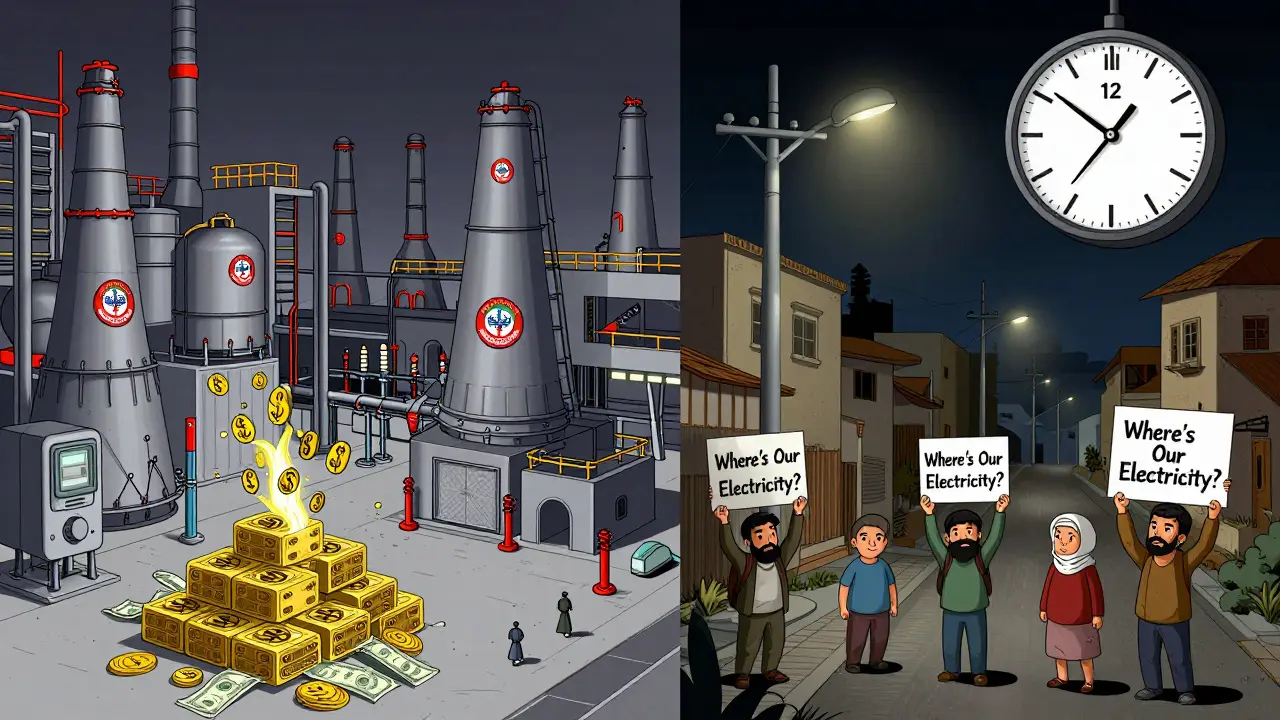
On social media, Iranians are no longer whispering. They’re shouting.
Twitter user @IranEnergyCrisis posted in July 2025: “21 hours of blackouts this week while the IRGC’s mining farms in Ahvaz Stadium tunnels run 24/7-this is economic terrorism against ordinary Iranians.” The post went viral. Telegram channels like “Iran Electricity Crisis” (with 187,000 members) now share real-time outage maps that line up perfectly with known mining locations. Every time Bitcoin’s price jumps, blackouts spike 30-40% within two days.
Reddit’s r/Iran community surveyed 1,450 users in June 2025. 92% blamed crypto mining for power cuts. One resident from Shiraz said: “I can’t charge my phone. My fridge goes warm. My kids can’t study after dark. But the miners? They’re running full blast.”
It’s not just frustration-it’s desperation. Families are rationing meals because refrigerators can’t stay cold. Hospitals are installing backup generators they can’t afford. Students are studying by candlelight. Meanwhile, mining rigs hum along in darkened warehouses, powered by state-subsidized electricity.
The Government’s Double Game
The Iranian government doesn’t deny any of this. In fact, it’s proud of it.
Energy Minister Ali Akbar Mehrabian said in June 2025 that regulated mining brings in $800 million annually in foreign exchange. That’s true. But he didn’t mention that the same system is costing the country billions in lost productivity, damaged infrastructure, and public unrest.
Here’s how the system works: Miners must get licenses from the Ministry of Industry, register with the power company, and get approval from the Central Bank. Only 40% of applicants get approved. The process takes 3-6 months. Approved miners pay $0.04-$0.07/kWh-still dirt cheap. But the real money is in the illegal side. Since household electricity is even cheaper ($0.01-$0.02/kWh), miners bribe officials, steal connections, and plug into residential grids. The government estimates over 2 gigawatts of power are being siphoned off this way-enough to run a major city.
To fight back, they’ve launched a reward program: citizens who report illegal mining get 10% of the recovered electricity costs. In the first six months of 2025, 8,432 reports led to 2,157 shutdowns. But the system is rigged. The IRGC owns the biggest operations. No one dares report them.
Why This Isn’t Going Away
Iran’s leaders know this is unsustainable. Former Energy Minister Reza Ardakanian warned in 2024 that mining was using up to 10% of the country’s total power capacity. He was fired soon after. Now, the government has adopted a strategy of seasonal bans. During summer, when air conditioning demand spikes by 30-40%, they shut down legal mining. In winter, when demand drops, they turn it back on.
This isn’t regulation. It’s damage control.
The International Energy Agency predicts that without major grid upgrades-which are unlikely due to sanctions and funding shortages-Iran’s power shortages could increase by 25-30% by 2027. That means longer blackouts, more economic damage, and deeper public anger.
Meanwhile, Iran’s crypto mining sector is projected to hit $1.5 billion in revenue in 2025. That’s 0.8% of the country’s GDP. But the real cost? It’s measured in hours without power, in children studying under flashlights, in hospitals running on diesel.
What’s Next?
The government isn’t going to stop mining. It’s too profitable. Too useful for sanctions evasion. Too tied to powerful elites.
But it might change how it’s done. New rules in early 2025 require all mining operations to use smart meters and register in industrial zones. That’s meant to cut down on residential theft. But miners are already adapting-using hidden solar arrays, battery buffers, and offshore rigs near the Persian Gulf.
For now, the game continues. Iran’s miners profit. The IRGC profits. The government profits. And the people? They keep waiting for the lights to come back on.
24 Comments
This isn't about energy policy. It's about power. The IRGC isn't mining Bitcoin-they're mining sovereignty. Every kilowatt stolen from a family's fridge is a vote of confidence in their regime. The math is brutal: $1,300 to mine a Bitcoin, $35,000 to sell it. That's not capitalism. That's colonialism with servers.
I'm genuinely horrified. The sheer moral bankruptcy of this... it's not just unethical-it's ontologically indefensible. The fact that children are studying by candlelight while ASICs hum in stadium tunnels? This isn't policy. This is a grotesque existential farce. I'm speechless. Truly.
From a systems perspective, this is a classic case of rent-seeking behavior. The state creates artificial arbitrage by subsidizing industrial power while neglecting infrastructure. Miners exploit the gap, IRGC captures the surplus, and the public bears the negative externality. The grid collapse isn't accidental-it's structural.
Oh wow. So Iran’s basically turned into a crypto dystopia where the poor are literally in the dark and the elite are mining their way to Silicon Valley? I mean... I knew it was bad, but this is like if Black Mirror and a 2020 meme had a baby and named it ‘Theocracy 2.0’
As someone from India, I’ve seen power cuts too-but never this deliberate. Here, it’s about poverty. There, it’s about power. The IRGC doesn’t care about the people. They care about keeping the regime alive. That’s why they let the lights go out. It’s not negligence. It’s strategy.
The 2,400 MW drop during the blackout proves it. When the miners shut off, the grid stabilized. That’s not correlation. That’s causation. This isn’t a side effect-it’s the core function of the system.
I mean... if you're gonna steal electricity, at least make it look cool. Like, why not power your rigs with solar and wind? Nah. Just steal from grandma's fridge. Peak villain energy.
The government's reward program for reporting illegal mining is a farce. It incentivizes betrayal, not justice. And yet, they expect compliance? When the perpetrators are the ones issuing the licenses? The entire architecture is designed to fail.
This is why I don't trust crypto. Not because of volatility. Because it's always been a tool for the powerful to extract value from the vulnerable. Iran is just the clearest example. The miners don't care about decentralization. They care about profit. And the system lets them.
I worked in power distribution in Alberta. This is textbook grid overload. When industrial users get subsidized rates while residential gets squeezed, you get cascading failures. The fix? Stop the subsidy. But that means admitting the IRGC is stealing the country's future. They won't.
This is what happens when you let technocrats run a theocracy. They think they’re being clever. They’re not. They’re just making the country poorer, angrier, and more unstable. The miners? They’re just the symptom. The disease is corruption.
I read this article and I just... sat there. Not because I was shocked. But because I’ve seen this before. In Venezuela. In Nigeria. In Russia. The pattern is always the same: state-backed extraction, public suffering, silent complicity. The tech changes. The cruelty doesn’t.
I'm not even mad. I'm just... disappointed. Like, you spent all this time building a crypto empire, and the only thing you did was make Iranians suffer more? That’s not innovation. That’s just laziness with a blockchain.
The real tragedy? The miners could’ve been green. Solar-powered rigs in the desert. Wind farms feeding the grid. But no. They chose the easy, cruel path. Because power isn’t about energy-it’s about control. And control, in Iran, is always violent.
They say the lights will come back on. But they don’t say when. Or if. And that’s the real horror. Not the blackouts. The silence that follows them.
I can’t believe people still think crypto is about freedom. This is the opposite. This is slavery with a hash rate. And the world watches. And does nothing. Because it’s not our problem. Until it is.
Man. I just watched a video of a kid in Shiraz doing homework by flashlight. Then I checked Bitcoin’s price. Up 8%. That’s not coincidence. That’s a blood sacrifice. And we’re all complicit.
It’s not that I don’t get it. I get it. The IRGC needs money. Sanctions hurt. But you don’t solve a humanitarian crisis by turning it into a mining farm. You don’t fix a broken system by breaking it further. This isn’t survival. It’s self-immolation.
Let’s break this down, shall we? Iran’s grid capacity: 80,000 MW. Mining consumption: 2,000 MW. That’s 2.5%. But the imbalance? 15-20%. Why? Because mining rigs don’t just draw power-they create demand spikes, destabilize voltage, and overload transformers. It’s not volume. It’s volatility. And the grid wasn’t built for that. It was built for lights, not algorithms.
The notion that this is somehow ‘economic sovereignty’ is a grotesque mischaracterization. This is not nation-building. This is necropolitics. The state is not governing. It is harvesting. And the human cost is not collateral damage. It is the product.
I’m American. And I’m ashamed. We preach ‘freedom’ and ‘democracy’ while ignoring this. We call it ‘Iran’s problem.’ But when your crypto is powered by a child’s darkness? That’s OUR problem too. We’re all part of this machine.
I’ve seen this before. In the 90s, Russia sold off state assets to oligarchs. Now Iran’s selling off its electricity. Same game. Different grid.
I’ve been saying this for years: this isn’t about Iran. It’s about the global crypto cartel. The U.S. and EU are just as guilty. We’re the ones buying the coins. We’re the ones driving the price. We’re the ones funding the blackouts. The IRGC didn’t create this. We did.
You're right. We're all complicit. But we can change it. Stop buying. Stop mining. Stop pretending this is innovation. Real progress doesn't need 35,000 homes to go dark.