
Impermanent Loss Risk on DEXs: How to Protect Your Liquidity
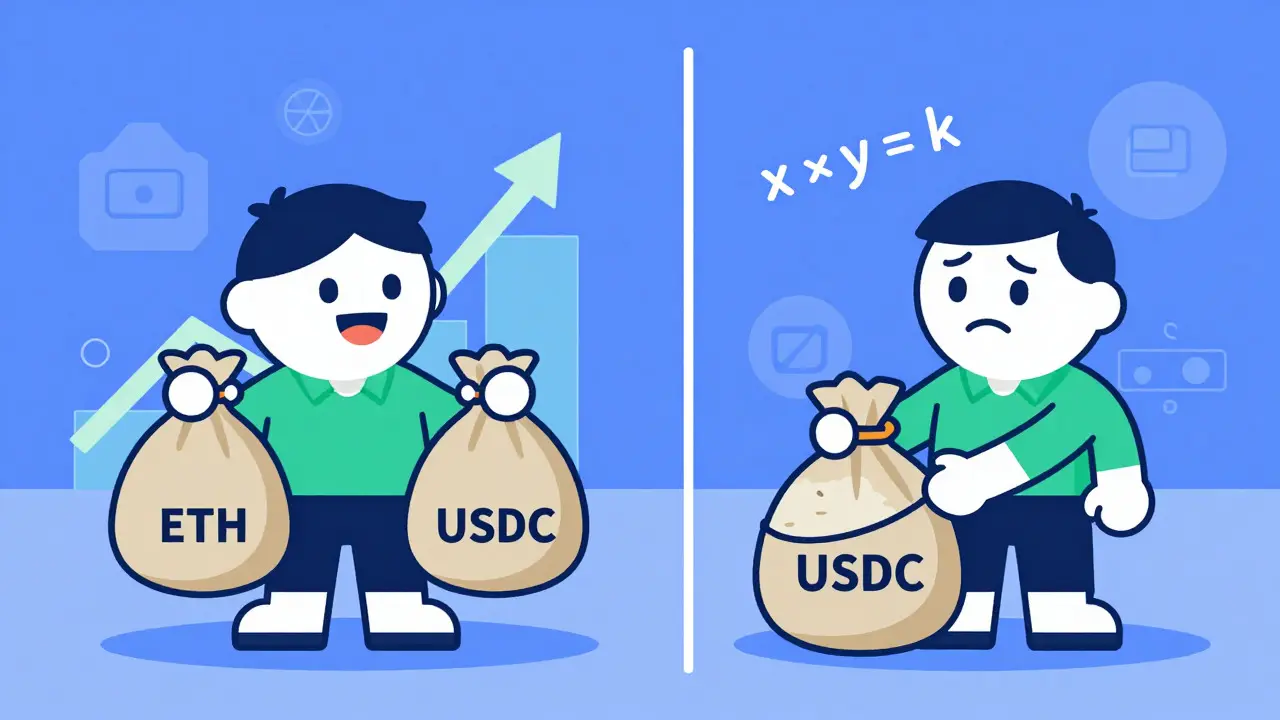
Imagine you deposit $1,000 worth of Ethereum and stablecoins into a decentralized exchange pool. A month later, the price of Ethereum doubles. You check your wallet, expecting massive gains. Instead, you see that if you had just held those tokens in your cold storage, you would have made more money. That gap between what you earned in the pool versus what you could have made by doing nothing is called impermanent loss. It is the single biggest psychological hurdle for anyone trying to earn yield in decentralized finance (DeFi).
You are not losing money in the sense that your balance goes to zero. Rather, you are missing out on potential profit compared to a simple buy-and-hold strategy. This concept, rooted in the math of Automated Market Makers (AMMs), dictates how much risk you take when providing liquidity. Understanding it isn't just about avoiding pain; it's about calculating whether the trading fees you collect are enough to justify the opportunity cost.
How Impermanent Loss Actually Works
To grasp why this happens, you need to look at how Decentralized Exchanges (DEXs) like Uniswap or PancakeSwap function. Unlike traditional stock exchanges with order books, most DEXs use a formula known as the constant product formula ($x \times y = k$). This ensures that as traders swap one token for another, the pool always has enough liquidity to facilitate the trade.
When you provide liquidity, you deposit two assets in equal value-say, 50% ETH and 50% USDC. The AMM algorithm automatically rebalances these assets as prices change. If the price of ETH shoots up, arbitrage bots will buy cheap ETH from your pool using their USDC. This means your pool sells off its appreciating ETH and accumulates more of the stagnant USDC. Conversely, if ETH crashes, the pool buys the dip, leaving you holding more depreciating ETH and less USDC.
The result? You end up with a portfolio composition that is worse than simply holding the original amounts. Here is a concrete example based on data from IOHK’s research:
- 1.5x Price Change: If ETH increases 1.5 times its original value against USDC, you face approximately a 2.0% impermanent loss.
- 2x Price Change: If ETH doubles, the loss jumps to roughly 5.7%.
- 3x Price Change: A tripling in price results in a 13.4% loss relative to holding.
- 5x Price Change: If the asset pumps five-fold, you look at a 25.5% opportunity cost.
This loss is termed "impermanent" because if the price returns to the exact ratio at which you deposited, the loss disappears. However, until that moment, every day you stay in the pool, you are carrying this drag on your performance.
| Price Change (Multiplier) | Impermanent Loss (%) | Risk Level |
|---|---|---|
| 1.5x | 2.0% | Low |
| 2x | 5.7% | Moderate |
| 3x | 13.4% | High |
| 4x | 20.0% | Very High |
| 5x | 25.5% | Extreme |
Why People Still Provide Liquidity
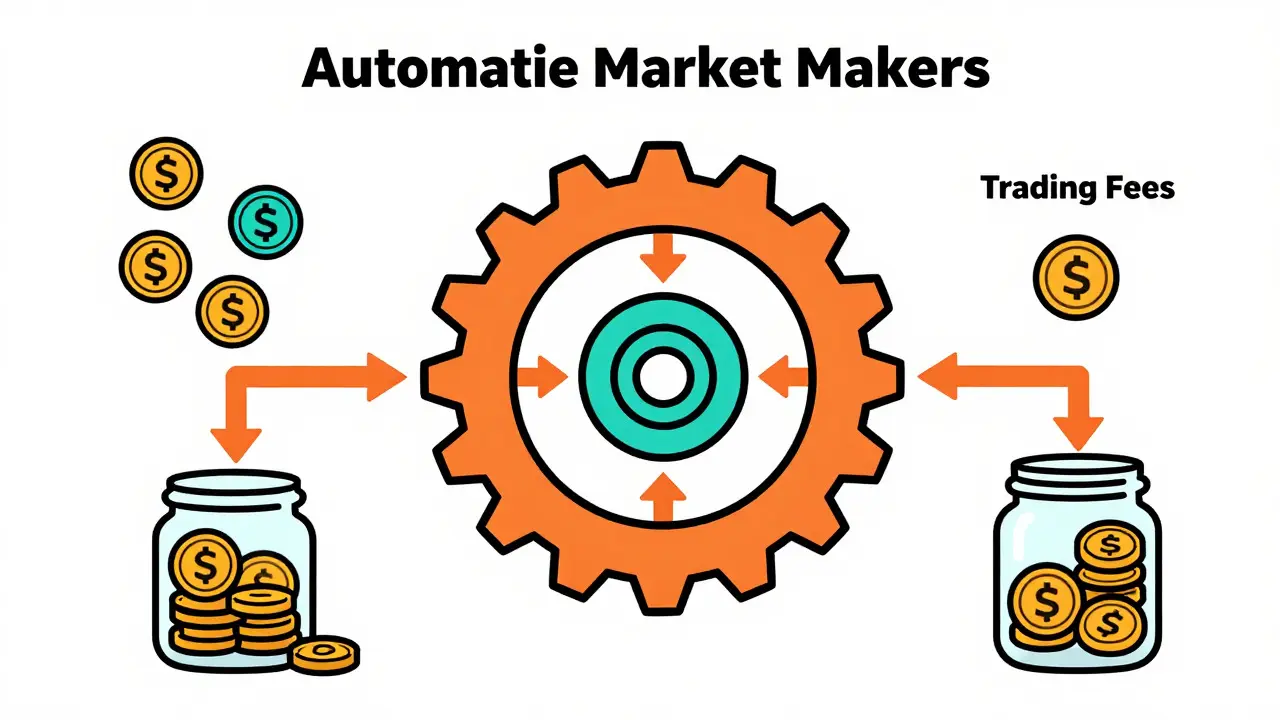
If the math looks so punishing, why does the Total Value Locked (TVL) in DeFi sit in the tens of billions? The answer lies in compensation. Liquidity providers (LPs) aren't doing this out of charity; they are paid for taking on this risk. There are two main sources of income that offset impermanent loss:
- Trading Fees: Every time someone swaps tokens in your pool, a small percentage (usually 0.05% to 0.3%) goes to LPs. In high-volume pools like ETH/USDC on Uniswap, these fees can accumulate quickly.
- Token Incentives: Many protocols reward LPs with their own governance tokens (like UNI, CAKE, or CRV) to bootstrap liquidity. These rewards can sometimes dwarf both the trading fees and the impermanent loss.
Research by Dr. Georgios Konstantopoulos at Paradigm showed that for a standard 0.3% fee tier on Uniswap V2, an LP breaks even on impermanent loss during a 1.5x price move if the pool sees trading volume equal to 12.5 times its size. For a 2x price move, you need volume equivalent to 33.3 times the pool size. If the volume is high enough, the fees cover the opportunity cost, and you still come out ahead compared to holding.
Strategies to Minimize Risk
You don't have to accept impermanent loss as a given. Several strategies and protocol features allow you to manage or mitigate this exposure significantly.
1. Stick to Stablecoin Pairs
The safest bet is to provide liquidity for pairs where the assets move together perfectly. Pools like USDC/USDT on Curve Finance experience minimal impermanent loss-often below 0.1%-because neither asset is expected to diverge wildly in value. While the yields are lower than volatile pairs, the capital preservation is near-guaranteed.
2. Use Concentrated Liquidity
Protocols like Uniswap V3 and Orca on Solana introduced concentrated liquidity. Instead of spreading your capital across all possible prices (from $0 to infinity), you specify a narrow range where you think the price will stay. This boosts your capital efficiency and can reduce impermanent loss by up to 50% if the price stays within your chosen band. However, if the price moves outside your range, you end up holding only one asset, and the benefits vanish until you rebalance.
3. Leverage Impermanent Loss Protection (ILP)
Some newer protocols offer insurance. Bancor, for instance, launched ILP mechanisms that cover up to 100% of impermanent loss for specific periods, usually funded by a small fee or protocol reserves. This turns an uncertain variable into a fixed cost, making it easier to calculate net returns.
4. Choose Correlated Assets
If you must take on volatility, pick assets that move in tandem. An ETH/WBTC pair will suffer far less impermanent loss than an ETH/USDC pair because Bitcoin and Ethereum tend to rise and fall together. The divergence required to trigger significant IL is much harder to achieve with correlated blue-chip assets.
Tools and Calculators You Need
Guessing your exposure is a recipe for disaster. Before depositing funds, run the numbers. Tools like the Pintail calculator or CoinGecko’s IL estimator process millions of queries monthly to help users visualize risk. Input your entry price and current price to see exactly what percentage of opportunity cost you are facing. Additionally, dashboards like Zapper.fi track your positions in real-time, alerting you when price divergence threatens your returns.
Remember, impermanent loss becomes permanent the moment you withdraw. Timing matters. If you exit during a period of high volatility without collecting sufficient fees, you lock in the loss. Experienced LPs often wait for the price to revert to their entry ratio before withdrawing, ensuring the "impermanent" nature of the loss holds true.
The Future of Liquidity Provision
The DeFi landscape is evolving to make liquidity provision safer. Hybrid models combining AMMs with order books, seen in platforms like dYdX, aim to eliminate the constant product formula's inherent risks entirely. Furthermore, as protocols mature, we are seeing a shift toward fee-only models rather than inflationary token emissions, forcing LPs to rely on sustainable trading volume rather than speculative airdrops. By 2025, analysts predict that concentrated liquidity and stablecoin dominance will reduce the overall impact of impermanent loss on DEX volume, but the fundamental math remains unchanged for volatile pairs.
Is impermanent loss a real loss?
Technically, no. It is an opportunity cost. You haven't lost capital unless the asset price drops to zero. Instead, you have less value than you would have had if you simply held the tokens in your wallet. It only becomes a "real" financial hit if you withdraw during a period of divergence and the trading fees collected do not cover the gap.
Can I avoid impermanent loss completely?
You can minimize it drastically by using stablecoin pairs (like USDC/USDT) or highly correlated assets (like ETH/BTC). Some protocols also offer Impermanent Loss Protection insurance. However, in any pool involving a volatile asset paired with a stablecoin, some degree of IL is mathematically inevitable due to the AMM formula.
Does impermanent loss happen if the price goes up?
Yes. This is counterintuitive but true. If the price of your volatile asset rises sharply, the AMM sells it to buy more of the stable asset. You end up with fewer shares of the winner and more of the loser. You still make money compared to your initial deposit, but less than if you had just held the rising asset.
Which DEX has the lowest impermanent loss risk?
Curve Finance generally offers the lowest risk because it specializes in stablecoin and pegged asset pools. Protocols offering concentrated liquidity like Uniswap V3 or Orca allow you to control risk better by narrowing price ranges, but they require active management. Standard AMMs like Uniswap V2 expose you to full-range risk.
How do trading fees offset impermanent loss?
Trading fees are paid directly to liquidity providers from every swap executed in the pool. If the pool has high volume, these fees accumulate rapidly. If the total fees earned exceed the calculated impermanent loss percentage, you actually outperform the buy-and-hold strategy, turning the "loss" into a net gain.