
How to Choose the Right Crypto Trading Pair for Your Strategy
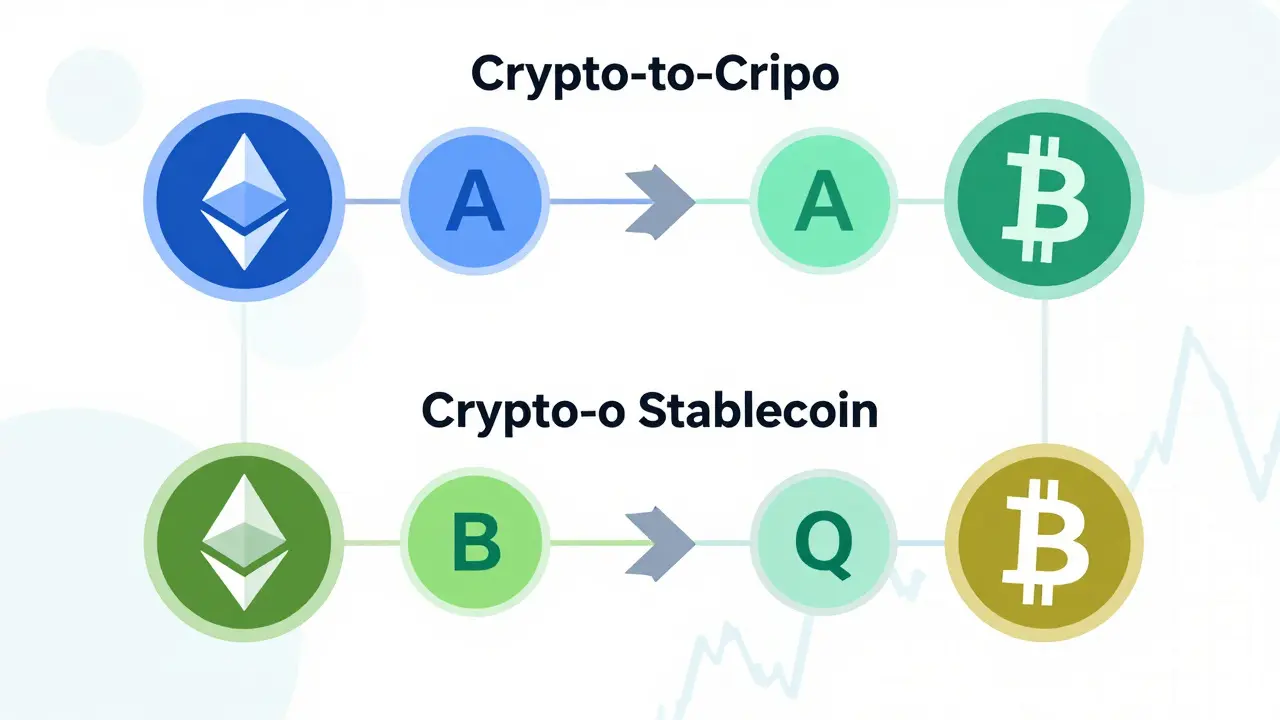
You don’t need to predict if Bitcoin is going up or down to make money in crypto. That’s the core promise of trading pairs, which are the fundamental building blocks of cryptocurrency markets where assets are quoted against each other to facilitate price discovery and exchange. By focusing on the relationship between two assets rather than their absolute price direction, you can build a strategy that profits from market inefficiencies regardless of whether the broader market is crashing or rallying.
But picking any two coins and hoping they move together is a fast track to losing capital. The difference between a profitable pairs trade and a disaster lies in statistical rigor, liquidity checks, and understanding market regimes. This guide breaks down exactly how to select the right trading pair for your specific strategy, avoiding common pitfalls like correlation breakdowns and hidden slippage costs.
Understanding the Anatomy of a Trading Pair
Before you run any statistical tests, you need to understand what you’re actually looking at. A trading pair consists of two components: the base currency and the quote currency. In a pair like ETH/BTC, Ethereum (ETH) is the base asset you are analyzing, while Bitcoin (BTC) is the quote asset used to measure its value.
The structure of the pair dictates your risk profile and potential returns. There are three main types you’ll encounter:
- Crypto-to-Crypto (e.g., SOL/AVAX): These offer high volatility and significant profit potential but carry higher risk if one asset suffers a project-specific failure. They are ideal for traders comfortable with larger swings.
- Crypto-to-Stablecoin (e.g., BTC/USDT): These provide clearer directional signals relative to fiat value. They are often less volatile than altcoin pairs but still subject to macro market moves.
- Crypto-to-Fiat (e.g., ETH/USD): These are typically found on centralized exchanges and offer deep liquidity. They are excellent for beginners because the quote currency (USD) doesn’t fluctuate independently.
Your choice here depends on your strategy. If you are running a market-neutral strategy, you want pairs that behave similarly during market stress. For example, during the 2021 DeFi boom, the ETH/BTC pair saw its correlation drop from 0.88 to 0.32 in just three months. Understanding these structural differences helps you avoid pairs that look good on paper but fail under pressure.
The Statistical Foundation: Correlation vs. Cointegration
This is where most retail traders fail. They confuse correlation with cointegration. Just because two assets move together (correlation) doesn’t mean they will revert to a mean relationship when they diverge (cointegration).
Dr. Ganapathy Vidyamurthy, a leading authority on quantitative methods, emphasizes that cointegration testing is non-negotiable. Here is why:
- Correlation (Pearson’s Coefficient): Measures how closely two assets move in tandem. A value above 0.85 is generally considered strong. However, as Hudson & Thames’ 2023 analysis showed, 30-40% of highly correlated pairs fail to mean-revert within practical timeframes. You might enter a trade expecting them to snap back together, only to watch them drift apart indefinitely.
- Cointegration (Engle-Granger Test): This is the gold standard. It tests whether the spread between two prices is stationary-meaning it fluctuates around a constant mean. You need a p-value below 0.05 to confirm stationarity. Cointegrated pairs generated 8.3% annualized returns with a Sharpe ratio of 1.8 in recent backtests, compared to just 3.2% for merely correlated pairs.
If you are using tools like Wundertrading or Python libraries such as Statsmodels, always prioritize cointegration results over simple correlation charts. A pair might have a 0.90 correlation but fail the cointegration test, signaling that the relationship is unstable and likely to break.
Liquidity and Volume: The Hidden Killers
A statistically perfect pair is useless if you can’t execute trades without moving the market. Liquidity is measured by daily trading volume, bid-ask spreads, and order book depth. According to BJF Trading Group’s 2023 analysis, viable crypto-to-crypto pairs should have minimum daily volumes of $5 million, while stablecoin pairs should exceed $50 million.
Why does this matter? Slippage. If you try to enter a position in a low-volume pair like FTM/ETH, you might face slippage exceeding 2.5% on entry and exit. Over multiple trades, this eats into your margins entirely. User experiences on Reddit highlight this sharply; one trader reported losing 37% of their capital trading low-volume pairs due to sudden correlation breakdowns combined with excessive slippage during the FTX collapse.
When evaluating a pair, check the following:
- 24-Hour Volume: Ensure it meets the minimum thresholds mentioned above.
- Bid-Ask Spread: Tighter spreads indicate better liquidity. Wide spreads increase transaction costs.
- Order Book Depth: Look for substantial buy and sell walls near the current price to ensure large orders can be filled without significant price impact.
Platforms like Binance support over 1,200 trading pairs, offering deep liquidity for major assets. Smaller exchanges may list exotic pairs with poor liquidity, creating false opportunities that trap inexperienced traders.
Selecting Pairs Based on Market Regimes
No single pair works in all market conditions. Your selection must adapt to the current macro environment. Wundertrading’s 2023 Market Regime Analysis provides clear guidelines:
| Market Condition | Bitcoin Dominance | Recommended Pair Type | Rationale |
|---|---|---|---|
| Risk-Off / Bearish | Above 50% | BTC-Pegged (e.g., ADA/BTC) | Altcoins tend to bleed against BTC during fear-driven sell-offs. |
| Risk-On / Bullish | Below 45% | Altcoin-to-Altcoin (e.g., SOL/AVAX) | Capital flows into smaller caps, creating divergence opportunities. |
| Sideways / Consolidation | Stable | High-Correlation Stablecoin Pairs (e.g., ETH/USDC) | Mean reversion works best in range-bound markets. |
For instance, during Bitcoin’s 160% rally in 2023, top pairs trading strategies returned only 4.2%, significantly underperforming spot BTC. This highlights a key limitation: market-neutral strategies excel in sideways or volatile markets but struggle during strong directional trends. Adjust your pair selection based on where we are in the cycle.

Platform Compatibility and Tools
Where you trade matters as much as what you trade. Not all exchanges support the same level of pairs trading infrastructure. Binance offers extensive API access with 127 endpoints for pairs data and recently launched a 'Pairs Analytics Dashboard' featuring real-time cointegration scoring. Coinbase Pro, while secure, offers only 180 pairs, limiting your universe of opportunities.
For serious implementation, consider using specialized platforms:
- Wundertrading: Holds 42% market share among retail-focused tools, offering automated execution and robust historical data.
- Hudson & Thames Quantopian Integration: Preferred by institutional traders for its advanced statistical modeling capabilities.
- Binance Grid Trading: Useful for simpler range-bound strategies directly on the exchange.
Ensure your chosen platform provides reliable API uptime (Binance reported 99.98% in Q2 2023) and comprehensive documentation. Poor tooling can lead to missed entries or failed exits, ruining even the best statistical edge.
Risk Management and Position Sizing
Even the best pairs can break down. During the March 2020 'Black Thursday' crash, ETH/BTC correlation dropped from 0.85 to -0.12 within 48 hours, causing 68% of active pairs trades to hit stop-losses. To survive these events:
- Limit Exposure: Never allocate more than 2-5% of your total portfolio to a single pair. Diversify across 5-10 uncorrelated pairs to achieve true risk mitigation.
- Dynamic Monitoring: Set alerts for >30% deviations from historical correlation norms. If the relationship breaks, exit immediately rather than hoping for a return.
- Regular Retesting: Run cointegration tests monthly. Relationships decay over time due to algorithmic competition and changing market dynamics.
Gartner’s 2023 survey found that only 18.3% of retail traders implementing pairs strategies achieved positive risk-adjusted returns over 12 months, compared to 63.7% of quantitatively trained traders. The difference? Rigorous risk management and continuous validation.
What is the best trading pair for beginners?
Beginners should start with high-liquidity, well-established pairs like ETH/BTC or SOL/USDT. These pairs have sufficient volume to minimize slippage and enough historical data for accurate statistical testing. Avoid exotic altcoin pairs until you have mastered the basics of cointegration and risk management.
How do I calculate cointegration for a crypto pair?
You can use the Engle-Granger two-step method via Python libraries like Statsmodels. First, test if both price series are integrated of the same order (usually I(1)). Then, regress one against the other and test the residuals for stationarity using an Augmented Dickey-Fuller test. A p-value below 0.05 indicates cointegration.
Is pairs trading profitable in a bull market?
Pairs trading can be profitable in bull markets, but it often underperforms simple long-only positions. During strong directional moves, correlations tend to converge toward 1, reducing mean-reversion opportunities. Focus on altcoin-to-altcoin pairs during bull runs when capital rotates between sectors.
What happens if my trading pair gets delisted?
Delisting is a significant risk, especially on smaller exchanges. Always monitor exchange announcements and maintain a backup plan. If a pair is delisted, you may need to convert both assets to a common denominator (like USDT) quickly, potentially realizing losses. Stick to major exchanges like Binance or Coinbase to mitigate this risk.
Do I need programming skills to trade pairs effectively?
While not strictly mandatory, programming skills (Python or R) provide a significant advantage. They allow you to automate cointegration testing, backtest strategies on historical data, and execute trades programmatically. Platforms like Wundertrading offer no-code solutions, but custom scripts offer greater flexibility and control.