
How Public Key Cryptography Secures Bitcoin: A Technical Guide
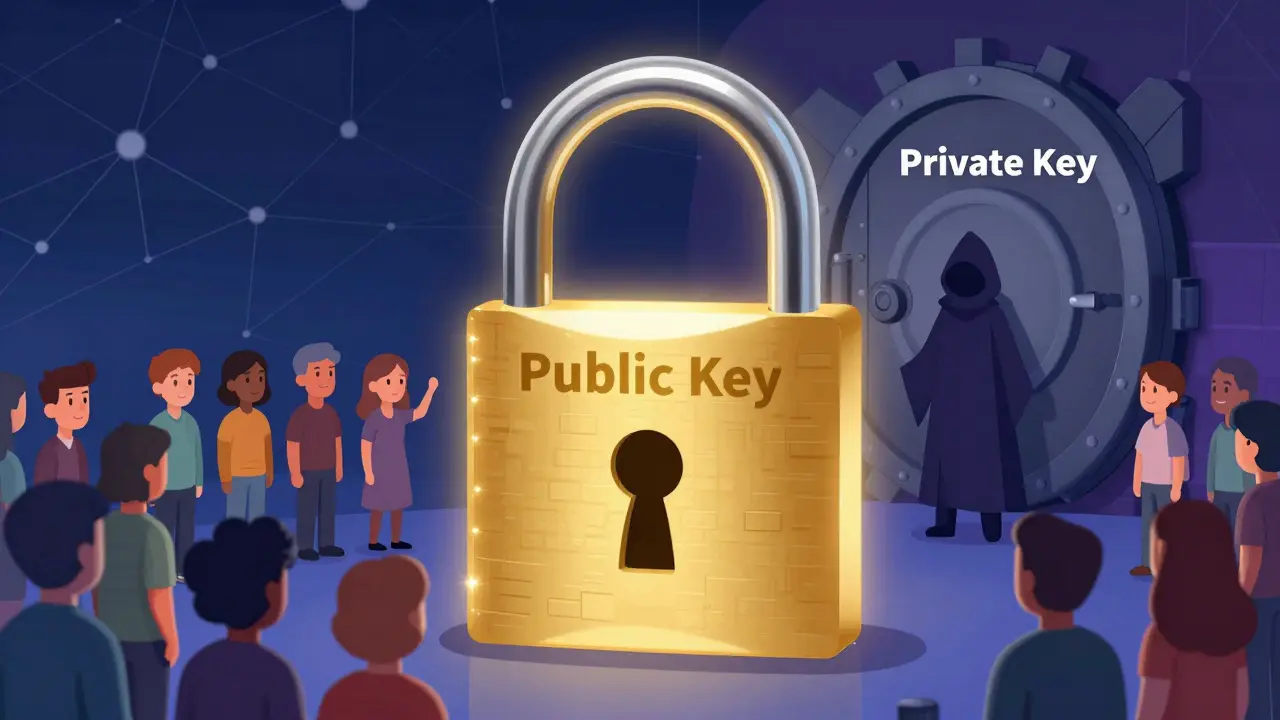
Imagine handing someone a letter sealed with a unique wax stamp. Anyone can see the stamp, but only you have the tool to create it. If the stamp is intact, everyone knows the letter came from you and hasn't been tampered with. This simple analogy captures the essence of Public Key Cryptography, which is the mathematical backbone that proves ownership and secures transactions in the Bitcoin network. Without this system, Bitcoin would be nothing more than a ledger anyone could edit at will.
You don't need to be a mathematician to use Bitcoin, but understanding how these keys work helps you protect your funds. It also explains why your wallet address looks like a random string of characters and why losing your private key means losing your money forever. Let's break down exactly how this technology works under the hood.
The Core Mechanism: Asymmetric Keys
At its heart, Bitcoin uses what is called asymmetric cryptography. Unlike traditional encryption where one key locks and unlocks data, this system uses two mathematically linked keys: a private key and a public key. Think of them as a pair of gloves. The left glove (private key) fits perfectly into the right glove (public key), but you can't turn one into the other just by looking at it.
Your Private Key is a secret 256-bit number that acts as your digital signature tool. It is essentially a large integer chosen randomly between 1 and approximately $2^{256}$. You must keep this number hidden. If anyone else gets it, they can spend your Bitcoin. Your Public Key is a derivative value calculated from the private key using elliptic curve multiplication. You can share this freely. In fact, you broadcast it to the entire network when you make a transaction.
The magic lies in the directionality. You can easily calculate your public key from your private key, but calculating the private key from the public key is computationally impossible with current technology. This one-way street is what makes the system secure. It relies on the Elliptic Curve Discrete Logarithm Problem (ECDLP). To crack a single Bitcoin key, an attacker would need to perform roughly $2^{128}$ operations. Even with all the supercomputers on Earth working together, this would take billions of years.
Why Bitcoin Uses secp256k1
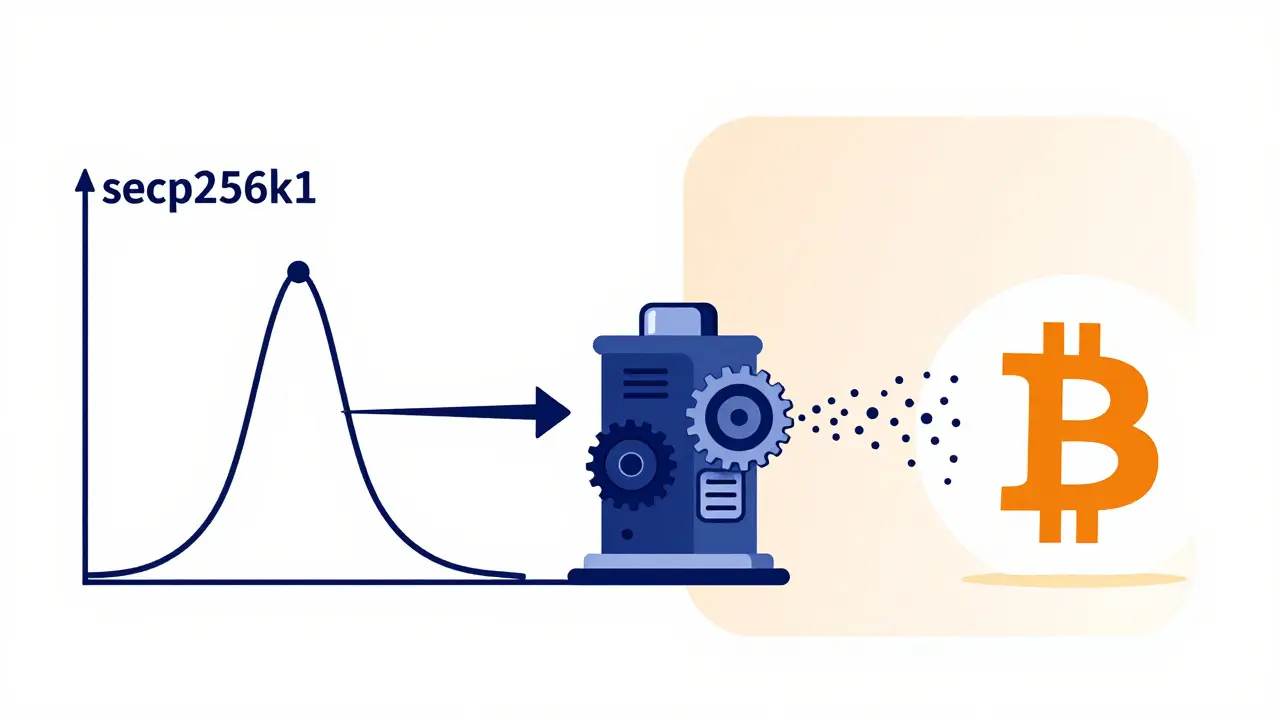
Not all cryptographic curves are created equal. Bitcoin specifically uses a curve called secp256k1, which is a specific elliptic curve defined by the equation y² = x³ + 7 over a finite field. Satoshi Nakamoto chose this curve for the original whitepaper in 2008 because it offers a strong balance of security and efficiency.
| Feature | Bitcoin (ECC/secp256k1) | RSA (Traditional Web) |
|---|---|---|
| Key Size for 128-bit Security | 256 bits | 3,072 bits |
| Signature Size | ~71-73 bytes | ~512+ bytes |
| Computational Speed | Faster signing/verification | Slower due to larger numbers |
| Bandwidth Efficiency | High (smaller data footprint) | Low (larger data footprint) |
As shown above, ECC is significantly more efficient than RSA, the standard used for most website HTTPS connections. For a decentralized network like Bitcoin, where every node needs to verify every transaction, smaller keys and signatures mean less bandwidth usage and faster processing. This efficiency was crucial for Bitcoin's early growth on limited internet infrastructure.
From Keys to Addresses: The Hashing Process
A common misconception is that your Bitcoin address is your public key. It isn't. Your public key is derived from your private key, but your address is derived from your public key through a hashing process. This adds an extra layer of security and privacy.
- Private Key Generation: A random 256-bit number is created.
- Public Key Derivation: The private key is multiplied by the base point G on the secp256k1 curve. This results in a public key, which can be compressed (33 bytes) or uncompressed (65 bytes).
- Hashing (SHA-256): The public key is hashed using SHA-256.
- Hashing (RIPEMD-160): The result is then hashed again using RIPEMD-160. This produces a 160-bit hash known as PubKeyHash.
- Address Creation: Version bytes and checksums are added to the PubKeyHash, and the whole thing is encoded in Base58Check (for legacy addresses) or Bech32 (for SegWit addresses).
Why do this? Hashing is a one-way function. Even if someone intercepts your public key during a transaction, they cannot reverse-engineer your private key. But by hiding the public key inside the address until the moment of spending, Bitcoin ensures that your public key isn't even exposed to the blockchain unless you move the funds. This delays any potential quantum computing attacks against your specific key, giving developers time to react.
Digital Signatures: Proving Ownership
When you send Bitcoin, you aren't sending the coins themselves. You are creating a transaction that says, "I authorize the movement of these UTXOs (Unspent Transaction Outputs) to this new address." To prove you own the UTXOs, you must sign the transaction with your private key.
Bitcoin uses the ECDSA, which stands for Elliptic Curve Digital Signature Algorithm, used to create verifiable proofs of authorship. When you initiate a transfer, your wallet takes the transaction data, hashes it, and combines it with your private key to generate a digital signature. This signature is attached to the transaction.
Nodes across the network then verify this signature. They use your public key (revealed in the transaction script) and the signature to check if the math holds up. If the signature is valid, it proves two things: first, that the person who signed it possesses the corresponding private key; and second, that the transaction data has not been altered since it was signed. If even one character in the recipient's address changes, the signature becomes invalid, and the network rejects the transaction.
The Evolution: Taproot and Schnorr Signatures
For over a decade, ECDSA was the sole method for signing Bitcoin transactions. However, it had limitations. It was verbose, making complex transactions expensive, and it leaked information about the structure of smart contracts. In November 2021, the Taproot upgrade changed this landscape by introducing Schnorr Signatures, which are a simpler and more flexible signature scheme based on linear algebra properties.
Schnorr signatures offer several advantages. They are shorter, reducing transaction fees. More importantly, they allow for signature aggregation. In a multi-signature setup (e.g., 2-of-3 keys required), ECDSA would require three separate signatures. Schnorr allows these to be combined into a single signature. This makes complex multisig setups look identical to simple single-sig transactions on the blockchain, greatly enhancing privacy.
This upgrade also paved the way for MAST (Merklized Abstract Syntax Trees), allowing users to deploy complex scripts without revealing their entire logic to the network unless a specific branch is triggered. It’s a significant step toward making Bitcoin more scalable and private while maintaining its core security model.

Security Risks and Best Practices
While the mathematics behind Bitcoin's cryptography are robust, human error remains the weakest link. Most losses occur not because the code was broken, but because private keys were mishandled.
- Randomness is Critical: Private keys must be generated using true randomness. If a wallet uses a flawed random number generator, attackers can predict your key. Always use reputable, open-source wallets.
- No Reuse: Never reuse addresses or keys across different networks or wallets. Reusing keys can leak information that compromises security, especially in older transaction formats.
- Backup Properly: Your private key (or seed phrase) is the only way to recover your funds. Write it down on paper or metal. Never store it digitally in plain text, email, or cloud notes.
- Quantum Threat: While quantum computers pose a theoretical threat to ECC, current estimates suggest we are decades away from machines capable of breaking secp256k1. Furthermore, the NIST post-quantum assessment indicates that Bitcoin's ability to implement soft forks allows it to migrate to quantum-resistant algorithms before such threats become practical.
Dr. Pieter Wuille, a key contributor to Bitcoin Core, noted that secp256k1 was optimized for speed and security. However, experts like Dr. Matthew Green have pointed out that the delay in adopting Schnorr signatures created unnecessary complexity for second-layer solutions like the Lightning Network. The recent adoption shows the community's commitment to evolving its cryptographic standards.
Conclusion: Trust Through Math
Public key cryptography transforms trust from people to mathematics. You don't need to trust a bank, a government, or even the person you're sending money to. You only need to trust the math. As long as your private key remains secret and the underlying elliptic curve problems remain unsolvable, your Bitcoin is secure. Understanding this foundation empowers you to participate in the network with confidence, knowing exactly what protects your assets.
Can my private key be hacked?
Mathematically, no. Breaking the secp256k1 curve requires computational power far beyond current capabilities. However, your private key can be stolen if your device is infected with malware, if you fall for a phishing scam, or if you store it insecurely online. The risk is operational, not mathematical.
What happens if I lose my private key?
Your Bitcoin is permanently lost. There is no customer support, no reset button, and no backdoor. The private key is the only proof of ownership. This is why creating multiple backups of your seed phrase or private key is essential.
Is Bitcoin vulnerable to quantum computers?
Theoretically, yes. Shor's algorithm could break ECC. However, practical quantum computers capable of doing this do not exist yet. Additionally, Bitcoin addresses hide the public key until a transaction is made, providing a window of opportunity to move funds to a quantum-resistant address if such a threat emerges. The network can also upgrade via soft fork to new algorithms.
Why does Bitcoin use secp256k1 instead of other curves?
Satoshi chose secp256k1 for its balance of security and efficiency. It allows for fast scalar multiplication and smaller key sizes compared to RSA. While some cryptographers argue for curves with more transparent constants, secp256k1 has stood the test of time for over 15 years with no successful breaks.
What is the difference between a public key and a Bitcoin address?
A public key is derived directly from the private key using elliptic curve math. A Bitcoin address is a hashed version of the public key. The address is what you share to receive funds. The public key is revealed to the network only when you spend those funds, adding a layer of privacy and security.
13 Comments
The secp256k1 curve is just one of many, but it's the standard for Bitcoin. Don't overthink the math.
I find that the explanation regarding the hashing process is quite illuminating and I believe that many users would benefit from understanding the distinction between the public key and the address as it provides an additional layer of security which is often overlooked by casual observers who might not realize that their public key is only revealed upon spending funds thus delaying any potential quantum attacks which gives developers time to react appropriately
Oh my god this is so important 😱 People need to stop storing keys on cloud notes!! It’s literally asking for disaster 📉💀 If you lose your seed phrase you are done for no reset button no customer support just gone forever into the void 😭🔥
It is imperative to note that while the mathematics are sound, the human element remains the most vulnerable component of this system; therefore, one must exercise extreme caution in the generation and storage of private keys, ensuring that true randomness is employed and that digital copies are never retained in plain text formats, as such negligence inevitably leads to catastrophic loss of assets.
its not just about the math its about the philosophy of trust shifting from institutions to algorithms which is a profound shift in human consciousness really we are moving away from faith in people to faith in code which is both liberating and terrifying at the same time because code can have bugs but people have biases so which is worse i suppose thats for the reader to decide but i think the elitist view here is that only those who understand the code should participate which is absurd because everyone deserves financial sovereignty regardless of their technical literacy
This is absolutely brilliant content! 🌟 The way you explained the difference between ECDSA and Schnorr signatures was top-notch. I love how Taproot makes complex multisig look like simple transactions. Privacy is king 👑🚀
When we consider the nature of ownership in a digital realm we must ask ourselves what it truly means to possess something that exists only as data and yet holds immense value in the physical world the concept of a private key as a tool for proving authorship is fascinating because it transforms the abstract idea of identity into a mathematical proof which suggests that our very sense of self in the digital age is becoming increasingly tied to cryptographic verification rather than social recognition or legal documentation which raises deep philosophical questions about the nature of reality and truth in an interconnected network where every transaction is a statement of existence and every signature is a declaration of intent
I have spent considerable time analyzing the implications of the ECDLP and while the theoretical security is robust the practical implementation often leaves much to be desired particularly when considering the various wallet software options available today many of which have been compromised due to poor random number generation or inadequate key management practices which underscores the necessity for users to remain vigilant and informed about the underlying technologies they rely upon for securing their assets as the margin for error is virtually non-existent in this domain
they want you to think its secure but its all part of the plan to track every move you make the government knows everything about your transactions even if you use privacy coins they have backdoors built in since day one dont trust the tech trust the conspiracy behind it all the elites are watching 👁️🗨️
u guys r so naive thinking math saves u from urself. if u cant keep ur keys safe u deserve to lose them. simple as that. no excuses.
listen up folks 💡 most of u are doing it wrong. hardware wallets are mandatory not optional. if ur keys touch the internet ur already dead. stay woke and stay secure 🔒🧠
this is super helpful info! im gonna print out my seed phrase and put it in a fireproof box lol. thanks for breaking it down so simply it makes me feel a lot more confident about holding my own bitcoin now instead of leaving it on exchanges which always felt sketchy anyway
it is wonderful to see such detailed explanations being shared openly as it helps demystify the technology for many who may feel intimidated by the technical jargon involved in cryptography and blockchain mechanics and i truly appreciate the effort put into making these concepts accessible to a broader audience because education is the first step towards empowerment and security in the digital financial landscape so keep up the great work and continue to foster a community where knowledge is freely exchanged and respected