
How Decentralized Identifiers (DIDs) Work on Blockchain
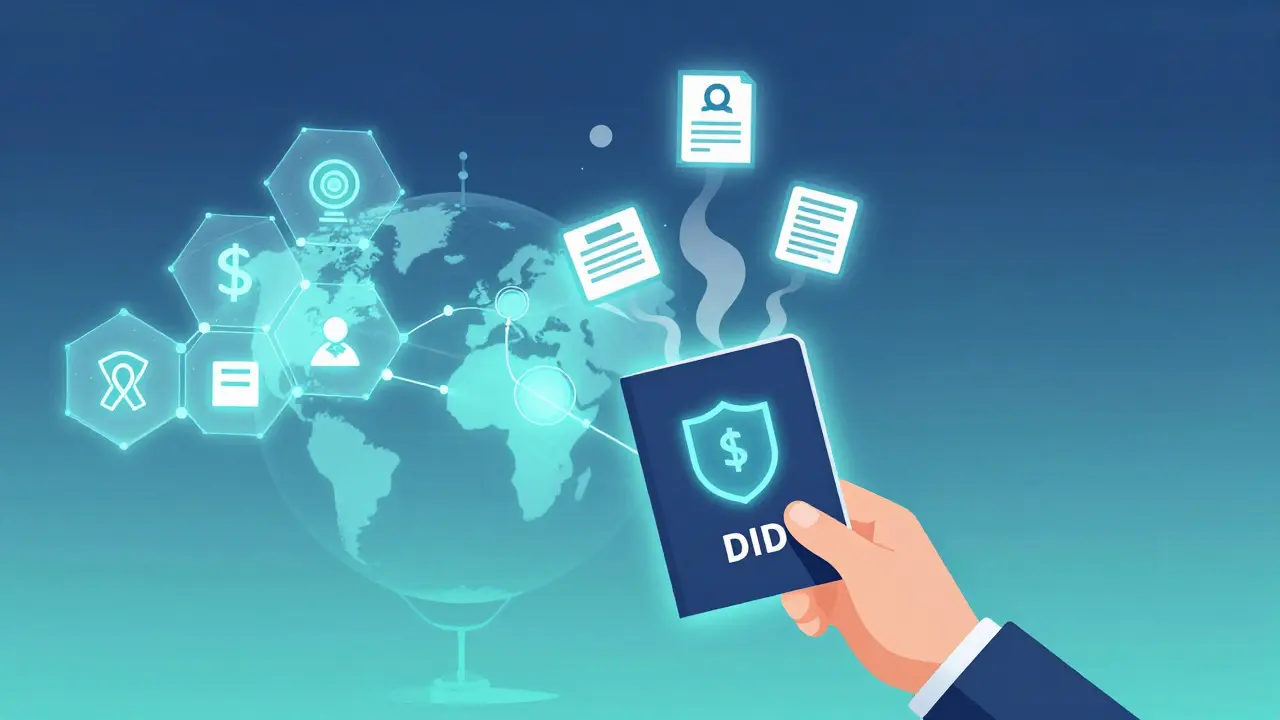
Imagine being able to prove you’re over 18 without showing your birth certificate. Or applying for a loan without handing over your entire credit history. Or logging into a website without a password - and without the company storing your data. That’s what DIDs are built to do. Decentralized Identifiers aren’t just another tech buzzword. They’re a fundamental rewrite of how digital identity works - and blockchain is the engine making it possible.
What Exactly Is a DID?
A DID is a unique string of characters that acts like a digital passport you own. Unlike your email or Facebook login - which are controlled by companies - a DID belongs entirely to you. It doesn’t rely on Google, Apple, or any government to verify who you are. Instead, it’s anchored to a blockchain, which acts as a tamper-proof public record.
Every DID follows a simple format: did:method:identifier. For example:
did:ethr:0x123...abc- uses Ethereumdid:xrpl:r123...xyz- uses the XRP Ledgerdid:web:example.com- uses a regular website (still tied to crypto keys)
The part after did: tells you which system created it. The rest is a unique ID generated from your private key. No one else can guess it. No central database holds it. It’s mathematically yours.
How DIDs Connect to Blockchain
Here’s where blockchain comes in. When you create a DID, you don’t just make a name - you create a whole digital profile called a DID Document. This document lives on the blockchain and contains:
- Your public keys (used to verify your identity)
- How you authenticate (e.g., signing with your private key)
- Links to services you use (like your digital wallet or profile storage)
Think of it like a public directory that anyone can check - but only you can update it. To change your DID Document, you need to sign a transaction with your private key. That signature gets recorded on the blockchain forever. If someone tries to fake it, the math won’t add up. The system rejects it instantly.
For example, on Ethereum, creating a DID costs about $0.45 and takes 15-30 seconds. On the XRP Ledger, it’s $0.0002 and takes under 5 seconds. The blockchain doesn’t store your name, address, or Social Security number. It only stores the cryptographic proof that you control the identity.
Verifiable Credentials: The Real Power
A DID by itself is just an address. The real magic happens when you pair it with verifiable credentials. These are digital versions of your diploma, driver’s license, or employee badge - but encrypted and signed by the issuer.
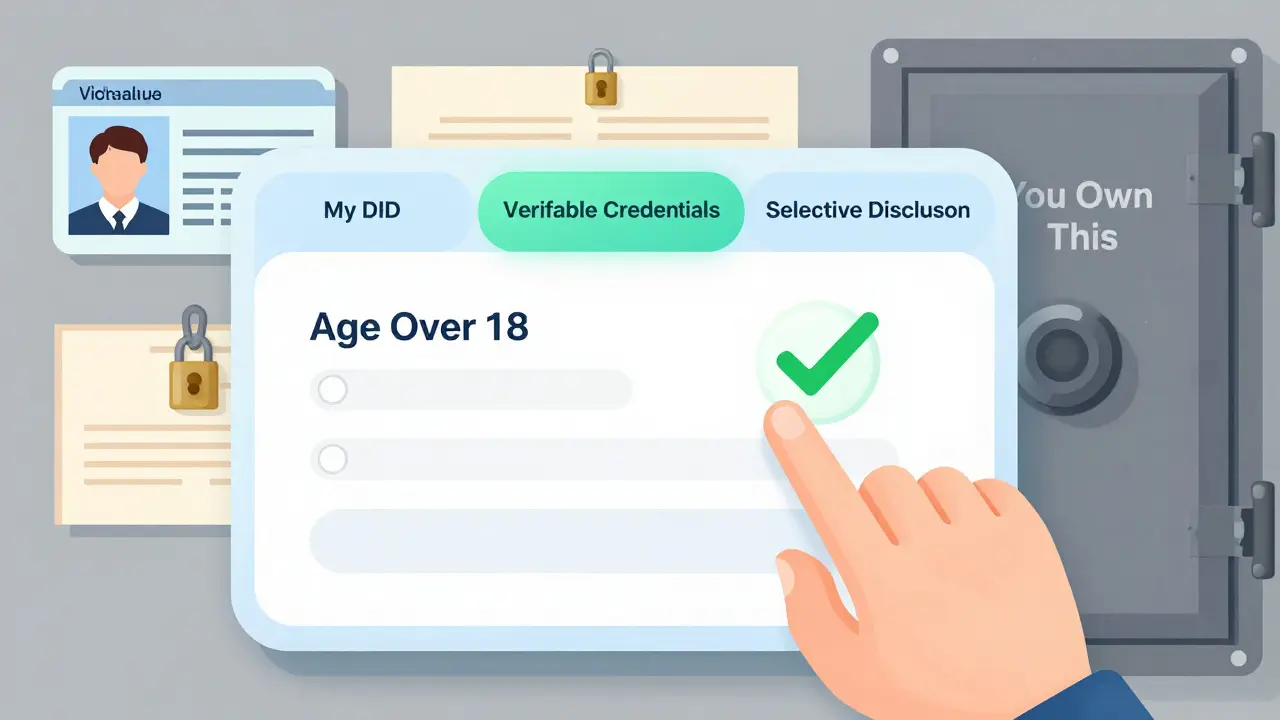
Let’s say your university issues you a digital degree. They sign it with their private key and attach it to your DID. Now, when you apply for a job, you don’t send them a PDF. You show them a cryptographically verified credential linked to your DID. They check the blockchain to confirm the university’s signature is valid. They see: “This person holds a degree from XYZ University.” That’s it. No transcript. No birth date. No student ID number.
This is called selective disclosure. You’re not giving away everything. You’re giving only what’s needed. And because the credential is cryptographically signed, no one can fake it. Even if someone steals your phone, they can’t create a fake degree - they don’t have the university’s private key.
Why Blockchain? Why Not Just a Database?
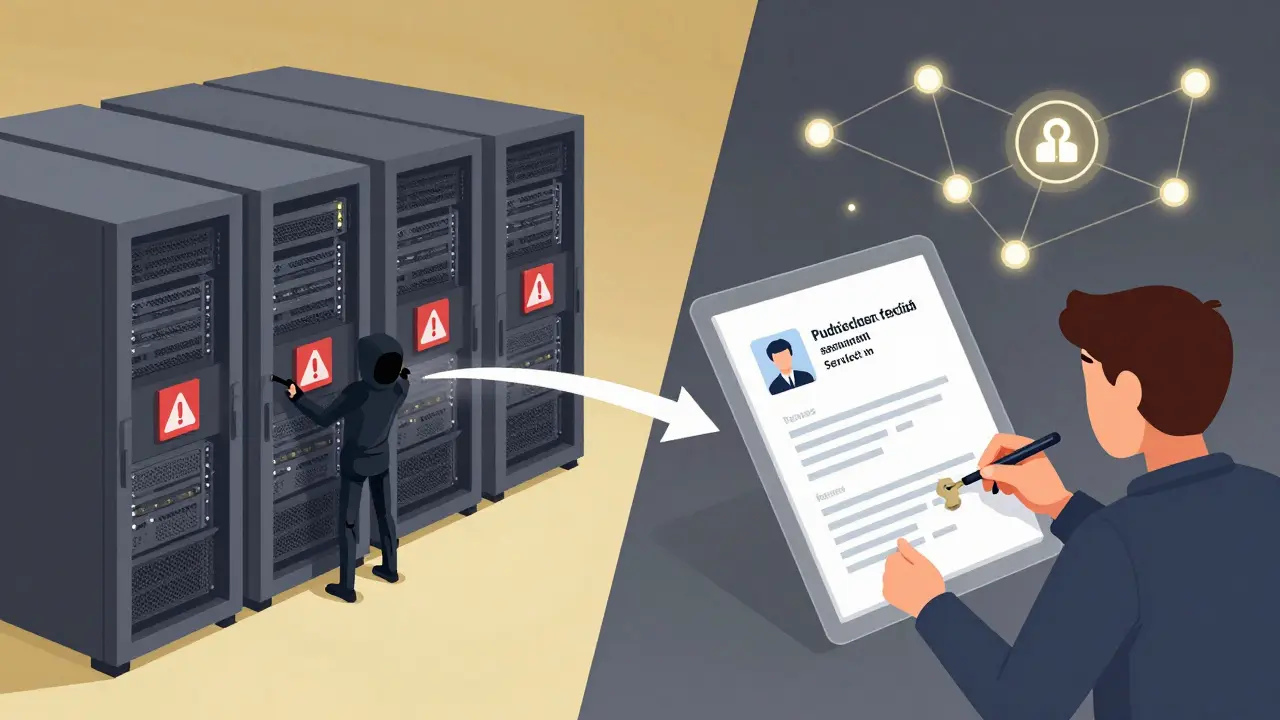
You might ask: Why not just use a secure database? Because databases can be hacked. They can be shut down. They can be changed by admins. In 2022, over 83% of identity theft cases came from breaches of centralized databases, according to the Identity Theft Resource Center.
Blockchain fixes that. Once a DID Document is written to the chain, it can’t be altered. No company can delete it. No government can block it. Even if the company that issued your credential goes out of business, your credential still works - because the signature is still valid on the blockchain.
It’s not just about security. It’s about control. Right now, your identity is scattered across Facebook, Amazon, your bank, your doctor’s office - each one holding a piece. With DIDs, you own the keys. You decide who gets access. And you can take it anywhere.
Real-World Use Cases
DIDs aren’t theoretical. They’re already in use:
- British Columbia’s BC Registries issues digital business licenses using DIDs. Over 12,000 credentials are verified monthly.
- European Union’s EBSI uses DIDs for cross-border academic credentials - letting students prove their degrees in any EU country.
- Healthcare providers are testing DIDs to share patient records without exposing full medical histories. Only relevant data (e.g., “patient has diabetes”) is shared, with consent.
- Job platforms like LinkedIn are experimenting with DID-based verification for skills and certifications - eliminating fake resumes.
In each case, the user stays in control. No third party owns the data. No central server gets targeted by hackers.
The Big Problems Still Left
DIDs aren’t perfect - and they’re not mainstream yet.
Key management is the biggest hurdle. If you lose your private key, you lose your identity. No “forgot password” button. No customer service to help. A 2022 Chainalysis report found that 20% of cryptocurrency users lost access to their funds due to misplaced keys. The same risk applies to DIDs.
Some wallets now offer “social recovery” - letting you name trusted friends or family to help reset access. But it’s still clunky. Most people aren’t ready to treat their identity like a vault.
Fragmentation is another issue. A DID on Ethereum doesn’t work on Solana or XRP Ledger. You need a different DID for each chain. Universal resolvers are emerging - tools that can translate between different DID formats - but they’re still early.
Legal recognition is weak. Only 12 countries have laws recognizing blockchain-based IDs as valid. The EU’s eIDAS 2.0 regulation (effective 2024) is a big step forward - but in the U.S., it’s a patchwork of state laws. Most businesses still require government-issued IDs.
Performance is slow. Ethereum handles 15-45 DID operations per second. Traditional systems like passport databases handle thousands. Layer-2 solutions like Polygon ID are fixing this - hitting over 2,000 operations per second - but adoption is still limited.
Who’s Building This?
Three main groups are pushing DIDs forward:
- Open-source communities - like the W3C Credentials Community Group - maintaining the global standard. Over 200 blockchains now support DID methods.
- Big tech - Microsoft’s Entra, IBM Blockchain, and Google are building enterprise DID tools, mostly for B2B use.
- Governments - Canada’s Verified.Me, Estonia’s e-Residency, and Australia’s Digital Identity program are testing DID pilots.
But the real momentum is in the developer community. According to 2023 Stack Overflow data, open-source DID projects have 68% of developer mindshare. That means the tools are getting better - faster.
What’s Next?
The next few years will decide if DIDs become mainstream or stay niche.
AI is starting to blend in. By 2026, the World Economic Forum predicts 40% of DIDs will use AI to verify biometrics - like facial recognition or voice patterns - without storing the raw data. That’s huge. It means your face becomes a key, not a file.
Web3 platforms are integrating DIDs into wallets. MetaMask, Phantom, and others now let you create a DID in one click. Soon, logging into a dApp won’t require connecting a wallet - it’ll just know who you are.
And as regulations catch up - especially with eIDAS 2.0 in the EU - businesses will start trusting DIDs for KYC, age verification, and access control. Right now, only 3% of major e-commerce sites support them. That number could hit 30% by 2028.
The vision is simple: You own your identity. No one else holds the keys. No one else profits from your data. You choose who sees what - and when.
It’s not here yet. But it’s coming. And blockchain is the only thing that makes it possible.
Can I use a DID to log into my bank?
Not yet, but it’s coming. Most banks still require government-issued IDs due to legal compliance. However, some fintechs and neobanks in the EU and Canada now accept DID-based verifiable credentials for KYC checks. Full adoption depends on regulators recognizing blockchain identities as legally valid - something the EU’s eIDAS 2.0 regulation is starting to enable.
What happens if I lose my private key for my DID?
You lose access to your identity permanently - there’s no reset button. That’s why key management is the biggest challenge. Some wallets now offer social recovery: you name 2-3 trusted contacts who can help you regain access if you lose your key. But this requires setup ahead of time. If you didn’t set it up, your DID is gone. Treat your private key like a house key - lose it, and you’re locked out.
Are DIDs the same as crypto wallets?
No, but they’re closely related. A crypto wallet stores your cryptocurrency and private keys. A DID is a digital identity tied to those keys. Many wallets (like MetaMask) now generate a DID automatically when you create a wallet. So you get both a wallet address and a DID at the same time. But you can have a DID without holding crypto - and you can hold crypto without a DID.
Do DIDs work on all blockchains?
Not automatically. Each blockchain has its own DID method - like did:ethr for Ethereum and did:xrpl for XRP Ledger. A DID created on one chain won’t work on another. But universal resolvers are being developed to bridge them. Tools like did:web and Sovrin’s resolver can translate between formats, making cross-chain identity possible - though it’s still experimental.
Are DIDs secure from quantum computing?
Most current DIDs use ECDSA or Ed25519 cryptography, which could be broken by future quantum computers. But the W3C and research groups are already working on quantum-resistant algorithms. New DID methods are being tested with post-quantum cryptography, like CRYSTALS-Kyber. While this isn’t mainstream yet, the standard is being built to adapt - so future DIDs will be quantum-safe.
23 Comments
DIDs are just crypto bros trying to reinvent the wheel while ignoring that 99% of people can't even manage a password manager. You lose your key? Congrats, you're now a digital ghost. This isn't innovation-it's a liability with a whitepaper.
You're giving people control? That's cute. But control without responsibility is just chaos wrapped in blockchain glitter. We don't need more digital freedom-we need more digital maturity. And most people? They'd rather have someone else handle it.
so you're telling me i have to become a crypto nerd just to prove i'm 18???
this is all a government backdoor to track you under the guise of "control". they want you to think you own your identity so you'll willingly hand over your biometrics and behavioral data. watch. they'll make you use it for voting next. 👁️
The technical architecture of DIDs is elegant, particularly in how they decouple authentication from authorization through cryptographically verifiable presentations. However, the human factors-key management, user onboarding, and cognitive load-remain significant barriers to adoption. Without addressing these, even the most robust protocol will remain an academic curiosity.
I get that this sounds like sci-fi, but imagine if your kid could prove they graduated high school without handing over their birth certificate, address, or social media history. It’s not about tech-it’s about dignity. We can do better than this.
This is the future we’ve been waiting for. Imagine being able to share only what you need-no more oversharing, no more data leaks. It’s not perfect yet, but every step forward matters. Keep building, keep learning. We’re not far off.
Simple. Secure. Scalable. The math works. The use cases exist. The only thing missing is mass adoption.
I’ve been testing this with my nonprofit’s volunteers. One woman, 72, just got her first DID through a tablet at the library. She said, ‘So I don’t have to give them my whole life just to sign up for a flu shot?’ Yes. Exactly. This matters.
In Nigeria, where 60% of adults lack formal ID, this isn’t a luxury-it’s liberation. Imagine being able to open a bank account, receive aid, or rent a home without a birth certificate or a government that doesn’t recognize you. DIDs aren’t just tech-they’re justice.
I built a DID-based login for my side project last week. Took 3 hours. My users didn’t even notice it was different-except they said, ‘I don’t feel like you’re spying on me.’ That’s the win. 🙌
i like the idea but why do i need another thing to remember? my phone is already full of apps that ask for my face and my fingerprint and my email and my password and now my blockchain key? 😅
The ontological rupture here is profound. We are transitioning from a heteronomous identity paradigm-where the subject is constituted by external institutions-to an autopoietic identity architecture, wherein the self becomes the sovereign node of verifiable existence. The blockchain isn’t the medium; it’s the epistemic scaffold for post-sovereign subjectivity. This isn’t identity 2.0-it’s the birth of the crypto-ego.
dids are just a fancy way of saying you need to pay 50 bucks to get your identity back from google and facebook and now you have to backup your keys too lol
So let me get this straight. You’re telling me I can’t log into my bank unless I memorize a 24-word phrase and pray I don’t drop my phone? This isn’t innovation. This is a middle finger to normal people.
I work in healthcare. We’re piloting DIDs for patient consent. A woman with Alzheimer’s had her daughter grant access to her medical records-only the diagnosis, no history, no names. The doctor said, ‘I’ve never seen a patient feel so in control.’ That’s the power.
While the technical merits of DIDs are sound, the current implementation landscape suffers from severe interoperability fragmentation. The proliferation of distinct DID methods without a unified resolution layer creates vendor lock-in risks and inhibits network effects. Standardization efforts like W3C DID Core must be accelerated and enforced.
i dont get why we need this when my phone already knows everything about me... but i guess its kinda cool that i could prove im over 21 without showing my id card? idk 🤷♀️
they're gonna use this to track your every move. first you get a did, then they make it mandatory, then they tie it to your taxes, your voting, your medical records, your bank account. before you know it, you're a number in a government blockchain. they already did it with social security. this is just the next step. 🚩
this is what happens when people who've never held a job think they can redesign society. you think a blockchain will stop fraud? try telling that to the guy who lost his keys and now can't prove he's a doctor. this isn't freedom-it's a dumpster fire with a roadmap.
Oh great. So now instead of Facebook owning my identity, I get to give it to some anonymous guy on GitHub who wrote a DID resolver in Rust. Brilliant. Let’s just make everyone a sysadmin. 🤡
America doesn’t need some crypto-ID system. We have REAL IDs. Driver’s licenses. Passports. Social Security. You want to replace them with math? Go live in Estonia. We’re not doing this.
bro i just wanna buy coffee without giving my name to 3 companies. if this lets me do that? sign me up. no drama. no jargon. just work.