
How Byzantine Fault Tolerance Ensures Blockchain Network Reliability

Byzantine Fault Tolerance Node Calculator
How Byzantine Fault Tolerance Works
To tolerate up to f faulty nodes, you need at least 3f+1 total nodes. This means your network can remain operational when up to 33% of nodes are malicious or faulty.
Result
33% ThresholdEnter values to see calculation results
Imagine a network of 100 computers trying to agree on a single truth - but 30 of them are lying, glitching, or even trying to break the system. How do the other 70 stay in sync? This isn’t science fiction. It’s the daily reality of blockchain networks. And the answer lies in Byzantine Fault Tolerance - or BFT.
What Byzantine Fault Tolerance Actually Does
BFT isn’t just a buzzword. It’s a mathematical guarantee. It says: Even if up to one-third of your network nodes act maliciously or fail randomly, the rest can still reach agreement. That’s it. No magic. Just math. This comes from the Byzantine Generals’ Problem, first described in 1982. Picture a group of generals surrounding a city. They need to coordinate an attack. But some generals are traitors. They might send conflicting messages - “attack” one minute, “retreat” the next. How do the loyal generals know who to trust? BFT gives them a protocol to ignore the liars and still move forward. In blockchain terms, those generals are nodes. The attack order is a transaction. And the traitors? They could be hackers, buggy software, or even misconfigured hardware. BFT lets the network keep running - even when up to 33% of its participants are compromised.How BFT Works in Practice
Most BFT systems, like Practical Byzantine Fault Tolerance (PBFT), work in four clear steps:- Request: A client sends a transaction to the primary node.
- Pre-prepare: The primary broadcasts the transaction to all other nodes.
- Prepare: Each node checks the transaction and says, “I’ve seen this.”
- Commit: Once 2f+1 nodes (a majority) confirm, the transaction is final.
Finality: The Killer Advantage Over Proof of Work
Bitcoin and early Ethereum use Proof of Work. Their finality is probabilistic. A transaction isn’t “final” until it’s buried under six blocks - about an hour. Even then, there’s a tiny, theoretical chance it could be reversed if someone controls 51% of the network’s mining power. BFT is different. Finality is absolute. Once a transaction hits the commit phase, it’s done. Done. Forever. That’s why banks, supply chains, and governments use it. JPMorgan’s Quorum, built on Istanbul BFT, hit 99.998% uptime over 18 months - even when engineers simulated attacks with 30% of nodes going rogue. No reorgs. No delays. Just certainty. Compare that to Ethereum’s old Proof of Work: 15 transactions per second, 10-minute blocks, and finality that took minutes - if you were lucky. BFT-based systems like Tendermint (used by Cosmos) process 10,000 transactions per second with finality in 3-5 seconds.
Where BFT Shines - and Where It Fails
BFT dominates enterprise blockchains. Gartner found that in 2022, 78% of enterprise blockchain projects used BFT. Why? Because businesses can’t afford to wait. Financial settlements, supply chain tracking, digital identity - these need instant, irreversible confirmation. Hyperledger Fabric, used by Maersk and Walmart, runs on BFT. It settles transactions in under two seconds. No mining. No waiting. Just speed and trust. But here’s the trade-off: BFT needs permissioned networks. You have to know who the nodes are. That’s fine for a consortium of banks. Not so fine for a public blockchain where anyone can join. Bitcoin’s genius is openness. Anyone can mine. But that comes at the cost of slow finality and massive energy use. BFT sacrifices openness for speed and certainty. That’s why you won’t see BFT on Bitcoin or Ethereum mainnet - at least not yet.Scalability and the Future of BFT
The biggest weakness of classic BFT? It doesn’t scale. Every node talks to every other node. That’s O(n²) communication. At 100 nodes, that’s 10,000 messages per round. At 1,000? A million. It’s a bottleneck. That’s why new versions are emerging. Ethereum researchers published a paper in early 2023 on “Linear Communication Cost BFT” - a version that scales with O(n), not O(n²). Cosmos is already testing Tendermint Core 2.0, aiming for 100,000 transactions per second across shards while keeping BFT security. The InterChain Foundation just poured $15 million into this exact problem. If they succeed, BFT could finally work on large public networks - without giving up finality.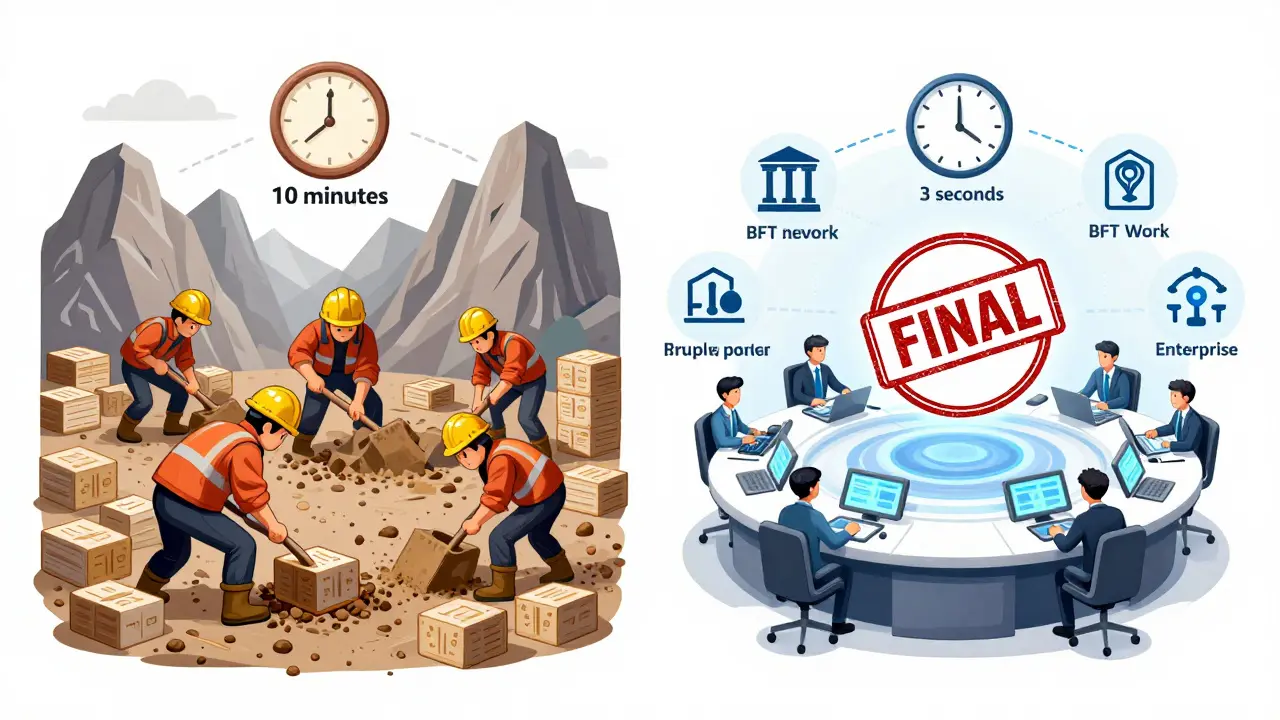
Real-World Reliability: Numbers Don’t Lie
- JPMorgan’s Quorum: 99.998% uptime with 30% simulated malicious nodes. - Hyperledger Fabric: 4.3/5 stars from 142 enterprise users, 78% cite “transaction reliability” as top reason. - Cosmos Network: 10,000 TPS, 3-5 second finality. - IBM: PBFT-based systems process transactions 30x faster than Bitcoin’s 6-confirm model. Meanwhile, users on Reddit’s r/blockchaindev report PBFT deployments taking weeks to tune - while Proof of Authority setups ran in days. But PoA doesn’t protect against malicious actors. BFT does.Is BFT Right for You?
Ask yourself:- Do you need transactions to be final in seconds, not minutes?
- Are you working with a known group of trusted partners (banks, suppliers, regulators)?
- Can you control who joins the network?
What’s Next for BFT?
The European Central Bank is using BFT for its Digital Euro prototype. Why? Because central banks can’t gamble with transaction finality. IDC predicts that by 2026, 65% of enterprise blockchains will use BFT - up from 48% in 2022. The demand for certainty is growing. And BFT delivers. The real question isn’t whether BFT works. It’s whether you’re willing to trade open access for ironclad reliability.What does Byzantine Fault Tolerance mean in blockchain?
Byzantine Fault Tolerance (BFT) means a blockchain network can keep functioning correctly even if up to one-third of its nodes are faulty or malicious. It uses cryptographic protocols to ensure honest nodes can still agree on the state of the ledger, ignoring bad actors.
How is BFT different from Proof of Work?
Proof of Work relies on computational power to secure the network and achieves finality probabilistically - meaning transactions aren’t final until many blocks are added (e.g., 6 confirmations in Bitcoin). BFT achieves immediate, cryptographic finality within seconds, but only works reliably in networks with a known set of validators.
Can BFT be used in public blockchains like Bitcoin?
Not in its traditional form. Classic BFT requires a permissioned, known set of nodes - which contradicts Bitcoin’s permissionless design. However, new research into linear-scaling BFT protocols may eventually make it feasible for public chains, though no major public blockchain currently uses it.
Why do enterprises prefer BFT over other consensus methods?
Enterprises need guaranteed transaction finality, low latency, and predictable performance. BFT delivers all three. Unlike Proof of Work, which can take minutes to confirm and has reorganization risks, BFT confirms transactions in seconds with zero chance of reversal - critical for financial and supply chain use cases.
What’s the biggest downside of BFT?
Its scalability limit. BFT communication grows quadratically with the number of nodes, making it impractical for networks larger than a few hundred participants without major protocol upgrades. It also requires trusted node selection, reducing decentralization - a trade-off most enterprises accept for reliability.
Is BFT more secure than Proof of Stake?
It’s secure in different ways. BFT relies on cryptographic consensus among known validators - it’s mathematically guaranteed to tolerate up to 33% malicious nodes. Proof of Stake relies on economic incentives: validators lose their stake if they misbehave. BFT offers faster finality and better performance in controlled environments; PoS offers better decentralization in open networks.
14 Comments
So BFT is basically the blockchain version of 'trust but verify' but with math instead of gut feeling? I like it. No more waiting 10 minutes for a transaction to 'probably' go through.
Real talk though, I've seen PBFT setups crash harder than my laptop during a Windows update. It's not magic, it's just brittle when you push it.
BFT finality is why I use Hyperledger for client work. No reorgs. No guesswork. Just get it done.
Proof of Work is for crypto bros who think waiting an hour is a feature.
One must solemnly observe that the very premise of Byzantine Fault Tolerance presupposes an ontological commitment to deterministic consensus mechanisms-a philosophical stance antithetical to the anarchic ethos of decentralized autonomy. One cannot simultaneously champion open participation and demand mathematical certainty from a system designed for opacity. The contradiction is not merely technical-it is existential.
If you're doing enterprise stuff, BFT is the clear winner. Fast, reliable, no drama.
Just don't try to use it for a public coin. That's like using a scalpel to open a soda can. Works? Sure. Smart? Nope.
America has better tech than this. Nigeria has better internet than most BFT networks. Why are we still talking about this like it's the future? We need real innovation, not math that needs 300 nodes to work.
I find myself deeply moved by how BFT mirrors human cooperation under uncertainty. We, too, live in networks where some members are unreliable-but we still find ways to align, to build, to move forward. The protocol doesn’t just solve a computational problem. It reflects a deeper truth about trust.
It’s beautiful, really. The way humans and machines both strive for harmony amid chaos.
I love how this article clarifies the difference between probabilistic and absolute finality. So many people conflate them.
Also, the 3f+1 rule is elegant. It’s like the blockchain version of 'you need at least three witnesses to confirm a sighting.' Simple. Sound. Scientific.
Oh wow. So we're giving banks and governments the keys to the blockchain kingdom because they don't trust strangers? Groundbreaking. Next you'll tell me Bitcoin should require a background check and a signed NDA.
The fact that you're still debating whether BFT belongs in public chains reveals a fundamental lack of intellectual rigor. The very notion of permissionless consensus is a naive fantasy built on the delusion that anonymity equals freedom. True freedom requires accountability. BFT delivers that. The rest? Just noise.
BFT is like that one friend who always shows up on time, remembers your birthday, and never ghosts you... even when everyone else is falling apart 😌✨
Also, 10k TPS? That’s faster than my coffee machine. I’m here for it.
The O(n²) problem is real. I’ve watched a 150-node PBFT cluster grind to a halt during peak load. The solution isn’t more nodes-it’s better messaging. Look at Tendermint’s latest gossip protocols. They’re cutting the chatter by 70%.
This is why America and China rule tech. They don't waste time with fancy math. They just build stuff that works. BFT? Sounds like overthinking. Just make it fast and let people use it.
Is BFT not just a metaphysical assertion dressed in cryptographic clothing? We say 'finality' but what we really mean is 'consensus among the privileged few.' The illusion of objectivity is the most dangerous kind of authority.
i read this whole thing and honestly i think bft is cool but like… what if the nodes get hacked? like not just faulty but like… owned? the article says 1/3 can be bad but what if they’re bad on purpose and coordinated? idk just wondering