
How Blockchain Solves Patient Data Privacy in Healthcare

Imagine losing your private key to your medical records. For two weeks, you can't see your test results or authorize a specialist to view your history. This isn't a hypothetical nightmare; it's a real complaint from a user on r/HealthIT back in March 2024. It highlights the core tension in Patient Data Privacy is the protection of sensitive medical information using decentralized cryptographic methods that return control to the individual rather than centralized institutions. While the promise of total ownership sounds great, the reality involves complex trade-offs between security, usability, and system speed.
The Broken Trust in Centralized Health Records
Why are we looking at distributed ledgers for something as personal as our health? The answer lies in the sheer volume of failures in traditional systems. According to World Economic Forum data from December 2023, 95% of patients worry about their health info being stolen or leaked online. In the first half of 2023 alone, over 41 million healthcare records were breached. When a giant hospital network like Epic or Cerner gets hacked, there’s usually one single point of failure. If that server goes down or gets compromised, everyone’s data is at risk simultaneously.
The IBM Cost of a Data Breach Report for 2023 documented that the average cost for a healthcare breach in centralized systems hit $10.93 million per incident. Compare that to $7.21 million for blockchain-secured systems, and you start to see why organizations are paying attention. But it’s not just about money. It’s about who holds the keys. In traditional Electronic Health Record (EHR) systems, the provider controls access. You ask them to share your data with a new doctor, and they decide if it’s “convenient” to do so. Blockchain flips this script by giving you the cryptographic keys to your own data.
How the Technology Actually Works
You don’t need to be a cryptographer to understand the basics, but knowing the mechanics helps explain both the power and the pain points. Most modern implementations, like the SPChain framework detailed in a January 2025 Nature Scientific Reports article, use a permissioned blockchain. This means not just anyone can join the network; only verified hospitals, doctors, and patients participate.
Here is how the data flow typically looks in these systems:
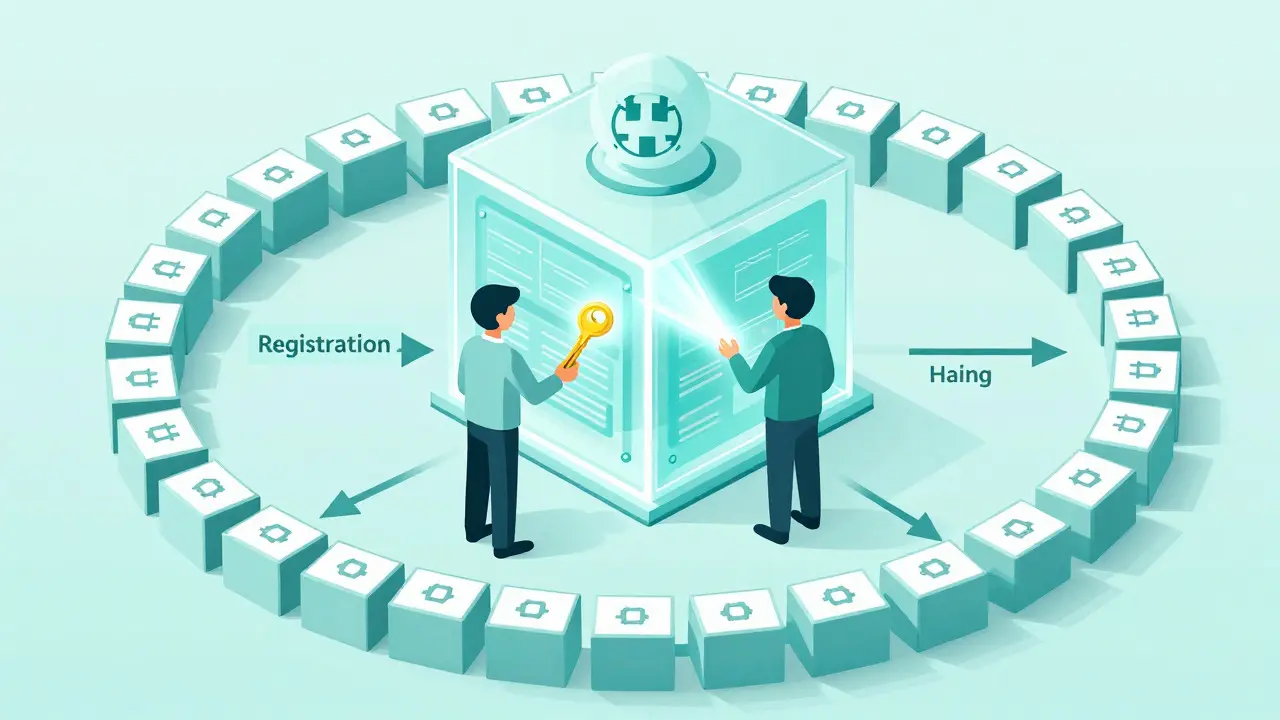
- Registration & Identity: You register and get a unique digital identity. Your name isn’t stored on the chain; instead, a hash of your identity is used to protect anonymity.
- Key Generation: The system generates a public key (Pk) and a private key (Sk). Think of the private key as your master password. Only you hold it.
- Encryption & Storage: Your actual medical record (the EHR) is encrypted using AES symmetric encryption. This encrypted file is then stored off-chain on a decentralized storage network like IPFS (InterPlanetary File System).
- On-Chain Hashing: A unique hash address pointing to that encrypted file is written onto the blockchain. This creates an immutable audit trail. If someone changes your record, the hash won’t match, and the tampering is instantly detectable.
This setup ensures that while your data is accessible to authorized parties, its integrity is mathematically guaranteed. The SPChain study noted transaction processing times of 2.3 to 4.7 seconds per record, which is slower than traditional databases but fast enough for most non-emergency workflows.
| Feature | Traditional Centralized EHR | Blockchain-Based EHR |
|---|---|---|
| Data Control | Provider/Hospital owns data | Patient owns data via private keys |
| Audit Trail | Central log, potentially editable | Immutable, transparent ledger |
| Breach Cost (Avg) | $10.93 million (IBM 2023) | $7.21 million (IBM 2023) |
| Transaction Speed | 0.8 - 1.5 seconds | 2.3 - 4.7 seconds |
| Scalability | 1,000 - 10,000 TPS | 50 - 200 TPS |
The Usability Gap: Why Patients Get Stuck
If the tech is this secure, why isn’t everyone using it? Because managing your own data is hard. Dr. Deborah Peel, founder of Patient Privacy Rights, warned in a July 2023 report that "blockchain alone cannot solve all privacy issues; it must be combined with robust identity management and patient education." She was right. The complexity of key management is the biggest hurdle.
In Kenya, Snark Health’s implementation reported 82% patient satisfaction with data control features. That’s impressive. But look closer at the data: only 67% of users actively managed their access permissions monthly. The rest? They probably forgot or got confused. On specialized forums, MedRec users reported 78% satisfaction with transparency but only 52% confidence in managing complex permission settings without help. If you lose your private key, recovering your medical history is a bureaucratic maze, not a simple "forgot password" email.
Performance Realities and Limitations
Let’s talk numbers, because hype often hides the engineering constraints. Current blockchain implementations handle roughly 50 to 200 transactions per second (TPS). Traditional centralized databases can handle 1,000 to 10,000 TPS. Does this matter? Yes, if you’re in an emergency room where every second counts. For high-volume documentation, blockchain might introduce a slight lag. However, for longitudinal care-tracking your health over years-the speed is perfectly adequate.
There is also a computational overhead. Cryptographic operations add approximately 15-22% more processing time compared to standard database queries. This requires hardware upgrades for many older hospital systems. Integration with legacy infrastructure remains a significant challenge, often taking 6 to 12 months for enterprise-level rollouts. A medium-sized hospital network (450 beds) took 8 months to implement SPChain, with 65% of that time spent on staff training and workflow redesign, not just coding.

Regulatory Landscape and Future Outlook
As of 2026, the regulatory environment is still catching up. HIPAA and GDPR are designed for centralized controllers, not decentralized autonomous individuals. Yet, blockchain’s inherent audit trails actually make compliance easier in some ways. You can prove exactly who accessed what and when, satisfying strict logging requirements. Gartner’s 2024 Healthcare Technology Hype Cycle places blockchain for patient data privacy on the 'Slope of Enlightenment.' We’ve moved past the peak of inflated expectations. Now, 37% of healthcare organizations are piloting solutions, but only 8% have fully operational patient-controlled systems.
The market is growing rapidly, projected to reach $8.92 billion by 2028. Companies like Guardtime and Medicalchain are leading the charge. By 2027, analysts predict 60% of patient data sharing will occur through blockchain-enabled systems. The future isn’t just about security; it’s about interoperability. HL7 International is working on FHIR blockchain implementation guides, aiming to standardize how different blockchain networks talk to each other. This is crucial for ensuring your data travels with you seamlessly across borders and providers.
Frequently Asked Questions
Is my medical data really anonymous on the blockchain?
Not entirely. While your name is hashed, metadata like timestamps and access patterns can sometimes link back to an identity if not carefully managed. True anonymity requires zero-knowledge proofs or similar advanced cryptography, which are still being refined in healthcare contexts.
What happens if I lose my private key?
You lose direct access to your encrypted records until recovery is complete. Most systems require a multi-signature setup or a trusted third-party recovery mechanism. This process can take days or weeks, which is why user experience design is critical in these platforms.
Can doctors edit my records without my permission?
They can add new entries, but changing old ones is difficult. Since the ledger is immutable, corrections are usually added as new entries referencing the previous one. Smart contracts can be programmed to require your signature for any modification to existing clinical notes, depending on the specific protocol used.
Is blockchain faster than current hospital systems?
No. Traditional systems process transactions in under 1.5 seconds, while blockchain takes 2.3 to 4.7 seconds. For routine check-ups, this difference is negligible. For emergency triage, it’s a consideration, though rarely a dealbreaker given the improved security benefits.
Does this comply with HIPAA and GDPR?
Yes, but it requires careful architecture. Storing encrypted data off-chain (like on IPFS) and keeping only hashes on-chain helps meet data minimization principles. The immutable audit trail supports accountability requirements. Legal frameworks are evolving, but current best practices align well with these regulations.