
Hong Kong Virtual Asset Ordinance 2025: Crypto Compliance Guide

Think you can just set up a crypto exchange in Asia and call it a day? If you’re eyeing Hong Kong, think again. The city-state has rolled out one of the most rigorous regulatory frameworks in the world, and if you’re running a business or holding significant assets there, ignoring these rules is a fast track to fines-or worse.
It’s not just one law. It’s a coordinated push by the Financial Services and Treasury Bureau (FSTB) and the Securities and Futures Commission (SFC) to turn Hong Kong into a global digital asset hub. But here’s the catch: "hub" doesn’t mean "wild west." It means strict compliance. Whether you’re issuing stablecoins, dealing in virtual assets, or offering custody services, the game has changed as of mid-2025.
| Regulatory Area | Status / Deadline | Key Requirement |
|---|---|---|
| Stablecoins | In Effect (Aug 1, 2025) | Licensing for Fiat-Referenced Stablecoin issuers |
| VA Dealing & Custody | Consultation Closed (Aug 29, 2025) | Dual-regulator approach (SFC + HKMA) |
| Tokenization Review | Q1 2026 Planned | Focus on tokenized bonds and RWAs |
The Stablecoins Ordinance: What Changed in August 2025
Let’s start with the big one that already hit. On August 1, 2025, the Stablecoins Ordinance came into force. This isn’t about regulating Bitcoin or Ethereum directly; it targets fiat-referenced stablecoins (FRS). Think USDT or USDC types that claim to be worth $1.
Why does this matter? Because if you issue a stablecoin in Hong Kong now, you need a license. The definition is specific: it must be a cryptographically secured digital representation of value, used as a medium of exchange, and purport to maintain stable value against an asset. If you miss any part of that definition, you might slip through the cracks, but don’t bet your business on it.
Excluded from this ordinance are limited purpose tokens, securities tokens, and central bank digital currencies. This exclusion list is crucial. One asset manager noted that having a clear list of what *isn’t* regulated saved them over 200 hours of legal consultation. Before this, everything was gray area. Now, it’s black and white.
Dealing and Custody: The Dual-Regulator Model
If you’re trading or holding client funds, you’re looking at the proposed VA dealing and custody regimes. These aren’t live yet-implementation is expected in 2026-but the consultation period closed in late August 2025, so the writing is on the wall.
Hong Kong is doing something unique here: a dual-regulator approach. The SFC sets the standards, while the HKMA acts as the frontline regulator for banks and stored value facility licensees. Why split it up? To cover all bases. Banks operate under different pressures than pure-play crypto exchanges. By involving the HKMA, regulators ensure that traditional financial institutions entering the crypto space don’t bypass their usual scrutiny.
Here’s where it gets expensive. To get licensed, you’ll need minimum capital of HK$129,730. That sounds manageable until you factor in the operational costs. Industry surveys suggest smaller firms could see a 15-20% increase in operating expenses due to new compliance demands. Plus, you need at least one responsible officer with three years of virtual asset portfolio management experience. Good luck finding those people quickly; they’re in high demand.

Strict Rules for Institutional Players
Hong Kong isn’t trying to be friendly to everyone. It’s aiming for institutional-grade credibility. This means retail access is restricted. The SFC requires intermediaries to assess clients’ knowledge before onboarding them. You can’t just let anyone sign up for complex derivatives without checking if they understand what they’re buying.
For fund managers, there’s a hard rule: funds must only trade through regulated exchanges in Hong Kong, the U.S., U.K., Dubai, and Japan. No obscure offshore platforms. This limits market efficiency, sure, but it protects investors from rug pulls on unregulated venues. Adrian Fong of Reed Smith calls this essential for investor protection, even if some traders find it restrictive.
Custody is another pain point. The framework mandates dual approval systems for wallet whitelisting. Every time you add a new address to your whitelist, two people have to approve it. Sounds secure? Yes. Efficient? Not really. 43% of surveyed firms reported this increased transaction processing time by 30-40%. If you’re managing high-frequency trades, this friction hurts.
Penalties and Extraterritorial Reach
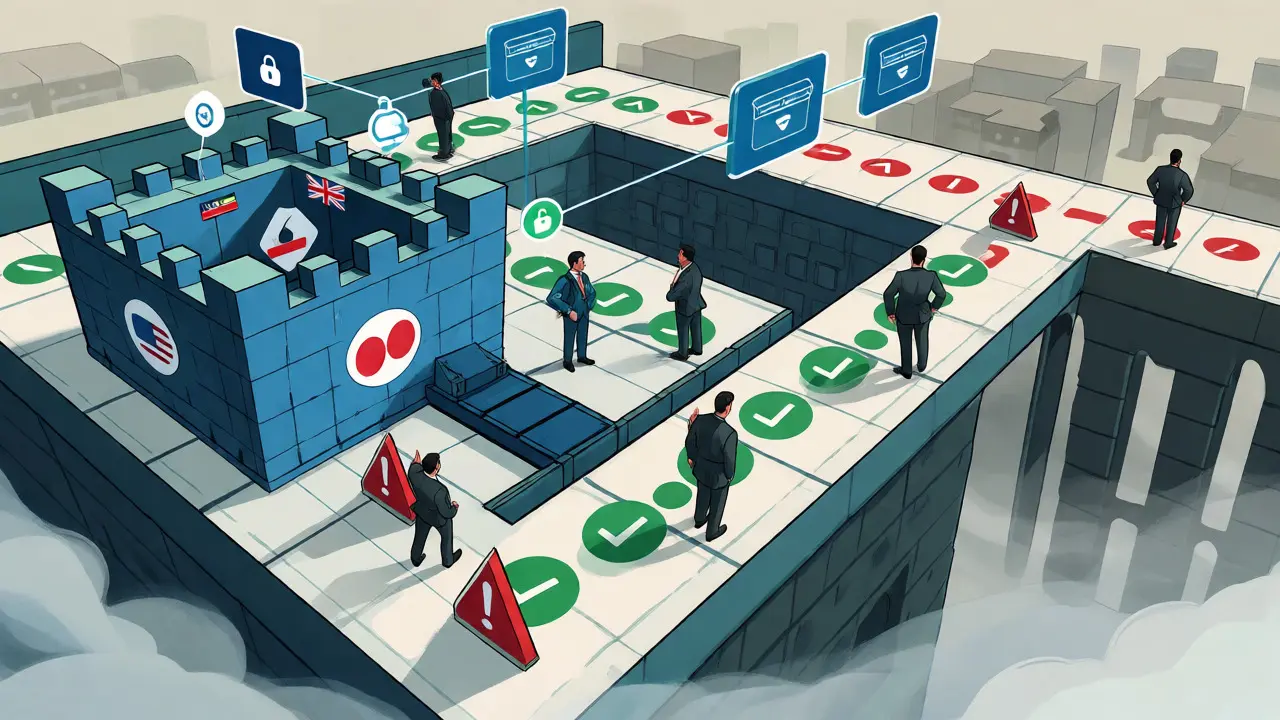
Don’t think you can ignore these rules because you’re based in Singapore or London. Hong Kong applies its regulations extraterritorially. If your activities target Hong Kong investors, you fall under this jurisdiction. This closes a gap that existed in Singapore’s Payment Services Act, which mainly focused on locally incorporated entities.
The penalties are severe. Violations can lead to fines up to HK$5 million and seven years in prison. Compare that to other jurisdictions where fines might be a slap on the wrist, and you see why serious players take this seriously. At least 12 cryptocurrency firms delayed their entry into the Hong Kong market specifically because of these stringent cybersecurity and compliance requirements.
Market Impact and Future Outlook
Is it working? Early signs suggest yes. Hong Kong’s share of Asia’s institutional crypto custody market is growing at 32% year-over-year, currently sitting at 18.7%. While Singapore still leads with 28.3%, the momentum is shifting. 15% of virtual asset firms surveyed said they plan to establish entities in Hong Kong due to its clearer, phased regulatory timeline.
Enterprise adoption is accelerating too. As of mid-2025, 42 asset managers held SFC licenses to manage virtual asset funds, up from 27 just six months prior. Eleven tokenized real-world asset (RWA) funds launched in Q3 2025 alone, representing $2.3 billion in assets under management. This isn’t speculation; it’s institutional money moving in.
Looking ahead, the FSTB plans a review of tokenization laws in Q1 2026, focusing initially on bonds. The HKMA will also launch a regulatory sandbox for cross-border stablecoin transactions in Q2 2026, with heavyweights like Standard Chartered and HSBC involved. NFTs? They’re likely next, with reviews expected by 2027.
Practical Steps for Compliance
If you’re navigating this landscape, here’s what you need to do right now:
- Audit Your Token List: Check if your products fall under the Stablecoins Ordinance exclusions. If you’re issuing an FRS, apply for a license immediately.
- Hire Experienced Officers: Find staff with three years of VA portfolio management experience. This is a non-negotiable requirement for licensing.
- Implement Blockchain Analytics: Tools like Chainalysis are used by 68% of compliant firms. They help prove you’re not laundering money.
- Set Up Multi-Sig Wallets: 82% of compliant custodians use multi-signature systems to meet security standards.
- Prepare for Delays: Expect 3-6 months to achieve full compliance. Don’t wait until the deadline to start.
The goal is clarity, not chaos. While the costs are high, the certainty is valuable. In a market rife with uncertainty, knowing exactly what the rules are gives you a competitive edge. Just make sure you have the budget to play by them.
Does the Virtual Assets Ordinance apply to Bitcoin?
Not directly. The current focus is on fiat-referenced stablecoins (FRS) and the licensing of dealing/custody services. Bitcoin itself is not classified as a stablecoin, but businesses handling it for clients in Hong Kong must comply with the broader VA dealing and custody regimes once implemented in 2026.
What is the minimum capital requirement for a VA license?
The proposed minimum capital requirement is HK$129,730, benchmarked against Type 3 SFO licences. However, firms should anticipate higher operational costs due to compliance infrastructure, with industry estimates suggesting a 15-20% increase in overall operating expenses.
Can foreign companies operate in Hong Kong without a local entity?
Yes, but they are subject to extraterritorial application. If a foreign company’s activities target Hong Kong investors, it must comply with the licensing regimes. Unlike Singapore, which focuses largely on locally incorporated entities, Hong Kong regulates based on activity targeting its market.
How long does the licensing process take?
Early adopters report a learning curve of 3-6 months to achieve full compliance. The SFC aims to process 100% of license applications within 120 days by Q3 2026, but preparation time for documentation and staffing often takes longer.
Are NFTs covered by the 2025 regulations?
No, not yet. Non-fungible tokens (NFTs) are currently excluded from the immediate legislative measures. The FSTB has indicated it will review the regulatory approach to NFTs following the implementation of the current framework, likely around 2027.