
Formal Verification of Smart Contracts: The Math-Based Security Standard
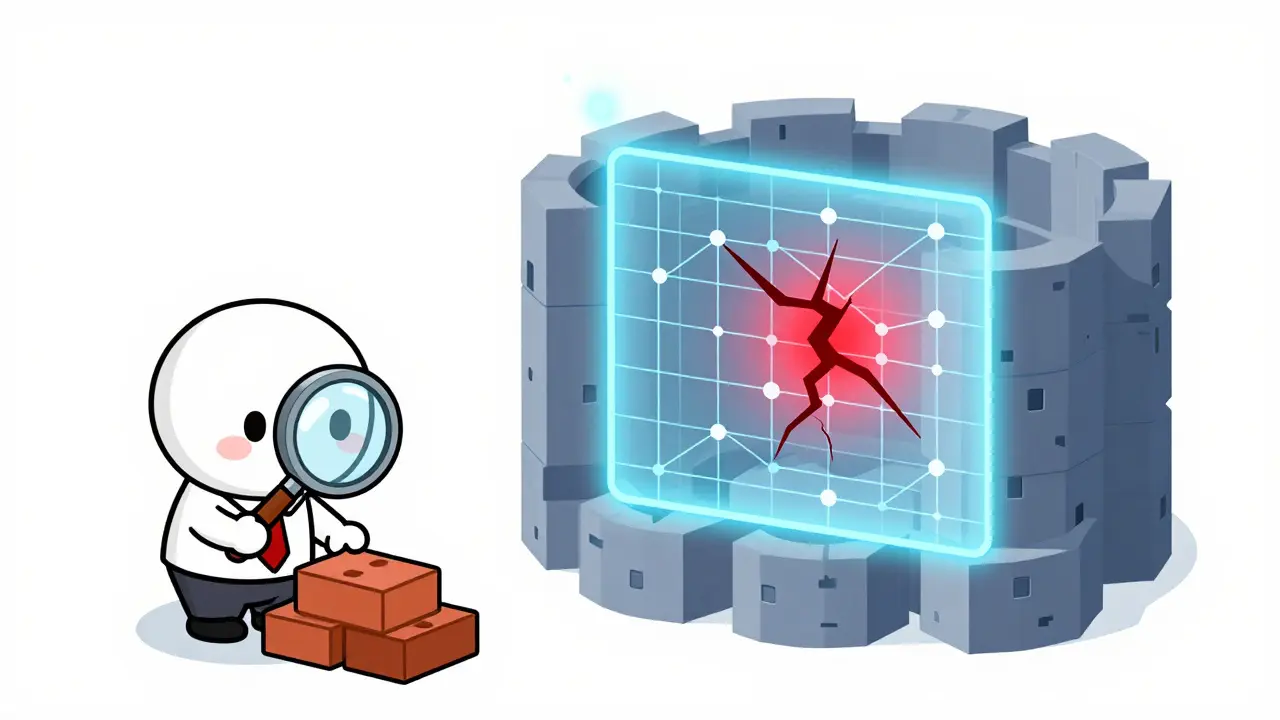
Imagine deploying a piece of code that manages $100 million, only to realize a tiny logical slip-up allows a stranger to drain every cent. In the world of blockchain, this isn't a nightmare-it's a recurring reality. Traditional testing and manual audits are great, but they only check the paths the developer remembers to test. They don't prove the code is perfect; they just prove they haven't found a bug yet. That is where Formal Verification is a mathematical methodology that provides rigorous proof that a smart contract behaves exactly as specified under all possible execution scenarios. Instead of guessing, it uses logic to guarantee that certain errors are physically impossible.
The Core Logic: Why Testing Isn't Enough
Most developers rely on unit tests-basically a set of "if this, then that" scenarios. But a smart contract can have millions of possible states. A human auditor might find a critical flaw by spotting a pattern they've seen before, but they can't possibly simulate every single combination of user inputs and contract states. Formal Verification changes the game by treating the contract as a mathematical object. It doesn't run the code with sample data; it analyzes the logic itself to see if there is any possible way to break a defined rule.
For example, if you have a token contract, a "critical invariant" would be that the total supply of tokens must always equal the sum of all individual balances. A manual audit might check this a few times. Formal verification, however, can prove that no matter what function is called-whether it's a transfer, a mint, or a burn-that equality can never be violated. This level of certainty is why it's become the gold standard for high-value protocols managing over $10 million in assets.
How It Actually Works: The Technical Workflow
You can't just click a button to "formally verify" a contract. It's a structured process that requires a shift in how we think about coding. It usually follows these steps:
- Specification: You write a set of rules (properties) in a formal language. If the contract is a vault, a rule might be: "Only the owner can withdraw funds."
- Modeling: The code is translated into a mathematical model that a computer can analyze. For instance, Solidity code might be converted to a lower-level representation like Yul to remove ambiguity.
- Analysis: Tools run mathematical proofs to see if the model ever violates the specifications.
- Iteration: If the tool finds a "counter-example" (a specific set of conditions that breaks the rule), the developer fixes the code and runs the proof again.
There are three main ways this analysis happens. Model Checking systematically explores every possible state the system can be in. Theorem Proving uses logical axioms to construct a formal proof of correctness. Lastly, Abstract Interpretation creates a simplified approximation of the code to find potential issues quickly.
| Feature | Manual Audit / Testing | Formal Verification |
|---|---|---|
| Approach | Heuristic & Pattern-based | Mathematical & Logical |
| Coverage | Selected execution paths | All possible states |
| Outcome | "No bugs found so far" | "This property cannot be violated" |
| Timeframe | 1-2 weeks (Medium complexity) | 2-4 weeks (Medium complexity) |
| Expertise | Security auditing experience | Mathematical logic & Formal methods |
The Industry Toolset
Different blockchains have different ecosystems for verification. In the Ethereum world, Certora is the heavy hitter. Most major DeFi platforms won't deploy a new version of a core contract without running it through the Certora Prover first. It integrates with tools like Foundry to help developers catch logic errors before they hit mainnet.
Over on Tezos, the approach is more academic. They use the Coq proof assistant combined with Mi-Cho-Coq to verify the Michelson language. This is a deeper, more manual form of proving that is incredibly robust but requires a PhD-level understanding of type theory.
Another powerhouse is the K Framework, developed by Runtime Verification. It allows developers to define the semantics of a language and then automatically derive properties from those definitions, which significantly speeds up the process for complex contracts.
The Trade-offs: Is it Always Worth It?
If formal verification is so much better, why doesn't everyone use it? The biggest hurdle is the "specification gap." A tool can prove your code matches your specification, but if your specification is wrong, the proof is useless. If you forget to specify that "users cannot withdraw more than their balance," the tool won't magically find that bug-it only checks the rules you actually wrote.
Then there's the cost and the learning curve. Less than 5% of blockchain developers have the mathematical background to write these specifications. It requires a massive investment in time and money-often ranging from $15,000 to $50,000 for a single project. For a small NFT project, this is overkill. For a protocol like Aave or Compound, it's a non-negotiable security layer.
It's also worth noting that formal verification struggles with certain things. It's great for safety properties (e.g., "money cannot be stolen"), but it's much harder to use for liveness properties (e.g., "the system will always eventually process a transaction"). It also can't account for external variables, like a price oracle being manipulated by a flash loan attack, because the oracle is outside the contract's logical boundary.
The Future of Code Certainty
We are moving toward a world where "audited" isn't enough; "formally verified" will be the requirement. Regulators are already leaning this way. The EU's MiCA regulation suggests formal verification for critical financial infrastructure, and the SEC has pointed to its absence in some DeFi failures.
The next big shift is automation. We're seeing the rise of machine learning algorithms that can help generate specifications by analyzing thousands of open-source contracts. This should lower the barrier to entry, making these tools accessible to the average developer, not just mathematical specialists. As tools like Certora and the K Framework continue to integrate with standard development environments, the time it takes to set up a verification pipeline is dropping, making it easier to maintain security as code evolves.
Does formal verification replace manual audits?
No, they complement each other. Formal verification proves that specific properties are held, but manual audits are better at finding "unknown unknowns," such as economic attack vectors or flaws in the overall business logic that weren't captured in the formal specifications.
How long does the process typically take?
For a medium-complexity contract, it usually takes 2 to 4 weeks. This is longer than a standard manual audit (which might take 1-2 weeks) because writing the mathematical specifications is a rigorous and time-consuming process.
Can formal verification prevent all hacks?
Not all of them. It can only prevent bugs that relate to the properties you specified. If a hack happens due to a flaw in the underlying blockchain protocol, an oracle failure, or a specification you forgot to include, formal verification won't stop it.
What is a "critical invariant"?
An invariant is a condition that must always be true, regardless of what happens in the contract. A common example is "Total Supply = Sum of all User Balances." If this ever becomes false, it means tokens were created or destroyed illegally.
Which tools are best for Ethereum?
Certora is currently the industry leader for commercial Ethereum projects. For more academic or low-level verification, tools like the K Framework and various Coq-based translations are used.
23 Comments
This is such a great explanation of a complex topic. It's really important for new developers to understand that a green checkmark in a test suite doesn't always mean the code is safe!
Imagine thinking a 'formal specification' actually solves the human error problem lol. It's just moving the goalposts from the implementation layer to the spec layer. If your invariants are mid, your security is mid. Absolute peak cope for the 'math is law' crowd.
wow this sounds super intense but cool. do you think regular devs can leran this without a phd??
The spec gap is the real killer here. Logic is only as good as the human defining the rules.
Classic industry hype. We're basically paying $50k to have someone tell us our code is 'probably' right according to a set of rules we might have written wrong. It's a psychological security blanket for VCs who don't understand how computers actually work. The irony is that the more complex the verification tool, the more 'black box' the security becomes, which is exactly what we should be avoiding if we actually cared about decentralization and transparency. Pure theater.
I completely agree with the point about the complementarity of audits and verification because while the math provides a certain level of absolute certainty regarding the invariants we have defined, the human element of a manual audit is what allows us to see the forest for the trees and identify those weird economic edge cases that a mathematical prover would simply ignore because it wasn't told to look for them in the first place.
There is a profound philosophical tension here between the desire for mathematical certainty and the inherent chaos of human-designed financial systems. When we attempt to reduce a smart contract to a mathematical object, we are essentially stripping away the social context of the transaction, which is where many of the most devastating exploits actually originate, meaning that while we might prove the code is 'correct' relative to its spec, we are still leaving ourselves open to the fundamental unpredictability of human greed and systemic failure.
omg 50k for a checkup??? that is insane!! literally who has that kind of money lol
idk why everyone is acting like this is some magic bullet. i bet most of these 'verified' contracts still get re-entranced bc someone forgot a line of spec lol
Actually, the mention of Yul is slightly underspecified here. Most people don't realize that the conversion to Yul is precisely where most translation errors happen during the modeling phase, which completely undermines the 'proof' if the model doesn't map 1:1 to the EVM bytecode. Its basic computer science 101.
A very detailed overview. The distinction between safety and liveness properties is quite important.
Oh wow, look at the West trying to 'standardize' security while their own banks are basically casinos. How cute that they think a little math will save their crumbling financial empire from the inevitable collapse they caused themselves!
The part about oracle manipulation being outside the logical boundary is interesting. It seems like the biggest weakness is the interface between the contract and the outside world.
It is imperative to note that formal verification should not be viewed as a replacement for rigorous unit testing, but rather as a final validation step. One must first ensure the code is functionally sound before attempting to prove its properties mathematically.
Love seeing the tech evolve! 🚀 It'll be awesome when AI makes this accessible for everyone. Keep learning folks! 💡
WAKE UP!!!! This is just another way for the SEC to control the code!!! They want a "standard" so they can decide who gets to launch what!!! TOTAL SURVEILLANCE STATE!!!! 🚩🚩🚩
this is realy helpful for a beginner like me. thnx for sharing!
LMAO imagine paying 50k for this 🤡
The EU's MiCA regulation is just a front for the globalists to ensure only the banks can run these contracts. Once the "standard" is set, they'll ban any code that doesn't fit their specific mathematical model. It's all about centralization.
I can see why this is intimidating for most. Just take it one step at a time. Start with the basic invariants and build up from there.
sounds hard lol
i'm literally shaking at the thought of my money in a 'verified' contract that still gets hacked
Exactly! Logic is the only way to be sure! 💯🚀