
Egypt's Crypto Ban: How Law 194 of 2020 Affects Traders and Businesses
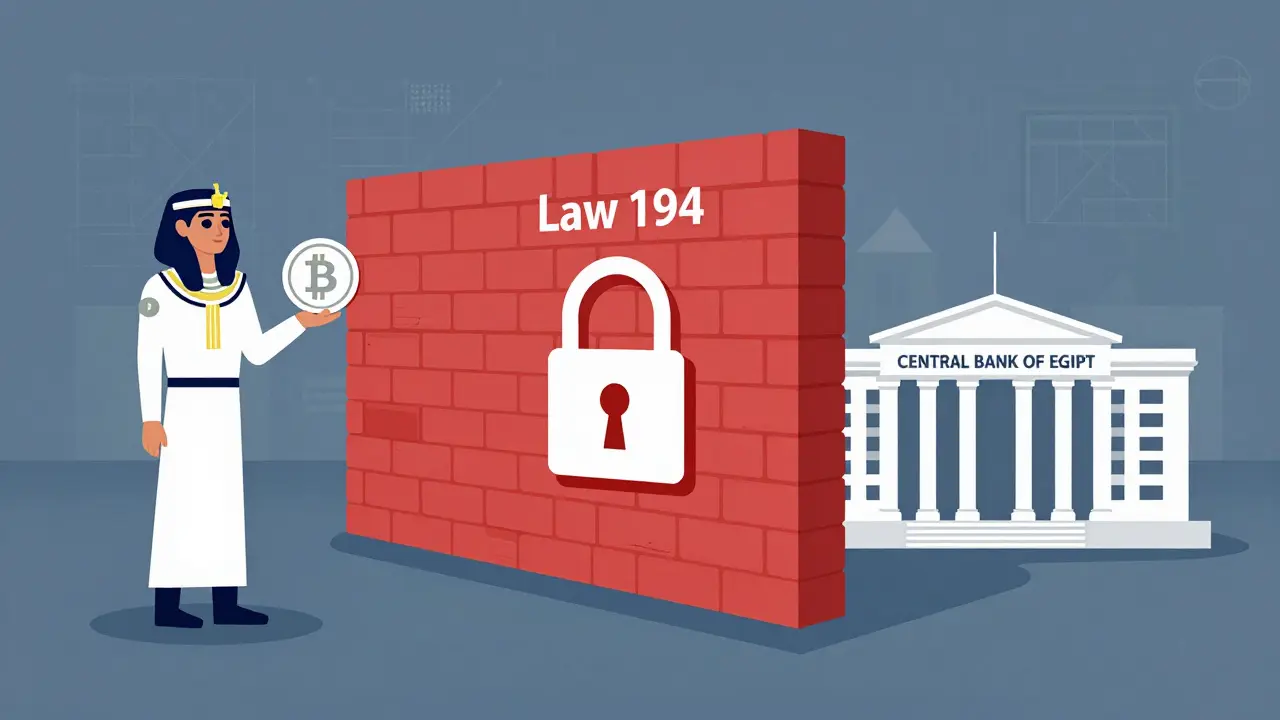
Buying Bitcoin in Egypt isn't just risky; it is illegal. If you are an Egyptian resident looking to trade digital assets, or a business trying to accept crypto payments, the legal landscape is starkly different from most of the world. The cornerstone of this restriction is Law No. 194 of 2020, formally known as the Central Bank and Banking Sector Law. This legislation, which came into effect on September 16, 2020, effectively placed a near-total ban on all cryptocurrency activities within the country. Understanding the specifics of this law is critical because ignorance of these rules can lead to frozen bank accounts, criminal charges, or significant financial loss.
The Legal Foundation: What Is Law 194 of 2020?
To understand why your crypto transactions are blocked, you need to look at the structure of the law itself. Before 2020, Egypt operated under Central Bank Law No. 88 of 2003. That older framework was repealed and replaced by the much more comprehensive Law 194. While the new law contains 241 articles covering various aspects of banking operations, one specific section has drawn global attention for its severity regarding digital assets.
Article 204 of Law 194 explicitly prohibits the issuance, trading, and promotion of cryptocurrencies without prior approval from the Central Bank of Egypt (CBE). This is not a vague guideline. It is a strict prohibition. The CBE, which operates with technical, financial, and administrative independence, holds the sole authority to grant exceptions. However, according to legal analyses from firms like Andersen Egypt, no such approvals have been granted to any commercial entity as of late 2023. This means that for all practical purposes, the market is closed.
The law targets three main activities:
- Issuance: You cannot create new tokens or conduct Initial Coin Offerings (ICOs).
- Trading: Buying, selling, or exchanging cryptocurrencies for fiat currency or other assets is banned.
- Promotion: Even marketing or advertising crypto services requires CBE approval, which is rarely given.
This broad scope ensures that not only exchanges but also mining operations and even informational platforms face regulatory hurdles if they lack explicit authorization.
Why Did Egypt Impose Such a Strict Ban?
It might seem counterintuitive for a nation eager to modernize its economy to shut out a growing global industry. However, the decision was driven by deep-seated concerns about monetary sovereignty and capital flight. Dr. Ahmed Kandil, a Professor of Financial Law at Cairo University, noted in a 2022 interview that the ban reflects fears that unchecked crypto adoption could destabilize the Egyptian Pound. Prior to the ban, internal reports estimated that crypto transactions were moving approximately $200 million annually out of the country.
The Central Bank of Egypt has consistently warned that cryptocurrencies lack legal protection and are subject to extreme price volatility. In their Fourth Warning Statement issued on March 8, 2023, the CBE reiterated these risks, emphasizing potential threats to consumer safety and overall financial stability. Unlike neighboring countries such as the UAE, which established the Virtual Assets Regulatory Authority (VARA) in 2022 to foster innovation, Egypt chose a prohibitive path similar to Algeria and Iraq. This stance places Egypt in the "prohibitive" category alongside major economies like China and India, according to the Cambridge Centre for Alternative Finance's 2023 Global Crypto Regulation Index.

Impact on Individuals: Frozen Accounts and Lost Funds
If you live in Egypt and try to use mainstream exchanges like Binance or Coinbase, you will quickly encounter barriers. These platforms often block IP addresses from Egypt or require identity verification that flags Egyptian residents against compliance lists. But the real danger lies in the banking sector.
Circular 4/2022, issued by the CBE, specifically prohibited banks from processing transactions to known cryptocurrency platforms. This directive forced Egyptian banks to implement aggressive transaction monitoring systems. The result? Many users found their accounts frozen after attempting to send money to crypto-related entities. Data from Chainalysis showed a 92% decline in peer-to-peer cryptocurrency trading volume in Egypt by Q4 2022 following these enforcement measures.
The human cost is significant. A Facebook group called 'Egypt Crypto Victims,' which had over 12,500 members by October 2023, documented hundreds of cases where individuals lost access to their funds. One survey indicated that 427 specific cases involved approximately $8.7 million in inaccessible assets. For many Egyptians who used crypto as a hedge against inflation or currency devaluation, this meant sudden, unrecoverable losses.
| Country | Regulatory Status | Key Authority | Business Friendliness |
|---|---|---|---|
| Egypt | Banned (with rare exceptions) | Central Bank of Egypt | Very Low |
| UAE | Regulated & Licensed | VARA / SCA | High |
| Saudi Arabia | Restricted but Exploring CBDC | SAMA | Moderate |
| Algeria | Banned | Bank of Algeria | Very Low |
Impact on Businesses and Fintech Startups
The ban hasn't just hurt individual traders; it has severely impacted Egypt's burgeoning fintech sector. Before the law, Egypt was seen as a promising hub for blockchain startups. However, the uncertainty and restrictions drove many entrepreneurs away. A November 2022 survey by the Egyptian Fintech Startup Association revealed that 78% of surveyed blockchain founders relocated their operations to Dubai or Singapore. This exodus represented an estimated $150 million in lost investment.
Faisal Arefin, Managing Director of the MENA Fintech Association, criticized the approach, arguing that the ban stifles a potential $3 billion market by failing to distinguish between speculative cryptocurrencies and useful blockchain technology applications. Indeed, the government’s position appears contradictory. In November 2022, while enforcing the crypto ban, the Ministry of Communications launched a national blockchain strategy. This paradox, described by Dr. Hanaa El Shenawy as "Egypt's Digital Policy Schizophrenia," leaves businesses confused about whether they can build on blockchain infrastructure without touching the banned assets.
For legitimate businesses, the compliance burden is heavy. All financial institutions must monitor transactions for crypto-related activity. Smaller institutions were given up to 18 months to implement these monitoring systems under Article 96's delegated services provisions. This creates a hostile environment for any startup hoping to integrate digital payments or explore decentralized finance (DeFi) solutions.

Enforcement Challenges and Loopholes
Despite the strict laws, enforcement is not perfect. The CBE acknowledges challenges in monitoring decentralized finance applications. In 2022, the bank allocated EGP 120 million ($3.8 million) for blockchain analysis tools, yet gaps remain. Approximately 3.2 million Egyptians, or 3.2% of the population, continue to access crypto services through virtual private networks (VPNs) and peer-to-peer transactions. Chainalysis estimates this underground market represents $1.1 billion in annual transaction volume.
However, using these loopholes carries immense risk. The law interacts with Egypt's 2018 Anti-Money Laundering Law, creating a scenario where violations can lead to dual prosecutions. The Egyptian Initiative for Personal Rights documented 47 known cases of such dual prosecutions in June 2023. Furthermore, Article 205 authorizes the CBE to refer violations to judicial authorities, though specific penalty amounts are not always publicized, leaving defendants uncertain about the severity of potential fines or imprisonment.
Future Outlook: Will the Ban Lift?
As we move into 2026, the question remains: will Egypt change its tune? Pressure is mounting from multiple directions. Egypt is negotiating an $8 billion bailout package with the International Monetary Fund (IMF). The IMF's July 2023 staff report specifically noted "regulatory barriers to fintech innovation" as an area requiring attention. This suggests that future tranches of aid might be tied to financial sector modernization, potentially including a reevaluation of the crypto ban.
Parliamentary discussions in February 2023 hinted at studying amendments to allow limited institutional trading. While no formal proposals were introduced by late 2023, the conversation has shifted from "total ban" to "controlled sandbox." Fitch Ratings suggested in September 2023 that regulatory evolution toward a controlled approach by 2026 is likely due to pressure from the tech sector and IMF conditions. Conversely, the World Bank projected the ban would remain intact through 2025 due to ongoing currency devaluation concerns.
For now, the status quo holds. The Central Bank of Egypt maintains that cryptocurrencies pose significant risks. Until there is a clear legislative amendment or a formal licensing framework announced by the CBE, engaging in crypto activities in Egypt remains a high-stakes gamble with severe legal consequences.
Is it illegal to own Bitcoin in Egypt?
While owning Bitcoin itself is not explicitly criminalized in a way that leads to immediate arrest for possession, the act of buying, selling, or trading it is strictly prohibited under Article 204 of Law 194 of 2020. Engaging in these transactions can lead to frozen bank accounts and legal action.
Can I use Binance or Coinbase in Egypt?
No. Major exchanges like Binance and Coinbase restrict access for users in Egypt due to the legal ban. Attempting to use them via VPN may result in account freezes, loss of funds, and potential legal repercussions under anti-money laundering laws.
What happens if my bank detects a crypto transaction?
Banks are required by Circular 4/2022 to monitor and block transactions to known crypto platforms. If detected, your account may be frozen pending investigation. The Central Bank of Egypt can refer such cases to judicial authorities for further legal action.
Are there any exceptions to the crypto ban?
Theoretically, yes. The Central Bank of Egypt has the authority to grant prior approval for cryptocurrency activities. However, as of late 2023, no commercial approvals have been publicly reported. Any exception would be highly restricted and case-by-case.
Will Egypt legalize cryptocurrency in the future?
There are indications that Egypt may move toward a regulated sandbox model by 2026, driven by IMF conditions and pressure from the fintech sector. However, current monetary sovereignty concerns mean a total lift of the ban is unlikely in the short term.