
DeFi Money Legos Explained: How Composable Protocols Build Complex Finance
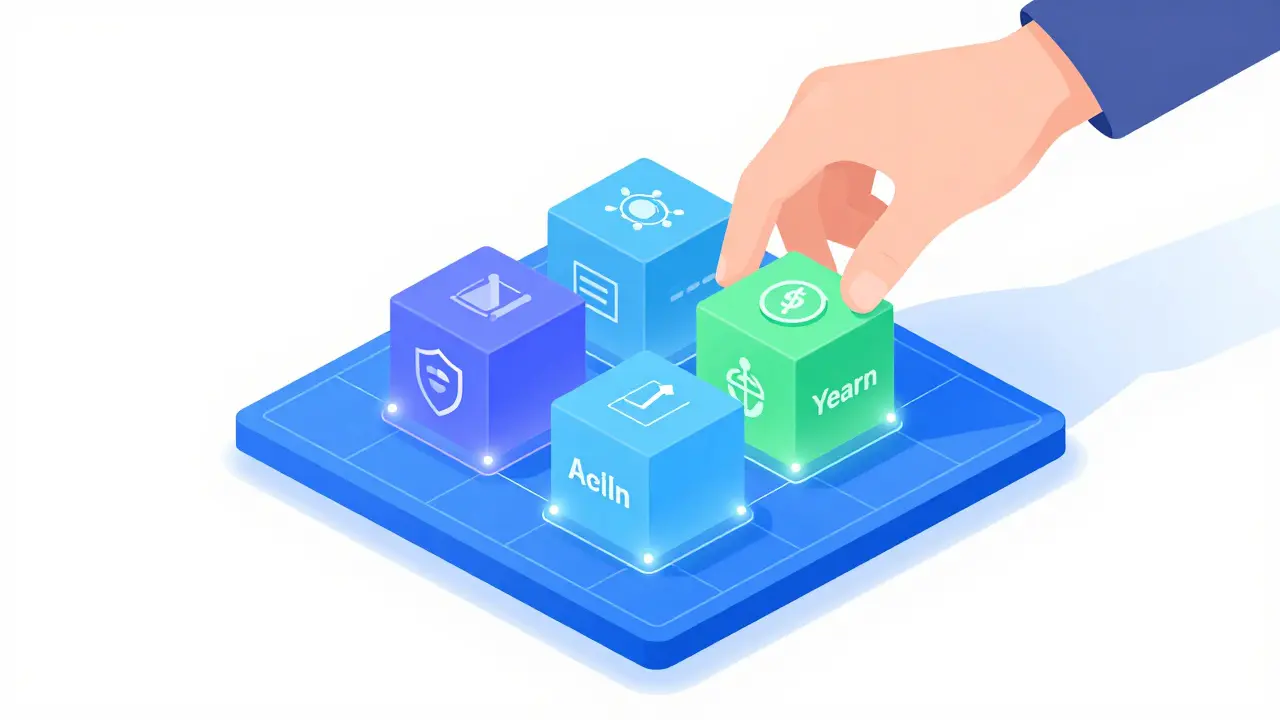
You’ve probably heard the term DeFi Money Legos thrown around in crypto Twitter threads or developer docs. It sounds playful, almost childish. But behind that nickname lies one of the most powerful technical advantages of decentralized finance (DeFi). Unlike traditional banking systems where each service is a walled garden, DeFi protocols are built to snap together like plastic bricks. This ability-called composability-lets developers and users stack financial tools on top of each other to create entirely new products without starting from scratch.
If you’re trying to understand how complex yield strategies work, why certain protocols grow so fast, or what makes DeFi different from Web2 fintech, this guide breaks it down. We’ll look at how these "legos" function, who uses them, and what risks come with building in public.
The Core Concept: Composability Over Isolation
In traditional finance, if you want to take out a mortgage, buy stocks, and get insurance, you deal with three separate companies. They don’t talk to each other easily. In DeFi, everything runs on open-source smart contracts that live on a blockchain. Because these contracts are transparent and permissionless, any protocol can interact with another as long as they share the same underlying standards.
This is what we mean by composability. A protocol doesn’t just offer a service; it offers an interface that other protocols can call. Think of it like API access, but instead of asking permission, you just read the code and build on it. The result? Financial infrastructure that acts more like a shared operating system than a collection of apps.
For example, Aave is a lending protocol that lets you borrow assets against collateral. But Aave isn’t just a loan provider-it’s a lego block. Another protocol, like Yearn Finance, can automatically deposit your borrowed assets into high-yield opportunities elsewhere. You didn’t have to move funds manually. The contracts did it for you, instantly and atomically.
How Developers Use Money Legos
Building from zero is expensive and slow. Most startups spend months creating basic features like wallets, payments, or identity verification. In DeFi, those basics already exist. Developers pick existing blocks and chain them together.
- Lending: Use Aave or Compound to borrow stablecoins.
- Trading: Swap tokens via Uniswap or Curve.
- Yield Optimization: Auto-compound returns using Yearn vaults.
- Insurance: Protect positions with Nexus Mutual.
- Identity/KYC: Add compliance layers via Civic or Polygon ID (optional).
A developer might combine all five into a single dApp that lets users borrow, trade, earn yield, insure their portfolio, and verify identity-all in one transaction flow. No backend servers needed. Just smart contracts calling smart contracts.
Platforms like Furucombo let non-coders experiment with these combinations visually. You drag and drop steps, simulate outcomes, and deploy if you’re ready. It’s prototyping at light speed.
Real-World Example: One Transaction, Multiple Actions
Let’s walk through a real scenario. Imagine you hold ETH and want to generate yield without selling your position. Here’s how you could use Money Legos:
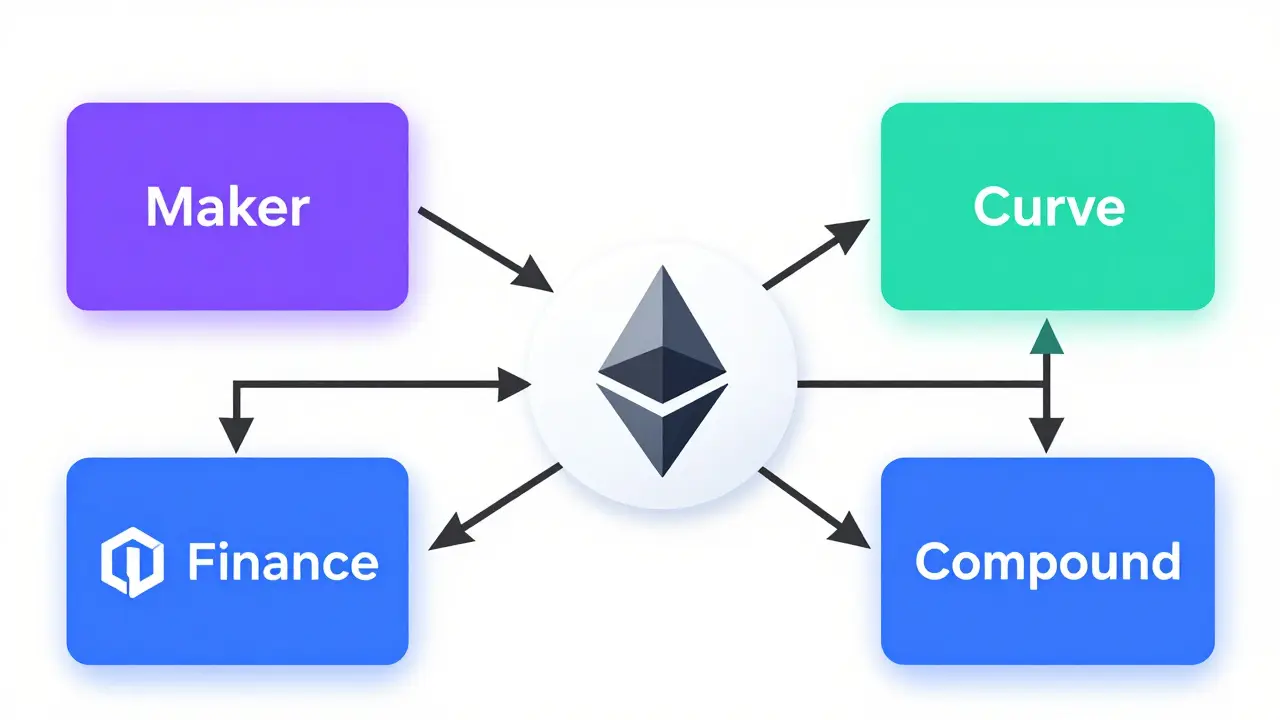
- Deposit ETH into MakerDAO as collateral.
- Borrow DAI (a stablecoin) against that ETH.
- Send half the DAI to Curve Finance to provide liquidity in a low-slippage pool.
- Use the other half to supply to Compound to earn interest.
- Set up a trigger so when ETH price drops 10%, the system auto-repays the loan to avoid liquidation.
All of this happens in a single atomic transaction. If any step fails, the whole thing reverts. No partial states. No manual intervention. That’s the power of composable architecture.
Why Ethereum Dominates the Lego Stack
Most DeFi Money Legos run on Ethereum. Why? Because it has the deepest liquidity, the most audited contracts, and the largest community of builders. As of early 2026, over $50 billion remains locked in Ethereum-based DeFi protocols, according to data from DefiLlama.
But Ethereum isn’t alone. Other chains are catching up:
| Network | Total Value Locked (TVL) | Avg Gas Fee (USD) | Key Protocols | Composability Maturity |
|---|---|---|---|---|
| Ethereum | $52B+ | $3-$15 | Aave, Uniswap, MakerDAO | High |
| Solana | $8B+ | $0.01-$0.10 | Hubble Protocol, Raydium | Moderate |
| Polygon | $4B+ | $0.05-$0.50 | QuickSwap, Aave V3 | High |
| Avalanche | $3B+ | $0.10-$1.00 | Benqi, Trader Joe | Moderate |
Cross-chain bridges and interoperability protocols like LayerZero and Wormhole are helping connect these ecosystems. Soon, you might build a strategy that starts on Solana, moves to Ethereum, and ends on Polygon-all without leaving your wallet.
Risks and Limitations
Composability brings efficiency, but also risk. When protocols depend on each other, a failure in one can cascade through others. This is called systemic risk.
Consider the 2022 collapse of TerraUSD. Many DeFi protocols accepted UST as collateral. When UST depegged, loans defaulted across multiple platforms. Even healthy protocols suffered because their underlying assets vanished overnight.
Other risks include:
- Smart contract bugs: A vulnerability in one lego can break the entire structure.
- Oracle manipulation: If a price feed is hacked, automated strategies may execute poorly.
- Regulatory uncertainty: Some jurisdictions view composability as facilitating unlicensed financial services.
- User complexity: Novices may not understand the risks of nested positions.
That said, audits, bug bounties, and formal verification methods are improving security. Tools like Slither and Mythril help developers catch issues before deployment. And user interfaces are getting smarter, showing risk scores and dependency maps.

Who Benefits From Money Legos?
Not everyone needs to build complex strategies. But understanding how Money Legos work helps you make better decisions whether you’re a developer, investor, or everyday user.
- Developers save time by reusing proven code instead of reinventing wheels.
- Investors can compare yields across protocols and optimize returns.
- Users gain access to institutional-grade tools without gatekeepers.
- Protocols benefit from network effects-the more people use your lego, the more valuable it becomes.
Even casual users win. For instance, if you just want to earn interest on USDC, you don’t need to know about flash loans or AMMs. You just deposit into a vault that handles the complexity behind the scenes.
The Future: Beyond Single Chains
We’re moving toward a multi-chain world where Money Legos aren’t limited to one network. Projects like Chainlink CCIP and Axelar enable secure cross-chain messaging. This means a protocol on Arbitrum can trigger actions on Optimism or Base seamlessly.
Imagine a future where your morning coffee routine includes checking a dashboard that shows:
- Your ETH staked on Lido earning rewards.
- Those rewards automatically swapped to USDT via 1inch.
- USDT lent on Aave to cover your monthly expenses.
- Any surplus sent to a savings account on Celo.
All automated. All composable. All yours.
What exactly are DeFi Money Legos?
DeFi Money Legos refer to the concept of composability in decentralized finance, where individual protocols act as building blocks that can be combined to create new financial products. Like physical Legos, these digital components snap together via smart contracts to form complex systems without requiring custom development for every feature.
Can I use Money Legos without coding knowledge?
Yes. While developers write the underlying smart contracts, end-users interact with front-end interfaces that abstract away the complexity. Platforms like Furucombo or Yield Guild Games allow non-programmers to design and execute multi-step strategies using visual builders.
Is it safe to rely on composable protocols?
Safety depends on the quality of the underlying contracts and the transparency of the ecosystem. Reputable protocols undergo regular audits, publish source code, and maintain bug bounty programs. However, systemic risks remain-always diversify and monitor dependencies.
Which blockchain supports the most Money Legos?
Ethereum currently hosts the largest number of composable DeFi protocols due to its first-mover advantage, deep liquidity, and mature tooling. However, Layer 2 solutions like Arbitrum and Optimism, along with alternative chains like Solana and Polygon, are rapidly expanding their own Lego stacks.
How do I start experimenting with Money Legos?
Begin by setting up a self-custody wallet like MetaMask or Rabby. Fund it with a small amount of ETH or stablecoins. Then explore platforms like Furucombo, DeFi Saver, or Zap to test simple strategies such as borrowing against collateral or providing liquidity. Start small, learn the mechanics, and scale gradually.