
Crypto Taxation in Mexico: Income, Capital Gains, and Compliance Rules

Buying Bitcoin in Mexico doesn't make you immune to the Servicio de Administración Tributaria (SAT), the country's tax authority. In fact, it might just add a layer of complexity to your finances that many investors overlook until they receive a notice. Unlike some countries with specific crypto-friendly laws or clear-cut exemptions, Mexico treats digital assets through the lens of general property and income laws. This means there is no single "crypto tax" rate; instead, your taxes depend on whether you are an individual or a corporation, how much you earn, and when you decide to sell.
If you are holding crypto in Mexico, you need to understand that silence is not a strategy. The regulatory framework, largely shaped by the 2018 Fintech Law, classifies cryptocurrencies as intangible movable assets. This classification has massive implications for how you report gains, calculate VAT, and keep records. Let’s break down exactly what you owe, when you owe it, and how to stay compliant without overpaying.
The Core Rule: Crypto Is Property, Not Currency
To understand Mexican crypto taxation, you first have to accept one fundamental premise: the government does not view Bitcoin or Ethereum as money. Under Articles 758 and 763 of the Federal Civil Code, these assets are classified as intangible movable assets. They are recognized as tradeable property, but they carry no government backing and are not legal tender.
Why does this distinction matter? Because it dictates how your taxes are calculated. If crypto were currency, you might only pay tax on exchange rate fluctuations. Since it is property, every time you dispose of it-whether by selling it for pesos, swapping it for another coin, or using it to buy coffee-you trigger a taxable event. You are essentially selling a piece of property at its fair market value at that exact moment.
This realization-based approach means that simply watching your portfolio grow in value does not create a tax liability. You only owe taxes when you actually transfer ownership or use the asset. However, this also means that active traders who frequently swap tokens can accumulate significant tax liabilities even if they never convert back to fiat currency.
Tax Rates for Individuals: Progressive Brackets Apply
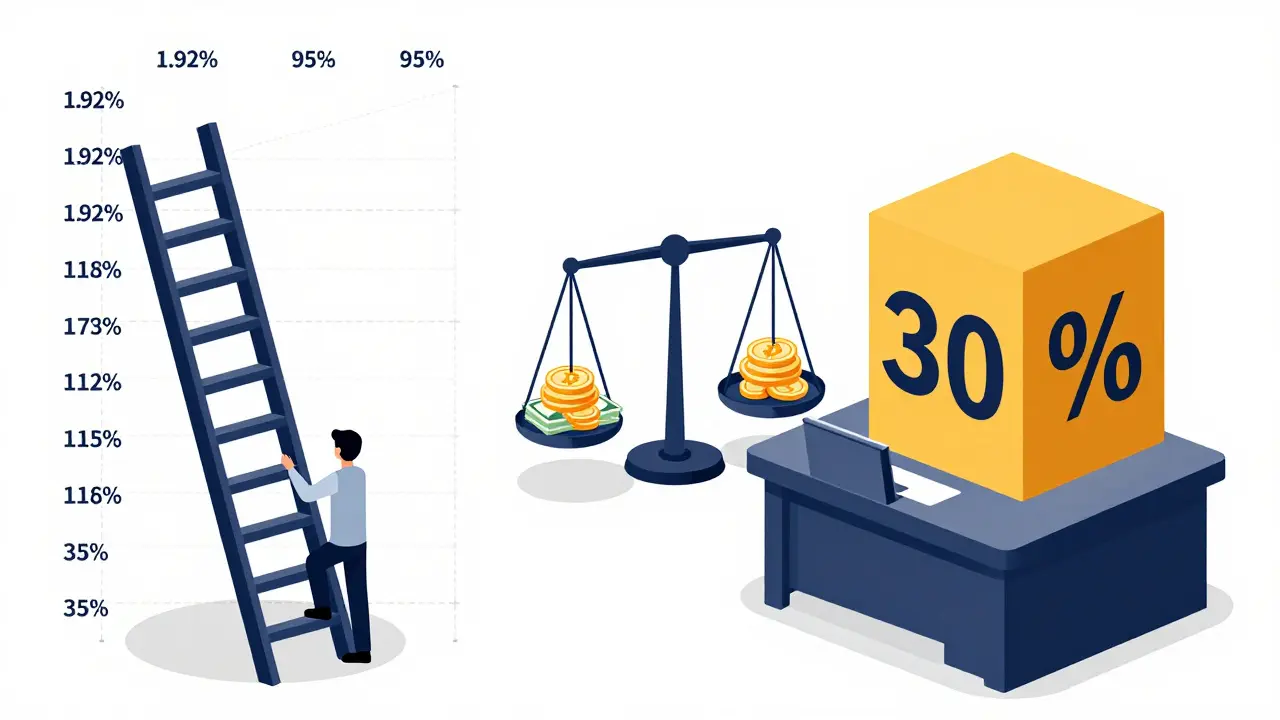
For individual taxpayers in Mexico, there is no special low rate for capital gains on cryptocurrency. Instead, profits from crypto transactions are added to your total annual income and taxed under the standard progressive Income Tax (ISR) brackets. These rates range from 1.92% to 35%, depending on your total taxable income level.
Here is how it works in practice:
- Total Income Calculation: You must combine your salary, business income, and crypto gains into one pot.
- Progressive Rate: The higher your total income, the higher the percentage you pay on the marginal portion of your earnings.
- No Distinction: The law does not differentiate between ordinary income (like wages) and capital gains (like crypto profits). Both are taxed at the same schedule.
There is a small silver lining for casual users. Mexican individuals benefit from an annual tax exemption on capital gains from the sale of movable property up to approximately $90,000 Mexican pesos (roughly USD $4,000-$5,000 depending on the exchange rate). If your total crypto gains for the year fall below this threshold, you may not owe any income tax on them. However, once you exceed this limit, the entire amount becomes subject to the progressive tax rates, integrated with your other income.
Corporate Taxation: A Flat 30% Rate
If you hold cryptocurrency through a company rather than personally, the rules simplify slightly but become steeper. Corporate income tax on cryptocurrency gains is levied at a flat rate of 30% for all legal entities operating in Mexico. This rate applies regardless of whether you held the asset for one day or ten years. There is no long-term capital gains discount for corporations.
For businesses, this means that trading desks, mining operations, or corporate treasury holdings must account for this 30% hit on all realized profits. It is crucial to note that losses can generally be deducted against future gains, but strict record-keeping is required to prove these losses occurred. The Mexican Income Tax Law (MITL) does not allow for mark-to-market accounting for most assets, so you cannot deduct paper losses; you must actually sell or dispose of the asset to realize the loss.
When Do You Owe Taxes? Understanding Realization Events
Many investors mistakenly believe they only pay taxes when they withdraw money to their bank account. In Mexico, this is incorrect. A "realization event" triggers tax liability whenever you change the ownership status of your crypto. Here are the most common scenarios:
- Selling for Fiat: Exchanging Bitcoin for Mexican Pesos (MXN) or US Dollars (USD) is a clear taxable sale.
- Crypto-to-Crypto Swaps: Trading Bitcoin for Ethereum is treated as two events: selling Bitcoin (triggering gain/loss) and buying Ethereum. You must calculate the gain on the Bitcoin based on its value at the time of the swap.
- Purchasing Goods or Services: Using crypto to pay for a laptop, rent, or even a coffee is considered a disposition. You are deemed to have sold the crypto at its fair market value at the time of purchase. If you bought the crypto years ago for less, you owe tax on the appreciation.
- Gifting or Transferring: Sending crypto to another wallet where you do not control the private keys can be viewed as a disposal, potentially triggering tax.
This creates a significant administrative burden for active users. Every transaction requires you to determine the cost basis of the specific coins being spent and compare it to their current market value.
Value-Added Tax (VAT) Implications
Beyond income tax, you must consider Value-Added Tax (IVA). Transactions involving cryptoassets are generally subject to VAT, although the application can be nuanced. Since crypto is treated as an intangible asset, services related to its management, such as those provided by exchanges or custodians, often attract the standard VAT rate.
However, the direct exchange of crypto for fiat or other crypto is not always explicitly taxed with VAT at the point of sale in the same way a retail good is, due to the lack of specific guidance. Most tax experts advise treating crypto-related professional services (like consulting or platform fees) as VAT-liable. If you are a business issuing invoices for crypto-related services, you must include VAT unless a specific statutory exemption applies. The absence of explicit SAT guidance here means caution is key: assume VAT applies unless you have a definitive ruling stating otherwise.
Compliance and Anti-Money Laundering (AML) Rules
Taxes are only half the battle. Mexico has strict anti-money laundering (AML) regulations overseen by the Ministry of Finance and Public Credit. Whether you are an individual or a non-financial entity, you are subject to these rules if you engage in "vulnerable activities," which includes virtual asset transactions.
The critical threshold is approximately USD $3,500 (or its equivalent in MXN). If you conduct transactions involving virtual assets above this amount, they must be reported to the authorities. For financial institutions like banks and licensed fintechs, the rules are even stricter. They require prior authorization from Banco de México to handle virtual assets and are prohibited from offering crypto services directly to the public or transferring risk to clients.
For the average investor, this means that large transfers or frequent high-value trades may trigger reports to the Financial Intelligence Unit. While this is primarily an AML measure, it ensures that your crypto activity is visible to the state, making tax evasion increasingly difficult.
| Feature | Individuals | Corporations |
|---|---|---|
| Tax Rate | Progressive (1.92% - 35%) | Flat 30% |
| Exemption Threshold | ~$90,000 MXN/year | None |
| Long-Term Discount | No | No |
| VAT Applicability | On services/fees | On services/fees |
| Reporting Trigger (AML) | >$3,500 USD equivalent | >$3,500 USD equivalent |
Record-Keeping: Your Best Defense
Because the SAT does not provide specific software or tools for crypto tracking, the burden of proof lies entirely with you. To defend your tax position in case of an audit, you must maintain detailed records for every transaction. This includes:
- Date of Acquisition: When you bought or mined the crypto.
- Cost Basis: How much you paid in MXN or USD, including fees.
- Date of Disposition: When you sold, swapped, or spent it.
- Fair Market Value: The value of the crypto in MXN at the exact time of the transaction.
- Counterparty Info: Who you traded with, if applicable.
Most professionals recommend using the First-In, First-Out (FIFO) method for calculating cost basis, as it aligns with general Mexican tax principles for movable property. This means the first coins you bought are the first ones considered "sold" when you dispose of any amount. Specialized crypto tax software can help automate this, but ensure it can generate reports compatible with Mexican peso conversions.
What About Mining and Staking?
The lines blur when you earn crypto rather than buy it. Mining rewards and staking yields are generally treated as income at the fair market value when received. This means you owe tax on the value of the coins on the day they hit your wallet, even if you don't sell them immediately. Subsequent sales then trigger capital gains tax based on the difference between that initial income value and the new sale price.
Airdrops and hard forks follow similar logic. If you receive free tokens, that is taxable income. The lack of specific SAT rulings on DeFi yield farming or complex smart contract interactions creates uncertainty, but the safest approach is to treat all inflows of value as taxable income upon receipt.
Future Outlook: Stability Amidst Caution
Under the current administration led by President Claudia Sheinbaum, there is little indication of a shift toward crypto-friendly policies. The ruling Morena Party has focused on amending existing laws rather than creating comprehensive crypto frameworks. Recent amendments have included efforts to regulate blockchain technology for security and imposing taxes on gains, reinforcing the status quo.
Unlike El Salvador, which experimented with Bitcoin as legal tender (a status modified in early 2025), or Argentina, which offered tax amnesties, Mexico maintains a cautious, restrictive stance. The focus remains on AML compliance and integrating crypto into the existing tax net. Investors should expect more administrative guidance rather than legislative reform in the near term.
Is crypto tax-free in Mexico?
No. Cryptocurrency is not tax-free. It is taxed as income or capital gains. Individuals pay progressive rates up to 35%, while corporations pay a flat 30%. There is a small annual exemption for individuals (~$90,000 MXN), but beyond that, all gains are taxable.
Do I pay tax if I swap Bitcoin for Ethereum?
Yes. Swapping one cryptocurrency for another is considered a taxable event. You are deemed to have sold the first crypto at its market value, triggering potential capital gains tax, and then purchased the second.
How do I report crypto income to the SAT?
You report crypto gains as part of your annual income declaration. You must calculate the profit (sale price minus cost basis) for each transaction, convert values to Mexican Pesos, and include them in your total taxable income. Use FIFO accounting for cost basis unless you have a justified alternative method.
Are there penalties for not reporting crypto?
Yes. Failure to report income can result in fines, interest on unpaid taxes, and potential criminal charges for tax evasion. Additionally, large unreported transactions may trigger AML investigations due to the $3,500 USD reporting threshold.
Does Mexico tax foreign residents on crypto?
Generally, non-Mexican residents are not subject to Mexican income tax on cryptocurrency transactions, even if they involve a Mexican counterparty, unless the income is sourced specifically within Mexico in a way that establishes a permanent establishment.