
Crypto Licensing Guide: Navigating US State and Federal Rules

Imagine building a revolutionary crypto exchange, pouring your life savings into development, and then getting shut down by regulators because you missed a single form in New York. That is the reality for many digital asset startups. The United States does not have one simple rulebook for cryptocurrency businesses. Instead, it has a tangled web of federal mandates and state-specific hurdles that can cost hundreds of thousands of dollars before you even process your first trade.
If you are launching a platform today, understanding these requirements is not just legal box-checking-it is survival. This guide breaks down exactly what you need to operate legally in the US as of 2026, cutting through the noise to give you actionable steps.
The Federal Baseline: FinCEN and MSB Registration
Before you worry about individual states, you must look at the federal level. In 2013, the Financial Crimes Enforcement Network (FinCEN) classified cryptocurrency exchangers and administrators as Money Services Businesses (MSBs). This classification falls under the Bank Secrecy Act (BSA), which means if you move value, you are subject to strict anti-money laundering (AML) rules.
Registering with FinCEN is mandatory for any business that accepts currency or other monetary instruments and transmits them to another location or person. This isn't optional. If you fail to register, you face heavy fines and potential criminal charges. The core requirement here is robust AML compliance. You must implement programs that detect suspicious activity, report transactions over $10,000, and keep records for five years. Think of this as your entry ticket. Without an MSB registration, no serious bank will touch you, and most state regulators won't even look at your application.
The State-Level Maze: Why One License Isn't Enough
Here is where things get complicated. While FinCEN sets the federal floor, each state sets its own ceiling. As of 2024, 47 states plus Washington D.C. maintain their own money transmitter licensing frameworks. This fragmentation means a startup operating nationally might need up to 32 separate licenses. Yes, thirty-two.
Most states require a Money Transmitter License (MTL) if you facilitate crypto-to-fiat transactions. Pure crypto-to-crypto exchanges often fall under different interpretations but usually still trigger MSB-like obligations. The variation is extreme. Some states are lenient; others are brutal. For example, Illinois exempts purely digital entities from certain traditional banking laws, while New York imposes some of the toughest regulations in the country.
| State | License Type | Min. Net Worth | Application Fee | Avg. Approval Time |
|---|---|---|---|---|
| New York | BitLicense | $500,000 | $5,000 | 6-12 Months |
| California | DFPI License | $250,000 | $2,500 | 3-6 Months |
| Wyoming | SPDI / MTL | Varies | $500 - $2,000 | ~90 Days |
| Texas | Money Transmitter | $100,000+ | $1,000+ | 4-8 Months |
The New York Standard: What is a BitLicense?
You cannot talk about crypto regulation without talking about the BitLicense. Introduced by the New York State Department of Financial Services (NYDFS) in 2015, this framework applies to any business serving New York residents, regardless of where the company is physically located. Because New York is a massive market, many companies treat the BitLicense as a de facto national standard.
The BitLicense covers five specific activities: receiving/transmitting virtual currency, storing/maintaining custody, buying/selling as a customer business, exchange services, and controlling/administering virtual currency. If you do any of these for NY users, you need this license. It requires rigorous background checks on all principals, detailed cybersecurity protocols (meeting Part 500 standards), and proof of financial stability. Superintendent Adrienne Harris noted in 2024 that these standards have protected consumers from billions in fraud, but they also create high barriers to entry. Expect to spend between $500,000 and $2 million on compliance costs alone to secure this license.

Wyoming and Other Friendly Jurisdictions
Not every state makes you jump through flaming hoops. Wyoming has positioned itself as a blockchain-friendly hub. Its Virtual Currency Act and Special Purpose Depository Institution (SPDI) charter offer more flexible requirements tied to business scale rather than rigid net worth floors. The application timeline in Wyoming averages 90 days, compared to New York's 180+ days. This speed attracts startups looking to launch quickly while maintaining regulatory compliance.
Other states like South Carolina have streamlined processes with single application portals covering multiple license types. If you are bootstrapped, targeting friendly jurisdictions first allows you to build revenue and compliance history before tackling harder markets like California or New York.
Compliance Costs and Hidden Pitfalls
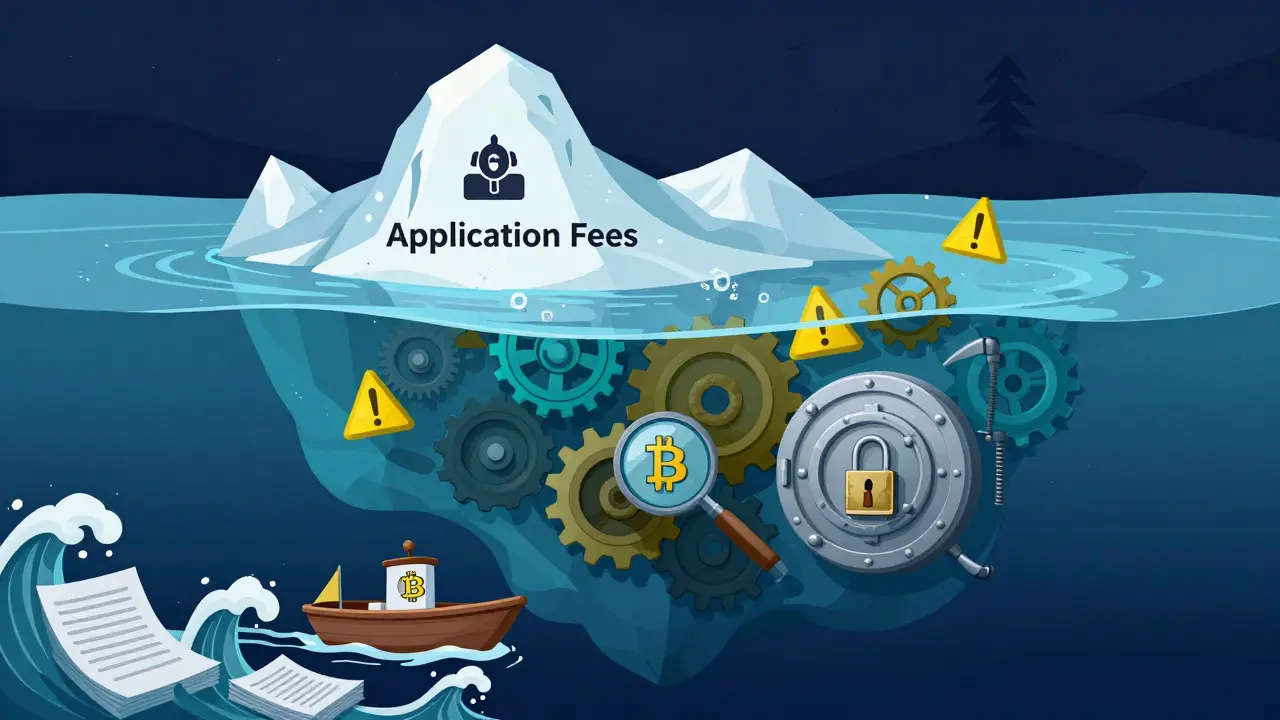
Licensing fees are just the tip of the iceberg. The real cost lies in operational compliance. Dr. Sarah Chen, Director of the Blockchain Regulatory Institute, testified that average compliance costs range from $500,000 to $2 million for startups. This includes hiring specialized legal counsel, implementing automated monitoring systems, and conducting regular audits.
One major pitfall is banking relationships. Traditional banks are risk-averse regarding crypto. A 2024 survey showed that 73% of crypto businesses struggle to secure banking services. Without a bank account, you cannot easily hold fiat reserves or process wire transfers, which are often prerequisites for state licenses. You may need to partner with specialized fintech banks or credit unions familiar with digital assets.
Another common failure point is inadequate AML documentation. Cornerstone Licensing reported that 42% of initial applications fail due to poor AML program details. Your policies must be specific, not generic. They need to address how you verify identities (KYC), monitor transactions, and report suspicious activities.
Recent Trends and Future Outlook
The landscape is shifting. The Money Transmitter Modernization Act, introduced in Congress, proposes a federal framework that could reduce state-level requirements by 40%. Meanwhile, the SEC has increased enforcement actions by 220% since 2022, focusing heavily on unlicensed security token offerings. DeFi platforms are also under scrutiny; recent FinCEN guidelines suggest that decentralized applications with sufficient centralization may require MSB registration.
Gartner forecasts that by 2026, 65% of US states will harmonize their licensing frameworks through interstate compacts. This would significantly lower compliance costs. However, until then, businesses must remain agile. The trend is toward stricter consumer protection and transparency, driven by high-profile failures like QuadrigaCX, which collapsed partly due to jurisdictional confusion.
Actionable Steps for Launch
- Determine your scope: Identify which states you serve. Do not try to go national on day one unless you have deep pockets.
- Register with FinCEN: Complete your MSB registration immediately. This is the foundation.
- Hire specialized counsel: General corporate lawyers often miss crypto-specific nuances. Look for firms experienced in BSA/AML and state money transmission laws.
- Secure banking early: Start conversations with crypto-friendly banks months before you need them.
- Build robust AML/KYC systems: Use automated tools for identity verification and transaction monitoring to satisfy regulators.
Do I need a license if I only trade my own crypto?
Generally, no. Individual investors trading for their own account are not considered money transmitters. However, if you act as an intermediary for others or run a business entity that facilitates trades for customers, licensing requirements apply.
How long does it take to get a BitLicense?
The process typically takes 6 to 12 months. This includes time for document preparation, background checks, and NYDFS review. Delays are common if your AML program or financial statements are incomplete.
Can I operate in multiple states with one license?
No, there is no single national license yet. You generally need separate licenses for each state where you conduct business, although some states have reciprocity agreements. Always check current state laws as they change frequently.
What happens if I operate without a license?
You risk severe penalties, including fines, cease-and-desist orders, and criminal charges. Additionally, banks may close your accounts, making it difficult to operate even if you eventually obtain a license.
Are stablecoins treated differently?
Yes, depending on the state. Some jurisdictions regulate stablecoin issuers under banking laws rather than money transmitter laws. Check with local regulators, as classifications vary significantly between states like New York and Wyoming.