
Crypto Consumer Protection in Australia: What the New Regulations Mean for You
Crypto Regulatory Threshold Calculator
Determine Your Regulatory Status
Check if your crypto business meets Australia's exemption thresholds for not requiring an Australian Financial Services Licence (AFSL).
Your business meets the low-risk exemption thresholds and does not require an AFSL.
You must still register with AUSTRAC, implement AML/KYC programs, and comply with Australian Consumer Law.
Your business exceeds the low-risk exemption thresholds and requires an Australian Financial Services Licence (AFSL).
You must obtain AFSL under the Corporations Act 2001 and comply with all related requirements.
Quick Takeaways
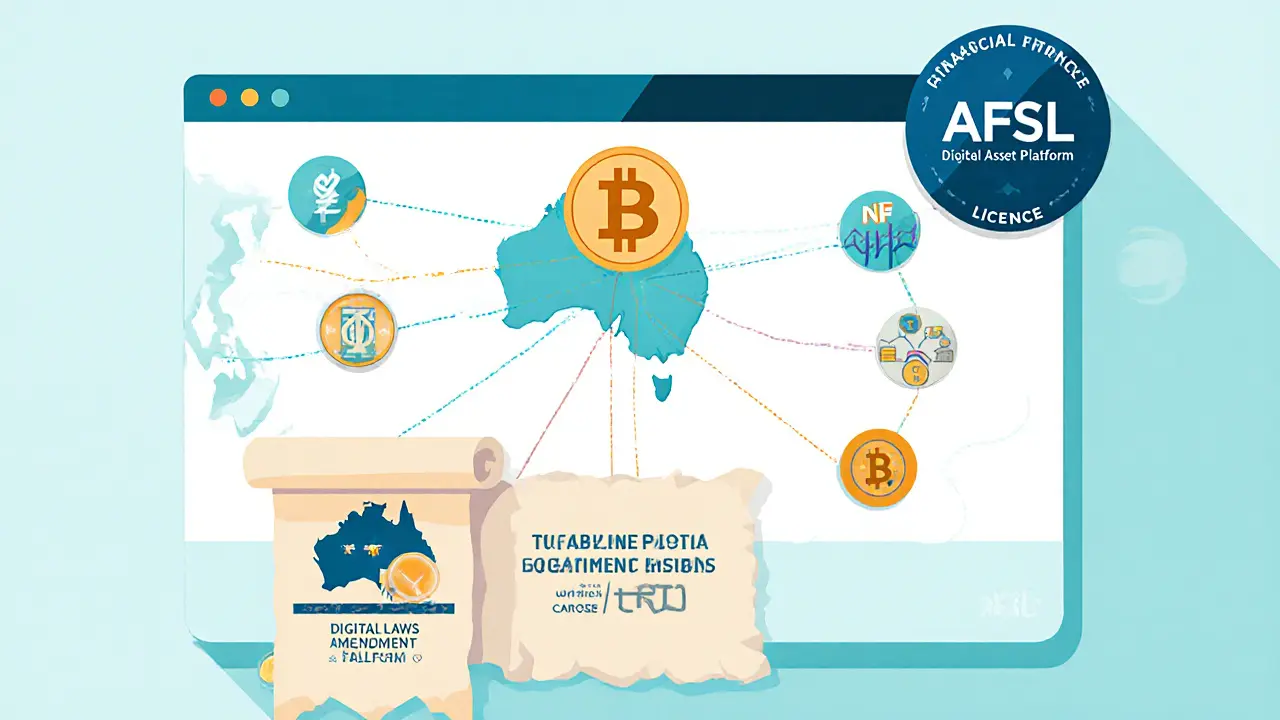
- From July 2025 the Treasury Laws Amendment Bill creates two new regulated product categories - Digital Asset Platforms (DAP) and Tokenised Custody Platforms (TCP) - that must hold an Australian Financial Services Licence (AFSL).
- All crypto‑exchange services that deal with Bitcoin, stablecoins, NFTs (except gaming‑only NFTs) and tokenised securities will fall under the new consumer‑protection rules.
- Platforms handling less than $5,000 per customer and $10 million in yearly transactions are exempt from licensing, but they still must obey AML/KYC and Australian Consumer Law.
- Breaches can attract fines of $16.5 million or more, plus compulsory dispute‑resolution and compensation schemes.
- Consumers should look for the AFSL badge, read the platform’s dispute‑resolution process, and verify that the service is registered with AUSTRAC.
Cryptocurrency regulation in Australia is the set of laws and consumer‑protection rules that govern crypto‑related services, from exchanges to token‑custody providers, under the Corporations Act 2001. The government’s latest push, the Treasury Laws Amendment Bill 2025, aims to plug the gaps exposed by the 2022 FTX collapse and bring crypto platforms into the same safety net that protects traditional financial services.
Why Australia Needed a New Framework
Before 2025 Australia’s crypto market was policed by a patchwork of agencies. AUSTRAC handled anti‑money‑laundering (AML) registration, while ASIC stepped in only when a token qualified as a financial product. This split oversight left consumers unsure whether their exchange was truly regulated, and it gave rogue operators room to slip through the cracks.
The Treasury’s “fourth step” consultation, running until 24 October 2025, recognised that a single, cohesive regime would give investors confidence and give regulators clearer enforcement tools.
What the Bill Introduces: Two New Product Categories
The legislation carves out two categories within the Corporations Act 2001:
- Digital Asset Platform (DAP): any service that enables buying, selling, or exchanging crypto‑assets for fiat or other digital assets.
- Tokenised Custody Platform (TCP): providers that hold, safeguard, or administer tokenised securities, stablecoins, or other bearer‑like assets on behalf of clients.
Both DAPs and TCPs are collectively called “crypto platforms” and must obtain an Australian Financial Services Licence (AFSL). Holding an AFSL brings the platform under the same conduct, disclosure, competence, and dispute‑resolution standards that apply to banks, insurers, and investment advisers.
Which Assets Are Covered?
The bill adopts a functional approach, covering any crypto‑asset that behaves like a commodity, a collectible, or a bearer instrument. In practice this means:
- Bitcoin and other major cryptocurrencies are fully regulated.
- Stablecoins, tokenised securities, and other “bearer‑like” tokens fall under the same rules.
- Non‑financial‑product NFTs are covered when they are marketed as investment opportunities, but gaming‑only NFTs are explicitly excluded.
Token issuers that use crypto purely for utility (e.g., access to a platform) are not forced to obtain an AFSL, but they must still comply with general consumer‑law prohibitions on misleading conduct.
Exemptions: The Low‑Risk Threshold
To avoid stifling small innovators, the bill carves out a “low‑risk” exemption. Platforms that meet BOTH of the following criteria do not need an AFSL:
- Average transaction per customer is under $5,000.
- Annual transaction volume across all customers is under $10 million.
Even exempt platforms must be registered with AUSTRAC, implement AML/KYC programs, and obey the Australian Consumer Law (ACL) - meaning no false advertising, no bait‑and‑switch offers, and an obligation to provide clear, accurate information.

Compliance Obligations for Licensed Platforms
Holding an AFSL is just the start. Licensed platforms must meet a suite of operational requirements:
- Conduct and disclosure: All fees, risks, and transaction processes must be disclosed in plain language.
- Competence and training: Senior managers need documented crypto‑industry qualifications and ongoing training.
- Conflict of interest management: Platforms must have written policies to prevent preferential treatment of any client.
- Risk management: Formal risk‑assessment frameworks for market, credit, and operational risks.
- Dispute resolution: Membership in an ASIC‑approved external dispute‑resolution scheme and clear internal complaint handling.
- Compensation arrangements: A fund or insurance policy to reimburse consumers if the platform collapses or loses assets due to negligence.
Failure to meet any of these standards can trigger fines of $16.5 million or higher, plus possible criminal sanctions for reckless conduct.
AML, CTF, and KYC: The Backbone of Consumer Safety
All crypto businesses, licensed or exempt, must run a robust Anti‑Money Laundering (AML) / Counter‑Terrorism Financing (CTF) program. Key components include:
- Know Your Customer (KYC) verification - identity documents, facial verification, and source‑of‑funds checks.
- Transaction monitoring - real‑time alerts for suspicious patterns.
- Suspicious Activity Reporting (SAR) to AUSTRAC within the statutory timeframe.
- Retention of detailed transaction logs for at least seven years.
These measures not only deter criminal activity but also give regulators a clear audit trail if something goes wrong.
Enforcement Landscape: Who Polices What?
Two regulators share the enforcement load:
- ASIC pursues breaches of the Corporations Act, including misleading marketing, failure to hold an AFSL, and inadequate compensation schemes.
- AUSTRAC enforces AML/CTF obligations, can impose daily fines for non‑registration, and can issue enforcement notices for inadequate KYC.
Both agencies have been active in recent years, issuing fines and banning unregistered operators. The new bill simply gives them clearer jurisdiction over the same entities.
Industry Reaction: Support, Concerns, and What’s Next
Major Australian exchanges-Independent Reserve, BTC Markets, and OKX Australia-have welcomed the clarity. OKX’s CEO, Kate Cooper, called the reforms “the clearest signal yet that crypto is embedded in the financial system.” However, they caution that enforcement must be consistent; otherwise, unlicensed operators could undercut legitimate players.
Legal experts, such as Thomson Geer partner Liam Hennessy, say the balance between innovation and consumer safety looks well‑calibrated. The main concern now is the implementation timeline-a clear rollout plan and predictable enforcement criteria will be essential for market confidence.
Practical Checklist for Consumers
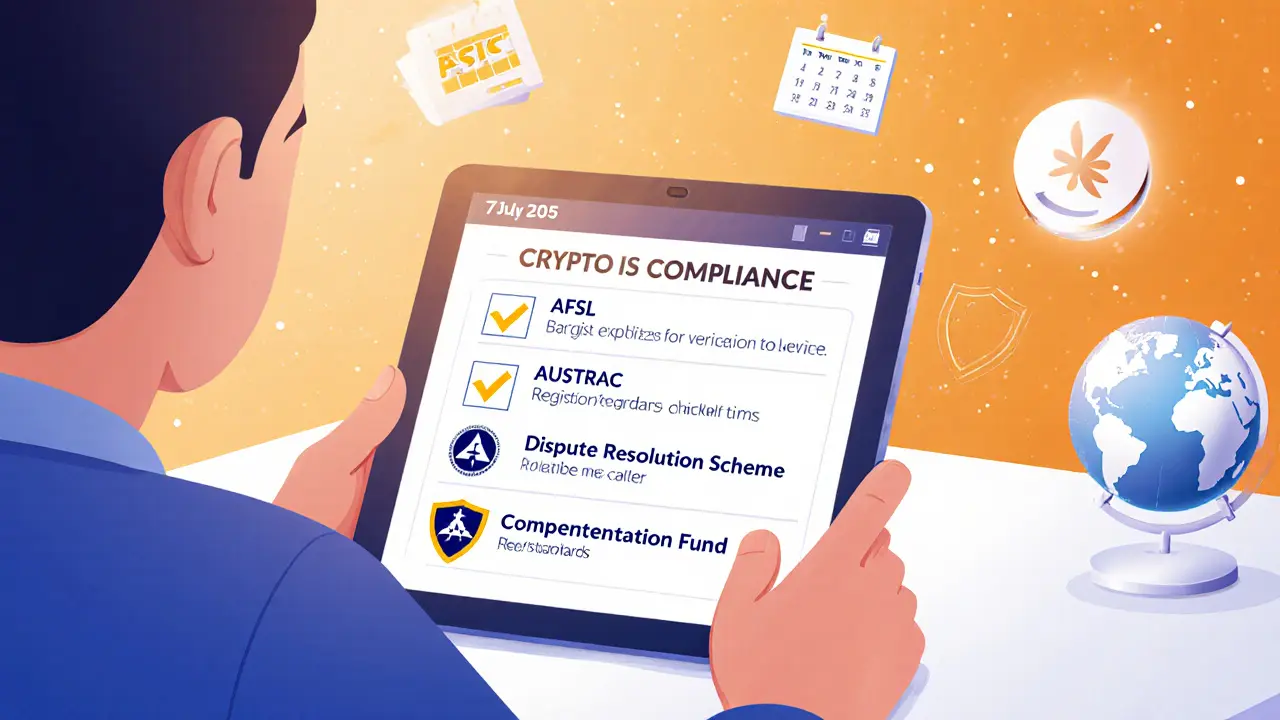
When evaluating a crypto service in Australia, use this quick list:
- Confirm the platform displays a valid AFSL number on its website.
- Check registration with AUSTRAC (the regulator shows a public register).
- Read the platform’s dispute‑resolution policy-look for ASIC‑approved external dispute schemes.
- Verify KYC requirements are transparent and that data is stored securely.
- Understand fee structures and any risk disclosures; they must be in plain English.
- Ask whether the platform participates in a compensation fund or has insurance for client assets.
- If the service advertises high returns or “guaranteed” profits, treat it with extra scrutiny-misleading claims are prohibited under the ACL.
Following these steps dramatically reduces the chance of ending up with lost funds or a platform that disappears overnight.
Comparison: Licensed Crypto Platforms vs Low‑Risk Exempt Platforms
| Feature | Licensed Platform (AFSL) | Low‑Risk Exempt Platform |
|---|---|---|
| Regulatory requirement | Must hold an AFSL under the Corporations Act | No AFSL needed if <$5,000 per customer & <$10 M annual volume |
| Consumer compensation fund | Mandatory participation or equivalent insurance | Not required, but still must follow ACL |
| Disclosure obligations | Detailed risk, fee, and conflict‑of‑interest disclosures | Basic fee transparency only |
| AML/CTF compliance | Full AML/CTF program, SAR reporting to AUSTRAC | Same AML/CTF registration and KYC standards |
| Enforcement penalties | Fines up to $16.5 M, possible criminal sanctions | Fines for AML breaches; lower civil penalties for consumer claims |
Looking Ahead: Australia’s Position on the Global Stage
By folding crypto platforms into the existing financial‑services regime, Australia joins a handful of jurisdictions-such as the UK and Singapore-that are trying to blend innovation with strong consumer safeguards. If enforcement is swift and transparent, the market could see a surge of reputable operators, more institutional participation, and improved access for everyday Australians wanting to dip their toes into digital assets.
Conversely, a delayed rollout or uneven enforcement could push users toward offshore, unregulated services-exactly what the bill aims to prevent. Stakeholders are watching the final implementation timetable closely; the next few months will likely shape the country’s reputation as a crypto‑friendly but responsibly regulated market.
Frequently Asked Questions
Do I need an AFSL to trade Bitcoin in Australia?
Yes, if the platform you use offers buying, selling, or exchanging Bitcoin for fiat, it must hold an AFSL under the new Treasury Laws Amendment Bill 2025. The AFSL requirement applies regardless of whether the service also offers other crypto assets.
What happens if a crypto exchange breaches the consumer‑protection rules?
ASIC can impose civil penalties up to $16.5 million, order restitution to affected customers, and even pursue criminal charges for reckless conduct. The platform may also lose its AFSL, forcing it to cease operations.
Are NFTs always regulated under the new framework?
Only NFTs marketed as investment or financial products fall under the regulations. Collectibles used purely for gaming or in‑game items remain excluded, although they still must comply with general consumer‑law prohibitions on deceptive advertising.
Can a small crypto startup avoid the AFSL?
If the startup’s average customer transaction stays below $5,000 and its total annual volume stays under $10 million, it qualifies for the low‑risk exemption and does not need an AFSL. It still must register with AUSTRAC and follow AML/KYC rules.
How can I verify a platform’s AFSL number?
Visit the ASIC register of Australian Financial Services Licencees, enter the licence number shown on the platform’s website, and confirm the licence status and scope. A valid licence will list “digital asset platform” among its authorized activities.
15 Comments
It feels like the government just handed us a new playbook for crypto safety. The AFSL badge is supposed to be the golden ticket, but who’s really checking the ink? If every platform flashes that badge, we might end up trusting a wolf in sheep’s clothing. Still, the idea of a unified regulator sounds better than the current patchwork. Just keep your eyes open and your wallet tighter.
One could argue that the mere presence of an AFSL doesn’t guarantee integrity, yet it’s a step toward transparency. The real test will be how ASIC enforces those hefty fines when they’re actually levied.
Dear community, I would like to thank the author for summarising the upcoming legislative changes. The delineation between Digital Asset Platforms and Tokenised Custody Platforms provides much‑needed clarity. It is advisable for consumers to verify both the AFSL registration and AUSTRAC listing before engaging. Moreover, understanding the dispute‑resolution mechanism can prevent future grievances. I trust this information will assist many in navigating the evolving landscape.
Check the AFSL number on the site and then hop over to AUSTRAC’s register-if it’s not there, walk away. Also read the fine print on fees, they’re often hidden. Don’t ignore the compensation fund details either.
Looks like another bureaucratic nightmare.
Wow, Australia finally decided to treat crypto like any other bank-because that’s exactly what we needed, more red tape.
Fifteen million dollars in fines? That’ll surely keep the big fish from swimming in our waters.
I’m sure the average user will understand the difference between a DAP and a TCP without a law degree.
The low‑risk exemption sounds nice, but “low‑risk” is a relative term, right?
Apparently, if you move $4,999 per customer you’re safe, but the moment you cross $5,001 you’re in the soup.
It’s comforting to know that the government will step in only after a scandal hits the headlines.
The requirement for a compensation fund is a brilliant move-who doesn’t love a safety net that might never be funded?
And let’s not forget the mandatory dispute‑resolution scheme; nothing says “trust” like an external arbiter you can’t possibly audit.
The AML and KYC obligations will finally give us all peace of mind-because we all love handing over our passports to another entity.
I’m thrilled that ASIC and AUSTRAC will now share a clear jurisdiction; that will eliminate all confusion forever.
The industry’s reaction is apparently “welcome”, which clearly means they’re not terrified.
The timeline until October 2025 gives everyone ample time to read the fine print-no rush.
If you’re a small start‑up, just stay under $5,000 per client and you’re good to go-no need for any fancy compliance team.
All in all, it’s a masterclass in regulatory over‑engineering, and I can’t wait to see how it plays out.
Cheers to the regulators for finally getting around to it.
Regulation is the new frontier of innovation, after all.
Hey folks keepin it real! If you see that AFSL badge on a site, that’s a good sign but still do your own homework. Look up the AUSTRAC register and read the dispute policy – don’t just click “I agree”. Stay safe out there and happy trading
Alright guys, this is huge! Finally some rules that actually mean something for crypto users down under. No more wild west vibes-time to get serious.
They’re just trying to trap us in another surveillance net, man. All this “protect consumer” talk is a cover for the powers that be to snoop on every transaction. Wake up!
Honestly, this could tighten the market but also scare off a lot of innovators.
🇦🇺 Sure, Australia can protect its own, but let’s not pretend the whole world will follow suit. This is just Aussie protectionism in disguise 😏
One must concede that the legislative endeavour undertaken by the Commonwealth reflects a certain intellectual audacity rarely observed in contemporary financial governance. By bifurcating the ecosystem into Digital Asset Platforms and Tokenised Custody Platforms, the architects of this bill have ostensibly embraced a dichotomous taxonomy that mirrors the very nature of the assets themselves. Yet, this very partition may engender a labyrinthine compliance regime wherein the average participant-be it a retail investor or a fledgling exchange-must navigate an odyssey of regulatory mile‑markers. The exemption thresholds, articulated with the precision of a mathematical inequality, betray an underlying assumption that low transaction volumes are synonymous with low risk, a premise that is philosophically contestable. Moreover, the mandated compensation fund, while noble in its intent, is shrouded in ambiguity regarding its funding mechanisms and solvency assurances. Consequently, the purported consumer protection may, in practice, amount to a perfunctory gesture designed to placate public outcry following high‑profile collapses. It is incumbent upon market participants to scrutinise not only the letter of the law but also its spirit, lest they be ensnared by a veneer of security that masks systemic vulnerabilities. In sum, while the regulatory framework is a commendable stride towards legitimacy, it is beset with complexities that demand vigilant and continual appraisal.
Well, if you’re still ignoring the red flags, you’re basically inviting disaster. It’s not just about profits, it’s about responsibility to the community and not feeding the greed‑machine.
From a risk‑management perspective, the integration of AFSL compliance into the operational architecture aligns with the broader ESG framework, thereby enhancing fiduciary diligence 😊. Engaging with AUSTRAC‑registered platforms also satisfies the KYC/AML synergy essential for cross‑border liquidity.
Let’s keep the discussion civil we all want a safe market but no need for yelling.