
Crypto Asset Service Provider Licensing in the EU: What You Need to Know in 2026

Starting in December 2024, the European Union made a major move to bring order to its crypto market. If you're running a crypto exchange, custody service, or trading platform in Europe, you now need a Crypto Asset Service Provider (CASPs) license under MiCA - the Markets in Crypto-Assets Regulation. This isn't just another rule. It’s a complete overhaul. No more patchwork of 27 different national rules. Now, one license lets you operate across the entire EU. But getting it? That’s where things get tough.
What Exactly Is a CASP?
A CASP is any company that provides one or more crypto services to clients on a professional basis. That includes:- Custody and administration of crypto-assets for others
- Operating trading platforms for crypto
- Exchanging crypto for euros or other fiat currencies
- Executing client orders
- Placing new crypto assets for sale
- Giving advice on crypto investments
If you do any of these, you’re a CASP - and you need authorization. The EU doesn’t care if you’re based in Singapore or Texas. If you serve EU customers, you need to be licensed. That means setting up a legal office inside the EU. No loopholes. No exceptions.
Key Requirements to Get Licensed
Getting a CASP license isn’t a formality. It’s a full operational upgrade. Here’s what you must deliver:- Minimum capital: €125,000 for custody, €150,000 for exchange services, and €730,000 if you run a trading platform. These aren’t suggestions - they’re hard caps.
- EU-based management: At least one director must live in the country where you apply. Remote directors from outside the EU? Not allowed.
- AML compliance: Your anti-money laundering system must meet the EU’s 6th AML Directive. That means real-time transaction monitoring, customer due diligence, and reporting suspicious activity - no exceptions.
- Data security: You must comply with the NIS2 Directive. That’s the EU’s cybersecurity standard for critical infrastructure. Think encryption, access controls, breach response plans - all documented and tested.
- Environmental reporting: This is new. If you use proof-of-work crypto (like Bitcoin), you must report your energy use. Even proof-of-stake platforms must disclose their environmental footprint using the EU’s Blockchain Observatory method. This isn’t greenwashing - it’s mandatory disclosure.
And if you serve 15 million or more EU users? You’re flagged as a significant CASP (sCASP). That triggers extra scrutiny: quarterly stress tests, mandatory third-party audits, and real-time transaction tracking. The European Central Bank says this was designed to prevent another FTX-style collapse.
How the Licensing Process Works
You apply to one National Competent Authority (NCA) - the financial regulator in the EU country where you set up your office. Once approved, you get a passport. That means you can offer services across all 27 EU countries without reapplying.But here’s the catch: the approval timeline varies wildly. Germany’s BaFin takes about 6 months. Spain’s CNMV? Up to 9. Estonia, which used to be a crypto hub, now averages 11 months. And despite MiCA saying applications should be processed within 6 months, many firms are still waiting over half a year. Reddit users report frustration - one founder said, “We submitted in January 2025. Still waiting. No one gives us updates.”
Some NCAs are better than others. Germany’s BaFin has the clearest guidelines. France’s AMF has approved 15 firms since January 2025. Lithuania’s Bank of Lithuania processed 29 applications but only approved 8. Malta’s MFSA? Low marks for inconsistent rules.

Costs Are High - And Getting Higher
Don’t think this is cheap. Based on PwC’s 2025 benchmarking study:- Basic custody license: €750,000
- Exchange service license: €1.2 million
- Full trading platform license: up to €2.5 million
These costs include legal fees, tech upgrades, compliance staff, and system builds. Most firms need 5-7 full-time compliance officers just to handle MiCA. Many non-EU companies underestimated this. Deloitte found 73% of applicants didn’t realize how deep the organizational changes had to go.
And that’s before you even factor in environmental reporting. Mid-sized exchanges now spend €200,000-€500,000 a year just on energy disclosures. That’s a new line item on every budget.
Who’s Winning - And Who’s Losing
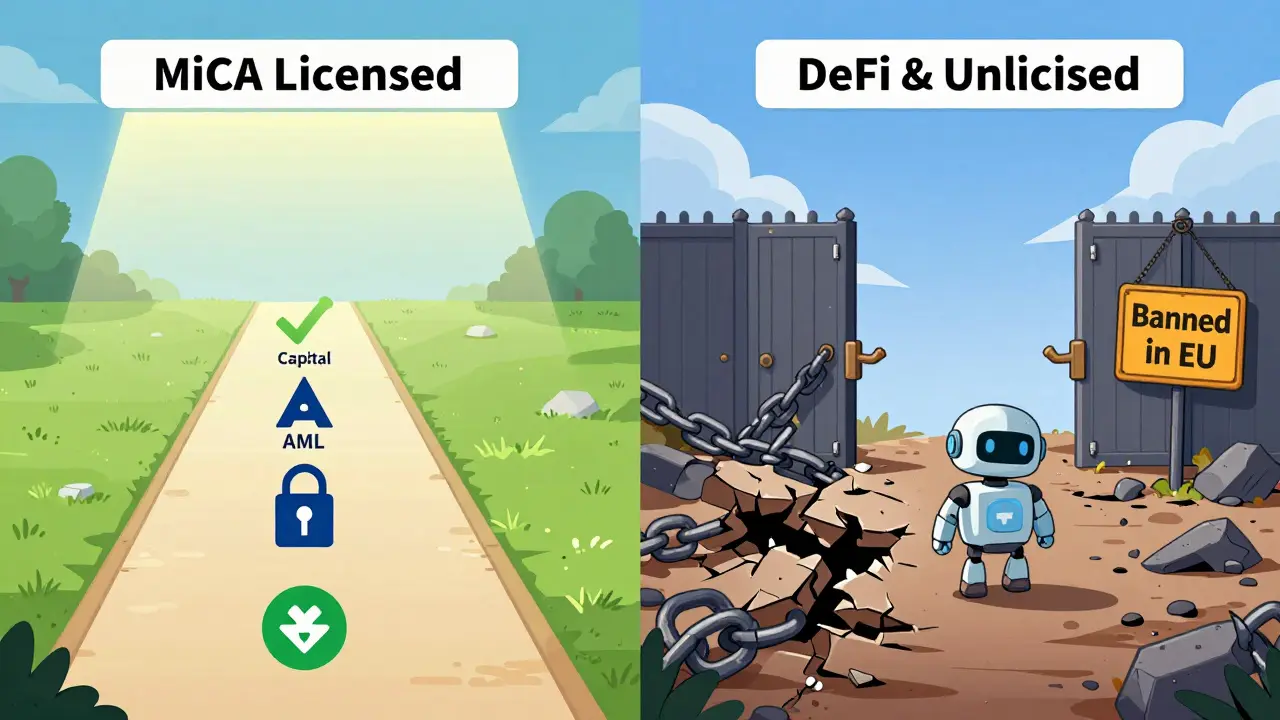
The winners? Established firms with deep pockets. Kraken got licensed in France in March 2025 and expanded to 15 EU markets in 30 days. Bitstamp got approved in Czechia and went live across the EU in weeks. Their advantage? They had EU offices, legal teams, and compliance infrastructure already in place.The losers? DeFi platforms. MiCA requires identifiable legal entities. That’s impossible for decentralized protocols with no CEO, no HQ, no legal person. A University of Zurich study found 68% of DeFi projects won’t enter the EU market at all. They’re choosing to stay out rather than restructure.
Stablecoin issuers are also under pressure. The EU requires 1:1 reserves for asset-referenced tokens. But after the USDC depegging in March 2023, regulators now worry even that’s not enough. The European Banking Authority says reserve rules may need tightening - and that could force stablecoin issuers to hold even more cash.
How MiCA Compares to the Rest of the World
The U.S.? A mess. Crypto firms juggle the SEC, CFTC, and 50 state regulators. That’s why 47% of major exchanges barely operate in the U.S., according to Coinbase’s 2024 report. MiCA’s single passport is a huge draw. As of August 2025, 187 firms had pre-applied to EU regulators - up from just 42 in early 2024.Switzerland? Lighter rules. FINMA’s capital requirements are 25-30% lower than MiCA’s. But Swiss firms can’t easily serve EU customers without a MiCA license. That’s why many are now applying to both - paying twice just to cover their bases.
The UAE’s VARA is tempting with faster approvals and no environmental reporting. But if you want real European market access, MiCA is still the only game in town. A Baker McKenzie study found 23 firms that started MiCA applications ended up in Dubai instead - but they’re missing out on the EU’s 450 million consumers.
What’s Next? MiCA 2.0 and the Road Ahead
The EU isn’t done. In June 2025, the European Commission proposed MiCA 2.0. This version aims to bring DeFi, NFTs, and decentralized protocols under regulation - but using a “functional approach.” That means rules based on what a service does, not what it’s called. If a DeFi protocol acts like a bank? It gets treated like one.Also coming: the Anti-Money Laundering Authority (AMLA), launching in June 2026. It will take over cross-border AML supervision from national regulators. That could mean more consistency - or more bureaucracy.
Real-time transaction monitoring starts in January 2026. That’s a major tech lift for smaller firms. And if the Digital Euro rolls out, MiCA-licensed CASPs might get direct access - but that’s still speculative.
For now, the deadline looms. The 18-month transitional period ends July 1, 2026. After that, any crypto service operating in the EU without a license will be illegal. Firms still operating under old national rules are at risk of shutdowns.
Real-World Impact: What Users Are Saying
Trustpilot reviews of MiCA-licensed exchanges show a 4.1/5 average rating. Why? Users say they feel safer. Transactions are clearer. Asset segregation rules mean your crypto isn’t mixed with the company’s money - a direct response to FTX.But complaints are loud too. 41% of negative reviews mention excessive risk warnings. Users say: “Every time I trade, I get a 10-page warning. It’s annoying.” Article 58 requires these, so firms have no choice.
Another issue? Fewer coins available. MiCA’s asset admission rules are strict. Tokens without clear utility, whitepapers, or audits get blocked. That’s good for safety - but bad for traders looking for the next meme coin.
For institutions, MiCA is a green light. J.P. Morgan found 78% of traditional banks now see MiCA compliance as a must-have before entering crypto. That’s up from 32% for U.S. compliance. The EU is becoming the gold standard for institutional crypto access.
Do I need a CASP license if I’m based outside the EU?
Yes - if you serve EU customers. MiCA applies to any service provider that targets EU residents, regardless of where you’re headquartered. That means if your website is in English, accepts EUR payments, or markets to EU users, you’re covered by MiCA. You must establish a legal entity inside the EU and apply through a National Competent Authority.
Can I apply to multiple EU countries at once?
No. You must choose one National Competent Authority (NCA) to apply to - the one in the country where you set up your EU office. Once approved, you get a passport that lets you operate across all 27 EU states. Applying to multiple countries will delay your process and cost more money.
What happens if I don’t get licensed by July 1, 2026?
You’ll be operating illegally. After July 1, 2026, any unlicensed CASP serving EU customers can be shut down by regulators. Fines can reach up to 5% of global turnover. Some firms have already been forced to block EU users. Others are rushing to apply - but backlogs mean many won’t make the deadline.
Are DeFi platforms banned under MiCA?
Not banned - but effectively excluded. MiCA requires identifiable legal entities with directors, offices, and compliance teams. Most DeFi protocols have none of that. As a result, 68% of them are avoiding the EU market entirely. MiCA 2.0 may change this, but for now, DeFi and MiCA don’t mix.
How long does it take to get a CASP license?
It varies. Germany’s BaFin takes about 6 months. Spain and Portugal can take 9. Estonia and Latvia are now at 11 months. MiCA says applications should be processed within 6 months - but NCAs are understaffed. Only 42% of regulators have dedicated crypto teams. If you’re serious about applying, start now - and expect delays.
Can I use a third party to handle my MiCA application?
You can hire consultants to help with documentation, but you still need to be the legal applicant. The NCA will require direct communication with your EU-based management team. No outsourcing of responsibility. The director living in the EU must sign off on everything. Consultants can guide you - but they can’t take the blame if things go wrong.
Is MiCA better than U.S. crypto regulation?
For firms wanting to operate across multiple jurisdictions, yes. MiCA’s single passport is far simpler than navigating the SEC, CFTC, and 50 state regulators. But for small firms or startups, U.S. rules can feel less burdensome - especially since the U.S. has no environmental reporting or minimum capital rules. It’s not about which is “better” - it’s about which fits your business model.
21 Comments
EU is turning into a bureaucratic nightmare. They think they can regulate crypto like it's a utility company? LOL. We're talking about decentralized tech, not your grandma's bank. This MiCA nonsense is just the state trying to control innovation. You'll see - this will backfire hard. Crypto will just go elsewhere. 🤡
I knew it. I KNEW IT. They're using "environmental reporting" to kill Bitcoin. This is a crypto ban in disguise. Who even cares about energy use? Solar panels? Wind turbines? They're all just fancy coal plants with pretty names. This is the deep state's plan. They don't want you to be rich. 💀
I'm kinda torn. On one hand, I get why they're doing this - FTX was a mess, and people lost everything. On the other hand, the costs are insane. €2.5 million just to apply? That's not regulation, that's a luxury tax for startups. I hope they make room for small players. The spirit of crypto isn't in big firms with legal teams. It's in the weird, scrappy ones.
Hey, I've been through this process. It's brutal, but it's worth it. I thought I'd lose my business, but once we got licensed, our user trust shot up. People feel safe. No more "where's my crypto?" panic. Yeah, the paperwork is a nightmare, and yes, we hired 6 compliance officers. But look - we're growing 3x faster now. Sometimes you gotta grow up to keep playing. 💪
The 10-page warnings? I get it. They're trying to protect people. But it's exhausting. I just want to trade. Not read a novel before every swap.
i think miica is a good thing honestly. i lost money in a scam exchange last year. now at least i know my coins are seperate from the company's. that's huge. yeah it's slow and expensive but safety > speed. also the environmental stuff? honestly fair. bitcoin mining is wild. we can do better.
decentralized? more like decimated 😂
The irony is beautiful. The EU, which once fought for freedom from centralized power, now builds the most centralized financial gatekeeper in history. Crypto was meant to break chains. Now we're lining up for permits. Is this progress? Or just a new kind of cage?
I love how this is making the world rethink what "regulation" means. In the US, it's chaos. In the EU, it's a maze. In Dubai, it's a party. Maybe the real win isn't which rules win... but which model lets innovation survive. I'm rooting for the underdog. The weirdos. The ones who still believe in peer-to-peer.
Let's be honest: MiCA is just the EU's attempt to compete with the US dollar. They're not regulating crypto. They're weaponizing it. Every license fee? Goes into their central bank's coffers. The environmental reports? A Trojan horse to kill proof-of-work so Bitcoin can't challenge the euro. This isn't consumer protection. It's financial imperialism.
Wow. Just... wow. So now I have to move to Germany to trade crypto? And pay €2.5 million? I'm starting a Patreon. "Help me afford my right to own Bitcoin." 🤷♀️
I’m so proud of how far we’ve come! 🥹 Even with all the red tape, seeing real institutions like J.P. Morgan finally say "yes" to crypto? That’s huge. It means the future is real. Yes, it’s hard. But every great movement has a cost. We’re building something that lasts. Keep going. 💖
wait so if i run a defi protocol on ethereum do i have to hire a ceo? like who even is the ceo of uniswap? it’s a smart contract. you can’t regulate code. this is like trying to sue gravity.
You people don't get it. This is the end of financial freedom. They're coming for your keys. They're coming for your privacy. They're coming for your money. This isn't about safety. It's about control. Wake up. 🕊️
I've been waiting 11 months for my license from Estonia. 11 MONTHS. My team is burned out. My investors are pulling out. I had to lay off my dev team because I couldn't afford to keep them on while waiting for a government that doesn't answer emails. They call this "harmonization"? It's a joke. It's a trap. And now they want me to report my energy use? Like I'm some kind of carbon criminal? I'm not the problem. The system is.
The regulatory ambition of the European Union is commendable. However, the implementation lacks philosophical coherence. One cannot impose juridical personhood upon algorithmic autonomy. This is not governance; it is epistemological violence against distributed systems. The outcome shall be stagnation.
DeFi is dead. Long live MiCA. 💀
I get the frustration, but look - the old system was a Wild West. People got scammed. Funds vanished. Now? Your assets are segregated. Your exchange has real capital. That’s not a burden - that’s a foundation. The next generation of crypto users will thank us for this. We’re not killing innovation. We’re giving it a home.
I work with developers from India, Nigeria, and Brazil. We’re all trying to build something meaningful. But MiCA? It feels like a wall built with gold bricks. Beautiful, but impossible to climb. I hope they create a path for global teams - not just EU-based corporations.
they made it so expensive only big corps can play. that’s not regulation. that’s a cartel. crypto was supposed to be the people’s money. now it’s just another bank with more steps.
i just want to buy eth without getting a 10 page warning and 3 factor auth and a notary. why is this so hard? i’m not a criminal. i just want to hodl.