
Criminal Penalties for Crypto Ban Violations: Global Legal Risks
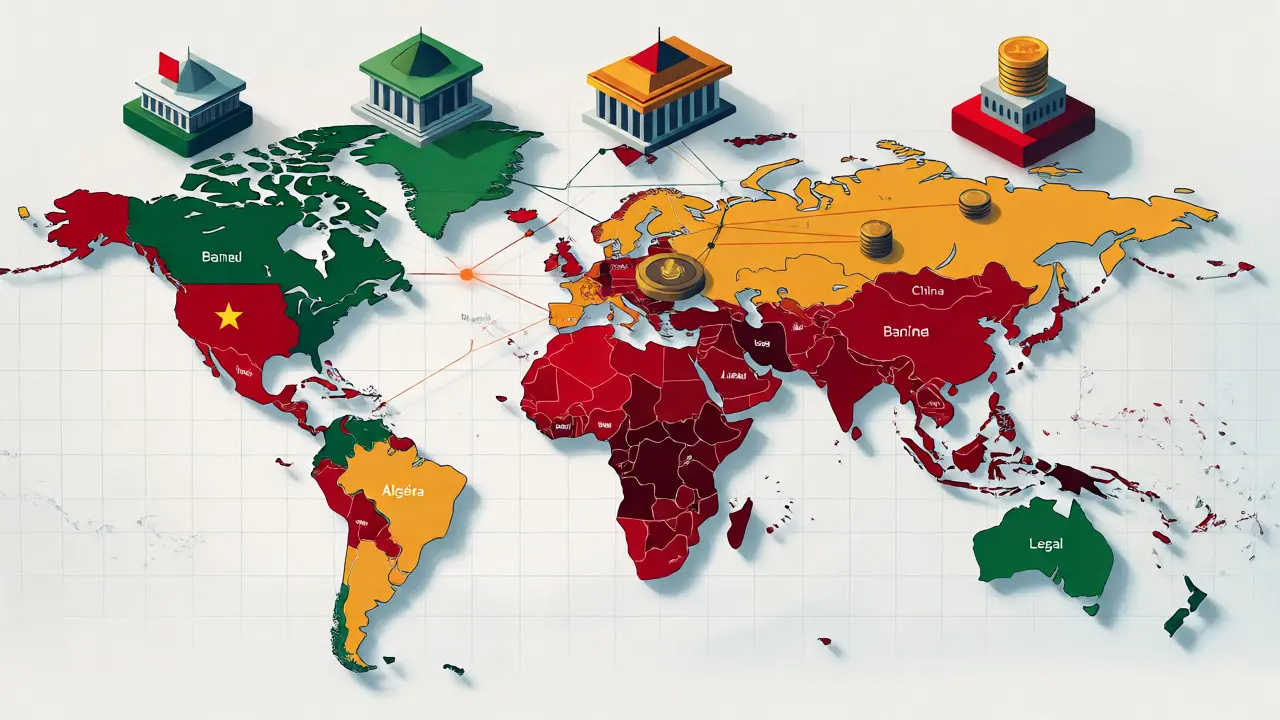
You buy Bitcoin in a country where it’s technically illegal. Do you go to jail? For most people, the answer is no-but the landscape is shifting fast. While headlines scream about bans, the reality of criminal penalties for crypto ban violations is far more nuanced than a simple "yes" or "no." As of late 2025, only about 10 countries have outright general bans on cryptocurrency, yet enforcement varies wildly from strict prison sentences to mere administrative fines.
The gap between law and practice is massive. In nations like Algeria and Morocco, holding crypto is prohibited by statute, but actual prosecutions of individual users are rare. Meanwhile, global powers are moving away from blanket criminalization toward targeted enforcement against money laundering and sanctions evasion. If you’re an investor, trader, or just someone curious about the legal risks, understanding who actually gets punished-and why-is critical. This guide breaks down the real-world consequences of ignoring crypto bans across different jurisdictions.
The Reality of Global Crypto Bans
First, let’s clear up the confusion. A "ban" doesn’t always mean what you think it means. According to data from the Atlantic Council’s Cryptocurrency Regulation Tracker (2025), out of 75 countries studied, cryptocurrency is fully legal in 45, partially restricted in 20, and generally banned in only 10. That last group includes nations like China, Egypt, and Algeria, but their approaches differ significantly.
China represents the strictest environment. Since 2021, Beijing has cracked down hard on exchanges and mining operations. However, the focus has been on infrastructure providers rather than individual holders. You might lose access to local trading platforms, but if you hold Bitcoin in a private wallet, Chinese authorities haven’t historically arrested individuals solely for possession. The goal was to control capital flight and stabilize the yuan, not to put every citizen with a Ledger device behind bars.
In contrast, North Korea uses cryptocurrency primarily for state-sponsored theft and illicit finance, making unauthorized personal use virtually impossible due to internet restrictions rather than specific crypto laws. Other nations, such as Bolivia and Bangladesh, prohibit transactions through banks but rarely pursue criminal charges against retail users. The primary driver for these bans isn’t usually moral panic; it’s economic control. Governments fear that unregulated digital assets undermine monetary policy and facilitate tax evasion.
Where Criminal Penalties Actually Apply
When do you face real jail time? It’s rarely for simply owning Bitcoin. Instead, criminal penalties kick in when your activity intersects with other serious offenses. The U.S. Department of Justice’s April 2025 memorandum, "Ending Regulation by Prosecution," shifted the focus away from classifying tokens as securities via lawsuits and toward prosecuting fraud, misappropriation, and sanctions evasion. This trend is global.
Consider the case of Mustafa Ayash, founder of GazaNow. He wasn’t sanctioned because he used crypto; he was sanctioned for raising funds for Hamas following the October 7 attacks. His use of digital assets was the vehicle, but the crime was terrorism financing. Similarly, Elena Chirkinyan and Khadzi-Murat Dalgatovich Magomedov faced designations under the UK’s National Crime Agency "Operation Destabilise" for money laundering roles. Their penalty wasn’t for holding coins, but for using them to hide the source of illicit funds.
In jurisdictions with explicit bans, the text of the law matters. Algeria’s Article 117 states that any breach of the virtual currency prohibition is punishable under existing laws, but it doesn’t specify a mandatory prison term. Morocco’s Office des Changes declares crypto transactions an infringement of exchange regulations, liable to fines provided by existing financial laws. These are often civil or administrative penalties, not criminal ones. However, if you’re caught running an unlicensed exchange in these regions, the stakes rise dramatically. Operating without a license can lead to seizure of assets and significant fines, which may escalate to criminal charges if linked to fraud.

Enforcement Mechanisms: Sanctions vs. Prison
The most powerful tool governments now wield isn’t the police handcuffs-it’s the sanctions list. The U.S. Treasury’s Office of Foreign Assets Control (OFAC) issued 13 sanctions designations including 86 cryptocurrency addresses in 2024 alone. These actions target specific wallets associated with entities like Hezbollah, IRGC-QF commodity sales, and Russian illicit economy support.
| Jurisdiction Type | Primary Target | Typical Penalty | Individual User Risk |
|---|---|---|---|
| Outright Ban (e.g., Algeria) | Transactions & Holding | Fines / Asset Seizure | Low (rarely prosecuted) |
| Partial Restriction (e.g., India) | Tax Compliance & Reporting | Tax Penalties / Freezing | Moderate (audit risk) |
| Sanctions Focus (e.g., USA/EU) | Illicit Finance & Fraud | Prison / Heavy Fines | High (if involved in scams) |
| Licensing Regime (e.g., Japan) | Exchange Operations | Licence Revocation | Very Low (legal usage) |
This shift reflects a pragmatic realization: banning technology is hard, but blocking specific bad actors is easier. When OFAC designates an address, it becomes illegal for U.S. persons to transact with it. Violating this can lead to severe criminal penalties, including decades in prison for willful violations. But this applies to those knowingly engaging with sanctioned entities, not the average person buying Ethereum on Coinbase.
Russia illustrates the complexity. Despite domestic inconsistencies, international pressure has forced stricter oversight. After OFAC designated exchanges like NetEx24 and Bitpapa, inflows dropped by 82% in three months. Users didn’t get arrested en masse; they simply lost access to services. The penalty was economic exclusion, not incarceration.
User Experiences in Banned Regions
What does it feel like to use crypto where it’s illegal? Community feedback from platforms like Reddit suggests that daily life continues largely unaffected for retail users. A March 2025 thread titled "Using crypto in banned countries" highlighted experiences from Algeria, Morocco, and Egypt. One user, u/MaghrebTrader, reported successful use of LocalBitcoins for 18 months without incident despite Morocco’s prohibition. Another, u/CairoCrypto, noted frequent payment processor blocks but no personal legal consequences.
This disconnect exists because enforcement resources are limited. Police aren’t checking every smartphone for MetaMask apps. Instead, they focus on large-scale flows. Peer-to-peer (P2P) networks thrive in these environments precisely because they bypass traditional banking channels. Chainalysis estimated $28.7 billion in P2P transactions originated from China in 2024, despite official prohibitions. The market adapts, creating underground liquidity pools that regulators struggle to monitor.
However, complacency is dangerous. While 90% of users might never face scrutiny, the remaining 10%-those moving large sums or attracting attention through conspicuous spending-face higher risks. In Egypt, while there are no specific criminal statutes for holding crypto, using it to evade foreign exchange controls can trigger penalties under broader financial laws. If you convert thousands of dollars into Bitcoin and then back into local currency without declaring it, you’re vulnerable to accusations of illegal currency trading.
The Shift Toward Regulatory Frameworks
Governments are increasingly realizing that total bans are ineffective. The European Union’s MiCA (Markets in Crypto-Assets) framework, implemented in 2024, avoids criminalizing usage entirely. Instead, it imposes strict licensing requirements on service providers. This model protects consumers while allowing innovation. Similarly, South Korea passed the Virtual Asset Users Protection Act in 2023, focusing on record-keeping and transparency rather than punishment.
In the United States, the GENIUS Act, signed in July 2025, regulates stablecoins as payment instruments. This functional approach enhances the Treasury’s ability to combat illicit activities without turning every user into a potential criminal. Dr. Sarah Bloom Raskin, former Deputy Secretary of the U.S. Treasury, noted in January 2025 that criminalization creates significant enforcement challenges when adoption rates remain high. Her point is supported by data showing no correlation between regulatory restrictiveness and actual usage levels.
Canada offers another example. The Canadian Securities Administrators maintain lists of prohibited platforms like KuCoin and Poloniex. But enforcement targets the platforms’ operations, not individual traders. If you trade on a banned platform, you might face account freezes during KYC checks, but you won’t go to court. Trustpilot reviews for these platforms show common complaints about account freezes, not legal threats.
Key Takeaways for Investors
If you live in or trade across borders, here’s how to navigate the legal minefield:
- Distinguish between holding and operating: Most bans target businesses. Individual holding is rarely prosecuted unless tied to other crimes.
- Watch the sanctions lists: Transacting with OFAC-designated addresses carries heavy criminal liability, even in friendly jurisdictions.
- Understand local exchange laws: In countries like Morocco and Algeria, the issue is often foreign exchange regulation, not crypto specifically. Large conversions attract attention.
- Keep records: Even in banned countries, proof that your funds came from legitimate sources can protect you from money laundering accusations.
- Expect administrative friction: Your biggest hurdle will likely be blocked bank transfers or frozen accounts, not jail time.
The global trend is moving away from blunt-force prohibitions toward sophisticated surveillance. As central bank digital currencies (CBDCs) roll out in over 90% of analyzed countries, private crypto usage may face new pressures. But for now, the threat of prison for simple ownership remains low. The real danger lies in using crypto to hide something else.
Can I go to jail for owning Bitcoin in a banned country?
It is highly unlikely for simple ownership. Most countries with bans, such as Algeria and Morocco, enforce restrictions through administrative fines or asset seizures rather than imprisonment. Criminal charges typically require evidence of money laundering, fraud, or sanctions evasion, not just possession.
What happens if I trade on a banned crypto exchange?
In many jurisdictions, the exchange faces the penalties, not the user. For example, in Canada, platforms like KuCoin are prohibited from operating, but individual users usually face account freezes or withdrawal delays rather than legal action. However, if the platform is seized, you may lose access to your funds temporarily.
Are crypto sanctions the same as a ban?
No. A ban prohibits the use of cryptocurrency within a country. Sanctions target specific individuals, entities, or wallet addresses. Trading with a sanctioned address, even in a legal jurisdiction, can result in severe criminal penalties, including fines and prison time, because it violates international financial laws.
Does China punish individuals for holding crypto?
China’s 2021 crackdown focused on shutting down exchanges and mining farms. While trading services were halted, individual holdings in private wallets were not explicitly criminalized. However, accessing offshore exchanges can be difficult due to internet restrictions, and large-scale movements may attract scrutiny for capital flight violations.
Why do some countries ban crypto if it’s so popular?
Governments often ban crypto to prevent capital flight, maintain control over monetary policy, and curb money laundering. Countries with unstable currencies or strict capital controls view decentralized assets as a threat to their financial sovereignty. However, high adoption rates persist despite bans, suggesting these measures often fail to stop usage.